 For most people, shampoo should come before conditioner. Shampoo removes excess oil, dirt, and product residue, while conditioner helps hair feel smoother, reduces friction, and makes it easier to detangle. Using conditioner after shampooing is the standard approach because it leaves conditioning ingredients on the hair after cleansing.
But that order isn’t the only option. If your fine hair looks flat or feels weighed down after conditioning, you may prefer reverse washing, which means applying conditioner before shampoo.
The better method depends on your hair texture, scalp needs, the products you use, and how your hair feels after drying. Here’s how to choose without making your washing routine unnecessarily complicated.
Why Shampoo Usually Comes Before Conditioner
Shampoo and conditioner serve different purposes, which explains why their usual order matters.
Shampoo contains cleansing ingredients called surfactants. These help water remove sebum, dirt, and product residue from the scalp and hair. Shampooing mainly targets the scalp, where oil and buildup accumulate.
Conditioner works differently. Its ingredients can reduce friction between hair strands, improve slip, and make hair easier to comb. Many formulas contain positively charged conditioning agents, fatty alcohols, silicones, or other ingredients that help hair feel smoother.
When you shampoo first, you cleanse the hair before applying those conditioning ingredients. Some of the ingredients can remain on the hair after rinsing, helping improve manageability.
The American Academy of Dermatology generally recommends using conditioner after washing, with application adjusted to hair type. For fine or straight hair, concentrating conditioner toward the ends may be enough. For dry or curly hair, more of the length may benefit.
This doesn’t mean the same routine works equally well for everyone. Conditioner formula, quantity, and placement can all influence the result.
What Happens When You Condition Before Shampoo?
Conditioning before shampooing is commonly called reverse washing.
Instead of cleansing first, you apply conditioner to wet hair, rinse it, and then shampoo. The idea is to give the lengths some initial conditioning while allowing the later cleansing step to remove some of the material that might otherwise leave hair feeling heavy.
This can appeal to people whose hair becomes limp after a rich rinse-out conditioner.
However, reverse washing has an important trade-off: shampooing afterward may remove some of the conditioning ingredients you just applied. Your hair might feel lighter, but it may also be less slippery or harder to detangle.
Whether that trade-off feels worthwhile depends on your hair and products.
Reverse washing has not been established as a superior method for repairing damage, preventing breakage, treating scalp conditions, or encouraging hair growth. Any perceived improvement in volume or lightness should be understood as a possible cosmetic effect, not a proven health benefit.
If your hair already feels comfortable and manageable after conventional washing, there is no need to change the order.
Which Order Works Better for Your Hair Type?
Your hair’s response matters more than following a washing trend.
| Hair type or concern | Suggested starting approach | Why |
|---|---|---|
| Fine hair that becomes flat | Try lighter conditioning first; consider reverse washing | May reduce the weighed-down feeling |
| Oily scalp with dry ends | Shampoo scalp, then condition lengths | Addresses different scalp and hair needs |
| Curly or coily hair | Shampoo, then condition thoroughly | Helps maintain slip for detangling |
| Bleached or damaged hair | Shampoo, then condition | Conditioning after cleansing supports manageability |
| Thick, dry hair | Shampoo, then condition lengths | Helps soften and separate strands |
| Normal, manageable hair | Keep your existing effective routine | No proven benefit from changing |
Fine Hair That Feels Heavy After Conditioner
Before reversing your routine, try using less conditioner and keeping it away from the roots.
A lightweight rinse-out formula may improve the result without changing the washing sequence.
If your hair still feels weighed down, reverse washing is a reasonable experiment. Compare how your hair looks and feels after it dries, not only while it is wet.
Oily Scalp but Dry Hair Ends
An oily scalp doesn’t necessarily mean your ends need less conditioning.
Concentrate shampoo on the scalp and let the rinse water and lather pass through the lengths without aggressively rubbing them.
Then apply conditioner where dryness is most noticeable.
If you frequently notice an unpleasant coated feeling, the cause may involve product selection, application, or residue rather than the washing order alone. Our guide to hair that feels waxy after washing explains other possibilities.
Curly, Coily, or Chemically Treated Hair
Hair that tangles easily, has undergone bleaching, or feels rough after cleansing may particularly benefit from conditioner applied after shampoo.
Conditioning can help reduce combing friction. However, this should not be confused with permanently reversing damage to the hair fiber.
You can experiment with pre-shampoo conditioning if it makes cleansing more comfortable, but removing conditioner entirely from the final step may leave your lengths harder to manage.
How to Wash Your Hair in Either Order
Both routines are straightforward. The main difference is when conditioning ingredients are applied relative to cleansing.
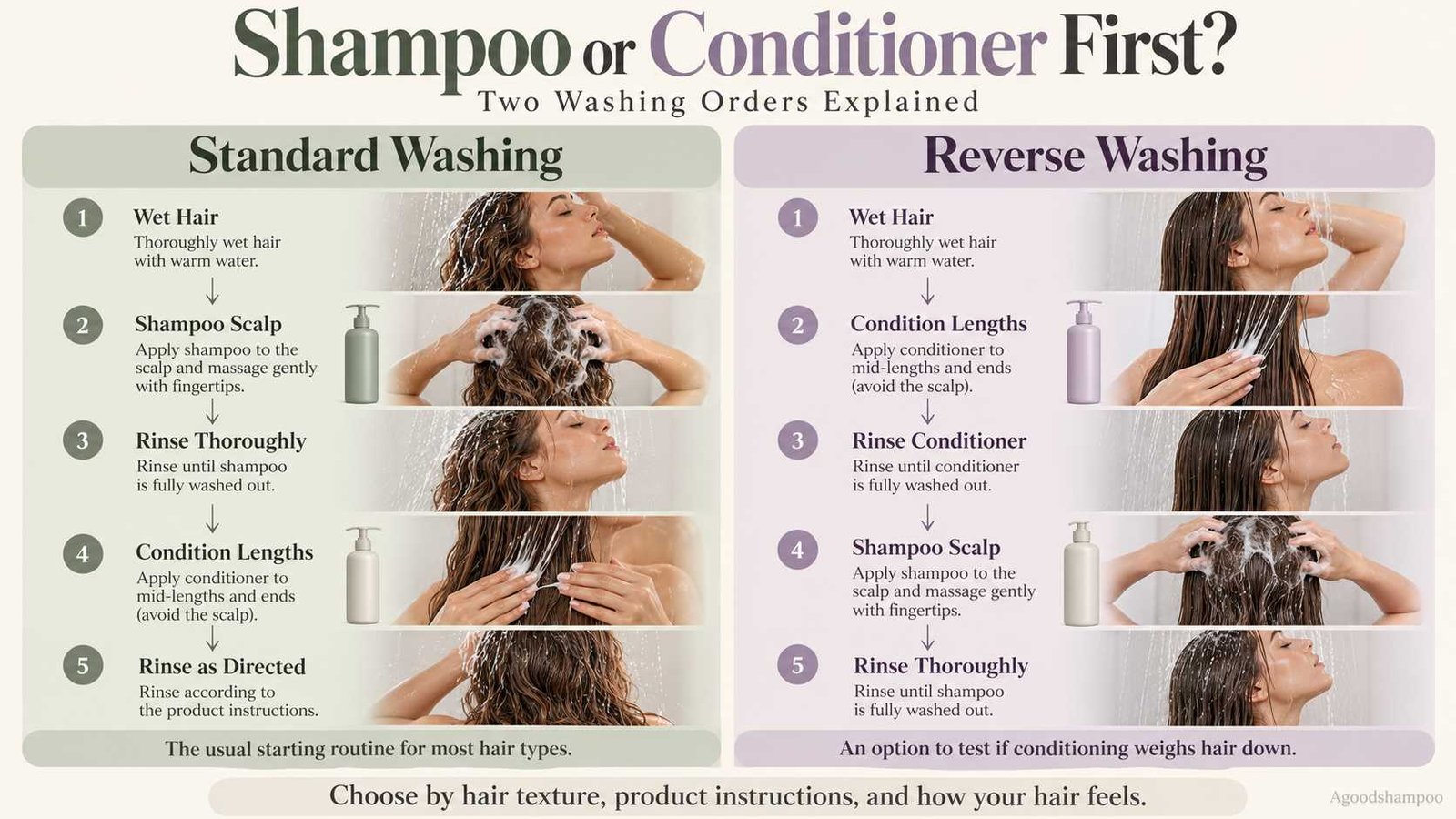
Method 1: Shampoo First, Then Conditioner
This is the simplest starting method for most people.
- Wet your hair thoroughly. Use comfortably warm water to saturate your scalp and lengths.
- Apply shampoo to the scalp. Massage gently with your fingertips rather than scratching with your nails.
- Rinse thoroughly. Allow the water to carry shampoo through the lengths without rubbing them aggressively.
- Apply conditioner. Focus on the mid-lengths and ends, or follow your product directions if conditioning nearer the scalp is appropriate.
- Leave it on as directed. Use the manufacturer’s recommended contact time.
- Rinse and dry gently. Avoid rough towel rubbing, particularly if your hair is prone to tangles.
If your conditioner leaves hair limp, try a smaller amount before switching methods.
Method 2: Conditioner First, Then Shampoo
Reverse washing is worth testing if conventional conditioning consistently makes your hair feel heavy.
- Wet your hair thoroughly. Make sure the lengths are saturated.
- Apply rinse-out conditioner to the lengths. Avoid heavily coating your roots unless the product specifically calls for it.
- Distribute gently. Use your fingers to spread the conditioner without pulling on tangles.
- Rinse the conditioner. Follow the product directions, especially if it is not marketed for pre-shampoo use.
- Shampoo your scalp. Cleanse gently, allowing the lather to move through the hair.
- Rinse thoroughly. Notice whether your hair feels manageable afterward.
Some products are specifically designed as pre-shampoo treatments and may have different instructions. Follow their labels rather than assuming every conditioner should be used identically.
After drying, evaluate whether your hair feels lighter without becoming rough or tangled.
If reverse washing improves volume but leaves your ends dry, you can return to conventional washing or add a small amount of conditioner after shampooing.
Can You Condition Before and After Shampooing?
Yes. Some people prefer a three-step approach:
Conditioner → Shampoo → Conditioner
The first conditioning step may help provide slip before cleansing, while the final application helps maintain manageability afterward.
This method can be worth considering for hair that tangles easily or has dry lengths, provided the products are suitable.
However, applying conditioner twice is not automatically better.
It adds product, water use, and time. Rich conditioners may leave fine hair heavy when used repeatedly.
You may also get the desired result simply by using an appropriate conditioner after shampooing. Our guide to choosing shampoo and conditioner for your hair can help you think about product suitability before adding more steps.
A dedicated pre-shampoo treatment may behave differently from a regular rinse-out conditioner, so the two shouldn’t be treated as interchangeable.
Signs You Should Change Your Washing Order
A useful test is how your hair behaves after it is completely dry.
Your hair feels flat or overly coated. Try reducing the conditioner amount, choosing a lighter formula, or applying it farther from the roots. If the problem continues, experiment with reverse washing.
Your hair feels rough after reverse washing. Shampoo may be removing more conditioning material than your lengths comfortably tolerate. Return to conditioning afterward.
Your roots feel oily but your ends remain dry. Keep scalp cleansing and length conditioning separate rather than removing conditioner altogether.
Your hair tangles more than usual. Prioritize conditioning and careful detangling. Persistent breakage may need more than an adjustment in washing order.
Your scalp becomes itchy, red, or irritated. Don’t assume reverse washing will solve it. Consider possible product sensitivity or scalp conditions, and seek professional advice if symptoms persist.
A product’s ingredients and formulation can matter more than its position in the routine. For example, switching to a silicone-free shampoo does not automatically prevent buildup or make a product more suitable for every hair type.
Likewise, conditioner does not always have to be avoided near the scalp, but scalp application should be guided by the formula and individual tolerance. Read more about using conditioner on the scalp if that is part of your routine.
Choosing the Order That Leaves Your Hair Manageable
If you aren’t experiencing a specific problem, keep shampooing first and conditioning afterward. It’s a practical routine supported by established hair-care guidance.
If your hair repeatedly feels weighed down, change one thing at a time. Begin with the conditioner amount or formula. Then test reverse washing if needed.
Compare your results over a few wash days, paying attention to softness, tangling, heaviness, and how your hair behaves once dry.
The right order is the one that cleans your scalp effectively while leaving your hair comfortable and manageable.

Marlena Stell makes everyday hair care easier to understand. From choosing a shampoo to managing common hair concerns, she breaks down confusing product claims and practical routines into straightforward advice that helps readers find what works for their needs.