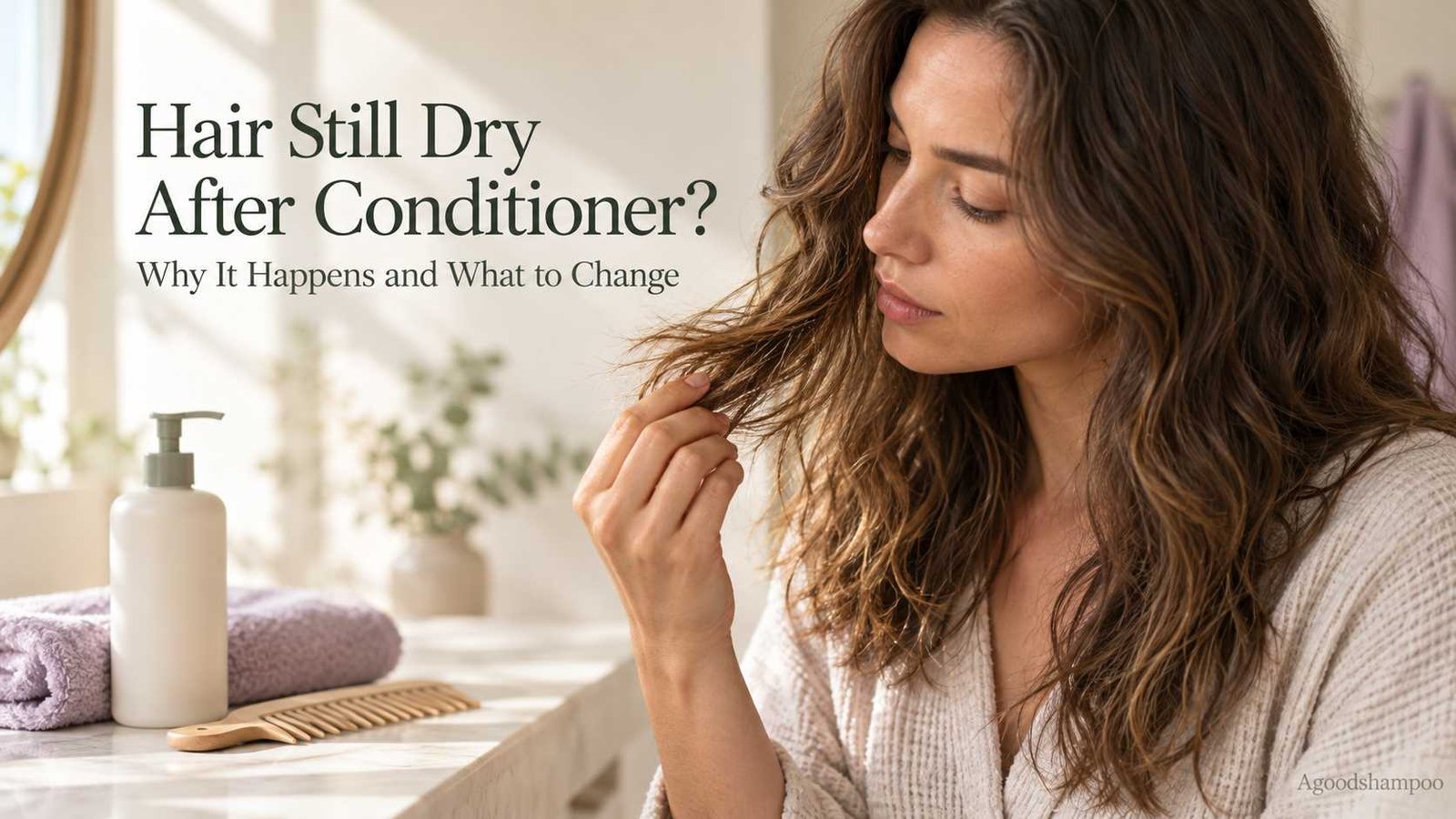
 Hair that feels dry even after conditioner can be frustrating, especially when the product promises softness and smoothness. You rinse it out expecting manageable hair, only to find that your ends feel rough, stiff or almost straw-like once they dry.
The problem isn’t necessarily that your conditioner is drying out your hair. It may not provide enough conditioning for your hair’s texture or condition, the product may not be reaching the areas that need it, or existing damage may be limiting how smooth your hair feels. Your shampoo and styling routine can also influence the result.
The most useful clue is when your hair starts feeling dry. That tells you more than simply adding another moisturizing product.
First, Notice When Your Hair Starts Feeling Dry
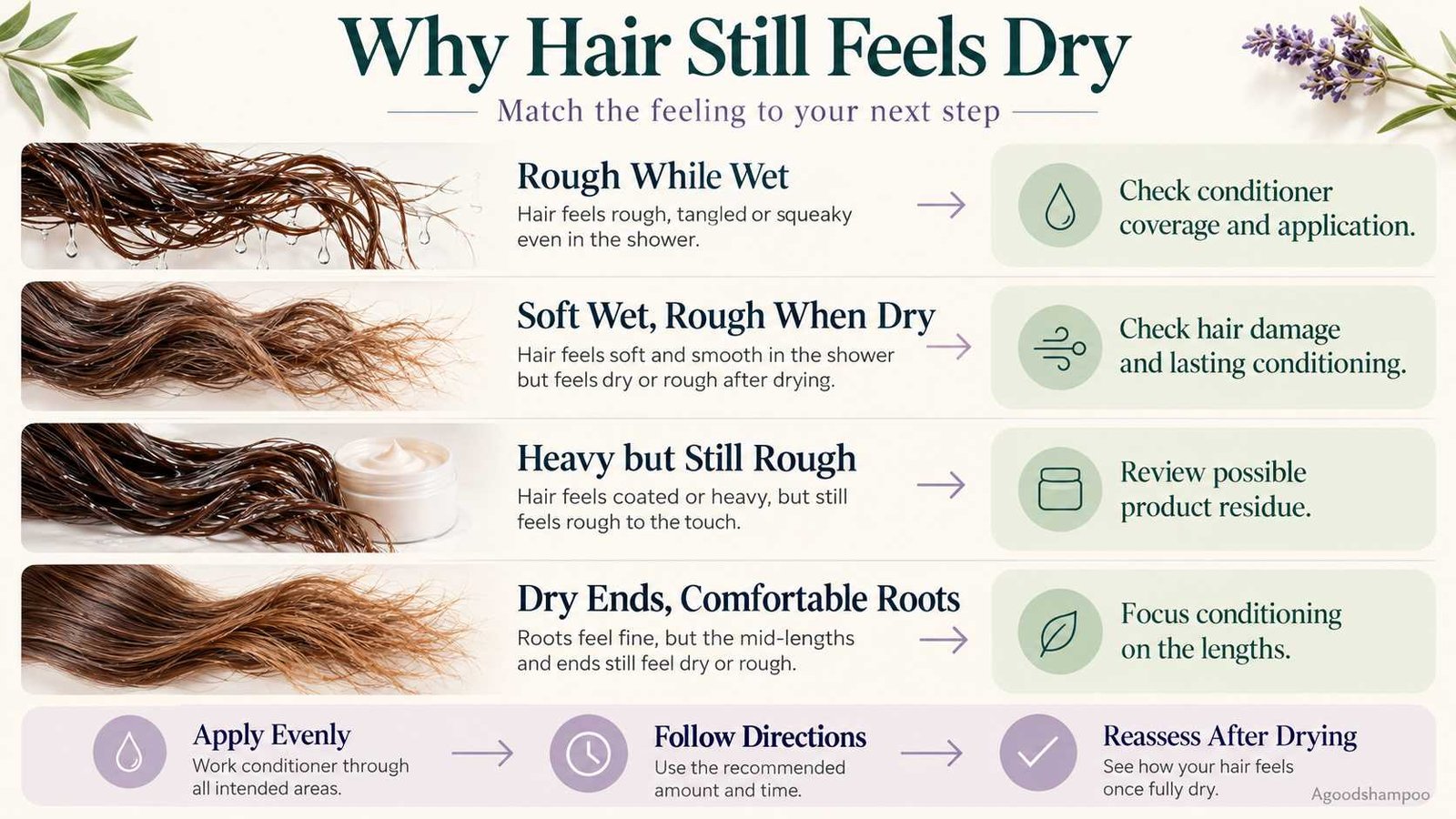
Conditioner can make hair feel slippery while wet without guaranteeing the same softness after drying. Pay attention to how your hair behaves at different stages.
| What you notice | What it may suggest | What to check first |
|---|---|---|
| Hair feels rough even with conditioner applied | Insufficient coverage or conditioning | Amount, distribution and product suitability |
| Hair feels soft while wet but rough once dry | Existing damage, friction or inadequate lasting conditioning | Hair condition and post-wash routine |
| Hair feels heavy but the ends are still rough | Possible product residue or an overly rich formula | Styling products and cleansing habits |
| Roots feel comfortable but ends are dry | Older lengths need more targeted conditioning | Where conditioner is applied |
| Hair feels soft initially but dry the next day | Conditioning may not last through drying, sleeping and styling | Leave-in care and friction |
These patterns are clues, not definitive tests. More than one cause can be present, particularly if your hair has been colored, bleached or frequently heat-styled.
Why Conditioner May Not Be Leaving Your Hair Soft
1. Your Conditioner Isn’t Rich Enough for Your Hair
Not all conditioners deliver the same level of softness, lubrication or manageability.
Lightweight conditioners are often designed to avoid weighing down fine hair. Richer formulas may contain greater amounts or different combinations of conditioning agents, fatty alcohols, oils and silicones to improve the feel of rougher lengths.
If your hair is thick, curly, bleached or particularly prone to tangling, a very lightweight conditioner may not provide the slip you need.
That doesn’t automatically mean you need the heaviest product available. Fine hair can become flat or coated when a formula deposits more conditioning material than it needs.
Choose according to how your hair behaves after drying, not just the words hydrating or repairing on the bottle.
2. Conditioner Isn’t Reaching the Dry Areas
Uneven application is easy to overlook.
You may apply conditioner to the outer layer of your hair while the inner sections and ends receive very little. This is especially relevant for long, thick or tightly curled hair.
Apply your conditioner to the lengths that need it. Work it gently through sections when necessary, ensuring the ends receive adequate coverage.
Follow the manufacturer’s instructions for contact time and rinsing. Leaving a rinse-out conditioner on longer than directed does not necessarily produce better results.
The American Academy of Dermatology recommends concentrating conditioner on the ends for fine or straight hair, while people with dry or curly hair may benefit from conditioning more of the hair length.
3. Your Hair Has Existing Damage
Bleaching, chemical treatments, frequent high-temperature styling and rough handling can alter the hair fiber’s surface.
Healthy-feeling hair generally has a smoother surface that allows neighboring strands to move past one another with less friction. Weathered or damaged hair may have a rougher cuticle surface, leading to more tangling and a straw-like sensation.
Conditioning ingredients can temporarily reduce friction and improve manageability. However, they cannot reverse every structural change caused by severe chemical or thermal damage.
This is why heavily processed ends may feel rough again after the conditioner has been rinsed away and the hair has dried.
If repeated coloring or heat styling is involved, our guide to choosing shampoo for dry and damaged hair explains why cleansing and conditioning need to work together.
4. Your Washing Routine Is Working Against Your Conditioner
Sometimes the problem begins before the conditioner goes on.
Aggressively rubbing shampoo through the lengths, frequent harsh cleansing and rough towel-drying can increase tangling and make vulnerable hair harder to manage.
Shampoo generally belongs primarily on the scalp, where oil and accumulated debris need to be removed. The lengths usually do not require the same degree of scrubbing.
After washing, squeeze out excess water gently rather than twisting or rubbing the hair vigorously. Detangle carefully, using a wide-tooth comb when appropriate for your hair type.
Reducing unnecessary friction may help your conditioner deliver a more noticeable improvement.
5. Product Residue May Be Affecting the Result
Hair that feels both heavy and rough deserves a different kind of attention.
Conditioners, styling creams, oils and certain styling polymers can deposit materials on hair. Some deposition is intentional and beneficial because it improves lubrication and combability.
However, when a product combination leaves hair unusually coated, limp or difficult to cleanse, residue may be contributing to the unpleasant feel.
This doesn’t mean silicones automatically prevent hair from absorbing moisture or that every conditioner causes buildup.
If your hair feels coated rather than simply dry, review your product use and read our guide to what clarifying shampoos are good for.
Clarifying may help with some residue problems, but repeated strong cleansing can make already rough hair harder to manage. It should not be the automatic response to every case of dryness.
What to Change at Your Next Wash
Instead of replacing every product immediately, try a controlled adjustment to your routine.
- Keep your usual shampoo for the first test. Unless it clearly causes irritation or excessive roughness, changing several products together makes it harder to identify the problem.
- Clean the scalp gently. Massage shampoo into the scalp without aggressively scrubbing the lengths.
- Distribute conditioner thoroughly. Apply it to the areas that feel dry, working through sections if necessary. Follow the product’s recommended contact time.
- Rinse and handle hair gently. Avoid rough towel friction and unnecessary high heat while drying.
- Assess your hair once it is completely dry. Notice whether the ends are softer, tangling is reduced and the hair remains manageable.
If improved application makes a difference, you may not need a new conditioner.
If the hair still feels rough, make one additional change at the next wash, such as trying a different conditioner formula. Keeping the rest of the routine reasonably consistent gives you a clearer comparison.
Should You Switch Conditioners or Add a Leave-In?
A different rinse-out conditioner may help when the current formula provides insufficient softness despite correct application.
For fine hair, try a lightweight product that gives the ends adequate slip without leaving them flat or greasy.
For coarse, curly or repeatedly processed hair, consider a richer conditioner formulated to improve detangling and manageability.
If your hair feels good immediately after rinsing but becomes rough as it dries, a properly formulated leave-in conditioner may be more useful than applying more rinse-out product.
Leave-in conditioners are designed to remain on the hair and provide continuing lubrication, softness and detangling support. They can be particularly helpful for longer or chemically treated hair.
Start with a small amount, concentrating on the mid-lengths and ends. Adjust the amount according to hair density, texture and product instructions.
Do not leave an ordinary rinse-out conditioner in your hair as a substitute. The American Academy of Dermatology explains that rinse-out and leave-in products have different formulations and intended uses.
When Persistent Roughness Needs More Attention
If your hair remains consistently rough despite a suitable conditioner, gentler cleansing and appropriate leave-in care, look more closely at possible ongoing damage.
Increasing breakage, severe tangling or brittle ends may indicate that the hair has experienced substantial physical or chemical weathering. Reducing heat exposure and further chemical processing can be as important as changing products.
It is also worth separating hair-shaft roughness from scalp symptoms.
Persistent itching, redness, scaling, sores or unusual shedding are not simply signs that your conditioner lacks moisture. These symptoms may need assessment by a dermatologist.
Similarly, if significant breakage continues despite careful handling and conditioning, a professional assessment can help identify concerns that ordinary cosmetic products cannot resolve.
Choose the Fix That Matches the Problem
If your hair feels dry immediately after conditioning, start with better product distribution and a formula suited to your hair’s texture.
If it feels soft while wet but rough after drying, consider existing damage, handling habits and whether a leave-in conditioner would provide additional support.
If it feels heavy and coated yet remains rough, investigate your product routine before automatically switching to a richer conditioner.
The goal isn’t to make every strand feel slippery at all costs. It’s to find a routine that leaves your hair comfortable, manageable and less prone to unnecessary tangling and breakage.
Change one thing at a time and judge the result after your hair has dried. That is usually more informative than repeatedly buying products labeled for extreme moisture.

Marlena Stell makes everyday hair care easier to understand. From choosing a shampoo to managing common hair concerns, she breaks down confusing product claims and practical routines into straightforward advice that helps readers find what works for their needs.