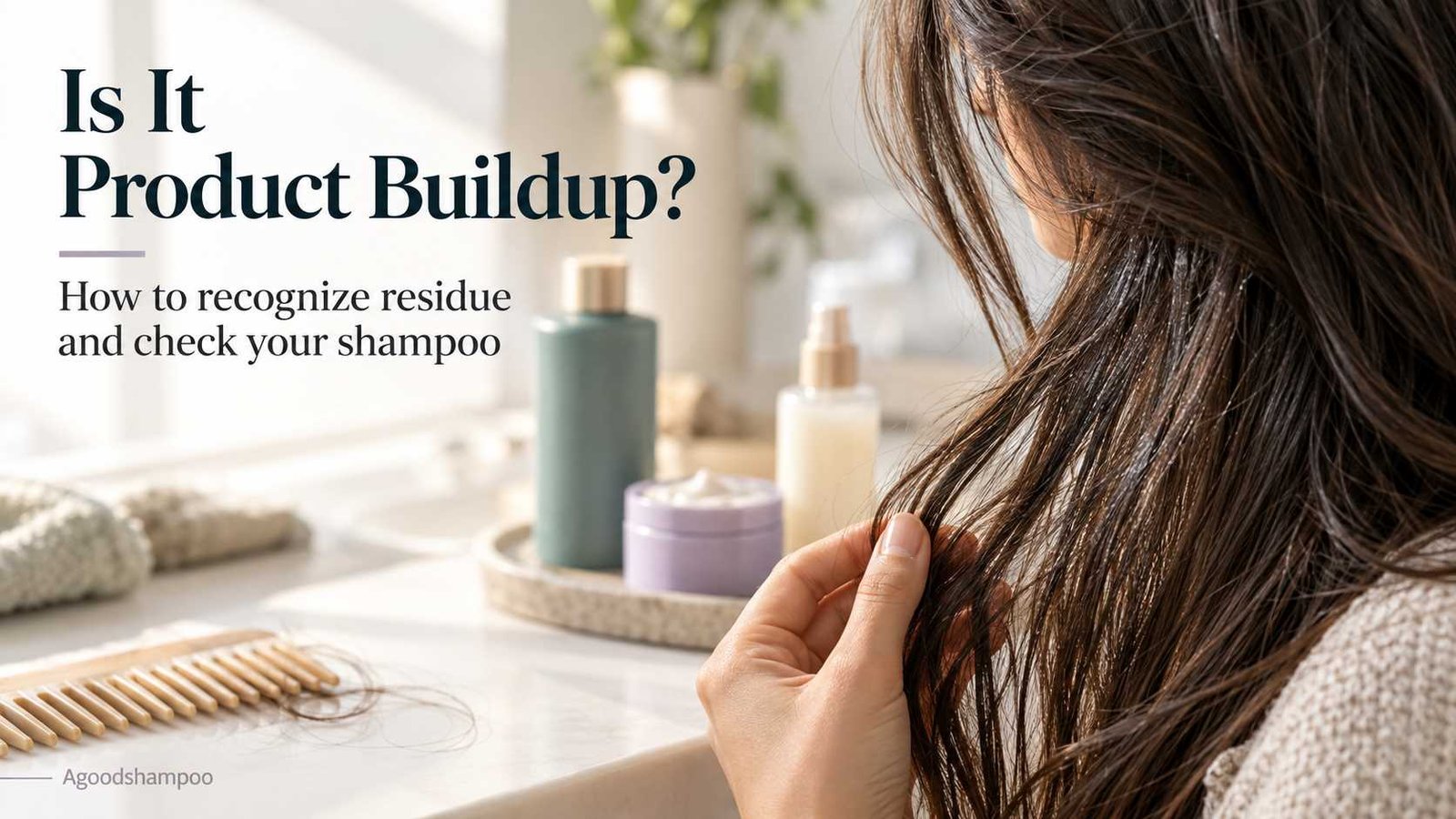
 Hair that feels heavy, coated, or unusually flat after washing may have product buildup, but that doesn’t prove your shampoo is responsible. Styling creams, conditioners, hair oils, dry shampoo, and natural scalp oil can all contribute to residue. Sometimes the problem is simply that your regular shampoo isn’t removing everything your routine leaves behind.
The American Academy of Dermatology recommends applying shampoo primarily to the scalp to remove accumulated oil, dead skin, and product residue. It also advises washing with shampoo and water after one or two applications of dry shampoo, since dry shampoo absorbs oil without actually cleansing the scalp.
To work out whether your shampoo is contributing to buildup, pay attention to when the problem started, where your hair feels coated, and which products you’re using. Those clues are more useful than assuming one ingredient must be the cause.
Five Signs Your Hair May Have Product Buildup
Product buildup doesn’t always look obvious. A thin layer of cosmetic residue can affect how hair feels and behaves without leaving visible flakes or deposits.
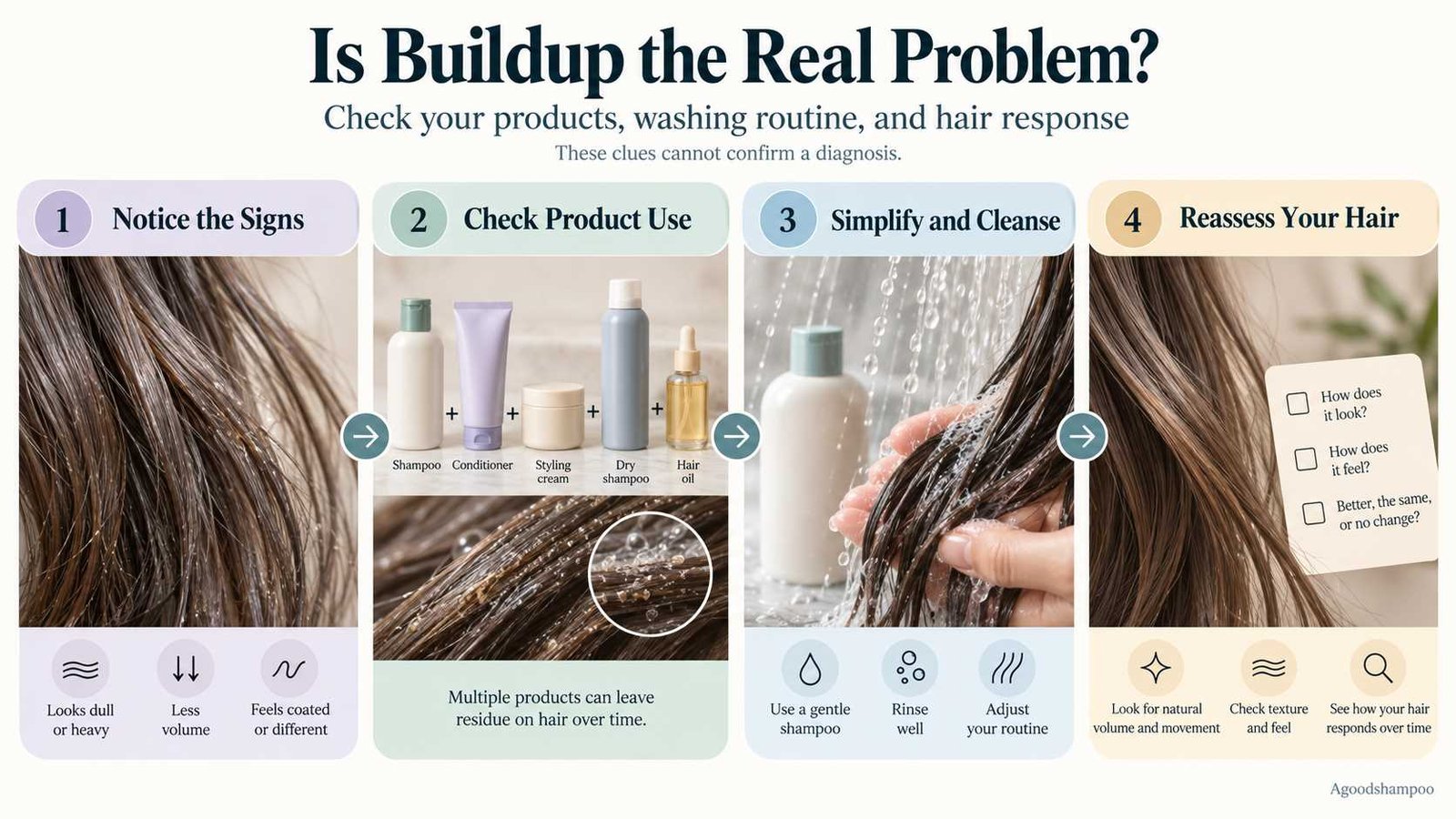
1. Your hair feels coated even after washing. Instead of feeling naturally soft and manageable, the strands may seem slippery, waxy, sticky, or unusually heavy. Different products can produce different sensations, so a coated feeling alone doesn’t identify the source.
2. Your roots become flat more quickly. Conditioning agents, styling products, and scalp oil can reduce movement when they accumulate near the roots. Fine hair may show this effect especially clearly because relatively small amounts of additional weight can affect volume.
3. Your hair looks dull or lacks its usual movement. A film of residue may change the way light reflects from the hair surface. However, dullness can also result from dryness, weathering, or damage, so it isn’t a reliable buildup test on its own.
4. Styling products stop giving the results you expect. Hair may become difficult to shape or hold in a style when several products are layered together. This can happen even when each product works well individually.
5. Your hair feels noticeably different after changing products. If the problem began after introducing a rich shampoo, leave-in conditioner, styling cream, or oil, the change is worth investigating.
None of these signs confirms buildup. The strongest clue is often a consistent relationship between product use, washing habits, and how your hair behaves afterward.
Is Your Shampoo Actually Causing the Buildup?
A shampoo can contribute to a coated feeling in two different ways. It may deposit conditioning ingredients onto the hair, or its cleansing system may not adequately remove materials already present.
These are not the same thing.
Conditioning ingredients can remain on hair intentionally
Shampoo formulas contain more than cleansing agents. Some include conditioning polymers, silicones, oils, or other ingredients designed to improve softness, reduce friction, and make hair easier to manage.
For example, polyquaternium compounds are used in hair-care formulations for conditioning and related performance benefits. Certain silicones can also create a smoother feel by forming a thin layer on the hair surface.
This deposition is not automatically undesirable. It can improve manageability, particularly for dry, damaged, or chemically processed hair.
The problem arises when the finished formula leaves hair feeling heavier than the user prefers or when deposits accumulate through repeated product use.
A rich conditioning shampoo that suits coarse, dry hair may leave fine hair looking flatter. That doesn’t make the product defective. It may simply be a poor match for the person’s hair characteristics.
The presence of dimethicone, amodimethicone, or a conditioning polymer on an ingredient list cannot tell you how much residue a finished shampoo will leave.
Concentration, ingredient interactions, delivery systems, and the overall formulation matter.
Your shampoo may not remove other products effectively enough
Sometimes shampoo receives the blame for residue created by something else.
Consider someone who uses dry shampoo between washes, follows with styling cream, and finishes with hair oil. Their regular shampoo may remove scalp oil effectively while leaving some of the accumulated styling materials behind.
A moisturizing shampoo doesn’t necessarily provide the same cleansing performance as a shampoo formulated specifically for substantial product accumulation.
However, terms such as moisturizing, sulfate-free, and clarifying do not establish exact cleansing strength. Different products within those categories can behave differently.
Sulfates aren’t automatically too harsh, and sulfate-free cleansers aren’t automatically too mild.
The more useful question is whether your cleansing routine removes the particular mixture of oil and styling products you’re using without leaving your scalp uncomfortable.
For readers considering stronger cleansing, our guide to what clarifying shampoos are good for explains their intended role.
How to Check Whether Product Residue Is the Problem
There is no simple home observation that conclusively proves your shampoo is causing buildup. You can, however, investigate the possibility without replacing your entire routine.
Start by identifying when the coated feeling appears.
| What you notice | Possible explanation | What to investigate |
|---|---|---|
| Hair feels coated immediately after shampooing | Conditioning deposits or incomplete cleansing | Shampoo formula and rinsing |
| Hair feels heavy after using conditioner | Rich or excessive conditioning | Amount and application area |
| Roots flatten after several styling days | Oil and styling-product accumulation | Product use between washes |
| Hair looks dull despite feeling clean | Residue, dryness, or surface damage | Other hair characteristics and routine changes |
| Coated feeling improves after a suitable clarifying wash | Removable material may have contributed | Whether the result continues with routine adjustments |
An improvement after clarifying suggests that removable materials may have played a role. It does not prove which product caused them.
A practical investigation begins with three changes.
First, review your recent product history. Note whether the problem appeared after adding a shampoo, conditioner, styling cream, serum, or dry shampoo.
Second, improve your ordinary washing technique. Distribute shampoo across the scalp, massage gently with your fingertips, and rinse thoroughly. Avoid applying excessive amounts of conditioner near oily roots unless your hair needs conditioning in that area.
Third, simplify your styling routine for a few washes. Temporarily reduce nonessential styling products while keeping other parts of the routine consistent.
If your hair begins to feel lighter or more manageable, reintroducing products individually may help identify a contributing factor.
Don’t deliberately repeat the use of a product that has caused a rash, burning, or another suspected allergic reaction.
How to Remove Buildup Without Making Hair Too Dry
Improve ordinary shampooing before using stronger cleansers
Many routine problems can be addressed by washing more effectively rather than immediately buying another shampoo.
Wet the scalp thoroughly, use enough shampoo for adequate coverage, and concentrate cleansing where oil and styling materials tend to accumulate.
Dense hair may benefit from being separated into sections during washing so the cleanser and rinse water can reach the scalp.
Conditioning still matters. Removing too much oil or using aggressive cleansing repeatedly may leave dry or damaged hair rough and difficult to detangle.
If your hair is fine, apply conditioner mainly to the lengths and ends when that provides sufficient softness. Curly, coarse, or very dry hair may require a different approach.
The goal is clean, manageable hair, not a stripped or squeaky sensation.
Use clarifying shampoo when accumulated products are the likely issue
Clarifying shampoo may help when ordinary cleansing doesn’t adequately remove styling residue, excess oil, or accumulated conditioning products.
It can be particularly relevant after repeated use of dry shampoo, heavy styling creams, or other products that leave substantial material on the hair.
However, clarifying formulas vary. Some use stronger cleansing systems, while others rely on different combinations of surfactants and supporting ingredients.
There is no universal clarifying schedule. Someone using substantial styling products may need it more often than a person with a minimal routine, but frequency should depend on the product directions and how the scalp and hair respond.
For an example of a product-focused analysis, see AGoodShampoo’s Neutrogena clarifying shampoo review.
If hard-water minerals are suspected, a chelating shampoo may be worth investigating. Chelating ingredients can bind certain metal ions, but a shampoo labeled clarifying isn’t necessarily formulated to address mineral deposits effectively.
People with bleached, colored, chemically treated, or fragile hair should be especially attentive to the product’s instructions and the risk of leaving the hair feeling dry.
Avoid trying to remove buildup with abrasive scrubs, baking soda, or repeated harsh cleansing. These approaches may increase roughness or irritation without establishing the original cause.
When Flakes or Irritation May Not Be Simple Buildup
A coated feeling on hair is different from persistent scalp inflammation.
Dry shampoo and styling products may leave residue near the roots, but itching, redness, painful areas, thick scales, and ongoing flakes can also occur with dandruff, contact dermatitis, psoriasis, or other scalp conditions.
The American Academy of Dermatology recognizes several possible causes of scalp itching, including reactions to hair-care products and inflammatory scalp disorders.
A clarifying shampoo cannot reliably distinguish these conditions or replace appropriate treatment.
If symptoms continue after reasonable routine changes, or you notice sores, significant inflammation, pain, or unusual hair loss, consult a dermatologist.
Cosmetic deposits on the hair shaft should also not be described as proof that follicles are blocked or that permanent hair loss is occurring.
Should You Change Your Shampoo or Your Routine?
If your hair feels coated immediately after washing, begin with your current cleansing and conditioning habits. Check shampoo coverage, rinse thoroughly, and reduce unnecessary product layering.
If the problem appeared after switching to a particular shampoo, its formula may not be suitable for your hair. Consider whether a different balance of cleansing and conditioning would work better.
When accumulated styling products seem responsible, occasional clarifying may be useful. But if the scalp is irritated, inflamed, or persistently itchy, stronger cleansing isn’t automatically the right response.
A shampoo doesn’t need to remove every trace of conditioning material to work well. The better test is whether your routine leaves your hair comfortably clean, manageable, and free from unwanted heaviness.
The aim is to identify what needs changing, not to remove every conditioning ingredient from your hair.

Michael Chen focuses on the science behind shampoos and hair-care ingredients. He explains how cleansing agents, silicones, proteins, and other formula components work, separating useful evidence from marketing claims to help readers better understand the products they use.