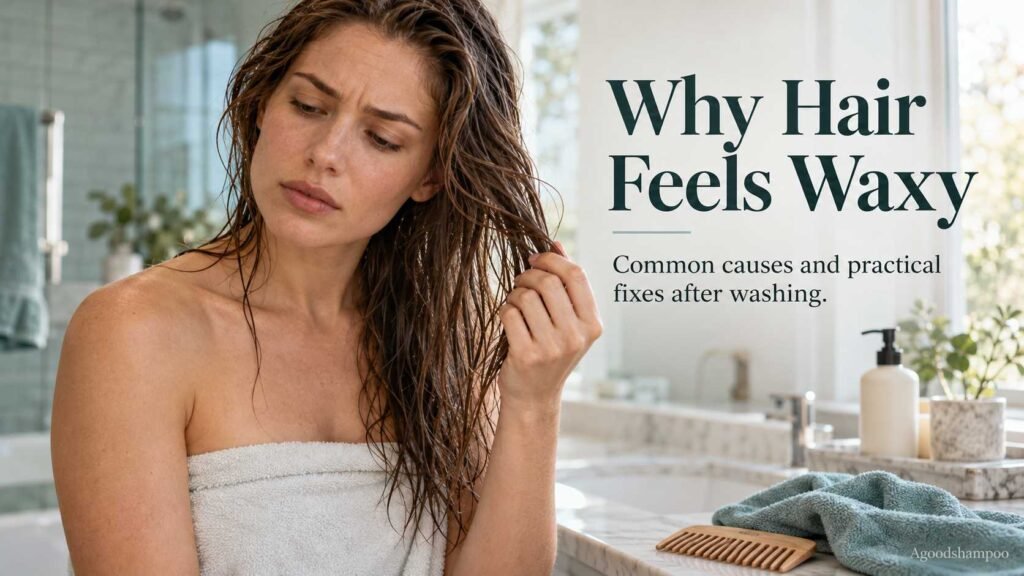
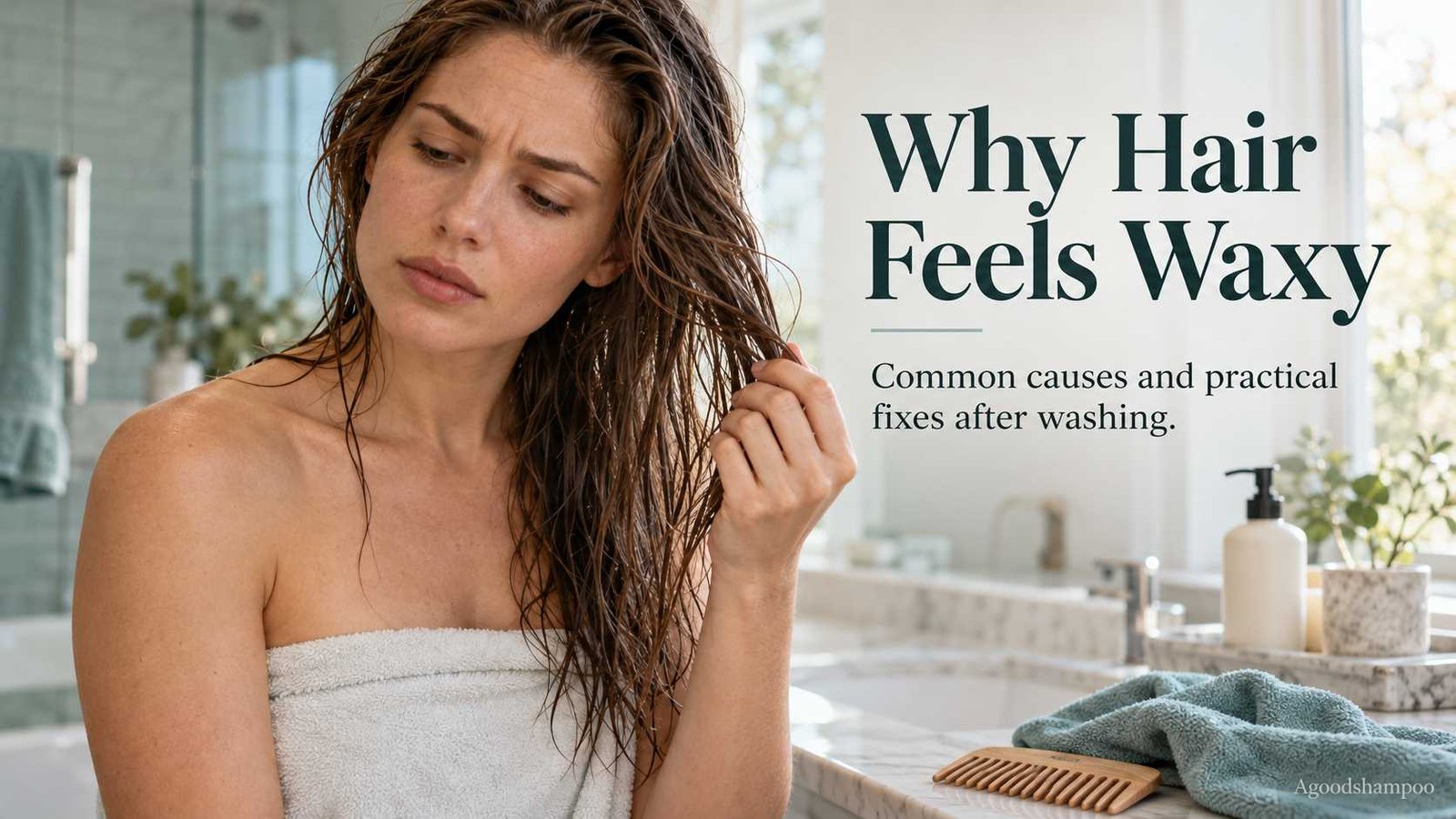
 Hair that feels waxy right after washing is often holding onto something the wash didn’t fully remove, such as styling-product residue, conditioner, or scalp oil. Hard-water minerals may also contribute to a coated feeling. The key is finding out what’s happening rather than immediately switching to the strongest shampoo available.
In a study using hair samples from 20 healthy volunteers, researchers found significantly more magnesium deposited on hair exposed to hard water for three weeks. However, they did not find a significant difference in visible structural surface damage. That distinction matters: residue on hair doesn’t necessarily mean the hair itself is damaged.
If your hair looks clean but feels coated, heavy, sticky, or strangely stiff, pay attention to where the sensation starts. Waxy roots, coated ends, and an entire head of stiff-feeling hair can point toward different explanations.
What Causes Hair to Feel Waxy After Washing?
Product residue can leave a coating on your strands
Leave-in conditioners, styling creams, waxes, dry shampoo, and hair oils can accumulate when regular cleansing doesn’t remove them adequately.
The result may be hair that lacks movement or feels coated even though it has just been washed. Fine hair may show this effect particularly clearly because added weight can reduce visible volume.
Silicones sometimes receive all the blame, but that oversimplifies the problem. Different silicones behave differently, and a product’s overall formulation matters more than the presence of one ingredient.
Silicone-free products can also leave hair feeling heavy when they contain rich oils, waxes, or conditioning ingredients. Our guide to silicone-free shampoo explains why removing silicones isn’t automatically the best solution.
Hard water may contribute to mineral deposits
Hard water contains relatively high concentrations of calcium and magnesium. These minerals can influence how some cleansing products behave and may contribute to deposits on hair.
The US Geological Survey explains that hard water can react with traditional soap to produce insoluble residue, which can leave hair difficult to manage. Modern shampoos often use synthetic detergents, so the effect depends on the cleansing formula rather than being identical for every shampoo.
If your hair began feeling waxy after moving to a new home or changing water supplies, hardness is worth investigating.
Still, chalky marks on shower fixtures are only clues. A water-hardness test is more informative, and hard water alone does not establish why your hair feels coated.
Your conditioner may be too rich for your hair
Conditioner is designed to improve hair’s softness, manageability, and detangling. But a formula or application method that works beautifully for thick, dry hair may leave fine hair looking flat.
Applying a rich conditioner directly to oily roots can also make freshly washed hair feel heavier.
The American Academy of Dermatology recommends applying conditioner mainly to the ends when hair is fine or straight. Dry or curly hair may benefit from conditioning more of its length.
This doesn’t mean conditioner is harmful. It means the amount, placement, and formula should suit your hair.
Scalp oil and incomplete cleansing can make roots feel greasy
The scalp naturally produces sebum, an oily substance that helps lubricate skin and hair. If shampoo isn’t worked through the scalp adequately, some sebum and styling residue may remain.
Fine or straight hair can show oil more visibly because it spreads along the strands relatively easily.
Rinsing also matters. Shampoo or conditioner that hasn’t been thoroughly washed away may leave hair feeling slippery, sticky, or coated.
How to Identify What’s Leaving Your Hair Waxy
Before buying another shampoo, think about when the problem started and where your hair feels different.
| What you notice | Possible explanation | What to check first |
|---|---|---|
| Waxy or greasy roots immediately after washing | Remaining scalp oil or styling residue | Shampoo distribution and rinsing |
| Coated lengths or heavy ends | Rich conditioner, oils, or leave-in products | Amount and placement |
| Hair feels unusually stiff after changing homes | Possible hard-water deposits | Water-hardness reading |
| Hair feels coated after introducing a new product | Formula or product accumulation | Recent routine changes |
| Fine hair becomes flat after conditioning | Excess weight from conditioning products | A lighter conditioner or smaller amount |
These clues are useful starting points, not definitive tests.
For example, hair that feels waxy at the crown might suggest remaining oil or styling product, but it doesn’t prove a particular ingredient is responsible.
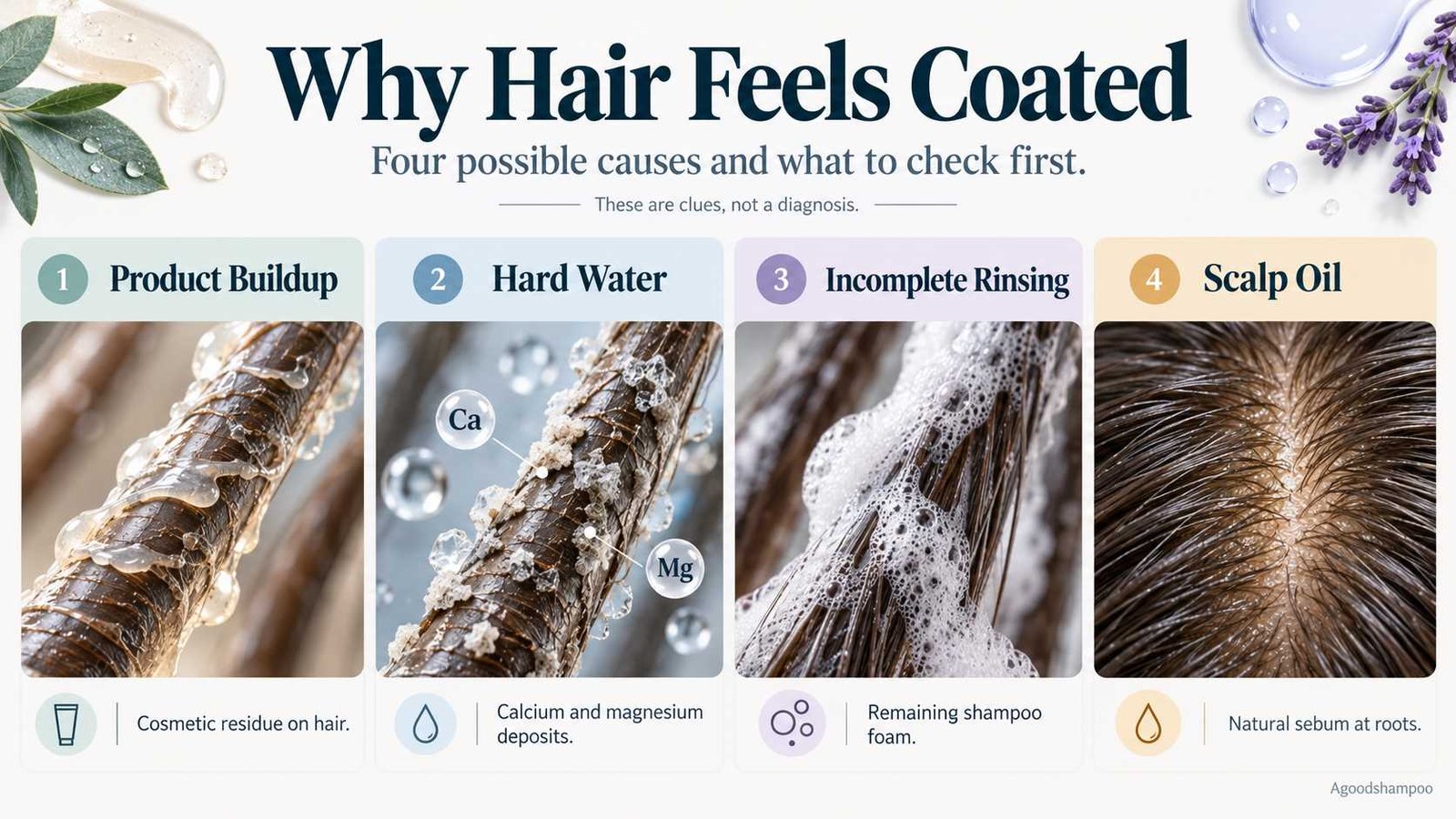
The best approach is to change one thing at a time. If you replace your shampoo, conditioner, mask, and styling cream simultaneously, you won’t know which adjustment helped.
How to Remove the Waxy Feeling Without Overwashing
Start by improving how you shampoo and rinse
Your first wash with an adjusted routine may tell you more than buying several new products.
Wet the scalp and hair thoroughly before applying shampoo.
Distribute an appropriate amount of shampoo across the scalp, including the crown, hairline, and back of the head.
Massage gently with your fingertips instead of scratching with your nails.
Rinse thoroughly, paying particular attention to areas where product tends to remain.
Apply conditioner according to your hair’s needs, then rinse as directed.
The AAD recommends concentrating shampoo on the scalp instead of aggressively washing the full length. This helps cleanse accumulated oil and products while limiting unnecessary friction on the strands.
Double shampooing isn’t essential for everyone. If you use substantial styling products or have a very oily scalp, a second gentle wash may sometimes be useful. But if your hair already feels dry or rough, repeated washing may make it less manageable.
Use clarifying shampoo when ordinary cleansing isn’t enough
A clarifying shampoo is intended to remove accumulated oils and styling-product residue more effectively than some everyday moisturizing shampoos.
It may be worth considering if your hair consistently feels weighed down after using dry shampoo, styling creams, hairspray, or oils.
A clarifying shampoo is not automatically suitable for every wash. How often you need it depends on your scalp, hair condition, products, and the specific formula.
Our article explaining how clarifying shampoo works provides more detail. You can also explore the Neutrogena clarifying shampoo review when comparing product options, while checking current availability and ingredients.
If hard-water deposits are the suspected issue, a chelating formula may be more relevant. Chelating agents bind certain metal ions, but not every product labeled clarifying is equally effective at addressing mineral deposits.
If your hair is bleached, colored, chemically treated, or particularly dry, check product instructions and proceed cautiously.
For textured hair, the clarifying shampoo options for curly hair guide offers additional considerations.
Adjust conditioner and styling products before adding treatments
If your hair feels waxy after conditioning rather than after shampooing, try using a smaller amount or applying it farther from the scalp.
Fine hair may feel lighter with a less rich conditioner. Thick, curly, or dry hair may still need substantial conditioning to reduce friction and tangling.
Review leave-in products too. Using a rinse-out conditioner, a leave-in cream, a heavy serum, and hair oil together may add more weight than your hair needs.
Avoid trying to strip away residue with undiluted vinegar, baking soda, harsh scrubbing, or repeated strong shampooing. These approaches may introduce new problems without addressing the actual cause.
Why Waxy Hair Keeps Coming Back
If your hair initially feels clean but becomes waxy after several washes, look for a recurring factor in your routine.
You might be applying styling products more quickly than your usual shampoo removes them. Your conditioner may be heavier than necessary, or your scalp may need washing more frequently.
There is no universal schedule that works for everyone. The AAD advises washing according to how oily or dirty hair becomes, with frequency differing between fine, straight, dry, curly, and textured hair.
Persistent scalp symptoms deserve separate attention. Waxy hair alone is usually a cosmetic description, not a diagnosis. But if you also notice continuing itchiness, redness, painful areas, sores, substantial flaking, or unusual shedding, a dermatologist can assess whether a scalp condition is involved.
Dandruff, for example, can be associated with scalp oiliness and inflammation and may require a more specific approach than ordinary clarifying shampoo.
What Should You Change First If Your Hair Feels Waxy?
Start with the simplest likely explanation.
If your roots feel oily immediately after washing, improve shampoo distribution and rinsing. If the lengths feel coated, reduce heavy conditioning or styling products. If the problem began after a water change, investigate hardness before assuming you need stronger shampoo.
An occasional clarifying wash may help with stubborn product residue, but it shouldn’t become the default solution for every hair problem.
The goal isn’t to make your hair feel squeaky or stripped. It’s to find a cleansing and conditioning routine that leaves your scalp comfortable and your hair manageable.
If your hair remains waxy after reasonable routine adjustments, especially alongside persistent scalp symptoms, professional assessment makes more sense than continuously experimenting with increasingly aggressive products.

Carolina Herrera writes about color-treated, damaged, and chemically processed hair. She focuses on understanding breakage, choosing suitable shampoos, and making sense of repair claims. Her goal is to help readers care for their hair with realistic expectations and informed product choices.