Why Does My Hair Feel Stiff After a Protein Treatment?

October 9, 2026

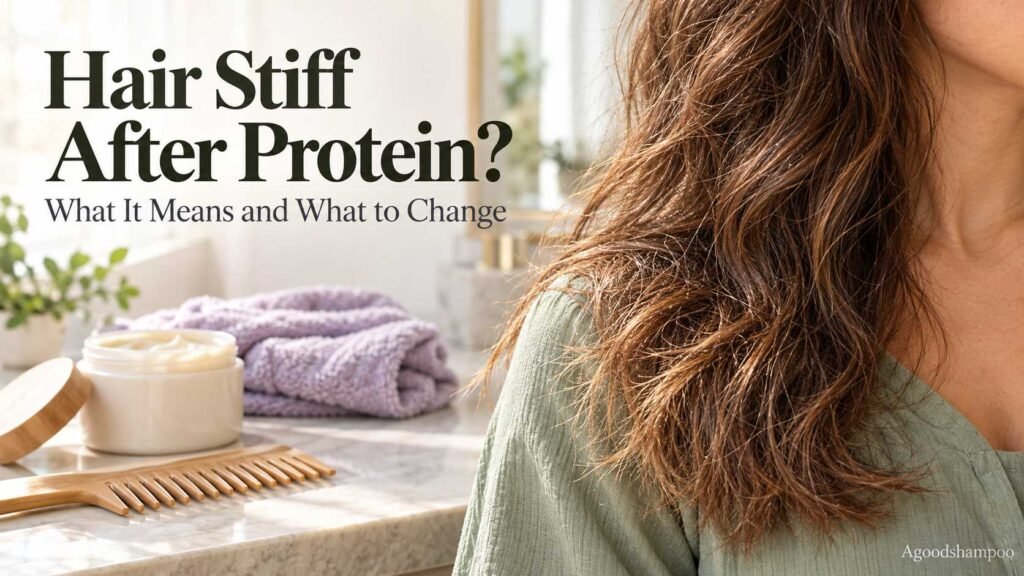
Wavy brown hair with mildly stiff-looking ends beside an unbranded hair treatment jar.Your hair felt reasonably soft before the treatment. Now the strands seem unusually firm, the ends catch against each other, and brushing feels more difficult. If that change happened immediately after using a protein mask or strengthening treatment, the product deserves a closer look.

Hair may feel stiff after a protein treatment because the formula changes how the hair fibers behave, leaves a noticeable coating, or doesn’t provide enough conditioning for your hair’s needs. Existing damage can also contribute to the rough feeling.

This doesn’t automatically mean your hair contains too much protein or that you’ve permanently damaged it. The better approach is to identify what changed, simplify your next wash, and see whether the stiffness improves.

Why Protein Treatments Can Leave Hair Feeling Stiff

Protein-containing treatments are designed to improve certain cosmetic properties of hair, particularly hair affected by chemical processing or everyday wear. However, their effects depend on the ingredients, formulation, hair condition, and application.

Some proteins can change hair-fiber stiffness

Hair is naturally made primarily of keratin, a structural protein. Many strengthening treatments contain hydrolyzed proteins, meaning proteins broken into smaller fragments.

Depending on their molecular size and formulation, these ingredients may interact with the outer surface of hair or penetrate parts of the fiber.

A study published in the International Journal of Cosmetic Science examined different molecular weights of hydrolyzed keratin on chemically relaxed textured hair. Some treatments increased measured hair-fiber stiffness while also reducing breakage under the tested conditions.

That distinction matters: greater mechanical stiffness does not necessarily mean greater damage. Laboratory measurements of a hair fiber’s resistance to stretching are also different from how soft or flexible the hair feels to your fingers.

The study does not establish that every protein mask will make hair stiff or that stiffness proves excessive protein accumulation.

The complete formula matters more than the protein label

A treatment jar may prominently advertise keratin, collagen, silk protein, or wheat protein. Yet those ingredients are only part of the formulation.

Conditioners, fatty alcohols, silicones, oils, and film-forming polymers can all influence slip, softness, and how strands move against one another.

Some formulas leave hair feeling smooth and flexible. Others may create a firmer finish, particularly when combined with styling products or applied in large amounts.

A stiff feeling can therefore reflect the overall product rather than one protein ingredient.

Previously damaged hair may already lack flexibility

Bleaching, repeated high-temperature styling, chemical straightening, and mechanical friction can weaken or roughen hair.

When damaged ends lack adequate lubrication, they may catch against neighboring strands and become difficult to detangle. A protein treatment may improve one property without making the surface feel noticeably softer.

This helps explain why someone’s roots can feel comfortable while their older, processed ends remain rough.

If your hair is curly, you may also notice changes in how the curls separate or clump. That doesn’t necessarily mean the protein permanently changed your curl pattern. For more on this distinction, see our guide to keratin shampoo for curly hair.

What Your Hair’s Texture May Be Telling You

The most useful clue is not simply that your hair feels hard. It’s when the feeling appears and what happens alongside it.

What you noticeWhat to investigate
Hair feels firm immediately after rinsingTreatment formula, quantity, and application instructions
Hair is stiff, coated, or unusually heavyResidue from the treatment or styling products
Hair becomes rough and tangled when dryConditioning, friction, and existing hair damage
Bleached ends feel particularly brittlePre-existing chemical damage
Hair feels better when you skip the treatmentPossible incompatibility with the product or routine
Short broken strands appear repeatedlyOngoing breakage requiring closer assessment

These observations can guide your next step, but none of them confirms protein overload.

For example, roughness and tangling can occur when the hair surface is damaged or insufficiently conditioned. A coated feeling may suggest product residue without revealing which ingredient is responsible.

Compare the treated hair with how it normally behaves after your usual wash and conditioner. That comparison is more meaningful than trying to diagnose a protein problem from appearance alone.
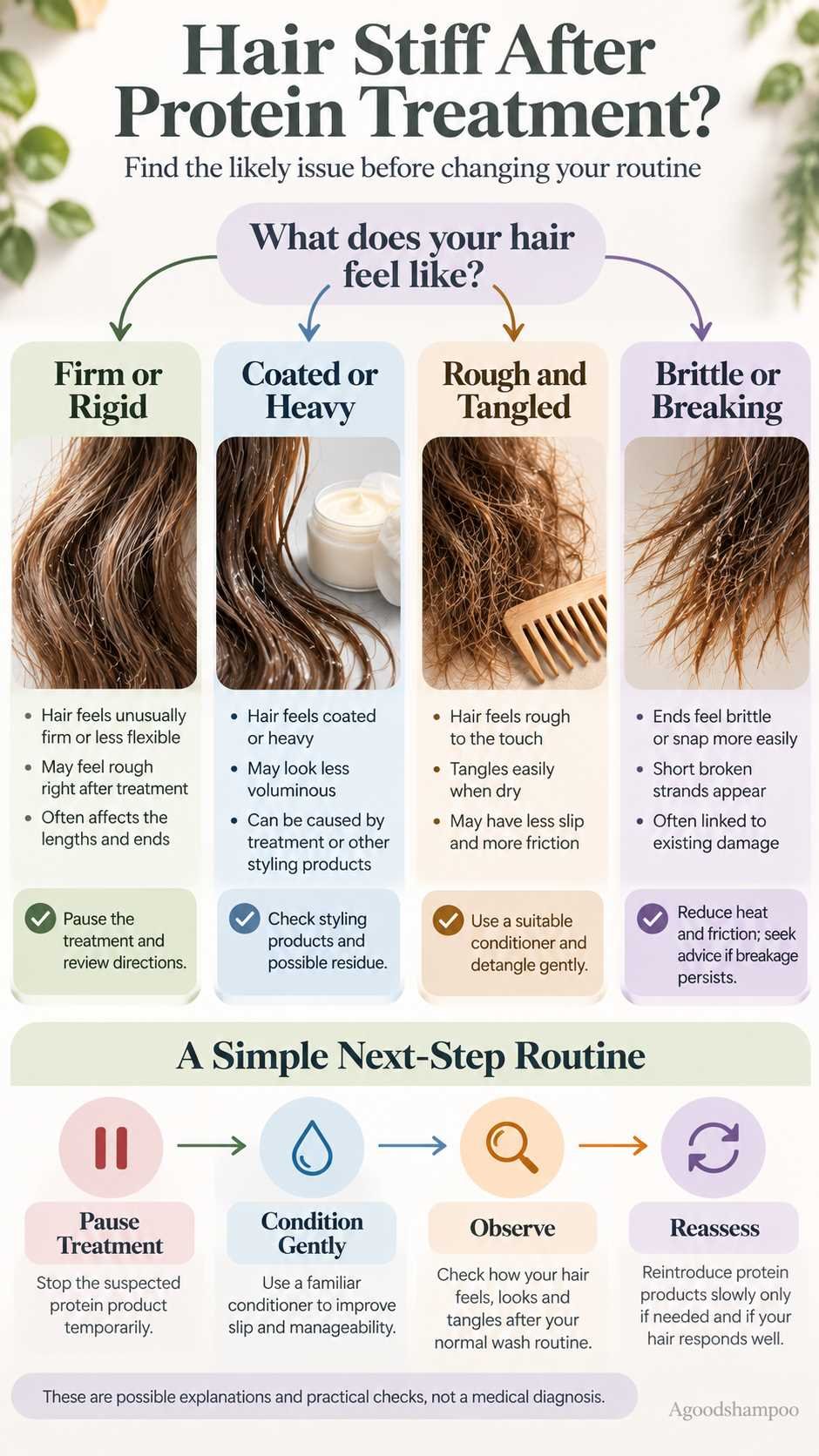
Four-part guide showing hair stiffness, residue, tangling, and breakage with suggested next steps.

How to Soften Hair After a Protein Treatment

You don’t need an elaborate recovery routine. Start with a few low-risk adjustments and give yourself a chance to observe the results.

1. Pause the suspected treatment

Stop using the protein mask or strengthening treatment temporarily.

This doesn’t mean avoiding every shampoo or conditioner that contains amino acids or hydrolyzed proteins. It means removing the product most closely associated with the unwanted change.

If you recently introduced several products, simplify the routine rather than trying to identify every possible problematic ingredient immediately.

2. Cleanse gently when your next wash is due

Use a shampoo appropriate for your scalp and hair type.

Concentrate shampoo on your scalp and allow the lather to rinse through the lengths instead of scrubbing the ends. This follows general hair-washing guidance from the American Academy of Dermatology.

If your hair feels unusually coated or heavy, check whether you’ve been using several leave-in products, styling creams, or treatments together.

A clarifying shampoo may help when product residue is genuinely suspected, but don’t assume you must aggressively strip your hair to remove protein. A harsh wash can leave already rough hair feeling worse.

3. Follow with a suitable conditioner

After shampooing, use a familiar conditioner that has previously made your hair easier to detangle.

Apply it through the areas needing conditioning, usually the mid-lengths and ends, adjusting for your hair type. Follow the product’s rinsing instructions.

Conditioning agents help reduce friction between strands and improve manageability. They can make hair feel noticeably softer without rebuilding damaged hair into its original condition.

A conditioner doesn’t need to be marketed as a protein-free rescue treatment to be useful.

4. Add leave-in conditioning if needed

If your ends remain rough after rinsing, a small amount of leave-in conditioner may help with detangling and frizz.

Choose a formulation suitable for your hair type. Fine hair may need a lightweight spray, while thick, curly, or highly textured hair may benefit from a richer product.

Apply only as much as needed through the lengths rather than layering several heavy products.

Importantly, a rinse-out conditioner is not automatically suitable for leaving in. Use products according to their intended instructions.

5. Reduce friction and high heat

Stiff or tangled hair can become more vulnerable to mechanical damage during handling.

Gently squeeze water from your hair with a soft towel or T-shirt instead of rubbing vigorously. Detangle with an appropriate wide-tooth comb, working gradually from the ends upward.

Limit hot styling tools while assessing the problem. If blow-drying is necessary, use moderate heat and appropriate heat protection.

You don’t need to repeatedly stretch your hair to test whether it has recovered. Pulling fragile strands can contribute to breakage.

6. Judge the result after your normal wash routine

After washing and conditioning, notice whether the hair feels less coated, separates more easily, and tangles less during styling.

If it improves, keep the routine simple and avoid immediately reintroducing multiple treatments.

If stiffness continues, consider pre-existing damage, the performance of your regular conditioner, or other products in your routine. Don’t assume every persistent problem has the same cause.

Should You Avoid Protein Treatments From Now On?

Not necessarily.

Protein-containing products are not inherently damaging, and hair doesn’t universally need a fixed schedule alternating protein and moisture treatments.

The useful question is whether a particular product improves your hair’s manageability without creating an unwanted finish.

Check the ingredient label for names such as hydrolyzed keratin, hydrolyzed wheat protein, hydrolyzed silk, or other protein derivatives. Their presence identifies components of the formula but doesn’t reveal their concentrations or predict your individual results.

Also distinguish everyday protein masks from professional keratin smoothing services. Salon smoothing treatments may involve chemical agents and substantial heat, creating different considerations from a rinse-out protein conditioner.

Related posts

Why Does My Hair Feel Stiff After a Protein Treatment?

October 3, 2026

Hair that feels unusually stiff after a protein treatment can be frustrating, especially when the product promised smoother, stronger, more manageable strands. Instead, your hair might feel like straw, become difficult to detangle, or seem less flexible than it did before treatment.

Hair can feel stiff after a protein treatment because of changes in how ingredients interact with the hair fiber, product residue, insufficient conditioning, or damage that was already present. It does not automatically mean you have protein overload.

The safest first step is to pause the treatment that appears to be causing the problem, use a suitable conditioner, and avoid unnecessary heat or aggressive brushing. What you do next depends on how your hair feels after an ordinary wash.

What Makes Hair Feel Stiff After a Protein Treatment?

Protein treatments contain ingredients intended to improve the cosmetic condition or mechanical properties of hair. However, these products vary considerably in formulation, concentration, application instructions, and results.

1. Protein Ingredients Can Change How Hair Feels

Hair is primarily made of keratin, a structural protein. Some strengthening treatments contain hydrolyzed proteins, which are proteins broken into smaller fragments.

Depending on their molecular size and the formulation, these ingredients may interact with the hair surface or penetrate portions of the fiber.

A 2021 study published in the International Journal of Cosmetic Science found that different molecular weights of hydrolyzed keratin behaved differently when applied to chemically relaxed, textured hair. Some treatments changed measurable mechanical properties, including stiffness.

That finding does not mean all protein masks make hair brittle. It shows why different protein ingredients and formulations may produce different effects.

2. Your Hair May Need More Conditioning

A strengthening treatment is not necessarily a good substitute for a conditioner.

Conditioning ingredients help reduce friction between strands, improve manageability, and make detangling easier. Without enough conditioning, hair may feel rough even after a strengthening product has been rinsed out.

This can be particularly noticeable on bleached, color-treated, curly, or frequently heat-styled hair.

If your hair feels rough at the ends but comfortable near the roots, the problem may be concentrated in the older, more weathered portions of the hair shaft.

3. The Complete Product Formula May Leave Residue

A protein mask may also contain silicones, oils, fatty conditioning ingredients, and film-forming polymers.

Some of these materials are designed to remain on the hair after rinsing. Depending on the product and your routine, the resulting finish may feel coated, heavy, or unusually rigid.

The sensation is not proof that protein itself has accumulated.

It is more useful to review everything you recently applied, including leave-in conditioners, styling creams, gels, and heat-protection products.

4. Existing Damage Can Make Stiffness More Noticeable

Hair that has undergone bleaching, chemical straightening, frequent coloring, or repeated heat styling can already be fragile.

A treatment may temporarily alter how damaged areas feel without reversing the underlying structural damage.

For example, hair with rough, weathered cuticles may continue to tangle or snap even when a conditioning treatment improves its surface feel.

If stiffness began after a salon smoothing service involving chemicals and substantial heat, investigate the treatment process itself rather than assuming an ordinary protein-mask reaction.

For more context, read our guide to keratin smoothing treatment advantages and disadvantages.

Is It Protein Overload or Something Else?

Protein overload is a popular hair-care term used to describe hair that feels hard, rough, or brittle after repeated use of protein-containing products.

However, it is not a standardized medical diagnosis, and there is no validated home test that identifies excess protein as the cause of stiff hair.

Several problems can produce similar sensations.

What You NoticePossible ExplanationSensible Next Step
Hair feels stiff immediately after one maskTreatment finish or inadequate conditioningPause the mask and condition normally
Hair feels heavy, coated, or clumpedResidue from one or more productsReview product use and cleansing
Ends are rough but roots feel normalWeathering, dryness, or previous damageConcentrate conditioner on the lengths
Hair tangles and snaps easilyFragile fibers or existing damageReduce friction and heat
Scalp burns, stings, or becomes inflamedPossible irritation or reactionStop the product and seek medical advice when appropriate

These clues help you decide what to investigate. They cannot establish a definite diagnosis.

The popular wet-hair stretch test is also unreliable for determining whether your hair needs protein or moisture. Stretching a fragile strand can cause more breakage, while the result can be affected by the hair’s condition and how much force is applied.

How to Soften Stiff Hair Without Making Damage Worse

You do not need an elaborate recovery routine. Start with a few controlled changes and observe the result.

Step 1: Pause the Suspected Treatment

Stop using the protein mask or strengthening product that appears to have triggered the stiffness.

You do not necessarily need to eliminate every product containing amino acids or hydrolyzed proteins. A shampoo with a small amount of hydrolyzed protein may behave very differently from a concentrated treatment mask.

The goal is to remove the most likely trigger while keeping the rest of your routine relatively consistent.

Step 2: Wash Gently When Your Hair Needs Cleansing

At your next normal wash, use a shampoo appropriate for your scalp and hair type.

Massage it primarily into your scalp rather than scrubbing the full hair length. Rinse thoroughly.

The American Academy of Dermatology recommends concentrating shampoo on the scalp and using conditioner after washing to help limit unnecessary hair damage.

Do not immediately use multiple clarifying washes, baking soda, or a strong vinegar rinse in an attempt to remove protein. These are not proven universal remedies and may leave already fragile hair harder to manage.

If you suspect substantial cosmetic-product buildup, an occasional clarifying shampoo may be reasonable, provided it is suitable for your hair and compatible with any salon treatment you have received.

Step 3: Use a Conditioner That Improves Slip

Choose a rinse-out conditioner appropriate for your hair type, preferably one you have previously tolerated.

Apply it thoroughly to the lengths and ends, following the label instructions.

Conditioning ingredients such as cationic surfactants, fatty alcohols, and certain silicones can help reduce friction and improve the way hair feels during detangling.

Ingredients such as behentrimonium chloride, cetyl alcohol, and dimethicone may serve useful conditioning functions in suitable formulas.

You do not need to avoid all proteins permanently, but temporarily choosing a conditioner without an emphasized strengthening or protein-treatment claim can make troubleshooting simpler.

Step 4: Detangle Without Pulling

Stiff hair may catch on neighboring strands more easily.

Use your fingers or a wide-tooth comb, start near the ends, and gradually work upward.

For tightly curled or highly textured hair, detangling while damp and conditioned may be easier. Straighter hair may benefit from allowing it to dry slightly before combing.

Avoid forcefully separating knots or repeatedly brushing the same section.

Step 5: Limit Heat and Added Treatments

Give your hair a break from unnecessary flat-ironing, curling, bleaching, and other potentially damaging processes.

If you must blow-dry, use an appropriate heat protectant and a lower heat setting.

A leave-in conditioner formulated for your hair type may help reduce friction and improve manageability. Use a modest amount, particularly if your hair is fine or easily weighed down.

For ongoing dryness after conditioning, focus on whether your conditioner offers enough lasting softness rather than automatically adding another protein treatment.

Step 6: Reassess After Your Next Few Normal Washes

Notice whether your hair becomes easier to comb, feels more flexible, or remains rough after your simplified routine.

If the stiffness disappears when you stop one treatment, that product or its application method may have contributed.

If the texture remains unchanged, consider previous chemical damage, ongoing styling habits, and whether the products you use provide enough conditioning.

There is no scientifically established number of washes required to reverse supposed protein overload.

Should You Stop Using Protein Treatments Completely?

Not necessarily.

A well-formulated protein-containing product can have useful cosmetic or mechanical effects on certain types of damaged hair. But using one is not essential for everybody.

How frequently you should use a treatment depends on the product instructions, your hair’s condition, and how your hair responds.

Avoid assuming that fine hair, curly hair, or low-porosity hair always needs a particular protein schedule. These characteristics alone cannot establish how an entire formula will perform.

If you regularly use keratin-containing cleansing products, our article on keratin shampoo for curly hair provides additional context about this product category. Remember that a keratin shampoo is different from a concentrated mask or salon smoothing procedure.

When trying a protein treatment again, follow its directions, avoid combining several new strengthening products, and evaluate your hair’s response before repeating it.

When Stiffness Becomes Breakage

Stiffness is a sensory description. Breakage is physical damage to the hair shaft.

You may notice breakage as shorter broken strands, increased tangling, visible splitting, or pieces of hair snapping during grooming.

Hair that has already been damaged cannot be permanently restored to its original, undamaged structure by a cosmetic mask. Conditioning can improve its feel, reduce friction, and help limit additional damage.

Excessive shedding is different. Shed hairs may be full-length strands released from the follicle, whereas broken hairs are fragments of the existing shaft.

If breakage is severe or persistent, your hair becomes increasingly difficult to manage, or you notice significant thinning, consult a dermatologist.

Scalp burning, sores, swelling, or substantial irritation after a treatment also deserves attention. Stop using the product; seek prompt medical evaluation for significant symptoms.

A salon chemical smoothing treatment may require additional investigation of the specific process and ingredients used.

Choosing Your Next Treatment

Your next product should address the problem you actually notice.

If your hair feels coated, review the products left on it and whether your cleansing routine removes residue effectively.

If it feels rough and tangles easily, prioritize conditioning and gentle handling.

If it breaks despite careful grooming, avoid further chemical and high-heat treatments and consider professional assessment.

And if your hair becomes comfortable again after removing one strengthening mask, there is no reason to force that product back into your routine simply because it promises repair.

Hair that feels soft, manageable, and less prone to breakage is a more useful practical goal than following a rigid protein-versus-moisture schedule.

IMAGE-GENERATION PROMPT
Create an exceptionally realistic, premium 16:9 landscape beauty-editorial photograph for AGoodShampoo.com illustrating hair that feels stiff after a protein treatment.

Show the mid-lengths and ends of an adult woman with naturally wavy, medium chestnut-brown hair. Her hair has slightly rigid-looking sections, realistic flyaways, mild uneven strand separation, and some roughness toward the ends. Keep the hair healthy-looking overall, without severe or dramatic damage.

Set the scene at a minimalist home hair-care vanity. Include a small unbranded protein hair-mask jar, a wide-tooth comb, and a neatly folded muted-sage towel.

Use soft natural daylight from the left, restrained realistic shadows, warm ivory, muted lavender, soft sage green, pale beige, and natural brown.

Photograph from a three-quarter perspective with sharp hair texture, realistic depth of field, and generous negative space for mobile-safe typography.

Add an elegant professional serif heading:
Hair Stiff After Protein Treatment?

Add a smaller supporting line:
Possible Causes and Gentle Next Steps

Place a subtle light-gray watermark in the bottom-right corner:
Agoodshampoo

Avoid commercial labels, fake clinical effects, exaggerated dryness, artificial gloss, laboratory imagery, hands pulling the hair, and before-and-after comparisons.

Aspect ratio: 16:9.
Recommended export target: 3840 × 2160 pixels.

SEO METADATA
Filename: hair-stiff-after-protein-treatment.webp
Image title: Hair Stiff After Protein Treatment
Alt text: Wavy chestnut-brown hair with rough ends beside a protein treatment mask
Image description: Editorial photograph showing mildly stiff hair texture following a strengthening treatment.
Exact placement: Set as the WordPress Featured Image, displayed above the introduction.

IMAGE-GENERATION PROMPT
Create a polished, scientifically restrained 16:9 landscape educational infographic for AGoodShampoo.com explaining how to troubleshoot stiff hair after a protein treatment.

Use a premium minimalist beauty-publication style with exceptionally readable typography, naturalistic hair illustrations, subtle directional arrows, and four evenly spaced horizontal troubleshooting rows.

Main heading:
Why Hair Feels Stiff After Protein Treatments

Supporting line:
Match the symptom to a sensible next step

Row 1: Stiff Right After Treatment
Show a slightly rigid-looking section of brown hair beside an unbranded strengthening-mask jar.
Label: Pause the treatment and review its directions.

Row 2: Rough, Tangled Ends
Show naturally textured hair with mildly rough ends and a wide-tooth comb.
Label: Use suitable conditioner and detangle gently.

Row 3: Coated or Heavy Hair
Show mildly clumped strands beside a small unbranded styling-cream container.
Label: Review residue before considering clarifying.

Row 4: Hair Snaps Easily
Show a realistic hair section with a few visible broken fibers, without exaggeration.
Label: Reduce heat and friction; assess ongoing breakage.

At the bottom, create a four-step decision flow:
Identify the change → Adjust one product → Wash and condition gently → Reassess

Include a small evidence-aware note:
Hair texture alone cannot diagnose protein overload.

Use warm ivory, muted sage green, pale lavender, light blue-gray, and natural brown. Keep the background clean and spacing sufficient for mobile readability.

Use consistent line illustration, realistic hair-fiber textures, minimal visual clutter, and professional editorial typography.

Include a small, subtle light-gray watermark in the bottom-right corner:
Agoodshampoo

Avoid fake microscope imagery, visual claims about protein blocking moisture, extreme strand damage, medical diagnostic symbols, invented percentages, before-and-after promises, and branded packaging.

Aspect ratio: 16:9.
Recommended export target: 3840 × 2160 pixels.

SEO METADATA
Filename: protein-treatment-hair-stiffness-troubleshooting-guide.webp
Image title: Protein Treatment Hair Stiffness Troubleshooting Guide
Alt text: Four-row infographic showing practical steps for different stiff-hair symptoms
Image description: Educational visual comparing common post-treatment hair concerns and appropriate next steps.
Exact placement: Insert immediately after the comparison table in the H2 section “Is It Protein Overload or Something Else?”, before the following H2 section.

Related posts