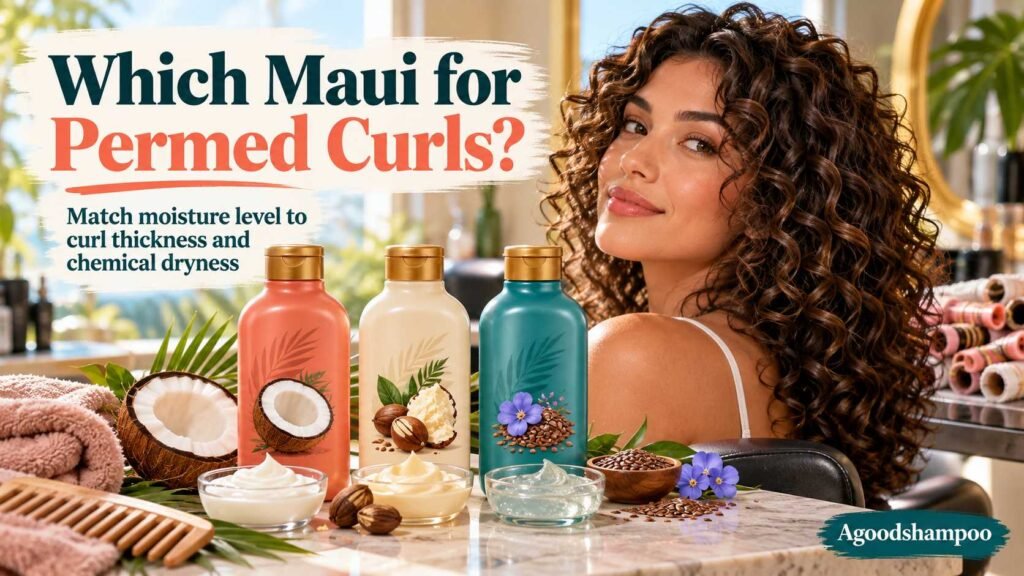
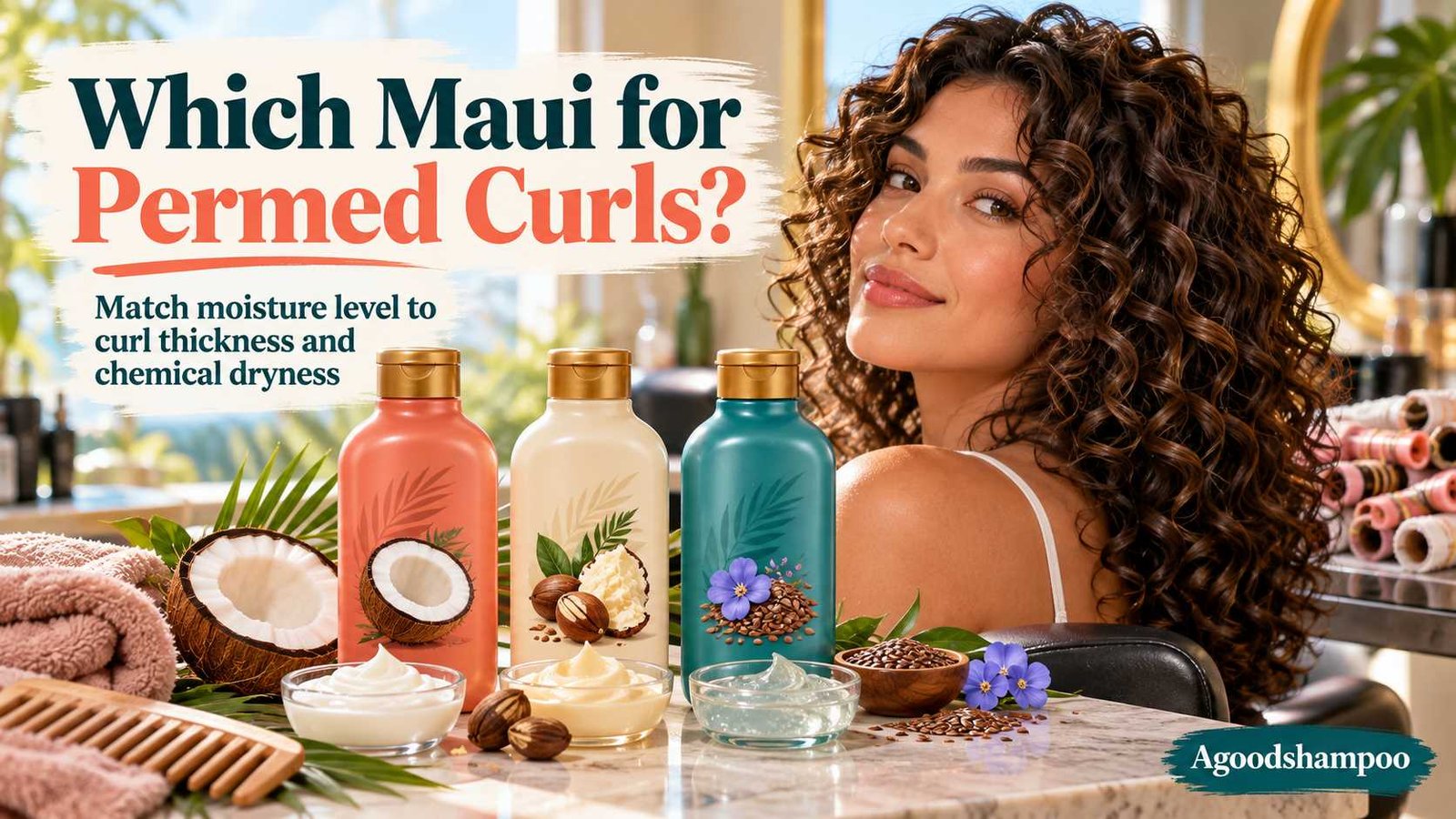
 If you have permed curly hair, Maui Moisture Curl Quench + Coconut Oil Shampoo is the strongest starting choice when your curls are thick, coarse, dry, or easily frizzy. Maui Moisture currently describes it as an intense-moisture shampoo specifically for thick, curly hair.
That does not make it the best Maui shampoo for every perm. Fine or medium permed curls can lose bounce when a routine is too rich, so Lightweight Curls + Flaxseed Shampoo may be a better fit. If chemical processing has left the hair especially dry, rough, or damaged, Heal & Hydrate + Shea Butter Shampoo deserves consideration instead.
The useful question, then, is not simply whether Maui Moisture is good for curly hair. It is which level of moisture matches your curl thickness and the condition of your hair after perming.
The Best Maui Moisture Shampoo Depends on Your Permed Curl Type
Maui Moisture currently places its shampoos on a moisture scale ranging from light to heavy moisture. Curl Quench + Coconut Oil and Heal & Hydrate + Shea Butter sit in the heavy-moisture group, while Lightweight Curls + Flaxseed sits in the light-moisture group.
That distinction matters for permed hair because chemically created curls can be dry without necessarily being thick. A person with fine strands may need conditioning and softness after a perm but still find a very rich formula makes the curls look flat.
| Your permed hair | Best Maui Moisture starting point | Main reason |
|---|---|---|
| Thick, coarse, dry or tight curls | Curl Quench + Coconut Oil | Intense moisture aimed at thick curly hair |
| Fine to medium curls that lose volume easily | Lightweight Curls + Flaxseed | Light moisture designed to preserve bounce |
| Very dry, rough or chemically stressed hair | Heal & Hydrate + Shea Butter | Intense moisture aimed at dry, damaged hair |
For most people asking which Maui Moisture shampoo is good for permed curly hair, Curl Quench is the most obvious first product to consider, but strand thickness should influence the decision just as much as the fact that the hair is curly.
If you want a broader look at the brand before choosing a formula, AGoodShampoo’s guide to how good Maui shampoo is covers Maui Moisture’s wider shampoo range.
Why Permed Curly Hair Needs Different Care From Naturally Curly Hair
A perm does more than temporarily bend the hair into curls. Permanent waving uses chemical reactions to alter bonds within hair proteins so that the strand can hold a new shape.
Research examining human hair with X-ray diffraction found that permanent waving involves breaking and reforming disulfide linkages. After a single perm treatment, researchers detected changes in keratin organization and intermediate filament structure inside the hair. Importantly, that study examined hair structure rather than proving that any particular shampoo can reverse perm damage.
That helps explain why a shampoo chosen for naturally curly hair is not automatically ideal after a chemical perm.
Permed hair may need a routine that cleans effectively while avoiding unnecessary roughness and provides enough conditioning to keep the hair manageable. At the same time, piling on increasingly rich products is not always the answer. Fine permed curls can become limp even while the hair itself remains dry.
AGoodShampoo’s guide to choosing shampoo and conditioner for permed hair explains the broader care considerations for chemically waved hair.
Why Curl Quench + Coconut Oil Suits Thick, Dry Permed Curls
Maui Moisture Curl Quench + Coconut Oil Shampoo is officially positioned for thick, curly hair with an intense moisture level. Maui says the shampoo is intended to help with detangling, frizz, curl definition, softness and body. Those are manufacturer claims rather than independent clinical findings, but the positioning itself is useful when deciding which formula fits a particular hair type.
The current U.S. ingredient list begins with aloe, water, sodium C14-16 olefin sulfonate and cocamidopropyl betaine. It also contains coconut water, coconut oil, papaya fruit extract, conditioning polymers and other cleansing and conditioning ingredients.
What matters is the complete formulation, not the tropical ingredients in isolation.
Coconut oil, aloe and plant extracts may attract attention on the label, but their presence alone does not prove how a finished shampoo will perform on your hair. Shampoo performance comes from the interaction of cleansing agents, conditioning materials, thickeners, humectants, preservatives and the rest of the formula.
Curl Quench is therefore most convincing as a choice because Maui formulated and positions the complete shampoo for thick curls and high moisture needs, not simply because coconut oil appears on the ingredient list.
There is one detail worth understanding before buying it.
Maui labels Curl Quench as sulfate-free and says its formulas contain no sulfated surfactants. The current ingredient list does, however, contain sodium C14-16 olefin sulfonate. Olefin sulfonate is not the same chemical family as common sulfate surfactants such as sodium lauryl sulfate or sodium laureth sulfate, so calling the shampoo sulfate-free is not chemically contradictory. But sulfate-free should not be interpreted as a guarantee that every person’s hair or scalp will find a shampoo exceptionally mild.
If your freshly permed hair feels unusually rough after washing, the practical response is not to focus on the sulfate-free label alone. Look at how your hair actually behaves after several washes and whether your shampoo, conditioner and styling routine together are giving you enough softness.
For more context on this distinction, see AGoodShampoo’s guide to sulfate-free shampoo for permed hair.
When Heal & Hydrate or Lightweight Curls Makes More Sense
Curl Quench is easy to recommend for substantial, thirsty curls, but there are two situations where another Maui formula can make more sense.
Choose Heal & Hydrate When Damage and Dryness Dominate
Maui Moisture Heal & Hydrate + Shea Butter Shampoo is aimed at dry, damaged hair and is also classified at the intense end of the brand’s moisture scale. Its current U.S. formula includes aloe, sodium C14-16 olefin sulfonate, cocamidopropyl betaine, shea butter, coconut oil, macadamia oil and conditioning polymers.
The distinction from Curl Quench is mainly the product’s intended use.
Curl Quench is primarily positioned around thick curly hair and curl definition, whereas Heal & Hydrate is positioned around dryness and damage. If the main issue after your perm is that the lengths feel coarse, rough or depleted rather than simply needing more curl definition, Heal & Hydrate may be the more logical Maui Moisture option.
That doesn’t mean it repairs broken chemical bonds or restores hair to its pre-perm structure. A cosmetic shampoo can improve cleansing, softness, manageability and the appearance of damaged hair, but those cosmetic effects should not be confused with reversing the internal molecular changes caused by permanent waving.
Choose Lightweight Curls When Your Perm Is Fine or Easily Weighed Down
Maui Moisture Lightweight Curls + Flaxseed Shampoo is designed for fine to medium curls and has a light moisture level. The brand specifically positions it as a formula that adds moisture without sacrificing volume.
Its current formula contains aloe juice, sodium C14-16 olefin sulfonate, cocamidopropyl betaine, coco-glucoside, coconut water and linseed oil, along with conditioning ingredients and fragrance.
This is often the more sensible direction if your perm creates soft curls or waves on naturally fine hair and heavy conditioners quickly stretch those curls out.
Think of moisture as a balance rather than a competition. More moisture is not automatically better. The right curly hair products for moisture should leave the strands flexible and manageable without making the curl pattern collapse under the weight of the routine.
AGoodShampoo’s broader guide to choosing shampoo for curly hair can help if you’re still deciding whether your hair behaves more like fine waves, medium curls or coarse curls.
Is Maui Shampoo and Conditioner Good for Permed Curly Hair?
A matching Maui Moisture shampoo and conditioner can be a reasonable combination for permed curly hair, provided you choose the pair according to your hair’s actual moisture needs.
Conditioner matters because shampoo’s primary role is cleansing. The conditioner supplies much of the slip and surface conditioning that helps wet curls detangle with less friction.
Maui currently offers matching conditioners for Curl Quench + Coconut Oil, Lightweight Curls + Flaxseed and Heal & Hydrate + Shea Butter.
For thick, dry permed curls, pairing Curl Quench shampoo with its conditioner makes sense as a starting routine. For fine curls, using the Lightweight Curls + Flaxseed pair is less likely to overload the hair than jumping straight to the richest combination.
You also do not have to use matching products simply because the labels belong to the same range. If your roots become oily faster than your ends, for example, you may prefer a lighter shampoo while using richer conditioning only through the mid-lengths and ends.
How often you wash matters as well. There is no universal schedule for permed curls. Wash when your scalp and hair need cleansing, then adjust based on oiliness, product buildup, exercise, styling products and how dry the lengths feel.
If the scalp develops persistent burning, significant itching, sores, swelling or unusual shedding after a perm, changing shampoo should not be the only response. Those symptoms deserve professional assessment.
Maui Moisture vs SheaMoisture and TRESemmé for Curly Hair
Searches such as whether SheaMoisture shampoo is good for curly hair or whether TRESemmé Moisture Rich shampoo is good for curly hair often appear beside Maui Moisture questions, but the brand name alone does not determine suitability.
Each company sells multiple formulas, and individual ingredient lists can differ substantially.
SheaMoisture is widely associated with rich curly and textured-hair formulas, but some products may be heavier than fine permed curls need. TRESemmé Moisture Rich is positioned around moisture and softness, but that does not make it automatically better or worse for chemically curled hair.
The more useful comparison is formula against formula.
For a person specifically shopping within Maui Moisture, the brand already provides a clear progression from light to heavy moisture. That makes it relatively straightforward to start with curl thickness and dryness:
fine or easily flattened curls → Lightweight Curls + Flaxseed
thick, dry curls → Curl Quench + Coconut Oil
very dry or damaged-feeling hair → Heal & Hydrate + Shea Butter
That is more useful than assuming one brand must be universally superior for curly hair.
Which Maui Moisture Formula Should Your Perm Actually Use?
If your perm has produced thick, defined curls that feel dry or frizzy, start with Maui Moisture Curl Quench + Coconut Oil. It is the clearest match because Maui currently formulates and markets it for thick curls and intense moisture.
If your curls are fine, soft or easily pulled flat by rich products, Lightweight Curls + Flaxseed is the smarter starting point. It gives you the curly-hair focus without automatically moving to the heaviest moisture level.
If the bigger concern is dryness and a damaged feel after chemical processing, consider Heal & Hydrate + Shea Butter. It is still a rich formula, but its product positioning focuses more directly on dry, damaged hair.
So, is Maui shampoo good for curly hair? Several Maui Moisture shampoos are specifically formulated and marketed for curls, and the range gives you useful choices according to moisture level. But the best shampoo for a perm is not decided by the word curly on the bottle.
For permed hair, look at strand thickness, current dryness, how easily the curls lose volume, and how the hair feels after chemical processing. Matching those factors to the formula gives you a much better chance of keeping your curls soft and manageable without unnecessarily weighing them down.

Carolina Herrera writes about color-treated, damaged, and chemically processed hair. She focuses on understanding breakage, choosing suitable shampoos, and making sense of repair claims. Her goal is to help readers care for their hair with realistic expectations and informed product choices.