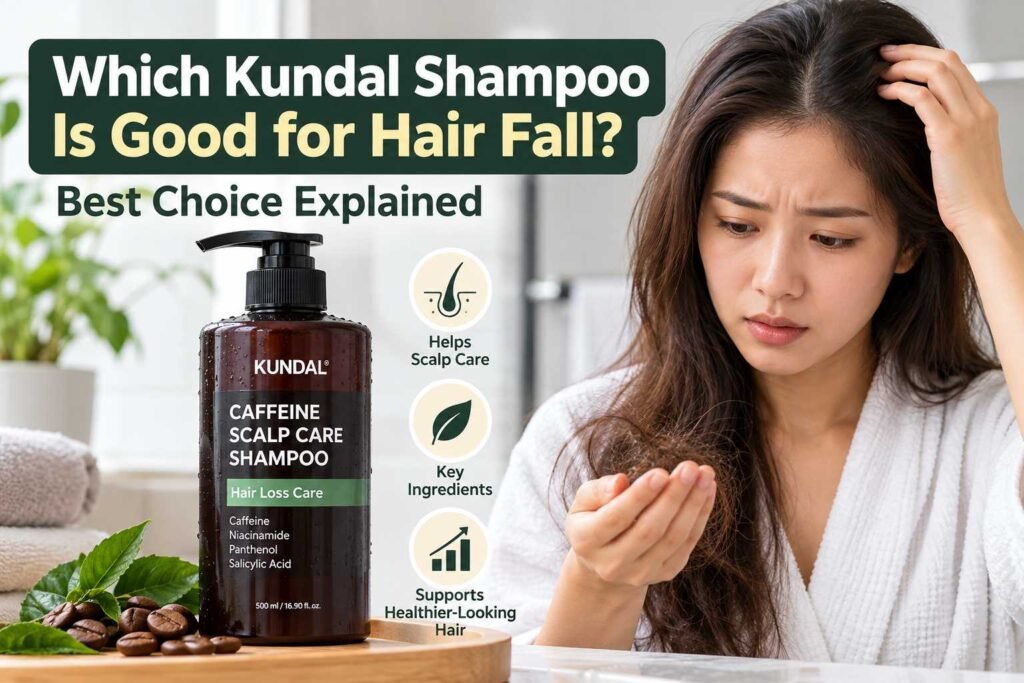
 If hair fall is your main concern, KUNDAL Caffeine Scalp Care Shampoo is the Kundal shampoo that makes the most sense to consider first. It is the variant most directly designed around scalp care and hair-fall concerns, and its current formula includes caffeine along with ingredients such as niacinamide, panthenol and salicylic acid.
That does not mean it is a proven treatment for every type of hair loss.
A shampoo can cleanse the scalp, remove excess oil and buildup, improve the feel of the hair, and sometimes reduce breakage if the formula suits your hair. Those effects can make hair look healthier and reduce the amount of broken hair you see during washing or brushing. They are not the same as reversing androgenetic alopecia, hormonal shedding, thyroid-related hair loss, alopecia areata or other follicle-level conditions.
So the useful question is not simply whether Kundal is a good shampoo. It is whether the Caffeine Scalp Care formula matches the reason your hair appears to be falling.
Which Kundal Shampoo Is Best for Hair Fall?
Among Kundal shampoos, the Caffeine Scalp Care Shampoo is the closest match for someone specifically shopping for hair fall.
Kundal’s better-known Honey & Macadamia shampoos are more general cleansing and hair-care products. They may suit people looking for fragrance, softness or routine cleansing, but they are not the most logical first choice when your main concern is shedding or thinning.
The Caffeine Scalp Care version is different because the formula and product positioning are focused more directly on the scalp.
Its current U.S. ingredient information includes:
- Caffeine
- Niacinamide
- Panthenol
- Salicylic acid
- Glycerin
- Menthol
- Botanical extracts
- Cleansing surfactants
- Fragrance
That combination gives the formula a reasonable scalp-care profile. Salicylic acid can help loosen surface buildup and dead skin. Panthenol is commonly used for conditioning and moisture support. Niacinamide is widely used in skin and scalp formulations, while caffeine is the ingredient most closely associated with the product’s hair-fall positioning.
Still, none of these ingredients automatically means the shampoo will stop medical hair loss.
That distinction matters because many people searching for which shampoo is good for hair fall are actually dealing with very different problems.
One person may be seeing broken strands because their hair is dry and damaged. Another may be shedding from the root because of stress, illness, hormones or genetics. A third may have scalp inflammation or severe dandruff.
Those situations need different solutions.
If you want a broader overview of how shampoos are selected for thinning and shedding, see our guide to <a href=”/best-shampoo-for-hair-fall-control-and-growth-solutions/”>choosing shampoo for hair fall and growth concerns</a>.
What Is Inside Kundal Caffeine Scalp Care Shampoo?
The strongest way to evaluate this shampoo is to look at the whole formula rather than focusing on one ingredient.
Caffeine, Niacinamide, Panthenol and Salicylic Acid
Caffeine is the ingredient that attracts the most attention because topical caffeine has been studied for hair-loss-related uses.
Laboratory and clinical research has explored whether caffeine can interact with hair follicles and potentially influence hair growth. A 2025 systematic review of topical caffeine studies identified nine eligible clinical studies involving 684 participants.
That sounds encouraging, but the evidence was not uniformly strong.
Only three of the studies were considered medium-quality evidence. One was rated low quality and five were rated very low quality. Different formulations, study methods and patient groups were used.
So it would be inaccurate to say that research has proved that a caffeine shampoo such as Kundal regrows hair.
The more careful interpretation is this: topical caffeine is scientifically interesting and has some supportive evidence, but the research is not strong enough to treat every caffeine shampoo as a clinically proven hair-loss treatment.
Niacinamide has a different role. It is widely used in cosmetic products because of its skin-supporting properties. In a shampoo, its practical value is more reasonably connected with scalp conditioning than with guaranteed hair regrowth.
Panthenol, also known as provitamin B5, is commonly used to improve moisture, flexibility and the feel of hair fibers. It can help hair feel smoother and less rough, but smoother hair should not be confused with increased follicle activity.
Salicylic acid can be useful for people whose scalp becomes oily, flaky or congested because it helps loosen surface buildup. That may improve scalp cleanliness, but again, scalp cleansing is not the same as treating the cause of hair loss.
The Cleansing System Matters Too
The current U.S. formula includes sodium coco-sulfate as part of its cleansing system.
This is worth knowing because some online listings or older descriptions may create the impression that Kundal Caffeine Shampoo is universally sulfate-free.
Current formulas can differ by market, and product descriptions do not always stay synchronized across retailers and countries.
For that reason, it is better to judge the bottle you can actually buy than an old ingredient list from a review.
Sodium coco-sulfate is a surfactant used to remove oil, sweat and residue. The fact that a shampoo contains a sulfate-based cleanser does not automatically mean it will damage everyone’s hair.
Cleansing strength depends on the entire surfactant system, concentration, conditioning ingredients, washing frequency and your own scalp and hair type.
If your scalp is oily or prone to buildup, stronger cleansing may be useful.
If your hair is bleached, very dry, curly or fragile, frequent use of a more cleansing formula may leave the lengths feeling rougher. In that situation, conditioner and washing frequency become important.
Fragrance and Menthol May Not Suit Every Scalp
Kundal products are known for fragranced formulas, and the current Caffeine Scalp Care Shampoo also contains fragrance.
Menthol is included as well.
Some users enjoy the cooling sensation from menthol, but cooling does not prove that circulation has improved enough to stimulate meaningful hair growth.
People with fragrance-sensitive, very dry or reactive scalps should pay attention to irritation, burning or persistent itching.
A scalp-care shampoo should make your scalp more comfortable, not progressively more irritated.
Can Kundal Caffeine Shampoo Actually Reduce Hair Fall or Grow Hair?
It may help with some causes of apparent hair fall, but it should not be expected to treat every cause of hair loss.
This is where shampoo advertising often becomes confusing.
If your hair is breaking because it is rough, tangled and difficult to manage, a better washing and conditioning routine can reduce mechanical breakage.
If excessive oil or buildup makes your scalp uncomfortable, better cleansing may improve scalp conditions.
If flakes and scratching are contributing to breakage, controlling the scalp problem may also help you handle your hair more gently.
Those are meaningful improvements.
But they are hair-care and scalp-care improvements, not proof that new follicles are producing more hair.
Hair shedding from the root is different.
Common reasons for true shedding or thinning can include:
- Androgenetic alopecia
- Telogen effluvium
- Major illness or fever
- Significant stress
- Nutritional deficiencies
- Hormonal changes
- Thyroid conditions
- Postpartum changes
- Certain medications
- Scalp disorders
- Alopecia areata
A rinse-off shampoo cannot reliably correct all of those causes.
That is why dermatology guidance tends to be much more cautious than shampoo marketing.
If your concern is widening of the part, recession at the temples, visible scalp, bald patches or a major increase in shedding, switching shampoos may not address the underlying cause.
For another example of how caffeine-shampoo claims should be interpreted, our review of <a href=”/is-alpecin-caffeine-shampoo-any-good/”>caffeine shampoo and hair-loss evidence</a> explains the difference between interesting ingredient research and evidence for a finished shampoo.
Which Shampoo Is Good for Hair Fall and Hair Growth?
There is no single shampoo that can reliably handle both hair fall and hair growth for everyone.
The best shampoo depends on what is causing the hair problem.
If your scalp is oily and your hair falls more heavily when buildup becomes severe, a scalp-cleansing shampoo such as Kundal Caffeine may make sense.
If your hair is snapping in the middle or at the ends, your priority may be a gentler shampoo plus better conditioning rather than a caffeine formula.
If you have severe dandruff or seborrheic dermatitis, choosing a shampoo with an appropriate anti-dandruff active may matter more than choosing one marketed for hair fall.
If your thinning is genetic or hormonal, evidence-based medical treatments may be more relevant than changing shampoo alone.
This is why the phrase best shampoo for hair fall and hair growth can be misleading. Shampoo can support a healthy routine, but most rinse-off cosmetic shampoos are not hair-regrowth treatments.
A sensible routine starts by identifying what you are actually seeing.
Broken hairs often vary in length and may lack a visible root bulb.
Shed hairs usually come from the follicle and are full-length strands.
That simple difference can change what kind of product makes sense.
Is Kundal Caffeine Shampoo Good for Men?
Yes, men can use Kundal Caffeine Scalp Care Shampoo.
There is nothing about the basic role of caffeine shampoo that makes it suitable only for women.
Men with oily roots, scalp buildup or an interest in caffeine-based scalp care may find the formula reasonable to try.
But men also need to be especially careful about confusing shampoo care with treatment for male-pattern hair loss.
Androgenetic alopecia in men typically involves progressive thinning around the temples, hairline or crown. A cosmetic caffeine shampoo should not be treated as a substitute for evidence-based treatment or professional assessment.
So if a man’s main problem is oily scalp plus mild shedding, Kundal may fit into the routine.
If the concern is progressive recession or crown thinning, shampoo should be viewed as supportive hair care rather than the main treatment.
For oily roots specifically, see our guide to <a href=”/what-shampoo-is-good-for-oily-hair-and-hair-loss/”>shampoo for oily scalp and hair loss</a>.
What if Hair Fall Comes With Dandruff or an Oily Scalp?
Kundal Caffeine Scalp Care Shampoo may be more useful when hair fall is accompanied by oiliness or buildup than when the scalp is extremely dry.
Its cleansing system and salicylic acid can help remove oil, surface flakes and accumulated residue.
But dandruff deserves separate attention.
Persistent dandruff is not simply a cleanliness problem. In some people, it is associated with seborrheic dermatitis and may respond better to shampoos containing recognized anti-dandruff actives.
That means Kundal should not automatically be your first choice just because you have both dandruff and hair fall.
If dandruff is mild and your main issue is oil and buildup, Kundal may be enough for routine cleansing.
If you have persistent flaking, redness, itching or greasy scales, a targeted dandruff shampoo may be more appropriate.
Our guide to <a href=”/best-shampoo-for-dandruff-and-hair-fall/”>shampoo for dandruff and hair fall</a> explains that decision in more detail.
For people who prefer botanical or simpler formulas, there are also <a href=”/what-is-a-good-natural-shampoo-for-dandruff/”>natural shampoo options for dandruff</a>, but natural does not automatically mean more effective or less irritating.
Plant extracts can still cause irritation, and a natural label does not tell you whether a shampoo treats the cause of dandruff.
How to Use Kundal Caffeine Shampoo Without Overdoing It
Current U.S. retail directions for the Caffeine Scalp Care Shampoo suggest applying about 3 to 5 mL to the scalp, massaging it in and leaving it on for more than three minutes before rinsing.
Follow the instructions on the package you actually purchase because directions may change by market or formulation.
Focus shampoo mainly on the scalp rather than repeatedly scrubbing the lengths.
The lather that runs through the hair while rinsing is usually enough to cleanse the rest of the strand.
If your ends are dry or damaged, follow with conditioner through the mid-lengths and ends.
How often you use Kundal should depend on your scalp.
Someone with an oily scalp may tolerate frequent washing.
Someone with dry, curly, bleached or chemically treated hair may need to alternate it with a milder shampoo or wash less often.
More shampoo does not mean faster hair growth.
Longer contact time than the manufacturer’s recommendation also does not mean better results.
If you experience persistent burning, redness, increased flaking or irritation, discontinue use and reassess the product.
What About Hair Oil for Hair Fall?
Hair oil can be useful, but its benefits are often misunderstood.
Certain oils can reduce friction, improve softness and protect the hair shaft from damage. Coconut oil, for example, has been studied for its ability to reduce protein loss from hair fibers under certain conditions.
That can be valuable if your main problem is breakage.
But oiling the scalp does not automatically stop follicle-level hair loss.
Applying heavy oil to an already oily or dandruff-prone scalp may also make some people feel more uncomfortable or increase buildup.
If you use both Kundal Caffeine Shampoo and a hair oil, think of them as different parts of the routine.
Oil can mainly support the hair fiber and reduce dryness depending on the oil and application method.
Shampoo removes excess oil, sebum and residue.
Neither should automatically be described as a treatment for the underlying medical causes of thinning.
Is a Natural Shampoo Better for Hair Fall?
Not necessarily.
A shampoo does not become more effective for hair fall simply because it is labeled natural.
Botanical extracts can make a formula interesting, but plant ingredients do not automatically stimulate hair growth.
A natural shampoo may be a good choice if you prefer a simpler ingredient philosophy or particular fragrance profile, but the same decision rules still apply.
Ask:
Does it cleanse your scalp adequately?
Does it make your scalp irritated?
Does it leave the lengths too dry?
Does it reduce tangling and breakage?
Does it contain an ingredient with evidence relevant to your actual scalp concern?
Those questions matter more than whether the front label says natural, herbal or botanical.
When Kundal Caffeine Shampoo Makes Sense and When It Doesn’t
KUNDAL Caffeine Scalp Care Shampoo is the best Kundal option to consider when hair fall is your main shopping concern, especially if you also have an oily or buildup-prone scalp and want a caffeine-based scalp-care formula.
Its current ingredient list gives it a more logical connection to hair-fall concerns than Kundal’s standard moisturizing shampoos.
Its biggest strength is the combination of scalp cleansing with caffeine, salicylic acid, niacinamide and panthenol.
Its biggest limitation is equally important: the available evidence does not establish that this finished shampoo can treat every cause of hair loss or reliably regrow lost hair.
Choose it if you want a scalp-focused Kundal shampoo and understand that the benefit may be improved scalp cleanliness, hair feel and routine support rather than dramatic regrowth.
Consider another shampoo if your main issue is severe dandruff, very dry damaged hair or fragrance sensitivity.
And if you are experiencing sudden shedding, rapidly worsening thinning, bald patches, scalp pain, open sores or visible progressive hair loss, the next step should not simply be buying a stronger shampoo. That is a good time to speak with a dermatologist or qualified healthcare professional.

Michael Chen focuses on the science behind shampoos and hair-care ingredients. He explains how cleansing agents, silicones, proteins, and other formula components work, separating useful evidence from marketing claims to help readers better understand the products they use.