If your scalp starts itching when you sweat, the sweat may be aggravating your skin rather than being the only cause of the problem. Heat, moisture, sweat residue, friction, dandruff, product irritation, or an existing scalp condition can all play a part. 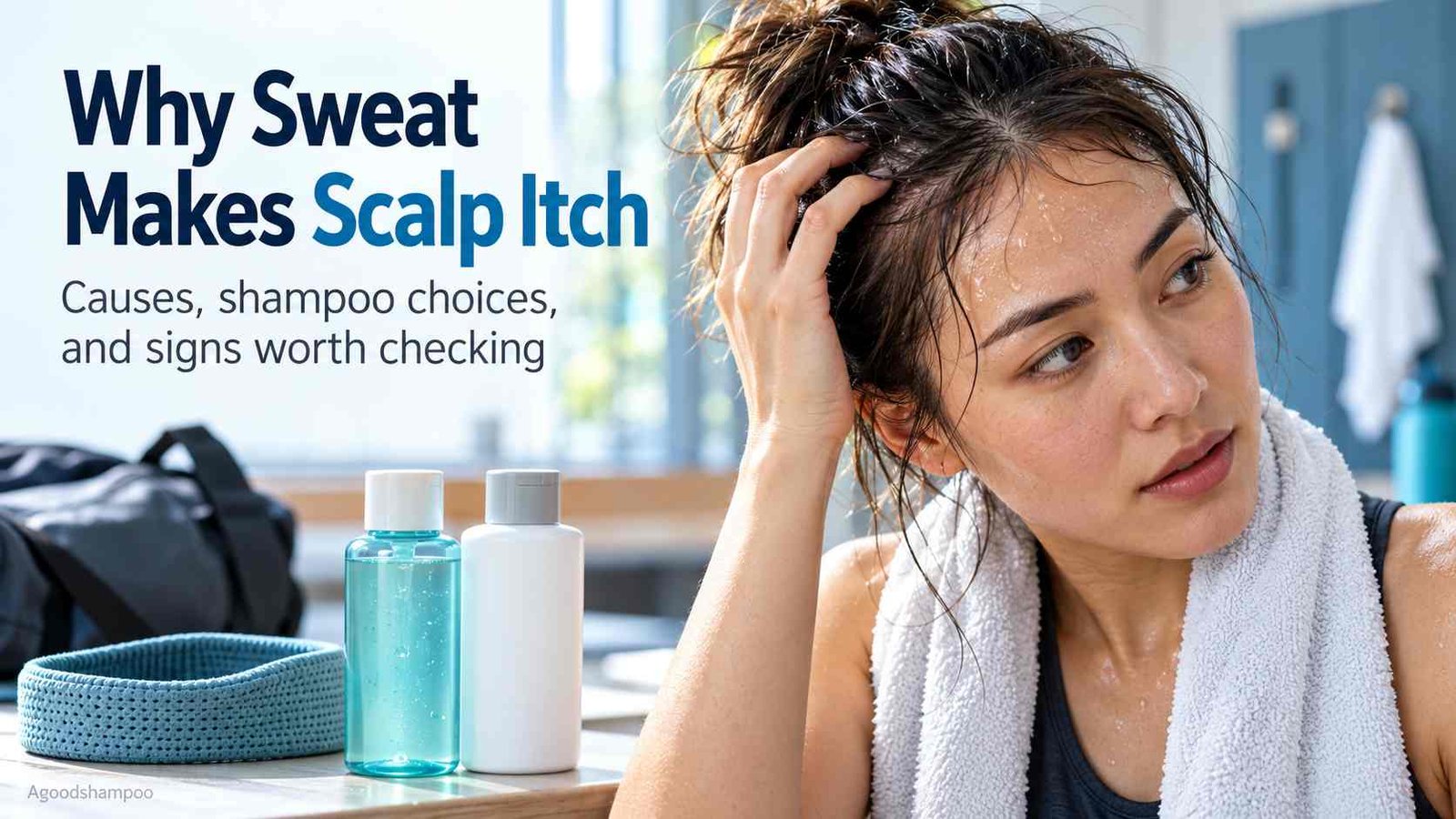
Sweating is especially relevant if your scalp is already prone to seborrheic dermatitis. The American Academy of Dermatology notes that becoming sweaty can trigger a flare in some people because sweat dries on the skin and the salt can irritate it.
That doesn’t mean every sweaty, itchy scalp has dandruff. If your scalp also burns, becomes red, develops bumps or sores, or consistently reacts after you use a particular shampoo, the cause may be irritation, allergic contact dermatitis, psoriasis, eczema, another inflammatory condition, or occasionally an infection.
The shampoo that helps therefore depends on why your scalp is itching, not simply on finding a bottle labeled “itchy scalp.”
Why Does My Scalp Itch When I Sweat?
Sweat is mainly water and salts. When it evaporates from your scalp, the remaining salt and moisture changes can feel uncomfortable on skin that is already sensitive or inflamed.
Several things may happen at the same time.
You sweat during exercise, hot weather, physical work, or while wearing a hat or helmet. Your scalp stays warm and damp for a while. Sweat begins to dry. Salt remains on the skin. Hair, headwear, or repeated rubbing adds friction.
If your scalp is healthy, you may barely notice any of this.
If you already have dandruff, seborrheic dermatitis, irritated skin, or a reaction to a hair product, however, sweating may make the itching much more noticeable.
The American Academy of Dermatology specifically lists sweating as a possible trigger for seborrheic dermatitis. It also advises gentle washing and thorough rinsing because irritated skin can flare more easily.
This explains why someone may feel fine before a workout but start scratching as the scalp gets hot and sweaty.
It does not prove that sweat has caused a scalp disease.
A useful question is what happens along with the itch.
What Itching, Burning, Flakes, or Bumps Can Tell You
An itchy scalp is a symptom, not a diagnosis. The pattern around that symptom often tells you more than the itch itself.
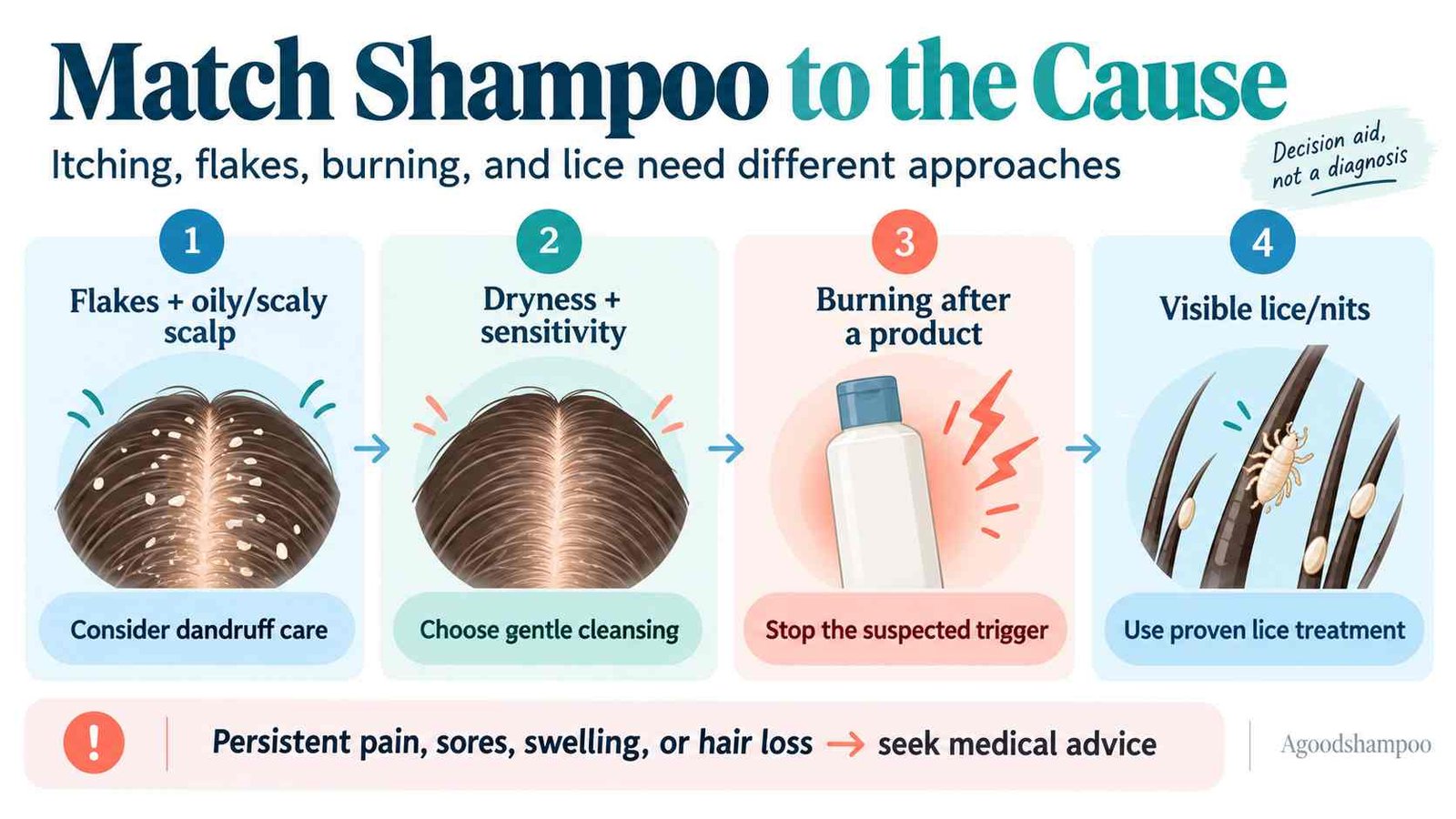
| What you notice | Possible explanation | Shampoo approach |
|---|---|---|
| White or yellowish flakes with itching | Dandruff or seborrheic dermatitis | Consider an appropriate dandruff shampoo |
| Greasy scale with irritated scalp | Seborrheic dermatitis may be possible | Medicated dandruff care may help |
| Burning soon after shampooing | Irritation or product sensitivity | Stop the suspected product and simplify the routine |
| Itchy rash after dye or another product | Contact dermatitis may be possible | Avoid the suspected trigger and seek assessment if persistent |
| Very dry scalp without greasy scale | Dryness or irritation | Gentle cleansing may make more sense than aggressive dandruff treatment |
| Thick plaques, marked inflammation, sores, or unusual hair loss | A condition beyond ordinary dandruff may be involved | Professional assessment is more appropriate |
| Moving lice or firmly attached nits | Head lice infestation | Use a proven lice treatment rather than ordinary shampoo |
These patterns can overlap, so they shouldn’t be used as a self-diagnosis.
Flakes and an itchy scalp can point toward dandruff
Dandruff commonly causes scalp flakes and itching. Seborrheic dermatitis is related but can produce more obvious inflammation and may also affect areas such as the eyebrows, ears, beard area, or sides of the nose.
The American Academy of Dermatology describes dandruff as a mild form of seborrheic dermatitis in some people. Seborrheic dermatitis can produce dry or greasy scale as well as itching or burning.
If sweat regularly makes an already flaky scalp worse, treating the underlying dandruff may be more useful than searching for a shampoo marketed specifically for sweat.
Burning after shampoo deserves a different response
An itchy scalp and a burning scalp aren’t always the same problem.
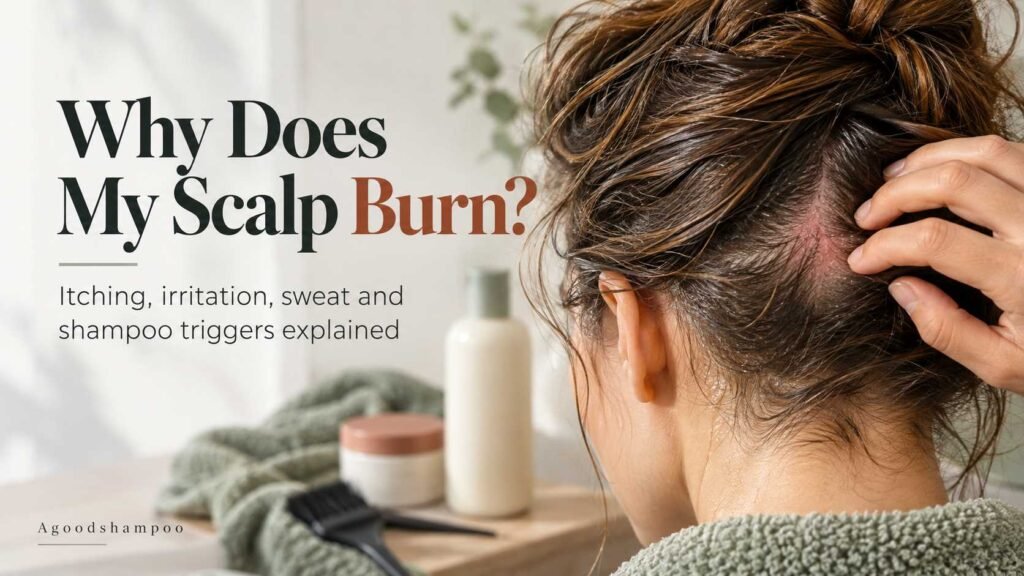
If burning appears after you introduce a shampoo, conditioner, dye, fragrance-heavy treatment, oil, or styling product, irritation or contact dermatitis becomes more relevant.
The American Academy of Dermatology notes that shampoo, conditioner, hair dye, and other products that contact the scalp can cause allergic contact dermatitis. An itchy rash may appear on the scalp and sometimes on nearby skin. Simply leaving shampoo residue behind can also irritate the scalp.
Mayo Clinic likewise lists personal-care products among potential causes of contact dermatitis.
If a particular shampoo reliably causes burning or stinging, continuing to use it because it is labeled “gentle,” “natural,” or “sulfate-free” doesn’t make sense.
Stop the suspected trigger and allow the scalp to settle.
Bumps, sores, severe scale, or hair loss need more attention
Ordinary dandruff usually doesn’t explain every scalp symptom.
Marked pain, crusting, pus, open sores, rapidly worsening inflammation, thick plaques, or unexpected hair loss deserves more caution. A dermatologist may need to distinguish dandruff or seborrheic dermatitis from psoriasis, eczema, fungal infection, contact dermatitis, or another condition.
AAD notes that several scalp conditions can look similar, which is one reason persistent symptoms shouldn’t be treated by repeatedly changing shampoos indefinitely.
What Shampoo Is Good for an Itchy Scalp?
The best shampoo for an itchy head is the one suited to the likely cause.
That sounds obvious, but it explains why one person’s “miracle shampoo” may do nothing for someone else.
When a dandruff shampoo makes sense
If itching comes with obvious dandruff or scale, a medicated dandruff shampoo is a reasonable starting point.
The American Academy of Dermatology lists several ingredients used in dandruff shampoos, including:
- ketoconazole
- selenium sulfide
- salicylic acid
- sulfur
- zinc pyrithione
- coal tar
They don’t all work in exactly the same way. Some help control factors involved in seborrheic dermatitis, while others primarily help loosen or reduce scale.
Don’t assume the shampoo failed after one quick wash.
Some dandruff shampoos need to remain on the scalp for several minutes before rinsing. AAD says directions vary by product and that some formulas may need about five to ten minutes of scalp contact.
Follow the directions on the actual product you purchase.
Frequency should also match your hair and scalp. Someone with an oily scalp and straight hair may wash more frequently than someone with tightly coiled, dry hair.
AAD notes that medicated shampoo frequency can differ according to hair type, and dandruff shampoo applied repeatedly through curly or coily lengths may dry the hair.
If you’re comparing products, AGoodShampoo also has a dedicated guide to choosing a shampoo for itchy scalp and dandruff.
When a simple gentle shampoo may make more sense
More treatment isn’t always better.
If you have little or no dandruff but your scalp feels tight, dry, or irritated after frequent washing, exercise, or exposure to several products, a simple cleanser may be more sensible than adding another aggressive medicated shampoo.
Look for a formula you tolerate well and avoid changing several products at the same time.
If fragrance seems to trigger irritation, a fragrance-free option can simplify troubleshooting. AAD recommends fragrance-free cleansing products for easily irritated seborrheic dermatitis-prone skin.
Rinse thoroughly. Shampoo left behind on the scalp can itself contribute to irritation.
Why can’t I find a good shampoo and conditioner that works?
Sometimes the problem isn’t that every shampoo is bad.
The target may be wrong.
A person treating product dermatitis with stronger dandruff shampoos may continue to burn. Someone with seborrheic dermatitis who repeatedly switches among ordinary moisturizing shampoos may continue to flake. Someone with psoriasis or another scalp disorder may see little improvement from cosmetic shampoos alone.
Even your needs can change over time.
Oil production, styling habits, climate, hair coloring, exercise, product buildup, and scalp condition can all change what feels comfortable.
Your hair also doesn’t become “immune” to shampoo simply because you’ve used the same bottle for months. AGoodShampoo’s guide on whether switching shampoos is necessary explains why changes in the scalp, hair, environment, and routine are more important than the idea that hair becomes accustomed to one formula.
Is Sulfate-Free Shampoo Better for an Itchy or Burning Scalp?
Not automatically.
“Sulfate-free” tells you something about the cleansing system, but it doesn’t tell you whether the finished shampoo will agree with your scalp.
Sodium lauryl sulfate and sodium laureth sulfate are cleansing surfactants. Some people prefer sulfate-free formulations because their hair or scalp feels better with a milder cleansing system.
But sulfate-free shampoos still contain surfactants. They may also contain fragrance, preservatives, botanical extracts, essential oils, or other ingredients that a particular person doesn’t tolerate.
The opposite is also true: the mere presence of a sulfate doesn’t prove that a finished formula will irritate everyone.
What matters is the complete formulation, how frequently you use it, the amount you use, your scalp condition, and how your own skin responds.
For readers considering a switch, see AGoodShampoo’s separate guide to why sulfate-free shampoo may suit some hair and scalp routines.
There’s also a broader guide examining the benefits and downsides of sulfate-free shampoo, which is useful if you’re deciding whether the label actually matters for your hair type.
For an itchy scalp, though, don’t let the sulfate question distract you from the bigger one:
Do you have dandruff, irritation, an allergic reaction, dryness, or another scalp problem?
That decision matters more.
What If the Itch Is Actually Head Lice?
Head lice require a completely different approach.
According to the CDC, head lice are parasitic insects that live mainly on the scalp and feed on human blood. Adults are roughly 2 to 3 millimeters long, about the size of a sesame seed.
Itching happens because of an allergic reaction to lice bites.
Interestingly, itching may not appear immediately during someone’s first infestation. The CDC says it can take about four to six weeks for itching to develop the first time a person gets head lice.
That means itching alone can’t confirm lice.
Look for live lice and properly identified nits rather than assuming every itchy scalp needs lice shampoo.
Ordinary shampoo, dandruff shampoo, sulfate-free shampoo, or clarifying shampoo is not a substitute for an appropriate lice treatment when an active infestation is present.
Both over-the-counter and prescription treatments are available. The correct instructions depend on the active ingredient, so follow the treatment label carefully.
For a deeper product-specific discussion, AGoodShampoo has a separate guide on what shampoo is used for head lice.
How to Wash Your Scalp When Sweat Triggers the Itch
If sweating reliably makes your scalp uncomfortable, the goal isn’t necessarily to scrub harder.
Try a simpler routine.
- Don’t leave a heavily sweaty scalp covered for hours. Once practical, remove tight hats, helmets, scarves, or headbands and allow heat and moisture to escape.
- Rinse or wash when needed. If sweat residue is a clear trigger, removing it may feel better than allowing it to dry repeatedly on the scalp.
- Use lukewarm rather than very hot water. AAD notes that hot showers can dry skin and scalp and may contribute to seborrheic dermatitis flares in susceptible people.
- Massage rather than scratch. Use fingertips gently. Aggressive scratching can further damage already irritated skin.
- Concentrate shampoo on the scalp. That’s where oil, sweat, scale, and medicated dandruff ingredients matter most.
- Rinse thoroughly. Residual cleanser can irritate some scalps.
- Dry the scalp rather than leaving it wet under headwear. You don’t need to make it bone-dry with high heat. Just avoid trapping prolonged moisture under a cap or helmet when possible.
- Change one product at a time if you’re troubleshooting. Replacing shampoo, conditioner, styling cream, oil, and hair spray together makes it difficult to identify the actual trigger.
If you exercise daily, that doesn’t automatically mean you need a medicated shampoo every day.
Your washing frequency should reflect oiliness, hair texture, dandruff severity, product use, and how the scalp responds.
When an Itchy, Burning Scalp Needs More Than a New Shampoo
A shampoo can cleanse the scalp, remove sweat and oil, reduce buildup, and, when it contains an appropriate active ingredient, help manage some forms of dandruff or seborrheic dermatitis.
It can’t diagnose every itchy scalp.
Consider professional assessment if the problem is persistent or worsening, particularly if you have:
- substantial pain or burning
- open or weeping sores
- pus, yellow crusting, or other signs of infection
- major swelling
- a widespread rash
- thick or persistent scaling
- unexplained patches of hair loss
- symptoms affecting sleep or normal activities
- symptoms that remain despite sensible self-care
- an immediate allergic reaction such as hives, facial swelling, or difficulty breathing
Mayo Clinic advises medical assessment when dermatitis becomes painful, disrupts normal life, appears infected, or continues despite self-care.
If a dandruff shampoo itself causes pronounced burning, itching, or stinging, stop using it. Mayo Clinic specifically recommends stopping a dandruff shampoo that produces these symptoms.
Choosing Shampoo Based on the Cause Works Better Than Chasing the Itch
If your head itches when you sweat, don’t assume that sweat itself is the entire problem.
Sweat can aggravate an already reactive scalp, and it is a recognized trigger for some people with seborrheic dermatitis. But dandruff, product irritation, contact dermatitis, dryness, inflammatory scalp conditions, and head lice can produce similar complaints.
Use what you can actually see and feel as clues.
Flakes and recurring scale make dandruff treatment more relevant. Burning immediately after a product makes irritation more suspicious. A very dry scalp without dandruff may need gentler cleansing. Visible lice require a proper lice treatment rather than another ordinary shampoo.
And sulfate-free isn’t a diagnosis or a treatment. It is simply one formulation choice.
If you’re constantly buying new shampoos without lasting relief, the smartest next step may not be bottle number ten. It may be identifying what your scalp is reacting to in the first place.

Carolina Herrera writes about color-treated, damaged, and chemically processed hair. She focuses on understanding breakage, choosing suitable shampoos, and making sense of repair claims. Her goal is to help readers care for their hair with realistic expectations and informed product choices.