 You may have heard that using the same shampoo for too long is bad because your hair gets used to it. Then someone else tells you the opposite: keep using one shampoo and never switch.
Neither rule is quite right.
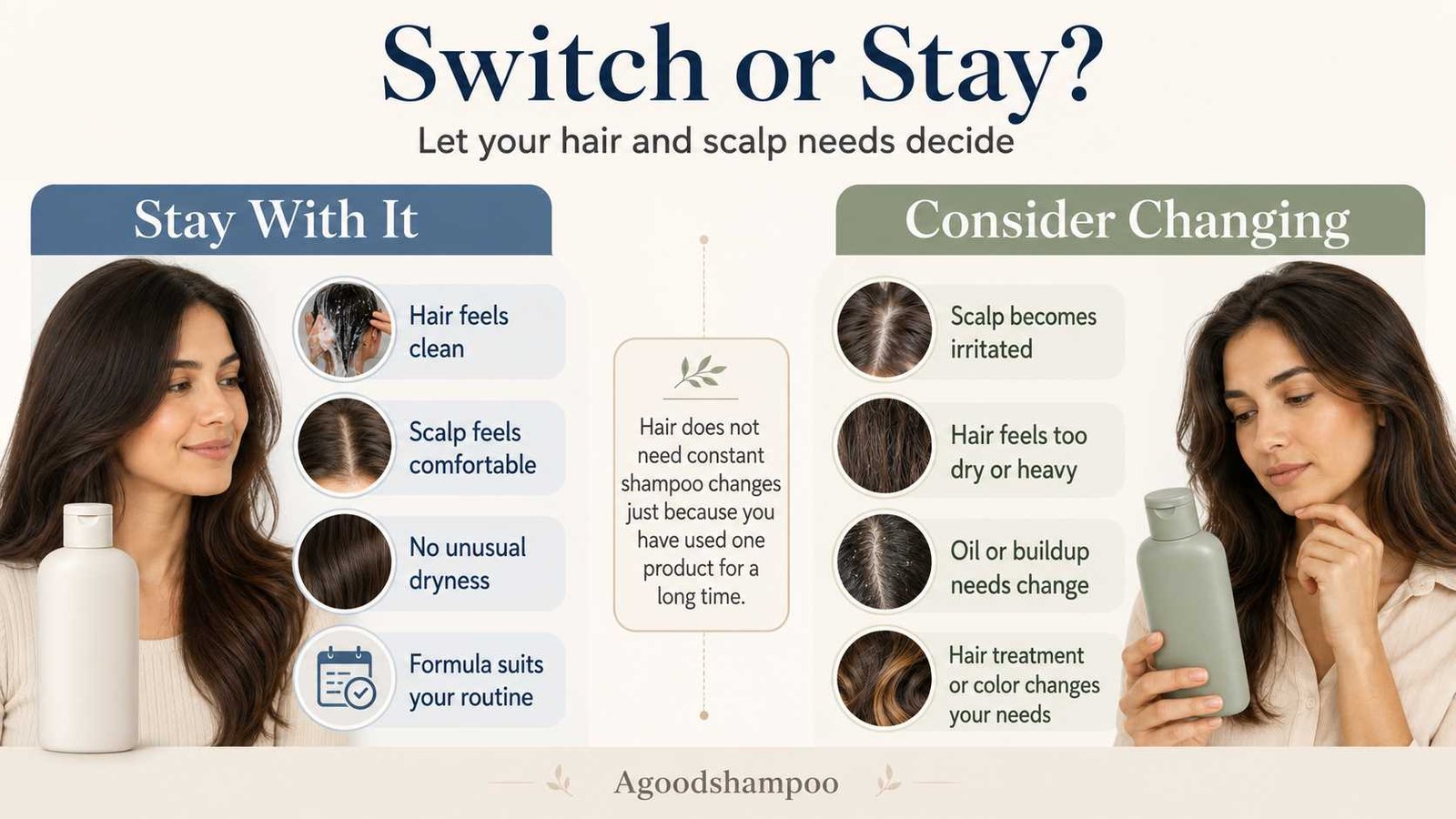
Switching shampoos is not automatically bad, and you do not need to change shampoos on a schedule. If your current shampoo keeps your scalp comfortable and your hair clean and manageable, there is usually no reason to replace it just because you have used it for several months.
Hair does not become immune to shampoo in the way bacteria can become resistant to certain medicines. The visible hair shaft is made mainly from non-living, keratinized cells, so it cannot learn or develop a tolerance to a shampoo formula.
What can change is your scalp, hair condition, styling routine, environment, or the products you use around your shampoo.
That is the part worth paying attention to.
Quick Answer
You do not need to switch shampoos simply to stop your hair from becoming used to one formula. Keep a shampoo that works. Change it when your scalp or hair needs change, when the formula causes irritation or dryness, or when you need a special shampoo for buildup or dandruff.
Is It Good to Switch Shampoos?
Yes, it can be good to switch shampoos when you have a reason.
Randomly rotating bottles every few weeks offers no proven advantage for normal, healthy hair. There is also no established rule saying you must change shampoo every three months, six months, or after finishing a certain number of bottles.
The better question is:
Does your current shampoo still suit your hair and scalp?
If the answer is yes, consistency is perfectly reasonable.
This makes sense when you look at what shampoo actually does. Shampoo is mainly a cleanser for the hair and scalp. Different formulas use different cleansing systems, conditioning ingredients, fragrances, preservatives, and other additives, which can change how your hair feels after washing. DermNet notes that shampoos differ partly in the strength and type of their surfactants, which are the cleansing ingredients that help remove oil and dirt.
So one formula may suit you very well while another leaves the same hair dry, flat, rough, oily, or difficult to manage.
Does Your Hair Get Used to Shampoo?
Not in the way this phrase usually suggests.
The visible hair shaft has no biochemical activity. It cannot develop a memory of your shampoo or decide that the cleansing ingredients no longer work.
There also isn’t good evidence that healthy hair requires regular shampoo rotation to prevent product tolerance.
The myth probably survives because the result from a shampoo can seem different after months of use.
That experience may be real. The explanation is simply more complicated than hair getting used to the bottle.
Why Can the Same Shampoo Suddenly Feel Less Effective?
A shampoo that once made your hair feel light and fresh may eventually leave it dull, oily, dry, or flat.
Before replacing it, look at what else has changed.
Your styling products may have changed
Leave-in conditioners, styling creams, oils, waxes, sprays, and some conditioning products can leave material on the hair.
Your normal shampoo may not remove every type of residue equally well. DermNet notes that styling products, conditioners, and chemical processes can leave residue on hair even after shampooing.
That can make hair feel:
- Heavy
- Greasy soon after washing
- Flat at the roots
- Dull
- Harder to style
In that situation, you may not need a completely new everyday shampoo. An occasional clarifying shampoo may make more sense.
Your hair itself may have changed
Bleaching, coloring, straightening, perming, heat styling, or simply growing your hair longer can change what feels good.
Hair that once handled a stronger cleansing shampoo without trouble may later feel dry after repeated coloring or heat exposure.
At that point, moving to a gentler or more conditioning shampoo is not proof that your old shampoo stopped working. Your hair now has different needs.
Your scalp may be producing more or less oil
A shampoo that feels perfect on a fairly oily scalp may feel too cleansing if your scalp becomes drier.
The reverse is also true. A rich moisturizing shampoo may start to feel heavy if your scalp becomes oilier or if you begin using more leave-in products.
This is why selecting shampoo by current hair and scalp needs makes more sense than following a fixed rotation schedule.
Your wash routine may have changed
Suppose you used to shampoo every three days and now wash daily after exercising.
The same formula is being used much more often.
A strong shampoo that felt comfortable three times a week may feel drying when used seven times a week. A mild daily-use shampoo may be a better match.
That isn’t shampoo tolerance. It is a change in how the formula is being used.
Why It’s Not Good to Switch Shampoos Without a Reason
The phrase why it’s not good to switch shampoos needs one important correction: switching itself isn’t harmful.
Problems happen when the new shampoo is a poor fit.
Changing formulas all the time can also make it harder to understand which product is helping and which one is causing trouble.
A new formula can irritate a sensitive scalp
Every new shampoo introduces a different mix of cleansing agents, fragrances, preservatives, botanical extracts, and conditioning ingredients.
Most people tolerate modern shampoos well. Still, DermNet notes that shampoo ingredients can sometimes cause irritant reactions, contact urticaria, or allergic contact dermatitis. Possible triggers can include certain surfactants, fragrances, preservatives, and botanical ingredients.
This does not mean trying a new shampoo is dangerous.
It means that if you already have a shampoo your sensitive scalp tolerates well, there is little reason to keep experimenting simply because someone told you hair needs variety.
A stronger shampoo may leave dry hair rough
Clarifying shampoos are designed for stronger cleansing.
That can be useful when you have a lot of oil or product residue, but stronger cleansing is not always better. DermNet advises that stronger clarifying shampoos generally should not be used as frequently as mild daily shampoos.
If you replace a gentle moisturizing shampoo with a strong clarifier and use it at every wash, dry or curly hair may feel worse.
The problem isn’t changing brands.
The problem is choosing a shampoo that does not match your needs.
Constant changes make troubleshooting difficult
Imagine that you change shampoo, conditioner, leave-in cream, and hair oil during the same week.
Then your scalp starts itching.
Which product caused it?
You don’t know.
A simpler routine makes it easier to notice what works. If you want to try a new shampoo, changing one main product at a time gives you a clearer picture.
When Switching Shampoo Is Actually a Good Idea
There are plenty of sensible reasons to change shampoo.
1. Your scalp becomes itchy, red, or uncomfortable
A shampoo should not regularly leave your scalp burning, painfully tight, or inflamed.
Stop using a product that appears to cause a reaction.
If itching, redness, scaling, sores, swelling, or irritation continues after you stop the product, speak with a dermatologist or qualified healthcare professional rather than trying bottle after bottle.
2. Your hair feels consistently too dry
Shampoo needs to remove unwanted oil and buildup, but your hair should not feel like straw after every wash.
If a shampoo repeatedly leaves your lengths rough or tangled, a milder or more moisturizing formula may suit you better.
The American Academy of Dermatology also recommends focusing shampoo mainly on the scalp instead of rubbing it through the entire length of the hair. This cleans the area where oil and buildup collect while helping reduce unnecessary drying of the lengths.
3. Your shampoo feels too heavy
Some formulas contain more conditioning ingredients than others.
That can be useful for dry or damaged hair, but fine hair may become limp or oily-looking.
If your hair feels coated shortly after washing, first consider how much conditioner, leave-in product, and styling product you use. If the shampoo itself still feels too rich, changing to a lighter formula is reasonable.
4. You have started coloring or chemically treating your hair
Chemical processing can alter the way hair behaves.
After coloring, bleaching, relaxing, perming, or similar treatments, you may prefer a gentler shampoo and more conditioning support.
That is a needs-based change, not an arbitrary shampoo rotation.
5. You develop dandruff
Dandruff is one situation where changing or alternating shampoos may have a practical purpose.
The American Academy of Dermatology lists several dandruff-shampoo ingredients and notes that if one dandruff shampoo does not work, people may try alternating products with different active ingredients.
Mayo Clinic gives similar advice for dandruff, including trying shampoos with different active ingredients when one option does not provide enough control.
That is very different from switching ordinary cosmetic shampoos because your hair supposedly became immune.
Why Shampoo Is Good for Hair and Scalp
Shampoo has a simple job that gets lost in a lot of beauty advice: clean the scalp and hair.
Sebum, sweat, dead skin, styling products, dirt, and other material can collect around the scalp and roots.
DermNet describes shampoo as a cleanser designed for both the scalp and hair.
The American Academy of Dermatology recommends applying shampoo mainly to your scalp so it can wash away excess oil, dead skin, and built-up products without unnecessarily drying the full hair length.
That doesn’t mean every shampoo is good for every person.
A shampoo can be:
- Too cleansing for very dry hair
- Too conditioning for fine or oily hair
- Irritating to a sensitive scalp
- Poor at removing heavy styling buildup
- Unsuitable for a specific scalp condition
The benefit comes from finding an appropriate cleanser and using it at a frequency that suits you.
Why Is It Not Good to Shampoo Every Day?
For some people, daily shampooing is completely reasonable.
So the statement that shampooing every day is always bad is another rule that needs more context.
The AAD says people with straight hair and an oily scalp may want to shampoo every day. People with dry, thick, textured, curly, or coily hair generally need less frequent shampooing.
Curly and coily hair tends to be more prone to dryness and breakage, and AAD guidance recommends washing it according to need rather than automatically washing every day.
Research on shampoo frequency is interesting but should be interpreted carefully.
A 2021 study examined Asian participants with mainly straight or low-texture hair. Higher shampoo frequency, including frequent washing, was associated with better scalp measures and better reported hair satisfaction, and researchers did not find objective hair damage from daily washing with the mild shampoo used in the study. However, several authors were affiliated with Procter & Gamble, and the researchers themselves noted that their findings may not apply in the same way to highly textured or curly hair.
So there is no useful universal number.
A better guide is:
| Hair or scalp situation | A practical washing approach |
|---|---|
| Oily scalp, straight or fine hair | May need frequent or even daily shampooing |
| Normal scalp | Shampoo when hair becomes oily, dirty, or uncomfortable |
| Dry, thick, curly, or coily hair | Usually wash less often and use a suitable moisturizing routine |
| Heavy exercise or sweating | Wash according to scalp comfort and buildup |
| Dandruff | Follow the medicated shampoo directions and hair-type guidance |
| Heavy styling-product use | Consider occasional deeper cleansing if buildup develops |
Your routine should respond to your scalp, not to a rule you saw on social media.
Is Not Using Shampoo Good?
Not necessarily.
Some people reduce shampoo use because their hair is dry or because they prefer a very simple routine. That can work for certain people if their scalp remains clean and comfortable.
But avoiding shampoo is not automatically healthier than using it.
The AAD explains that washing with regular shampoo and water removes oil, dead skin cells, microorganisms, and accumulated hair products. Its dermatology guidance also makes clear that dry shampoo is not a complete replacement for washing the scalp with water and a cleansing shampoo.
This is especially worth remembering if you use:
- Dry shampoo
- Hair oil
- Pomades
- Styling creams
- Gels
- Heavy conditioners
- Sweat-producing headwear
- Frequent workout routines
You do not need to chase a squeaky-clean feeling, but you also do not need to fear normal cleansing.
If your current routine leaves your scalp comfortable, clean, and free of persistent flakes or heavy buildup, that matters more than whether your routine fits a popular no-shampoo trend.
Should You Rotate Two Different Shampoos?
Sometimes.
A simple two-shampoo routine can be useful when each product has a clear job.
For example:
Regular shampoo: Used for your normal washes.
Clarifying shampoo: Used occasionally when styling-product residue or heavy buildup becomes a problem.
DermNet notes that clarifying shampoos contain stronger cleansing systems and are generally intended for less frequent use than mild daily formulas.
Another example is dandruff care.
You may use a dandruff shampoo as directed while also using a gentler normal shampoo when appropriate for your hair type. Some people with stubborn dandruff may alternate different dandruff active ingredients under label or dermatologist guidance.
This is purposeful rotation.
It is very different from opening a new bottle every month because your hair is supposedly bored with the old one.
How to Switch Shampoo Without Guessing
If your current shampoo no longer suits you, make the change simple.
1. Decide what you want to fix
Do not start with a brand.
Start with the problem.
Is your scalp oily? Is your hair dry? Do you have styling buildup? Have you colored your hair? Is your scalp irritated?
Knowing what you want to change makes shopping much easier.
2. Match the shampoo to your hair and scalp
AAD guidance recommends choosing products designed for your hair type.
A person with fine, oily hair usually wants something different from someone with very dry, tightly coiled hair.
There is no single shampoo that is ideal for everyone.
3. Change one main product at a time
Keep the rest of your routine fairly steady at first.
If your scalp suddenly becomes irritated or your hair feels much better, you have a better chance of knowing why.
4. Pay attention to scalp comfort
A little difference in softness or volume after changing formulas isn’t dangerous.
Persistent burning, rash, swelling, sores, or severe itching is different.
Stop the suspected product and get medical advice if the reaction is significant or does not settle.
5. Do not assume every bad hair day means the shampoo failed
Humidity, styling, hair damage, conditioner, water exposure, sweat, and product buildup can all change how your hair looks and feels.
A shampoo should be judged as part of the whole routine.
Expert Verdict: Should You Keep Switching Shampoos?
The idea behind why it’s not good to switch shampoos is partly right for the wrong reason.
You do not need to stay loyal to one shampoo forever. Switching to a better-suited formula can be a smart move.
But you also do not need to rotate shampoos because your hair will become immune to the one you use now. The visible hair shaft is non-living keratinized material, and regular shampoo rotation has no established scientific advantage for preventing supposed hair tolerance.
If a shampoo:
- Cleans your scalp well
- Does not cause irritation
- Does not leave your hair excessively dry or heavy
- Fits your wash frequency
- Works with your styling and conditioning routine
then there is no good reason to abandon it just because the calendar says it is time.
Change your shampoo when your needs change, not because your hair supposedly gets bored.
Frequently Asked Questions
Is it good to switch shampoos often?
There is no proven need to switch shampoos often if your current shampoo works well. Switching can be useful when your hair or scalp needs change, but routine rotation just for variety is unnecessary.
Does hair get used to the same shampoo?
The visible hair shaft cannot develop a biological tolerance to shampoo. It consists mainly of non-living keratinized cells. If a shampoo seems less effective, look for changes in buildup, hair condition, scalp oiliness, styling habits, or your overall routine instead.
How often should you change your shampoo?
There is no standard timetable. You can keep using the same shampoo as long as it suits your scalp and hair. Change it if it causes irritation, leaves your hair too dry or heavy, no longer fits your hair needs, or you need a specialized product.
Is it bad to shampoo your hair every day?
Not for everyone. People with oily scalps and straight or fine hair may need daily washing. Dry, thick, curly, and coily hair often needs less frequent cleansing. Choose frequency according to oiliness, hair texture, product use, and scalp condition.
Is not using shampoo good for your hair?
Avoiding shampoo is not automatically healthier. Your scalp still needs appropriate cleansing to control oil, dead skin, sweat, microorganisms, and product buildup. How often you need shampoo depends on your individual hair and scalp.
Can I use two different shampoos?
Yes. Two shampoos can make sense when they serve different purposes. You might use a gentle regular shampoo for most washes and a clarifying shampoo occasionally, or use a medicated dandruff shampoo alongside your normal routine as directed.
Can switching shampoos cause hair loss?
Simply changing shampoo is not an established cause of permanent hair loss. However, a product that causes significant scalp irritation should be stopped. If you have sudden shedding, bald patches, scalp sores, or persistent hair loss, see a dermatologist rather than assuming shampoo is the cause.
Should I switch shampoo if I have dandruff?
Possibly. The AAD notes that if one dandruff shampoo does not work, alternating products with different dandruff-fighting active ingredients can be useful. Follow the product directions because medicated shampoos may need a specific contact time on the scalp.

Marlena Stell makes everyday hair care easier to understand. From choosing a shampoo to managing common hair concerns, she breaks down confusing product claims and practical routines into straightforward advice that helps readers find what works for their needs.