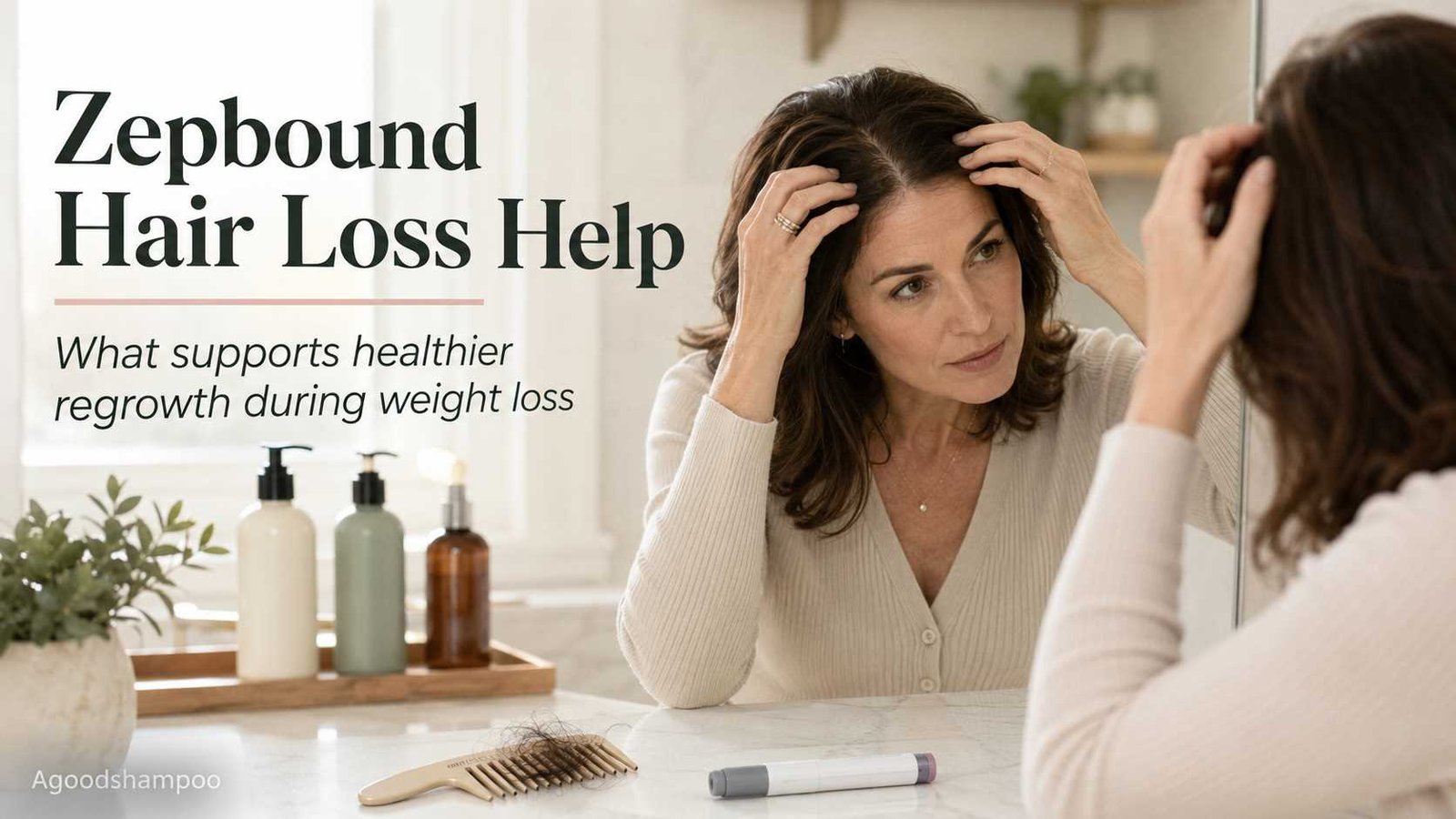
 Seeing extra hair in the shower after starting Zepbound can be frightening, especially when the medication is otherwise helping you reach your health goals. The reassuring part is that increased shedding during major weight loss often behaves differently from permanent hair loss.
Zepbound’s current U.S. prescribing information lists hair loss as a common adverse reaction. In pooled weight-reduction trials, hair loss was reported by about 4% to 5% of people taking Zepbound, compared with 1% taking placebo. The label also says these reactions were associated with weight reduction and were reported more often in women than men.
There is no single Zepbound hair loss treatment that works for everyone. The first job is figuring out whether you’re dealing with temporary shedding, a nutritional problem, female or male pattern hair loss, a thyroid problem, menopause-related changes, breakage, or more than one issue at the same time.
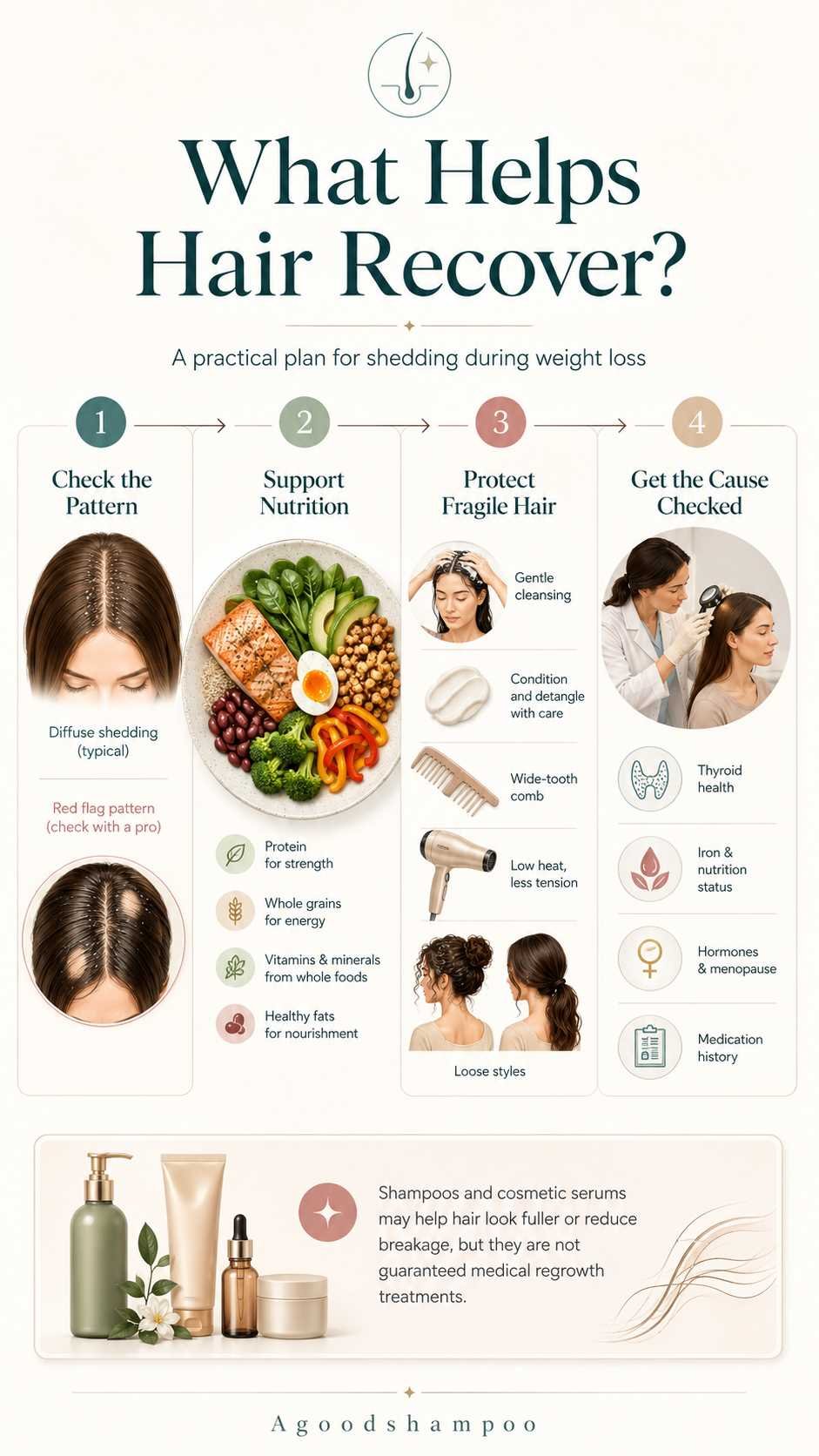
For many people with diffuse shedding after significant weight loss, the most useful approach is supporting adequate nutrition, treating any deficiency, handling the hair gently, and giving the growth cycle time to recover. A dermatologist can help when the pattern doesn’t fit simple temporary shedding.
Quick Answer: Zepbound-related shedding may be connected to rapid weight loss and the body changes that come with it. Dermatologists commonly describe this type of shedding as telogen effluvium. Current evidence has not proved that every case comes directly from tirzepatide itself.
Is There a Treatment for Zepbound Hair Loss?
There isn’t an established medication specifically approved to treat “Zepbound hair loss.”
Treatment depends on why your hair is falling out.
If your dermatologist believes you have telogen effluvium triggered by major weight loss, the main approach is usually to identify and correct the trigger. That can include making sure you’re eating enough protein and nutrients while losing weight.
If testing shows iron, zinc, or another deficiency, correcting that deficiency may matter more than buying an expensive hair serum.
If you also have female or male pattern hair loss, treatment may be different. Topical minoxidil is an established treatment for pattern hair loss and may be recommended in appropriate cases. It should not automatically be treated as the answer to every case of shedding after Zepbound.
This distinction saves you money and frustration. A shampoo can make fine hair look fuller. A conditioner can reduce snapping. A serum may improve the feel of your scalp. None of those benefits prove that the product is correcting the biological cause of hair shedding.
Why Can Hair Start Shedding While Taking Zepbound?
Zepbound contains tirzepatide, a medication used for weight management and other approved indications. Hair loss appears in its current prescribing information as an adverse reaction.
In the pooled Zepbound weight-reduction trials, the rates were:
| Group | Reported Hair Loss |
|---|---|
| Placebo | 1% |
| Zepbound 5 mg | 5% |
| Zepbound 10 mg | 4% |
| Zepbound 15 mg | 5% |
The label gives another useful detail. Among Zepbound-treated participants, hair loss was reported in 7.1% of female patients and 0.5% of male patients. The prescribing information states that the hair-loss reactions were associated with weight reduction.
That does not mean tirzepatide can never influence hair follicles directly. It means we don’t yet have enough evidence to say that a direct drug effect explains most cases.
A 2026 dermatology review found growing evidence linking GLP-1-related therapies, including tirzepatide, with hair loss. Telogen effluvium and androgenetic or pattern hair loss were among the reported forms. The researchers also emphasized that rapid weight loss appears to be an important contributor and that better prospective studies are still needed to establish the exact cause.
The American Academy of Dermatology gives a similarly cautious explanation. Dermatologists believe sudden weight loss may trigger thinning in some people taking GLP-1 therapies. Eating substantially less may also make it harder to get enough protein, vitamins, and other nutrients. Researchers have not yet ruled out a more direct medication effect.
What is telogen effluvium?
Hair doesn’t grow continuously forever. Each follicle moves through growth and resting stages.
A major physical change can push more hairs than usual into a resting stage. Those hairs later shed.
This is called telogen effluvium.
Rapid or substantial weight loss is one recognized trigger. The AAD notes that excessive shedding often becomes noticeable a few months after a major body stressor rather than immediately. When the trigger resolves, many people gradually regain their normal fullness.
This delay explains something that confuses many Zepbound users.
You might increase your dose or lose significant weight in January but not notice dramatic shedding until March or April. That doesn’t necessarily mean something new happened the week the hair began falling.
Is It Temporary Shedding or Another Type of Hair Loss?
Not every loose hair is proof that your follicles are permanently failing.
Look at the pattern.
Signs that can fit temporary diffuse shedding
Telogen effluvium often causes:
- More loose hairs during washing or detangling
- More hair on your pillow, clothes, or brush
- Reduced overall density rather than one clean bald patch
- Shedding from many areas of the scalp
- A noticeable increase that begins after major weight loss, illness, stress, surgery, childbirth, or another physical change
The AAD explains that excessive shedding can resolve as the body readjusts. In many cases linked to a temporary stressor, normal fullness gradually returns within about six to nine months after the trigger settles.
That timeline isn’t a guarantee for Zepbound users. Weight loss can continue for months, and another cause of thinning may exist at the same time.
A widening part deserves a closer look
Female pattern hair loss often behaves differently.
Instead of suddenly finding much more hair in the shower, you may slowly notice:
- A wider center part
- A smaller ponytail
- More scalp showing on top
- Gradual thinning over months or years
Female pattern hair loss becomes more common in midlife and can become more noticeable around or after menopause. It is progressive without appropriate treatment in many women.
It is also possible to have both pattern hair loss and telogen effluvium. A period of rapid shedding can make previously mild pattern thinning suddenly look much more obvious.
Patchy loss is another clue
Round or sharply defined bald areas don’t fit the classic picture of simple weight-loss shedding.
Neither do significant:
- Scalp pain
- Burning
- Redness
- Crusting
- Scarring
- Intense itching
- Broken hairs concentrated around the hairline
Those signs deserve professional assessment.
A dermatologist can examine the scalp and hair shafts and decide whether you’re seeing telogen effluvium, pattern hair loss, traction alopecia, alopecia areata, inflammatory scalp disease, breakage, or a combination.
What Can Help Zepbound-Related Hair Shedding?
There is no magic shampoo routine. Start with the things most likely to affect the actual cause.
1. Tell the clinician who prescribes your Zepbound
Don’t quietly stop Zepbound or change your dose because you’re worried about shedding.
The AAD advises people who believe a medication or treatment is causing hair loss to discuss it with their doctor rather than stopping treatment on their own.
Tell your clinician:
- When you started Zepbound
- When the shedding started
- How quickly your weight has changed
- How much you’re currently eating
- Whether nausea or other side effects make eating difficult
- Any recent illness, surgery, severe stress, or pregnancy
- Other medicines and supplements
- Whether your periods have changed
- Any thyroid history
- Whether relatives have pattern hair loss
That timeline may reveal more than the number of hairs in your brush.
2. Pay attention to nutrition during weight loss
Eating less is part of why medicines like Zepbound can help with weight reduction. But a much smaller appetite can also make a balanced diet harder to maintain.
Hair is not the body’s highest survival priority. If nutritional intake becomes poor, hair growth can suffer.
Instead of immediately buying “hair vitamins,” first look at your normal food.
Try to include regular sources of:
- Protein
- Iron
- Zinc
- Essential fats
- Fruits and vegetables
- Vitamin B12, especially if you eat a vegan diet
- Other nutrients appropriate for your individual diet
Your needs depend on your age, body size, medical conditions, weight-loss plan, and other factors. A doctor or registered dietitian can help if your appetite has become very low.
3. Don’t assume more supplements mean more growth
Hair gummies are tempting because they offer a simple solution to a complicated problem.
But taking large amounts of nutrients without knowing whether you’re deficient can backfire.
The AAD recommends treating deficiencies based on appropriate assessment. It notes that blood testing can identify certain nutritional shortages and warns that getting excessive amounts of some nutrients can itself contribute to hair loss.
So an “everything for hair” supplement isn’t automatically safer than doing nothing.
If your doctor suspects iron, zinc, or another deficiency, testing can guide the decision.
4. Reduce avoidable breakage
You cannot stop telogen effluvium by using conditioner, but you can stop making thinning hair look worse through unnecessary breakage.
For now:
- Shampoo the scalp gently rather than scrubbing the entire length.
- Use conditioner after shampooing.
- Detangle slowly.
- Limit high-heat styling.
- Avoid repeatedly pulling the hair into tight styles.
- Reduce aggressive bleaching, relaxing, or chemical processing while the hair feels fragile.
The AAD recommends these kinds of changes for people dealing with hair loss because heat, pulling, and chemical processing can add physical damage to already vulnerable hair.
This won’t switch a resting follicle back into growth overnight. It simply helps you keep more of the hair shaft you already have.
Should You Use Minoxidil for Zepbound Hair Loss?
Minoxidil deserves a careful answer because it is a real hair-growth medication, not merely a thickening shampoo.
Topical minoxidil is FDA-approved for certain forms of pattern hair loss. The AAD says it can stimulate growth and reduce further loss, but results take time and continued use is generally needed to maintain its benefit in pattern hair loss.
That does not mean everyone who notices Zepbound shedding should immediately start minoxidil.
If your shedding is uncomplicated telogen effluvium and the trigger is resolving, your follicles may recover without long-term hair medication.
Minoxidil becomes more relevant when a dermatologist finds:
- Female pattern hair loss
- Male pattern hair loss
- Persistent thinning
- More than one type of hair loss
- Another condition for which minoxidil is considered part of the treatment plan
Minoxidil can also irritate some scalps and may temporarily increase shedding when first started. Women who are pregnant, planning pregnancy, or breastfeeding need specific medical guidance; AAD guidance advises avoiding minoxidil during pregnancy and breastfeeding.
Oral minoxidil is different from over-the-counter topical minoxidil. Low-dose oral minoxidil is increasingly prescribed off-label by dermatologists for selected patients, but it is a systemic medication and should not be self-prescribed.
Does Nioxin Help With Zepbound Hair Loss?
Nioxin can be useful for the appearance and management of thinning hair, but that isn’t the same as treating the cause of Zepbound-related shedding.
Nioxin’s current System Kits are marketed for thicker and fuller-looking hair. The brand offers different systems for natural and color-treated hair and for lighter or more progressed thinning.
For example, Nioxin System 2 Shampoo currently contains ingredients including cleansing surfactants, salicylic acid, niacinamide, panthenol, biotin and botanical ingredients. Nioxin makes its own claims about improving the appearance of fullness and thickness. Those are manufacturer claims and should not be confused with proof that the shampoo reverses telogen effluvium caused by major weight loss.
The AAD makes the broader distinction especially clear: shampoos marketed for hair loss can make hair appear fuller or reduce breakage, but shampoos do not regrow hair or prevent progressive medical hair loss.
So where does Nioxin fit?
Potentially useful for:
- Making fine hair look fuller
- Cleaning an oily scalp
- Supporting a routine designed for thinning hair
- Reducing some breakage through the full conditioning system
Not a substitute for:
- Correcting iron or nutrient deficiency
- Treating thyroid disease
- Treating significant telogen effluvium
- Diagnosing female pattern hair loss
- Medical treatment of inflammatory or scarring alopecia
If you enjoy how Nioxin makes your hair look, you can use it as cosmetic support. Just don’t make the shampoo carry a job it wasn’t designed to do.
What About Kérastase Hair Loss Treatment?
Kérastase Genesis often appears in searches for hair fall, but the wording matters.
Kérastase itself states that Genesis targets hair fall due to breakage from brushing. Its U.S. website specifically distinguishes Genesis from a medical hair-loss product.
That makes it a different tool.
Imagine two hairs on your bathroom floor.
One has naturally released from the follicle as part of increased shedding. The other snapped halfway along the shaft because the fiber was dry and fragile.
They look like the same problem when you’re cleaning the floor. Biologically, they aren’t.
A strengthening or conditioning product may help reduce the second type. It cannot necessarily prevent the first.
Kérastase may therefore make sense if your Zepbound-related thinning is being made worse by dry, fragile, heat-damaged, bleached, or easily broken hair. It should not be presented as a treatment for the underlying medical cause of telogen effluvium.
Is a Vegan Hair Loss Treatment Better?
A vegan label tells you something about how a product is formulated or sourced. It does not tell you how well it treats hair loss.
A vegan scalp serum can be pleasant, well-formulated, and useful cosmetically. It can also be completely ineffective at reversing the type of hair loss you have.
Judge a vegan hair loss treatment by:
- Its active ingredients
- The type of hair loss studied
- Whether the finished product has meaningful evidence
- Whether the claim is about growth, thickness, breakage, or simply conditioning
- Whether the product irritates your scalp
The diet side needs attention too.
You can absolutely eat a balanced vegan diet while taking Zepbound. But when appetite drops sharply, restrictive diets can make it more challenging for some people to consistently obtain enough protein, iron, zinc, vitamin B12, and other nutrients.
The right answer isn’t “take every supplement.” It is to make sure your diet remains nutritionally complete and investigate genuine deficiencies when appropriate.
Hair Loss Treatment for Curly Hair During Zepbound Use
Curly and tightly coiled hair needs one extra layer of protection because breakage can easily disguise itself as worsening hair loss.
The AAD notes that curly and coily hair tends to be more prone to dryness and breakage. Dermatologists recommend moisturizing the hair and detangling carefully with fingers or a wide-tooth comb while the hair is wet or damp rather than aggressively brushing dry curls.
If you’re shedding while taking Zepbound:
- Keep your scalp clean on a schedule that suits your hair type.
- Use a moisturizing conditioner.
- Detangle in sections.
- Add slip before combing.
- Avoid pulling knots apart while dry.
- Reduce high heat.
- Keep braids, buns, extensions, and ponytails comfortable rather than tight.
Tight styles create another problem called traction alopecia. Repeated tension can damage follicles, particularly around the hairline, and advanced traction alopecia can become permanent.
So if you’re already shedding from a body-wide trigger, this isn’t the time to place extra strain on the remaining hair.
Can a Keratin Treatment Cause More Hair Loss?
A keratin smoothing treatment does not treat Zepbound-related hair shedding.
If you’re actively losing density, I would treat smoothing as a cosmetic decision rather than a recovery treatment.
The combination of chemical processing, high heat, and repeated handling can make fragile hair more vulnerable to breakage. AAD hair-loss guidance recommends limiting chemical straightening and high-heat tools when you’re trying to protect fragile hair.
There is another issue to know about.
Some salon smoothing treatments contain or release formaldehyde or related chemicals when heated. The FDA advises consumers to check ingredient information and ask salons about formaldehyde, formalin, or methylene glycol because inhaled formaldehyde can cause health problems.
That doesn’t mean every product sold as a “keratin treatment” is identical.
Formulas vary.
If your hair is shedding heavily, waiting until things feel more stable may be the kinder choice for the hair fiber. If you do have a smoothing treatment, ask exactly which product will be used rather than relying only on the word keratin.
Menopausal Hair Loss Can Overlap With Zepbound Shedding
A woman starting Zepbound in her 40s, 50s, or 60s may have more than one reason for noticing less hair.
Female pattern hair loss often appears in midlife. The AAD says it commonly starts with widening of the part and may become more noticeable after menopause. Hormonal changes may contribute, although genetics remain important.
This creates an easy mistake.
You start Zepbound.
You lose weight.
Your hair suddenly seems thinner.
It is natural to blame the newest change.
But a dermatologist may find that rapid shedding has simply exposed underlying female pattern thinning that had been progressing quietly for years.
Treatment for menopausal or female pattern hair loss may include topical minoxidil and, for selected patients, prescription options chosen by a dermatologist. These medicines have their own benefits, limits, side effects, and pregnancy considerations.
That is very different from buying a stronger shampoo.
Could Thyroid Hair Loss Be Mistaken for Zepbound Hair Loss?
Yes.
Thyroid conditions can cause changes in hair.
The American Thyroid Association lists hair loss among possible symptoms of hypothyroidism. Other symptoms can include fatigue, dry skin, constipation, cold sensitivity, depression, and weight changes.
That does not mean everyone taking Zepbound who sheds hair needs to assume they have thyroid disease.
It means thyroid problems remain part of the bigger diagnostic picture, especially if you have other symptoms or a personal history of thyroid disease.
A doctor can decide whether thyroid testing is appropriate.
This is another reason not to make your shampoo the center of the investigation.
If thyroid disease is causing the problem, treating your scalp with increasingly expensive cosmetic products won’t correct thyroid hormone levels.
When Should You See a Dermatologist?
You don’t need to wait until the problem becomes severe.
Consider getting professional advice when:
- Hair is coming out heavily and continues to worsen
- Shedding continues for many months
- Your center part keeps widening
- You develop bald patches
- Your hairline is receding
- The scalp burns, hurts, itches, crusts, or looks inflamed
- You notice shiny areas where hair no longer grows
- You are losing eyebrow or body hair too
- You suspect a nutritional deficiency
- You have symptoms that suggest thyroid or hormonal problems
- You’re unsure whether hairs are shedding or breaking
- Hair loss is causing enough worry that it affects your daily life
A dermatologist can examine the scalp, look at your pattern of loss, review medications and health history, and order appropriate tests when needed.
Effective hair-loss treatment starts with identifying the cause.
Zepbound Hair Loss Treatment: Practical Verdict
Zepbound-associated hair loss deserves to be taken seriously, but it doesn’t automatically mean your follicles are permanently damaged.
Current Zepbound prescribing information confirms that hair loss occurred in clinical trials and says these reactions were associated with weight reduction. Dermatology guidance and recent research point toward rapid weight loss and telogen effluvium as important explanations, while researchers continue studying whether these medications may also have direct effects on hair.
For most readers, the smartest plan is simple:
Don’t panic-buy products. Find the cause first.
Keep your diet nutritionally adequate while losing weight. Protect fragile hair from breakage. Tell your Zepbound prescriber about significant shedding. See a dermatologist if the pattern is persistent, patchy, painful, or looks like progressive thinning.
Nioxin and Kérastase can have a place in a cosmetic routine. A moisturizing shampoo can make curly hair easier to protect. A vegan serum may fit your personal preferences.
But none of those choices should distract from the main question: Why is your hair coming out?
Once you know that, the treatment decision becomes much clearer.
Frequently Asked Questions
Does Zepbound hair loss grow back?
It can, particularly when the problem is temporary telogen effluvium linked to major weight loss or another short-term body stressor. The AAD says excessive shedding from temporary stressors often settles as the body readjusts, with fullness gradually returning over time. Your outcome can differ if another type of hair loss is also present.
How long does Zepbound hair shedding last?
There is no single proven timeline specifically for Zepbound. Telogen effluvium often begins a few months after a trigger and can take months to settle. The AAD notes that hair may regain normal fullness within roughly six to nine months after a temporary trigger resolves, but continuing weight loss or another ongoing cause can extend the process.
Should I stop Zepbound if my hair is falling out?
Don’t stop or change a prescribed medication on your own because of suspected hair loss. Discuss the shedding with the clinician who prescribes your Zepbound. They can weigh the medication’s benefits against the severity of the problem and investigate other possible causes.
Can a dermatologist treat hair loss while I continue Zepbound?
Often, yes. The right treatment depends on the diagnosis. A dermatologist may identify telogen effluvium, pattern hair loss, a scalp condition, traction damage, nutritional concerns, or overlapping problems and build treatment around the actual cause. The AAD specifically encourages people using GLP-1 therapies who are concerned about hair loss to work with a dermatologist.
Does Nioxin stop Zepbound hair loss?
There is no good evidence that Nioxin stops the underlying cause of Zepbound-associated shedding. Nioxin markets its systems for thicker, fuller-looking hair and thinning-hair care. That may improve appearance or help with breakage, but cosmetic thickening is different from reversing telogen effluvium.
Is Kérastase good for Zepbound hair loss?
Kérastase Genesis may help weakened hair that breaks during brushing. Kérastase specifically describes Genesis as targeting hair fall caused by breakage and states that Genesis is not a hair-loss product. It can support the hair fiber but shouldn’t replace diagnosis or treatment of excessive shedding from the follicle.
Should I have a keratin treatment while my hair is shedding?
A keratin smoothing treatment won’t treat the reason your hair is shedding. If the hair is already fragile, delaying intensive heat or chemical processing can reduce additional breakage. If you choose a smoothing service, ask the salon about the exact formula and whether it contains or releases formaldehyde-related ingredients.
Can thyroid problems or menopause make Zepbound hair loss worse?
They can create additional hair-loss problems that may happen at the same time. Thyroid disease can include hair loss among its symptoms, while female pattern thinning becomes more common in midlife and after menopause. A medical history, scalp examination, and selected tests can help separate these possibilities.

Marlena Stell makes everyday hair care easier to understand. From choosing a shampoo to managing common hair concerns, she breaks down confusing product claims and practical routines into straightforward advice that helps readers find what works for their needs.