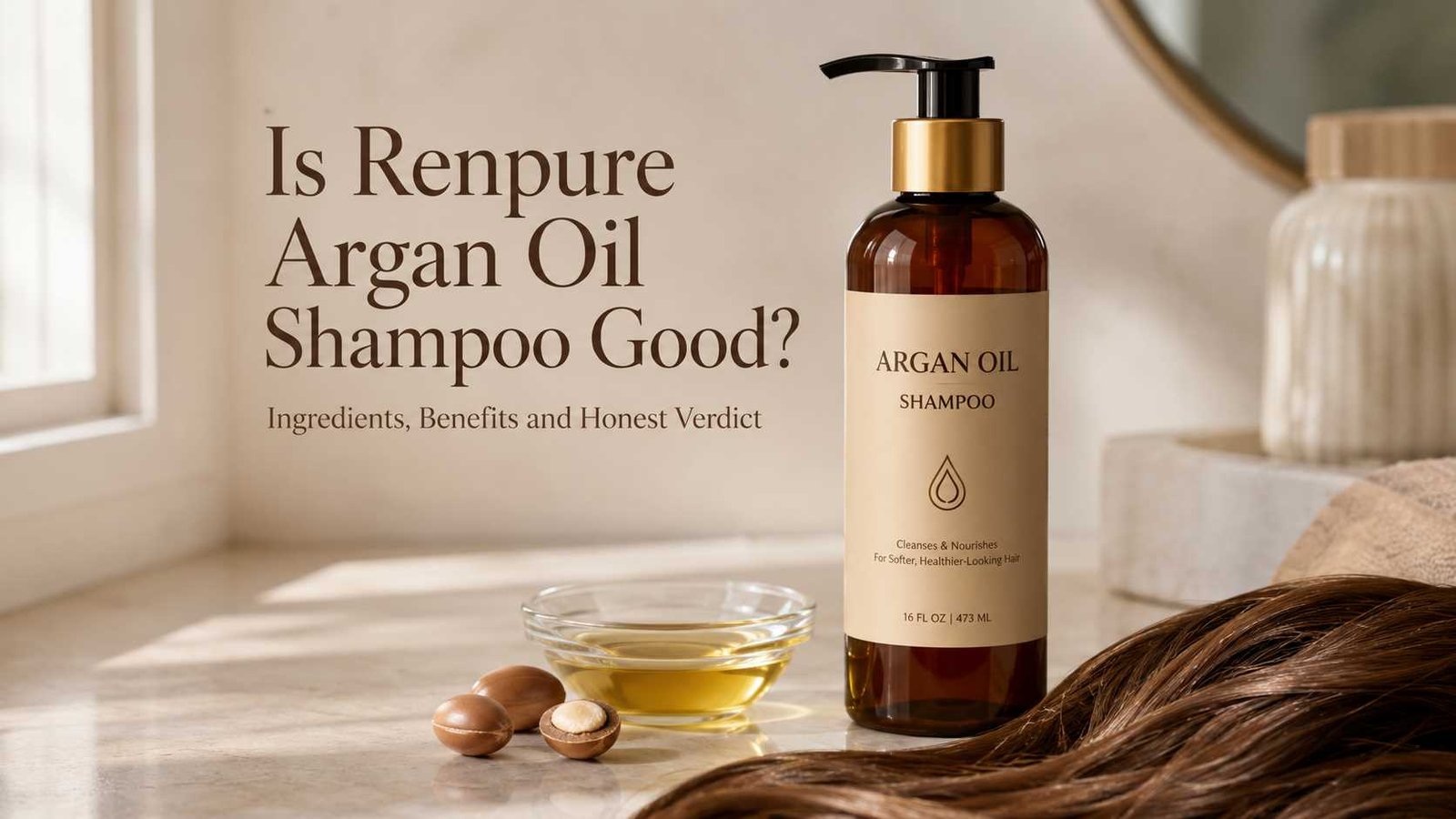
 You grab a bottle called Argan Oil Luxurious Shampoo and your brain fills in the rest.
Argan oil. Moisture. Shine. Soft hair. Probably gentle. Maybe even a little fancy.
That’s the promise, anyway.
But is Renpure Argan Oil Shampoo good when you stop looking at the front label and start looking at what actually cleans your hair?
My answer is yes, with a few catches.
Renpure Argan Oil Luxurious Shampoo can be a good choice for normal, dry, frizzy, thick, or mildly damaged hair. It gives you a sulfate-free wash, includes real argan oil, and has conditioning ingredients that can make rough hair feel smoother. Renpure also currently describes its hair products as pH balanced and free from sulfates, parabens, phthalates, dyes, gluten, and propylene glycol. The company says its products are PETA-certified cruelty-free and that its bottles and pumps use post-consumer recycled plastic.
Still, I wouldn’t call it a perfect shampoo.
Some ingredient lists published for this product include sodium C14-16 olefin sulfonate, a strong cleansing surfactant, along with fragrance and the preservatives methylchloroisothiazolinone and methylisothiazolinone. Those last two matter if your scalp is very sensitive or you have a history of contact allergy.
So this is one of those shampoos where the answer isn’t simply good or bad.
It depends on your hair.
My quick take on Renpure Argan Oil Shampoo
I’d put it around 7.5 out of 10 for the right person.
The strongest part of the formula isn’t some miracle dose of Moroccan oil. It’s the combination of cleansing agents, conditioning polymers, glycerin, silicone-derived conditioning ingredients, and argan oil.
That can leave hair cleaner, smoother, less tangled, and shinier.
But if you expect the shampoo to repair years of bleach damage, stop hair loss, permanently heal split ends, or somehow feed your follicles with argan oil, that’s asking a rinse-off shampoo to do a job it really can’t do.
And there’s another little wrinkle.
Ingredient lists online do not completely agree.
A recent H-E-B listing gives a formula containing cocamidopropyl betaine, sodium C14-16 olefin sulfonate, glycerin, argan kernel oil, seaweed extracts, PEG-7 dimethicone, fragrance, methylchloroisothiazolinone, and methylisothiazolinone.
An EWG entry last updated in 2022 shows an older packaging formula with a somewhat different cleanser and preservative system, including disodium cocoamphodiacetate, sodium lauroyl sarcosinate, glucosides, diazolidinyl urea, and iodopropynyl butylcarbamate.
That tells me something important.
Check the ingredient list on the bottle you’re actually buying.
Hair-care formulas change. Retailers can also carry older stock. What matters is the bottle in your hand, not an ingredient list copied onto the internet five years ago.
So what does the shampoo actually do?
The first job of shampoo is boring but important.
It cleans.
Oil, sweat, styling products, pollution, dead skin, and bits of whatever your hair picked up during the day eventually need to come off.
That happens mainly because of surfactants.
One current Renpure Argan Oil Shampoo ingredient list starts with water, cocamidopropyl betaine, and sodium C14-16 olefin sulfonate among its main cleansing ingredients. It also includes glycerin, argan oil, conditioning guar, seaweed extracts, sorbitol, PEG-7 dimethicone, and other supporting ingredients.
Sodium C14-16 olefin sulfonate deserves a second look.
People sometimes see sulfate-free on a bottle and automatically assume ultra-gentle.
Not quite.
Olefin sulfonate is not SLS or SLES, so a formula using it can truthfully be sulfate-free. But it is still an effective anionic cleanser. Whether it feels gentle depends on its concentration and the rest of the formula.
That distinction matters if your hair feels like straw every time you shampoo.
A shampoo can be sulfate-free and still cleanse strongly.
On oily roots, that can actually be useful.
On bleached curls that already feel like crispy autumn leaves? Maybe not every day.
Ingredient breakdown that actually matters
Here’s how I look at this formula rather than getting distracted by every botanical name.
| Ingredient or group | Why it is there | My take |
|---|---|---|
| Argan kernel oil | Conditioning and lubrication | Useful, but don’t expect miracles from a rinse-off product |
| Cocamidopropyl betaine | Cleansing and foam support | Common cleanser that can help balance stronger surfactants |
| Sodium C14-16 olefin sulfonate | Main cleansing action in one listed formula | Effective but potentially too cleansing for very dry hair |
| Glycerin | Humectant | Helps support a softer, hydrated feel |
| PEG-7 dimethicone | Conditioning silicone derivative | Helps improve slip and smoothness |
| Guar hydroxypropyltrimonium chloride | Conditioning polymer | Helps reduce roughness and tangling |
| Citric acid | Formula and pH adjustment | Useful because hair generally prefers a mildly acidic environment |
| Fragrance | Scent | Fine for many people, less ideal for reactive scalps |
| MCI and MI in one listed formula | Preservatives | Effective preservatives but known contact allergens for some people |
That last row is the part I wouldn’t casually ignore.
A large North American Contact Dermatitis Group analysis looked at reactions associated with hair-care products. Among relevant allergen reactions, methylisothiazolinone accounted for 9.7 percent, methylchloroisothiazolinone plus methylisothiazolinone for 8.7 percent, and cocamidopropyl betaine for 5.9 percent. Shampoo and conditioner products were the most frequent source of hair-care-product-associated reactions in that patient dataset.
That does not mean 9.7 percent of everyone using Renpure will develop an allergy. Not even close. The study involved people undergoing patch testing for suspected contact dermatitis.
But if your scalp already reacts to fragranced shampoos or preservatives, this is worth knowing.
Burning, persistent itching, rash around your hairline, irritated ears, or eyelid irritation after washing aren’t signs that your scalp is detoxing.
They’re signs to stop using the product and figure out what’s irritating you.
What research really says about argan oil and hair
This is where things get interesting.
Argan oil contains lipids and antioxidant compounds, and there is some evidence that applying it directly to hair can help protect the fiber.
A 2022 laboratory study tested argan oil as a pretreatment before human hair was exposed to oxidative damage. The researchers found less protein loss and concluded that argan oil pretreatment helped protect the hair against oxidative damage.
Sounds fantastic.
But notice one word.
Pretreatment.
The researchers were studying argan oil applied to hair before damage. They were not proving that a shampoo containing a smaller amount of argan oil, massaged in for a minute and rinsed away, gives the same effect.
That difference gets lost in beauty marketing all the time.
Another scientific review examining coconut, castor, and argan oils found that evidence supporting argan oil for improving hair growth or overall hair quality was limited. Coconut oil had much stronger supporting evidence for reducing brittleness and hair damage.
So I like argan oil.
I just don’t worship it.
In a shampoo, I view it mainly as part of the conditioning package. It may help lubrication and softness while washing. If you want a stronger argan-oil effect, a conditioner, mask, serum, or small amount of leave-in oil usually gives the ingredient much more time to sit on your hair.
That’s chemistry, not negativity.
What Research Says
Hair damage often comes down to friction.
Healthy cuticle cells lie relatively flat. Once coloring, bleaching, heat, UV exposure, rough brushing, and repeated washing start wearing that surface down, strands rub against each other more easily. Tangling gets worse. Shine drops. Breakage becomes easier.
A scientific review of hair cosmetics notes that cosmetic conditioning can help reduce friction and water uptake, which may help protect damaged hair from further breakage.
That’s why the boring conditioning ingredients in Renpure matter.
The guar polymer and silicone derivative may not look nearly as romantic as argan oil on Instagram, but they can play a very practical role in how your hair feels after washing.
Sometimes the ingredient with the prettiest story isn’t doing all the work.
Is Renpure shampoo good for your hair?
For many people, yes.
I think Renpure Argan Oil Shampoo makes the most sense when you have normal to dry hair that gets rough, dull, or frizzy but still needs a decent cleanse.
Medium and thick hair may particularly like that balance.
If your roots become oily quickly while your ends feel dry, it could also work. Keep most of the shampoo on your scalp rather than scrubbing it aggressively through your lengths.
Your ends usually don’t need a full detergent bath.
The suds running through them during rinsing are often enough.
Where I become more cautious is very bleached, extremely porous, tightly coiled, or chronically dry hair.
A strong cleansing system can sometimes make those hair types feel rough even when the bottle says sulfate-free.
That doesn’t make the shampoo bad. It makes the hair-product match bad.
Big difference.
Does pH matter here?
Renpure currently says its formulas are pH balanced and describes that as helping maintain the natural pH of hair and skin.
I like seeing attention paid to pH because hair really can respond differently to alkaline products.
A study reviewing 123 shampoos found pH values ranging from 3.5 to 9.0. Researchers explained that a more alkaline environment can increase the negative electrical charge on hair fibers, potentially raising friction, frizz, cuticle damage, and breakage.
The study found only about 38 percent of the shampoos tested had a pH of 5.5 or below.
Now, Renpure doesn’t give me the exact measured pH of this particular bottle on the product information I reviewed, so I’m not going to invent a number.
I’ll simply say that pH-balanced formulation is a nice brand-level feature.
I’d still judge the shampoo by how your own hair responds.
Your shower is sometimes a surprisingly useful laboratory.
Will it help dry and damaged hair?
Possibly, but keep expectations sane.
Hair that has already been severely damaged is dead keratin fiber. Shampoo cannot biologically heal it the way living skin heals a cut.
Cosmetic products can coat damaged areas, improve lubrication, reduce friction, make hair easier to comb, decrease roughness, and help prevent additional mechanical damage. Reviews of hair-fiber science describe conditioning as a key way to improve manageability and reduce damaging friction.
That’s where Renpure can help.
Your hair may feel softer.
It may look shinier.
Frizz may become easier to manage.
Combing may feel less violent.
Those changes matter.
But if bleach has taken your hair from normal to gummy and stretchy, I wouldn’t build the whole rescue plan around an argan oil shampoo. You’d get more value from gentle cleansing, consistent conditioning, reduced heat, careful detangling, and treatments made specifically for damaged hair.
Is Renpure a healthy brand?
Healthy is a messy word in cosmetics.
I don’t classify shampoos as healthy or unhealthy based on whether the package has leaves printed on it.
Renpure does have several qualities ingredient-conscious shoppers may appreciate.
The brand currently says its formulas contain no sulfates, parabens, dyes, gluten, phthalates, or propylene glycol. It also states that its products are PETA-certified cruelty-free and that both bottles and pumps are recyclable and made from post-consumer recycled plastic.
Those are meaningful product and sustainability choices.
But natural, clean, and sulfate-free do not automatically mean irritation-free.
Plants can cause allergies.
Fragrances can cause allergies.
Synthetic ingredients can be perfectly useful.
Preservatives are necessary because I would much rather have properly preserved shampoo than a bottle of warm, microbe-friendly water sitting in my bathroom for six months.
The real question is whether the complete formula suits your hair and scalp.
One listed Renpure Argan Oil formula includes methylchloroisothiazolinone and methylisothiazolinone. These preservatives have a documented history of contact sensitization, although exposure and risk differ between rinse-off and leave-on products. European scientific safety assessments have specifically examined restrictions for methylisothiazolinone because of its sensitization potential.
So yes, Renpure can fit a more ingredient-conscious routine.
No, I wouldn’t call every ingredient automatically gentle for every scalp.
Both things can be true.
What about hair loss?
I wouldn’t buy this shampoo as a hair-growth treatment.
Argan oil shampoos are sometimes discussed online as if the oil somehow travels through your scalp and switches sleepy follicles back on.
We don’t have good evidence for that.
A review of hair oils found no significant clinical evidence supporting argan oil for hair growth.
Shampoo can absolutely make hair look better by reducing oil, improving texture, limiting breakage, and helping strands appear smoother.
Less breakage can also make your hair appear fuller over time because you keep more length.
That is not the same as stimulating new follicles.
If you have sudden shedding, bald patches, widening of your part, scalp pain, or persistent thinning, I would treat that as a scalp or medical question rather than an excuse to buy another beauty shampoo.
Is argan oil shampoo good for your hair in general?
Yes, particularly when you want softness, shine, and easier detangling.
But I care much more about the whole formula than whether argan oil appears somewhere on the label.
Imagine two shampoos.
One contains a tiny drop of argan oil but uses a cleansing system your hair hates.
The other contains less glamorous conditioning ingredients but cleans gently and leaves your hair easy to comb.
Guess which one I’d use?
The second one. Every time.
Argan oil becomes a nice bonus when the foundation of the shampoo already works for you.
That’s the healthier way to shop.
Is Renpure good for curly hair?
It can be.
Curly hair often struggles with dryness because scalp oil has a harder time traveling down bends and coils.
That makes excessive cleansing especially noticeable.
Renpure being sulfate-free may appeal to curly-haired users, but remember the olefin sulfonate issue I mentioned earlier. A formula can avoid traditional sulfates while still cleansing quite effectively.
Loose waves and curls that get oily or accumulate styling products may really enjoy that.
Extremely dry coils may prefer something milder for frequent washes.
There isn’t one universal curly-hair rule.
If your curls spring up, feel clean but not crunchy, and detangle easily after conditioning, your routine is probably doing its job.
If they turn into a giant dry cloud immediately after shampoo day, your hair has already answered the question for you.
Fine hair is another story
Argan oil gets marketed so heavily toward dry hair that people with fine strands sometimes assume the shampoo will leave them flat and oily.
Not necessarily.
Shampoo is rinsed away.
And in this formula, argan oil isn’t the only thing happening.
I’d be more concerned about the total amount of conditioning material you stack afterward.
Fine hair could probably handle Renpure shampoo more easily than shampoo plus rich argan conditioner plus mask plus oil plus leave-in cream.
At that point your hair isn’t moisturized.
It’s wearing a winter coat in July.
Keep the routine lighter and see what happens.
Which brand of argan oil shampoo is best?
There isn’t one winner for everybody.
Renpure makes sense if you want an affordable, sulfate-free argan shampoo and your hair tolerates its cleanser and fragrance system.
If I were specifically shopping for dry or damaged hair today, I would also look at HASK Repair + Argan Oil Shampoo. HASK currently markets it for dry and damaged hair and lists it as free from sulfates, parabens, phthalates, silicone, gluten, drying alcohol, and artificial colors. The brand lists it at $8.99 on its U.S. site at the time of checking.
For someone willing to spend more on damaged or chemically treated hair, Moroccanoil Moisture Repair Shampoo is another strong option. The company describes it as sulfate-free and formulated with argan oil, keratin proteins, and fatty acids for weakened or damaged hair.
I’d think of the three roughly like this.
Renpure for budget-friendly cleansing and shine.
HASK for dry hair when you want an accessible repair-focused formula.
Moroccanoil for someone who wants a more premium damaged-hair routine and doesn’t mind paying for it.
Not because one brand owns better argan trees.
Because the rest of the formula matters.
A strange thing about Renpure’s availability
Availability seems a little inconsistent right now.
H-E-B still has a product listing for the 16-ounce Renpure Argan Oil Luxurious Shampoo, while Walmart’s 32-ounce listing currently shows the item as out of stock online.
That doesn’t necessarily mean the product has been discontinued. Retail inventory changes constantly, and marketplace sellers can keep older products floating around for years.
But it gives me another reason to inspect the actual bottle when buying online.
Look at the ingredient label.
Look at the seller.
Look at the bottle size.
And if you’re buying from a marketplace seller rather than a major retailer, pay attention to how old the stock appears.
Cheap shampoo stops being a bargain when it arrives looking like it survived three apartment moves.
Who should probably try it?
Here’s the simplest way I can put it.
Renpure Argan Oil Shampoo looks most appealing for someone with normal, slightly dry, frizzy, medium, or thick hair who wants a strong enough clean without traditional sulfates.
It could also work well for people using moderate amounts of styling products.
I’d hesitate if your scalp already has eczema, contact dermatitis, unexplained itching, or known fragrance and preservative allergies.
I’d also pay attention if your hair is extremely bleached, porous, coarse, coily, and chronically dry.
You might love it.
Or the cleansing system might simply be more than your hair needs.
A patch-test history and your own wash-day experience beat an internet rating.
How I would use it
Here’s the one routine I’d keep simple:
- Wet the scalp completely, use a small amount of shampoo mainly at the roots, massage with your fingertips instead of your nails, let the foam move through the lengths while rinsing, then follow with conditioner from roughly ear level downward. Start with one wash rather than automatically shampooing twice. If the roots still feel dirty, then consider a second cleanse.
If your hair comes out squeaky, tangled, and rough after every wash, don’t celebrate because it feels extra clean.
That squeak isn’t a trophy.
Try using less product, washing less often, or moving to a milder shampoo.
The part I like most
Oddly enough, it isn’t the argan oil.
I like that this formula doesn’t depend on argan oil alone.
You have humectant support from glycerin, conditioning from guar derivatives, a silicone-based conditioning ingredient in one current listing, and a cleansing system capable of actually removing oil and buildup.
That is a much more believable recipe for smooth-feeling hair than a bottle screaming ARGAN in giant gold letters while putting three drops of oil into an otherwise mediocre formula.
There’s actual formulation logic here.
I just wish the sensitive-scalp story were a little cleaner.
My final verdict
So, is Renpure Argan Oil Shampoo good?
Yes, I think it’s a decent shampoo and potentially a very good one for the right hair type.
It gets points for being sulfate-free, containing real argan oil, using several conditioning ingredients, and coming from a brand that publicly emphasizes pH balance, cruelty-free practices, recyclable packaging, and post-consumer recycled plastic.
I also like that argan oil isn’t just a random marketing story. Laboratory research suggests argan oil pretreatment can help protect hair against oxidative damage, although that evidence should not be stretched into claims about hair growth or guaranteed repair from a rinse-off shampoo.
The main drawback is that sulfate-free does not mean ultra-mild. A currently listed formula contains sodium C14-16 olefin sulfonate, and the presence of fragrance plus MCI and MI may make that version a poor match for some sensitive scalps.
For normal, frizzy, oily-at-the-roots, medium, or thicker dry hair, I’d happily consider it.
For severely damaged hair, I’d use it only if it leaves your strands comfortable after washing and pair it with a good conditioner.
For a reactive scalp, I’d read that bottle twice.
And if your only reason for buying it is the idea that argan oil will grow your hair faster, save your money.
Buy shampoo to clean your scalp and help keep your hair manageable.
Everything else is a bonus.

Michael Chen focuses on the science behind shampoos and hair-care ingredients. He explains how cleansing agents, silicones, proteins, and other formula components work, separating useful evidence from marketing claims to help readers better understand the products they use.