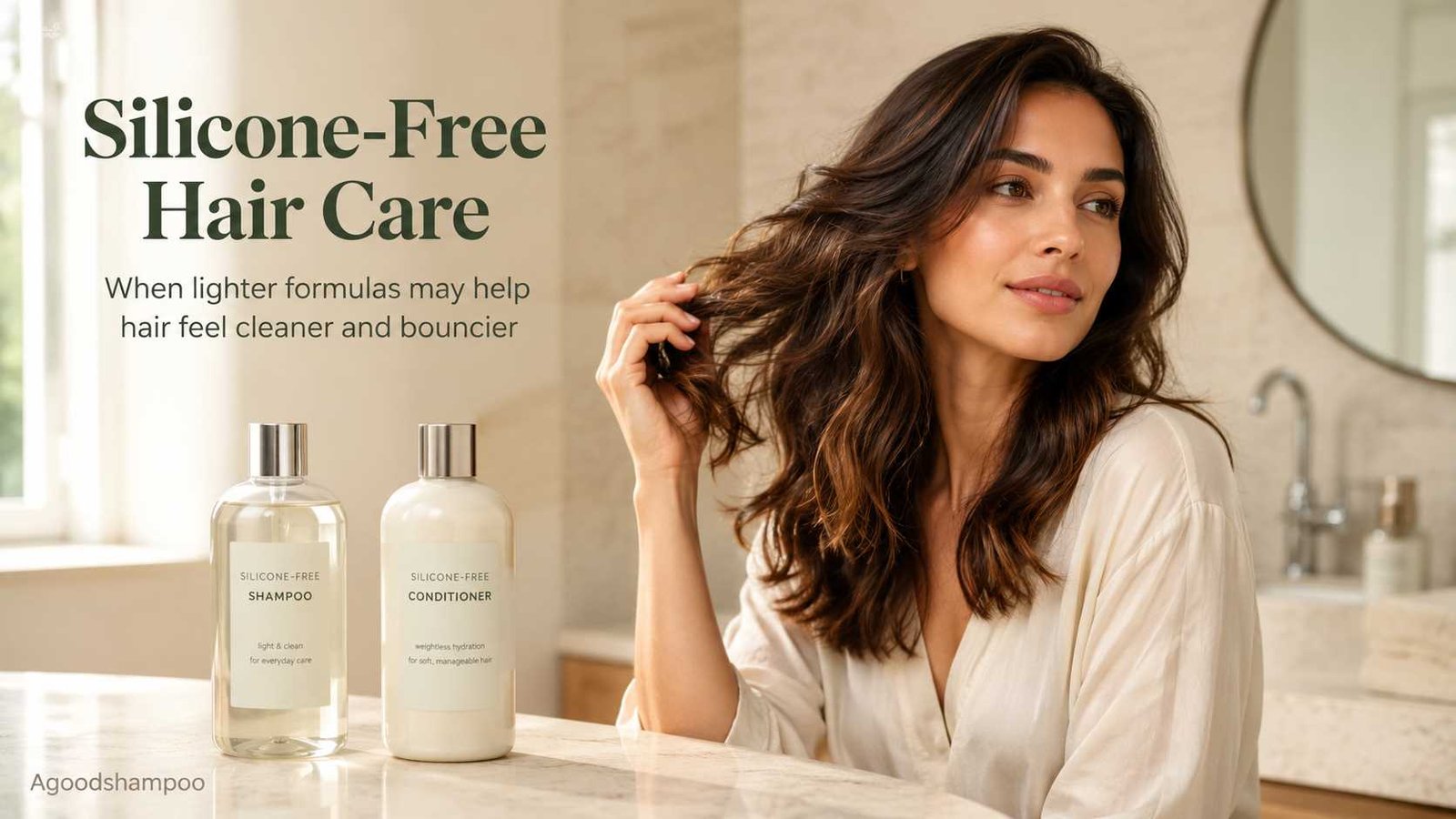
 If your hair feels heavy, flat, coated, or harder to style after a few wash days, switching to silicone-free shampoo may help. The main benefit is simple: you stop adding silicone-based conditioning films to your hair through that product. For some people, especially those with fine hair or very gentle cleansing routines, that can make hair feel lighter and easier to refresh.
But silicone-free does not automatically mean healthier.
Silicones such as dimethicone and amodimethicone can reduce friction, improve slip, add shine, and help protect damaged hair. A 2025 review of silicones in hair care found real conditioning benefits as well as a possible buildup problem with some water-insoluble silicones when they are not removed well.
So the better question isn’t whether silicones are good or bad. It is whether your hair, your shampoo, and your full routine work well together.
Why Is Silicone-Free Shampoo Good for Some Hair?
Silicone-free shampoo can be a good choice if your hair becomes weighed down easily, you use very mild cleansers, or you want to avoid adding more silicone residue from shampoo.
It may be especially useful for fine hair that loses volume or for people who co-wash and rarely use stronger cleansing shampoos.
Still, silicones are not automatically harmful. Research shows that they can smooth the hair surface and lower friction between strands. That may be especially helpful for bleached, colored, heat-damaged, tangled, or frizz-prone hair.
A silicone-free shampoo is therefore an option, not a universal upgrade.
What Are Silicones Doing in Hair Products?
Silicones are a large family of ingredients built around silicon and oxygen atoms. Cosmetic chemists use different silicone types because they can spread across the hair shaft and change how the surface feels.
You may see names such as:
- Dimethicone
- Amodimethicone
- Dimethiconol
- Silicone-related copolymers
- Various modified or water-dispersible silicones
These ingredients do not all behave in exactly the same way.
Some form stronger, more persistent films. Some are easier to disperse or remove. Some have chemical groups that help them deposit more strongly on damaged sections of hair.
That difference matters.
Calling every silicone a heavy coating is a little like calling every oil the same. Coconut oil, mineral oil, and a lightweight ester do not behave identically. Silicones also vary in molecular size, structure, charge, solubility, and how they interact with the rest of the formula.
A dermatology review explains that silicones reduce friction between hair fibers and can improve shine, slip, smoothness, and manageability. Dimethicone is also used to protect the hair shaft from abrasive forces.
That is why silicones appear so often in conditioners, masks, serums, smoothing products, and some 2-in-1 shampoos.
So Why Is Silicone Free Shampoo Good for Hair Health?
The strongest reason is not that silicone-free shampoo somehow feeds or heals your hair.
It does not.
The hair you see above your scalp is mostly nonliving keratin fiber. Shampoo mainly cleans the scalp and hair surface. A silicone-free formula changes what gets deposited on that surface.
For the right person, avoiding extra silicone deposition can solve a few practical problems.
Hair May Feel Lighter
Some hair loses volume quickly when several conditioning products leave films behind.
This often shows up as hair that looks clean at the scalp but still feels strangely heavy through the lengths. Fine hair may separate into flat sections. Curls may lose some spring. Roots can seem greasy sooner even when the scalp is not producing more oil than usual.
Silicone isn’t always the cause. Oils, butters, styling polymers, dry shampoo, sebum, mineral deposits, and conditioners can all contribute to surface residue.
Still, removing one source of deposition can simplify the routine.
If your shampoo, conditioner, leave-in, serum, and heat protectant all contain rich film-forming ingredients, a silicone-free shampoo may help reduce the total amount being layered onto the hair.
It Can Make Gentle Cleansing Routines Easier to Manage
Water-insoluble silicones can accumulate when cleansing does not remove deposited material well enough. The 2025 silicone review notes that stronger surfactants may sometimes be needed to remove this accumulation.
This becomes more relevant if you rarely shampoo or mostly co-wash.
A medical review of cleansing conditioners found that co-washing can be gentle, but residue may accumulate when cleansing is insufficient. The same review described severe buildup in a case involving silicone-containing leave-in products combined with co-washing alone.
That does not mean co-washing is bad or that curly hair should avoid every silicone. It means product deposition and cleansing need to stay in balance.
If you prefer mild cleansing, using fewer hard-to-remove conditioning films can make that balance easier.
You Can See What Your Hair Actually Needs
People sometimes keep adding rich products because their hair still feels rough, while the real problem may be product layering.
A short silicone-free period can make your routine easier to assess.
Does your hair regain volume? Does it become more tangled? Does frizz increase? Do the ends feel rougher? Does wash day last longer?
Those changes tell you much more than a silicone-free label does.
If your hair becomes soft, light, and manageable, silicone-free hair care may suit you.
If it becomes rough and difficult to detangle, your old silicone-containing conditioner may have been doing useful work.
Does Silicone Build Up on Hair?
It can, but the answer needs context.
Modern hair products are designed around deposition and removal. Conditioners are supposed to leave something useful behind. If every conditioning ingredient rinsed away completely, many conditioners would do very little.
Research using atomic force microscopy has shown that shampoos and conditioners can both change deposits on the hair surface. Some formulas leave scattered deposits, while others leave more continuous layers.
Silicones are only one part of that picture.
The newest major review on silicone hair care states that water-insoluble silicones may accumulate when they are not properly cleansed. At the same time, older work on 2-in-1 shampoo technology found that a properly designed dimethicone system could provide conditioning without progressive buildup because later shampooing removed previously deposited material.
Those findings sound contradictory until you look at the formulations.
They actually make the same point: formula design and cleansing matter.
A silicone in a well-designed shampoo-and-conditioner system may behave very differently from repeated layers of serum, leave-in conditioner, curl cream, and oil followed by very mild cleansing.
Is Silicone-Free Shampoo Healthier Than Regular Shampoo?
Not automatically.
A silicone-free shampoo can still be harsh. It can contain strong surfactants, a lot of fragrance, or other ingredients your scalp does not tolerate well.
Likewise, a shampoo containing silicone can be gentle and well formulated.
This is one of the biggest mistakes people make with ingredient labels. They judge an entire formula by one ingredient family.
Silicone-free does not automatically mean:
silicone-free = sulfate-free = gentle = natural = non-irritating = better for everyone.
Those claims describe different things.
If scalp comfort is your priority, pay attention to the cleansing system, fragrance, your wash frequency, and how your scalp actually responds.
If hair breakage and roughness are your priorities, look closely at conditioning performance as well.
Silicone ingredients themselves are not considered unsafe simply because they are silicones. The Cosmetic Ingredient Review Expert Panel has assessed many dimethicone, methicone, and related polymers and concluded that the evaluated ingredients are safe in cosmetics under their reported conditions of use when formulated appropriately.
That safety question is different from asking whether a specific silicone formula feels good on your hair.
What Silicones Can Do Well
Silicone-free marketing sometimes makes silicones sound like an outdated ingredient that only creates artificial shine.
That misses why cosmetic chemists use them.
Hair becomes rougher as its surface gets damaged. Bleaching, coloring, heated tools, brushing, and normal weathering can increase friction between fibers. A 2025 review of hair friction explains that damaged hair loses part of its naturally protective surface and develops higher friction. Conditioners work in part by depositing materials that lubricate the surface.
That matters because high-friction hair tangles more easily.
More tangling can mean more pulling during detangling. More pulling can increase mechanical stress.
Silicones can help by creating slip.
Another hair-cosmetics review describes dimethicone as protective against abrasive action and notes that some silicone systems can help smooth lifted cuticle scales and protect against heat-related damage.
So if your hair is bleached, chemically processed, long, very tangled, or frequently heat styled, removing every silicone simply because it sounds cleaner may not improve your hair.
You need enough conditioning from somewhere.
Can Silicone-Free Products Condition Hair Properly?
Yes.
Silicones are useful conditioning agents, but they are not the only ones.
A good silicone-free conditioner may use fatty alcohols, cationic ingredients, esters, oils, polymers, humectants, or combinations of these ingredients to improve softness and combing.
For example, research on bleached Mongolian hair compared silicone-containing and silicone-free conditioning emulsions. The researchers found that advanced silicone-free formulas based on other conditioning materials could restore useful surface properties and reduce friction in a way that was comparable with established silicone-containing products in their laboratory tests.
That does not prove every silicone-free conditioner works just as well.
It proves something more useful: silicone is not required for effective conditioning if the rest of the formula is designed well.
Research on cationic polymers also shows that ingredients such as polyquaterniums and modified guar polymers can help deposit conditioning materials and improve hair lubricity.
This is why reading only the silicone-free claim tells you very little about how a product will feel.
Silicone-Free Shampoo and Conditioner: Do You Need Both?
No.
You can use a silicone-free shampoo with a silicone-containing conditioner. You can also do the opposite.
Hair care does not need to follow an all-or-nothing rule.
Think about what each product does.
Shampoo mainly removes sebum, sweat, pollution, styling residue, and deposited product from the scalp and hair. Conditioner mainly reduces friction, improves detangling, and changes how the hair surface feels.
If your hair becomes flat easily, you might prefer a simple silicone-free shampoo and lightweight conditioner.
If your scalp gets oily but your bleached ends tangle badly, you may like a silicone-free cleanser at the roots and a silicone-containing conditioner on the damaged lengths.
If your curls do well with a silicone-free conditioner, there is no scientific reason to add silicone just because other people use it.
The full routine matters more than keeping every bottle in the same ingredient category.
Is Silicone-Free Conditioner Good for Curly Hair?
It can be.
Curly and tightly curled hair often needs strong conditioning because bends in the fiber can increase tangling and make grooming more difficult. Very aggressive cleansing may also leave some curly hair feeling dry or frizzy.
That helps explain why co-washing and low-shampoo routines became popular.
If someone cleanses very gently, avoiding heavily depositing water-insoluble ingredients may make buildup easier to control. That is one reason silicone-free conditioner for curly hair is common.
But there is no rule saying curls cannot use silicone.
Silicones can reduce friction and improve combability, and those are useful properties for curly hair too. The best choice depends on curl pattern, strand thickness, damage, styling products, wash frequency, and cleansing strength.
A curl routine that works should leave hair easy to detangle, flexible, reasonably clean, and comfortable at the scalp.
Ingredient ideology matters less than that result.
Who Is Most Likely to Prefer Silicone-Free Hair Care?
Silicone-free hair products often make the most sense when hair repeatedly feels coated despite regular washing.
You may want to try them if you have fine strands that collapse under rich products, use several leave-ins or styling products, wash with very mild cleansers, co-wash frequently, or simply notice better volume when your routine contains fewer depositing ingredients.
On the other hand, think carefully before removing effective conditioning from hair that is heavily bleached, frequently straightened, very long, coarse, rough, or prone to severe tangling.
Those hair types often benefit from strong lubrication.
If you remove silicones, replace their function rather than just removing the ingredient.
A silicone-free hair conditioner with good fatty alcohols, conditioning polymers, esters, or oils may do that well. A weak formula may not.
How to Choose Silicone-Free Hair Products
Ignore the front label for a moment and read what the product is trying to do.
A volumizing silicone-free shampoo and a rich moisturizing silicone-free shampoo can feel completely different even though both make the same silicone-free claim.
For shampoo, consider the cleansing system. If your scalp gets oily quickly or you use lots of styling products, you may need enough cleansing power to remove residue. If your hair is dry and lightly styled, a milder cleanser may work better.
For conditioner, check whether the formula still provides enough slip.
Fatty alcohols such as cetyl alcohol and cetearyl alcohol are common conditioner ingredients and should not be confused with drying alcohols simply because the word alcohol appears in the name.
Conditioning polymers such as certain polyquaterniums and cationic guar derivatives can also improve deposition and lubrication.
Then judge the result on your own hair.
The label cannot tell you whether your hair will tangle.
Do You Need a Clarifying Shampoo Before Going Silicone-Free?
Not everyone does.
If your hair already feels clean and light, simply replace products as they run out.
If it feels heavily coated, limp, unusually waxy, or difficult to wet, a more thorough wash may help remove accumulated sebum and product residue before you judge a new routine.
That does not mean you need an aggressive clarifying shampoo every few days.
The 2025 silicone review notes that stronger surfactants used repeatedly to remove persistent buildup may contribute to dryness.
Use clarifying based on need rather than a fixed detox schedule.
Hair does not go through a proven silicone detox phase. If it feels different after a switch, the simpler explanation is usually that you changed cleansing, deposition, lubrication, or several of these at once.
What Happens When You Stop Using Silicone?
There is no single response.
Hair that was being weighed down may gain volume and movement.
Hair that depended on silicone for lubrication may feel rougher.
Curls may spring up more or may become frizzier. Fine hair may stay fresh longer or may become harder to detangle. Bleached ends may suddenly make it clear how much smoothing your old conditioner was providing.
Give the new routine enough washes to see a pattern, but do not force yourself through weeks of bad hair because someone online says your hair is detoxing.
If your hair gets progressively more tangled, rough, dull, or difficult to manage, change the conditioning step.
A successful silicone-free routine should still make your hair practical to live with.
What Silicone-Free Shampoo Cannot Do
Silicone-free shampoo does not treat hair loss, make follicles grow faster, repair scalp disease, or permanently repair broken hair fibers.
Those claims go beyond what removing silicone can reasonably do.
Silicones mainly affect the cosmetic behavior of the hair shaft. Whether they are present or absent tells you little about the cause of sudden shedding, bald patches, scalp sores, severe itching, or persistent inflammation.
If you have those symptoms, changing shampoo ingredients alone may not address the cause. A dermatologist or qualified healthcare professional can help assess persistent scalp problems or unusual hair loss.
Is Silicone-Free Shampoo Good? The Practical Verdict
Yes, silicone-free shampoo can be good for your hair when it solves a real problem in your routine.
It makes the most sense when your hair is easily weighed down, your cleansing routine is very gentle, or repeated film-forming products leave the hair feeling coated.
But silicones themselves are not the enemy.
Modern evidence shows that silicones can reduce friction, improve combing, smooth the hair surface, add shine, and protect damaged fibers. Some water-insoluble silicones may accumulate when cleansing does not keep up with deposition, which is why the right balance matters.
So if you’re wondering why silicone free shampoo is good for hair health, the most accurate answer is this:
It can reduce unnecessary deposition and help some hair feel lighter, but healthier-looking hair comes from matching cleansing and conditioning to your actual hair needs, not from avoiding one ingredient family at all costs.
Frequently Asked Questions
Is silicone-free shampoo good for hair?
Yes, it can be good for hair that becomes heavy, limp, or coated easily. It is also useful for people who want fewer silicone deposits in a mild-cleansing routine. It is not automatically better than a well-formulated shampoo containing silicone.
Why is silicone-free shampoo good for fine hair?
Fine strands can lose volume when too many rich conditioning products build up on them. A lighter silicone-free routine may help some fine hair feel cleaner and fuller. Other ingredients can also weigh down fine hair, so silicone is not always the cause.
Does silicone damage hair?
Silicone is not inherently damaging to hair. Research describes useful effects such as lower friction, improved smoothness, easier combing, and protection of the hair surface. The main concern for some routines is accumulation of certain water-insoluble silicones.
Can silicone make hair dry?
Silicone itself should not automatically be blamed for dryness. A persistent silicone film may require more thorough cleansing in some routines, and frequent strong cleansing can leave hair feeling dry. Your shampoo, conditioner, styling habits, chemical processing, and heat exposure all matter.
Is silicone-free shampoo better for curly hair?
Not always. Curly hair may benefit from silicone-free products if mild cleansing does not remove deposited products well. But silicones can also reduce tangling and friction, which may help curls. Choose based on how your curls respond rather than following a blanket rule.
Should I use silicone-free shampoo and conditioner together?
You do not have to. A silicone-free shampoo can work with a silicone-containing conditioner, especially if your ends need extra slip. Likewise, a good silicone-free conditioner can work well if alternative conditioning ingredients give your hair enough softness.
How do I know if silicone is building up on my hair?
Possible signs include persistent heaviness, dullness, loss of volume, or hair that still feels coated after washing. Those symptoms are not specific to silicone, though. Oils, styling polymers, sebum, mineral deposits, and other conditioning ingredients can create similar effects.
How can I tell whether a product contains silicone?
Read the ingredient list rather than relying only on the front label. Dimethicone, amodimethicone, and dimethiconol are common examples. Silicone chemistry is diverse, so a name ending in one familiar pattern should not be your only test when evaluating a formula.

Michael Chen focuses on the science behind shampoos and hair-care ingredients. He explains how cleansing agents, silicones, proteins, and other formula components work, separating useful evidence from marketing claims to help readers better understand the products they use.