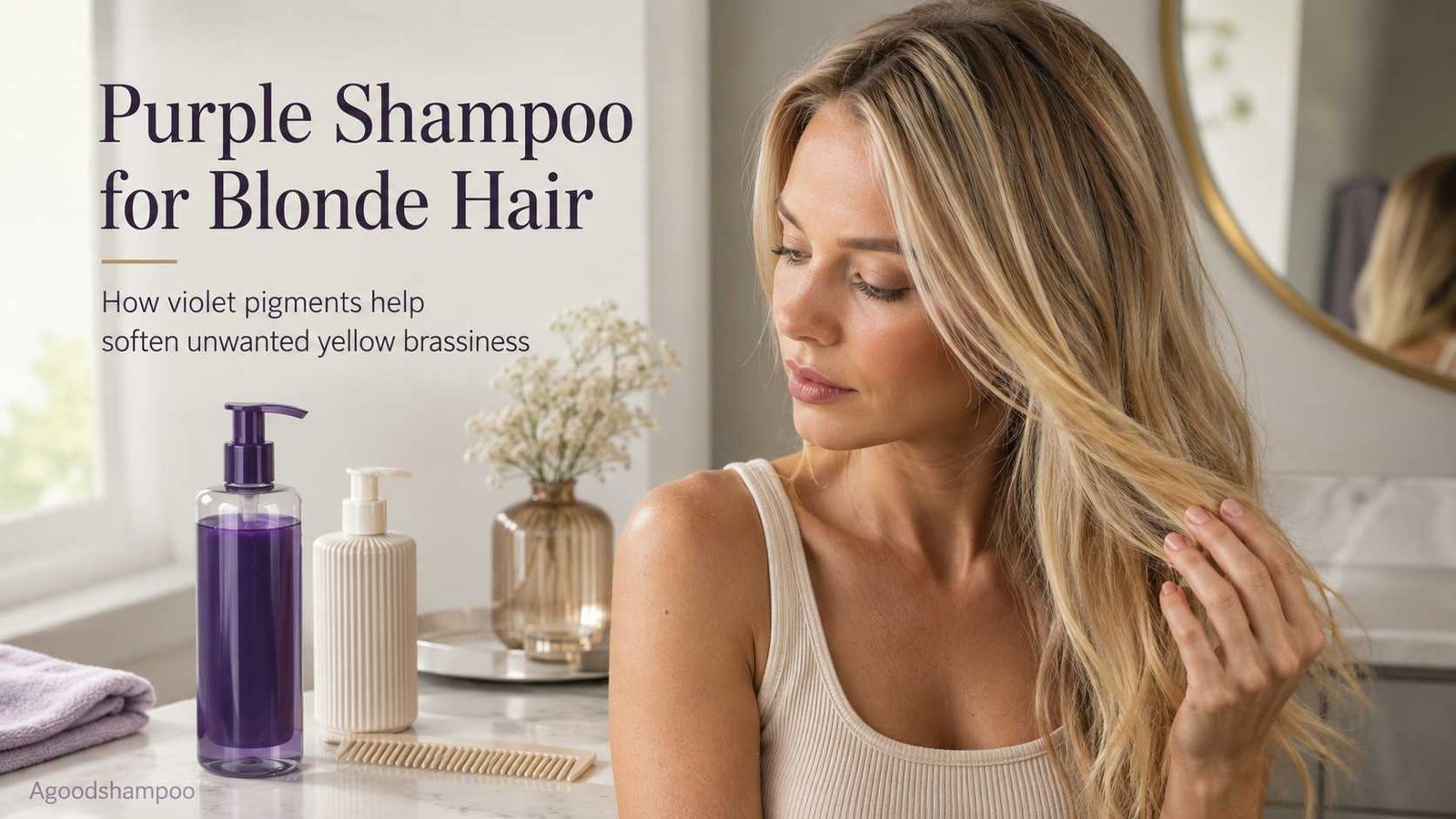
 Purple shampoo is good for blonde hair when the problem is unwanted yellow or brassy warmth. The violet pigments in the shampoo temporarily change how those yellow tones look, helping a cool blonde appear cleaner, brighter, or more neutral.
What purple shampoo does not do is just as important. It does not bleach hair lighter. It does not permanently change your natural pigment. And it cannot repair structural damage caused by bleaching.
That last point matters because many people using purple shampoo also have highlighted or bleached hair. Research shows that repeated or excessive bleaching can damage the cuticle and weaken the hair fiber. So the best blonde routine usually combines occasional toning with regular conditioning and gentle handling.
Quick Answer: Why Is Purple Shampoo Good for Blonde Hair?
Purple shampoo is useful because violet and yellow sit opposite each other on the color wheel. When a violet-colored shampoo deposits pigment on blonde hair, it reduces the visible effect of unwanted yellow tones.
That makes purple shampoo especially useful for:
- Light blonde hair that looks too yellow
- Platinum or icy blonde shades
- Bleached hair
- Blonde highlights
- Balayage with pale blonde pieces
- Gray or silver hair developing yellow tones
It is less useful when the unwanted warmth is strongly orange or copper. In that case, a blue-toned product may be a better match.
Purple shampoo should therefore be thought of as a color-maintenance product, not an everyday shampoo that every blonde automatically needs.
What Does Purple Shampoo Actually Do to Blonde Hair?
Purple shampoo combines normal cleansing ingredients with violet or purple colorants.
A current example is Wella INVIGO Blonde Recharge Cool Shampoo. Its published ingredient list includes Acid Violet 43, along with cleansing and conditioning ingredients. Wella markets the product specifically for neutralizing yellow tones in blonde and silver hair.
The toning effect is based on direct color deposition rather than another round of bleaching.
Research on non-oxidative hair color helps explain the idea. Temporary colorants mainly remain on or close to the outside of the hair fiber instead of relying on the strong oxidative chemistry used in permanent coloring and bleaching. They gradually wash away.
So if your blonde starts looking warm again after several washes, that does not necessarily mean the shampoo failed. The toning pigment was never meant to be permanent.
Purple shampoo tones. It does not lighten.
This is probably the most important distinction.
Bleach lightens hair by chemically breaking down melanin, the pigment inside the hair. Purple shampoo does not perform that process.
Imagine very pale yellow paper under a thin violet filter. The filter can change how you perceive the yellow, but it does not make the paper itself lighter.
Purple shampoo works in a similar cosmetic way.
If your blonde is too dark, purple shampoo will not lift it to platinum. If your roots are several shades darker than your blonde lengths, purple shampoo will not bleach the roots.
You would need actual hair-lightening or coloring for those changes.
Why Does Blonde Hair Become Yellow or Brassy?
Blonde hair can look wonderful immediately after a salon visit, then slowly become warmer.
There is no single reason.
Underlying warm pigment can become more visible
Dark hair contains natural pigment that must be lightened to create blonde. As hair is lifted, warm yellow, gold, orange, and red undertones can become visible at different stages.
A toner can refine those undertones after lightening, but the cosmetic tone can gradually fade.
That is one reason a previously cool blonde may begin looking warmer.
Artificial color and toner can fade
Hair color does not stay visually identical forever.
Repeated washing, styling, environmental exposure, and normal color fading can change the balance of a blonde shade.
Purple shampoo can help when the warmth that returns is mainly yellow.
Porous hair can behave differently
Bleached hair often becomes more porous because chemical lightening alters the hair fiber.
A recent microscopic study of excessively bleached hair found broken and separated cuticle scales, areas where the cortex became exposed, and structural changes inside the fiber. Earlier research has also found greater hair-shaft damage among people who regularly bleach, dye, or straighten their hair.
This matters for purple shampoo because highly porous sections can sometimes take up color differently from healthier sections.
Your dry ends may therefore react more strongly than newer hair near the roots.
That is one reason leaving a heavily pigmented shampoo on for longer is not always better.
Which Blonde Hair Benefits Most From Purple Shampoo?
Not every blonde needs the same toning routine.
Here is a practical way to decide.
| Blonde hair situation | Is purple shampoo useful? | Why |
|---|---|---|
| Platinum blonde with yellow tones | Yes | Violet helps soften visible yellow |
| Bleached pale blonde | Often | Useful between toning appointments |
| Blonde highlights | Often | Can cool yellow highlighted sections |
| Ash blonde becoming warm | Yes | Helps restore a cooler-looking tone |
| Gray or silver hair with yellowing | Often | Violet can reduce yellow cast |
| Golden blonde | Sometimes | Too much purple may remove warmth you actually want |
| Dark blonde with orange brassiness | Limited | Blue may suit orange better |
| Blonde that is already very cool | Not necessarily | Extra pigment may make it dull or violet-toned |
The question is not simply, “Am I blonde?”
Ask instead:
What unwanted color can I actually see?
If the answer is pale yellow, purple makes sense.
If the answer is coppery orange, rethink the product.
Purple Shampoo vs. Blue Shampoo for Blonde Hair
Purple and blue shampoos are often placed together on store shelves, but they are not interchangeable.
A simple color-wheel rule helps:
Purple counters yellow. Blue counters orange.
Wella’s current color-care guidance similarly places purple shampoo with blonde, highlighted, gray, and silver hair showing yellow brassiness, while blue shampoo is aimed more toward orange or copper tones in darker color-treated hair.
That does not mean a person with blonde hair can never use blue shampoo.
Consider a brunette who has been lightened only to dark blonde. The remaining warmth may be more orange than yellow. A blue formula could make more sense in that situation.
On pale platinum hair with banana-yellow warmth, purple is usually the more logical choice.
Look at the unwanted tone, not just your hair-color label
Two people can both call themselves blonde while needing different toning products.
One may have level-10 platinum hair with pale yellow warmth.
The other may have dark blonde balayage with copper-orange pieces.
Those are different color problems.
What Is a Good Shampoo for Blonde Hair?
A good shampoo for blonde hair is not automatically a purple shampoo.
Your regular cleanser still needs to match your scalp, hair texture, chemical history, and moisture needs.
For many color-treated blondes, a useful routine contains two different shampoos:
- A regular shampoo suited to the scalp and hair condition
- A purple shampoo used only when yellow warmth appears
Wella also treats color-safe shampoo and purple shampoo as separate tools rather than direct replacements for each other.
For dry or heavily bleached blonde hair
Look beyond the words “for blondes.”
Bleached hair may need more conditioning because bleaching can damage the hair surface and reduce mechanical strength.
A shampoo paired with a good conditioner may therefore be more useful for daily maintenance than repeatedly reaching for the strongest purple formula.
The American Academy of Dermatology recommends using conditioner after washing because it moisturizes, detangles, and improves manageability. It also advises concentrating shampoo primarily on the scalp rather than aggressively rubbing shampoo through dry lengths.
For oily blonde hair
Your scalp still needs proper cleansing.
Choosing an extremely rich shampoo solely because the hair is bleached may leave an oily scalp feeling coated.
You can cleanse the scalp properly while protecting the lengths with conditioner.
For a sensitive scalp
Pay attention to the complete ingredient list.
Purple pigment does not make a shampoo automatically gentle. A formula may still contain fragrance, stronger cleansing agents, preservatives, or other ingredients your scalp dislikes.
If a product causes persistent burning, itching, redness, or scaling, stop using it rather than assuming discomfort means the toner is “working.”
How Often Should You Use Purple Shampoo?
There is no universal schedule.
Follow the directions on the exact bottle first.
Different products contain different pigments and cleansing systems.
For example, L’Oréal Paris currently directs users of EverPure Purple Shampoo to use it one to three times per week or as needed and to leave it on for up to two minutes. Wella’s general professional guidance gives different timing and suggests purple shampoo can be used according to the amount of warmth present.
The difference between those instructions is useful.
It shows why generic advice like “always leave purple shampoo on for five minutes” is poor advice.
A sensible starting approach
If you are new to purple shampoo:
- Wet your hair thoroughly.
- Apply the shampoo according to the package directions.
- Distribute it evenly rather than loading one section with pigment.
- Use the shortest recommended contact time the first time.
- Rinse very thoroughly.
- Follow with conditioner if the product directions allow or recommend it.
- Check your color after drying.
- Adjust the next wash only if needed.
Your goal is not to make the hair absorb as much purple as possible.
Your goal is to reduce unwanted yellow while keeping the blonde shade you actually like.
Can You Leave Purple Shampoo on Too Long?
Yes, especially with a strongly pigmented formula or porous hair.
The result may look:
- Violet
- Lavender
- Grayish
- Dull
- Uneven
- Too cool compared with your intended blonde
This usually reflects excess temporary pigment rather than permanent purple coloration.
Because direct colorants can attach to the outer hair fiber and wash away over time, unwanted violet toning will often fade with subsequent shampooing.
Still, repeatedly over-toning fragile blonde hair is unnecessary.
More time does not mean healthier hair.
Follow the manufacturer’s timing.
Why Bleached Blonde Hair Needs More Than Purple Shampoo
This is where blonde routines often go wrong.
Someone notices yellow hair and concentrates entirely on toning. Meanwhile, the ends feel dry, rough, tangled, and fragile.
Those are separate issues.
Purple shampoo addresses color appearance. Conditioning addresses properties such as softness, slip, and manageability. Neither one can truly return heavily bleached hair to its original virgin structure.
Bleaching uses oxidative chemistry to break down melanin. The same process can also affect hair proteins, lipids, cuticle structure, and mechanical properties.
Studies using electron microscopy have documented cuticle damage and structural changes after bleaching and other chemical treatments.
So if your blonde is both yellow and damaged, you have two jobs:
Tone the color and protect the fiber.
Do not confuse one with the other.
Best Hair Products for Colored Blonde Hair
You do not need a bathroom full of products.
A simple routine can cover most needs.
1. A regular shampoo
Use this for normal cleansing.
Choose based on your scalp and hair condition rather than the word blonde alone.
2. A purple toning shampoo
Use when yellow brassiness appears.
It does not necessarily need to replace your normal shampoo every wash.
3. Conditioner
Colored and bleached hair often benefits from regular conditioning.
Apply enough to give the lengths good slip, especially if the ends tangle easily.
4. Leave-in conditioner or detangler
This can make brushing easier and reduce the need to pull at fragile lengths.
5. Heat protectant
Bleached hair already has a chemical damage history. Frequent high-heat styling adds another source of stress.
Reducing unnecessary heat exposure is often more useful than continuously adding more “repair” products.
6. Occasional clarifying care when genuinely needed
Product or mineral buildup can affect the way blonde hair looks.
But heavily bleached, dry hair may not enjoy aggressive clarifying every few days.
Use such products for a clear reason, not simply because they are trending.
Dry Shampoo for Blonde Hair: Is It Useful?
Yes, but it solves a different problem.
Dry shampoo absorbs oil and can make the roots look fresher between wet washes. It does not neutralize yellow brassiness like purple shampoo unless a specific product also contains toning pigment.
The American Academy of Dermatology says dry shampoo absorbs oil rather than actually cleaning hair. Dermatologists recommend continuing to use ordinary shampoo and water, and suggest washing normally after roughly one or two dry-shampoo uses rather than repeatedly layering more product on the scalp.
For blonde hair, a color-matched dry shampoo can also make powdery residue less obvious.
But think of the products this way:
Purple shampoo = tone control
Dry shampoo = temporary oil control
They are not substitutes for each other.
Is Aussie Shampoo Good for Blonde Hair?
Some Aussie shampoos may work perfectly well for a person with blonde hair, but the brand name alone does not tell you whether a shampoo is suitable for your blonde.
Choose by the specific formula and your goal.
As of this review, Aussie’s current U.S. official product lineup includes general cleansing, moisturizing, repair, smoothing, and dry-shampoo products. I could not verify a dedicated current purple toning shampoo in the U.S. lineup displayed on the company’s official site.
Aussie does state that its Miracle Repairer Shampoo can be used on color-treated hair. Its current U.S. ingredient list includes sodium lauryl sulfate, cocamidopropyl betaine, aloe juice, fragrance, silicones, conditioning polymer, and other formulation ingredients. That product is designed around cleansing and damage-care claims rather than violet toning.
So:
Is Aussie shampoo good for blonde hair? It can be, if the particular formula fits your scalp, texture, dryness level, and color-care needs.
Will any Aussie shampoo remove yellow brassiness? No. For that purpose, you specifically need an appropriately pigmented toning formula.
Brand formulations can also differ between countries and change over time, so check the current local bottle rather than relying on an old online ingredient list.
Is Charcoal Shampoo Good for Blonde Hair?
Charcoal shampoo is not a standard treatment for yellow blonde brassiness.
A charcoal formula may be marketed for deep cleansing, oil, or buildup, but the complete formula determines how strongly it cleans.
For a blonde with product buildup and an oily scalp, an occasional cleansing shampoo might be useful.
For very dry, porous, freshly bleached hair, an aggressive clarifying formula might make the lengths feel rougher.
Most importantly:
Charcoal is not a substitute for violet toning pigment.
If your problem is yellow brassiness, choose a product designed to correct yellow rather than assuming a black or charcoal-colored shampoo will do the same thing.
Common Purple Shampoo Mistakes
Purple shampoo is fairly easy to use, yet a few mistakes create most disappointing results.
Using purple shampoo on orange hair
Purple is best matched to yellow.
If your brassiness is clearly orange or copper, blue may be more useful.
Using it every wash without looking at your color
Purple shampoo is a tool, not a compulsory daily step.
If your hair already looks cool, continuing to add violet pigment may take you farther from the shade you want.
Assuming longer contact time always works better
A stronger toning result is not automatically a better one.
Follow the label rather than leaving the shampoo on for an arbitrary 20 or 30 minutes.
Treating purple shampoo like bleach
It cannot make dark roots blonde.
It cannot take a level-7 blonde to platinum.
It does not replace professional lightening.
Ignoring conditioning
A beautifully toned blonde can still look rough if the hair is dry and tangled.
Tone and condition are different parts of hair care.
Scrubbing fragile ends
Your scalp usually needs the most cleansing.
There is little benefit in aggressively rubbing already fragile bleached ends together.
Copying someone else’s schedule
Your friend’s platinum pixie and your highlighted waist-length hair may react very differently to the same product.
Porosity, shade, pigment concentration, washing frequency, and desired warmth all matter.
How to Tell If You Are Using Too Much Purple Shampoo
Your routine may be too aggressive if:
- Yellow is gone but the blonde now looks lavender
- Pale ends appear gray or muddy
- Some sections have noticeably more violet pigment than others
- You are using it automatically even though no brassiness is visible
- Your hair feels increasingly dry and you have stopped using a suitable regular shampoo
- You keep increasing contact time instead of reassessing the actual color problem
If the hair is simply over-toned, return to your normal shampoo routine and allow the temporary pigment to fade.
If your scalp is irritated, stop the product.
Persistent scalp inflammation, sores, severe itching, unexplained shedding, or significant breakage deserves professional assessment rather than more experimenting with shampoos.
Is Purple Shampoo Good for Blonde Hair? Final Verdict
Yes. Purple shampoo is good for blonde hair when the blonde has unwanted yellow tones and you want a cooler-looking result.
Its biggest strength is also its limitation: it is a targeted cosmetic tool.
Purple shampoo can help maintain platinum, ash, highlighted, bleached, gray, and silver shades between color appointments. Violet pigment makes yellow warmth less noticeable without carrying out another bleaching reaction. Current professional and consumer-brand guidance consistently uses purple shampoos for this purpose.
But it is not automatically the best shampoo for every wash.
If your blonde is intentionally golden, you may want very little purple shampoo. If your brassiness is orange, consider blue. If your main problem is dryness or breakage, prioritize conditioning and gentle care. And if your hair needs to become lighter, purple shampoo cannot do that job.
For bleached blonde hair, the most balanced approach is simple:
Use regular shampoo for cleansing, purple shampoo when yellow appears, conditioner consistently, and avoid unnecessary chemical and heat stress.
That gives you control over the tone without forgetting the condition of the hair underneath.
Frequently Asked Questions
Is purple shampoo good for blonde hair?
Yes, when blonde hair has unwanted yellow or brassy tones. Violet pigments help make yellow appear more neutral or cool. Purple shampoo is less useful if your blonde already has the warmth you want.
Why is purple shampoo good for blonde hair?
Purple sits opposite yellow on the color wheel. Depositing violet pigment onto yellow-looking blonde hair reduces the visual intensity of the yellow, which is why purple shampoo is commonly used to maintain cooler blonde shades.
Can natural blondes use purple shampoo?
Yes. You do not have to bleach your hair before using purple shampoo. A natural blonde who develops unwanted yellow warmth may still benefit from violet toning. If the hair already has a natural golden tone you like, however, there may be no reason to neutralize it.
Can purple shampoo make blonde hair lighter?
No. Purple shampoo changes visible tone rather than lifting the hair’s natural or artificial color. Bleaching requires an oxidative chemical process that breaks down melanin inside the hair fiber. Purple shampoo does not perform that process.
Why is purple shampoo good for bleached hair?
Bleached hair often reveals yellow undertones as toner fades or warmth becomes visible. Purple shampoo can reduce the appearance of that yellow between color services. It does not, however, reverse the structural damage bleaching may cause.
Is blue shampoo good for blonde hair?
Sometimes. Blue shampoo is better matched to orange or copper brassiness, while purple is better matched to yellow. Darker blondes with orange warmth may therefore prefer blue, while very light blondes usually need violet.
Can I use dry shampoo on colored blonde hair?
Yes. Dry shampoo can absorb oil and refresh the roots between washes. Choose one suited to your hair color and type, but remember that dry shampoo does not actually replace washing with shampoo and water.
Is charcoal shampoo good for blonde hair?
It can be used on blonde hair if the overall formula suits your hair and scalp, but charcoal itself does not perform the same yellow-neutralizing role as purple pigment. Choose charcoal for a genuine cleansing need, not as a substitute for blonde toner.
Carolina Herrera writes about color-treated, damaged, and chemically processed hair. She focuses on understanding breakage, choosing suitable shampoos, and making sense of repair claims. Her goal is to help readers care for their hair with realistic expectations and informed product choices.