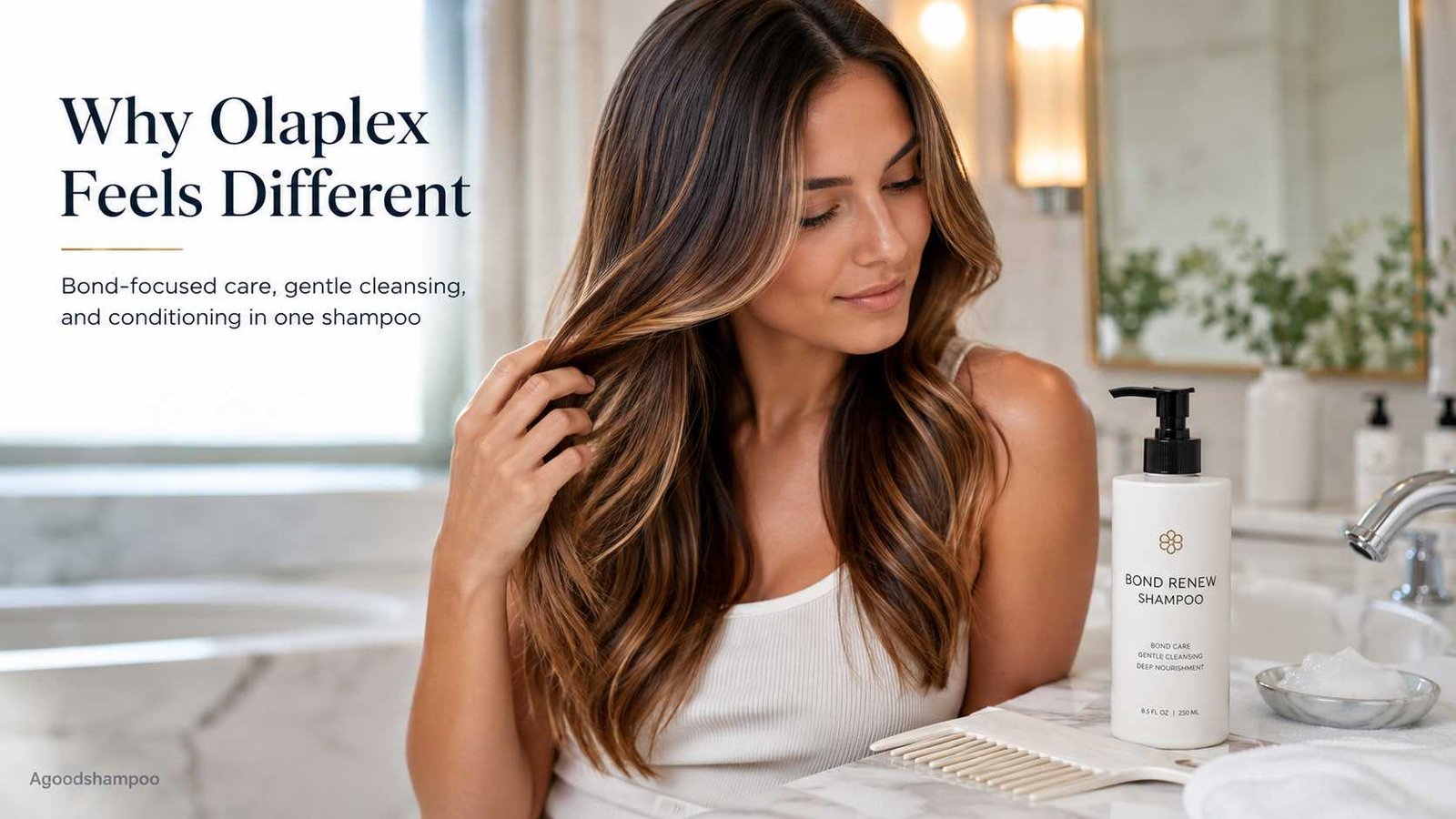
 If you have dry, bleached, colored, heat-damaged, or breakage-prone hair, Olaplex Nº.4 can feel very different from a basic shampoo. It doesn’t just rely on cleansing ingredients. The formula also contains conditioning polymers, silicone-based conditioning agents, humectants, oils, and Olaplex’s signature ingredient, Bis-Aminopropyl Diglycol Dimaleate.
That combination helps explain why Olaplex shampoo is so good for some people. It can cleanse while leaving damaged hair smoother, softer, and easier to manage.
But there’s an important limit to the hype. A shampoo cannot return heavily damaged hair to its untouched original state. Olaplex also makes stronger bond-repair claims than independent published research currently proves for the finished Nº.4 shampoo.
So, is Olaplex shampoo good? Yes, especially for medium-to-coarse, dry, chemically treated, or damage-prone hair. But the formula, your hair texture, and your expectations matter more than the Olaplex name alone.
Quick Answer
Olaplex Nº.4 is good because it combines a sulfate-free cleansing system with conditioning ingredients and the brand’s bond-building ingredient. The current standard Nº.4 is aimed mainly at medium, thick, and coarse hair, while Nº.4FINE is designed for finer hair. Olaplex says Nº.4 strengthens hair and reduces damage, but some visible softness and smoothness also come from familiar cosmetic ingredients such as amodimethicone and conditioning polymers.
Why Is Olaplex Shampoo So Good?
Olaplex Nº.4 works well because it does several jobs at the same time.
A normal shampoo mainly needs to remove oil, sweat, dirt, styling residue, and other buildup from your scalp and hair. Olaplex Nº.4 does that, but its formula also contains ingredients intended to make damaged hair feel better after cleansing.
The current formula includes:
- Several sulfate-free surfactants
- Bis-Aminopropyl Diglycol Dimaleate
- Amodimethicone
- Polyquaternium conditioning agents
- Guar Hydroxypropyltrimonium Chloride
- Panthenol
- Glycerin and other humectant-type ingredients
- Sunflower, apricot, and argan oils
- Sodium hyaluronate
- A hydrolyzed vegetable protein derivative
- Fragrance
Olaplex currently describes Nº.4 Bond Maintenance Strengthening Shampoo as a concentrated shampoo for medium-to-coarse hair and says it is color-safe and suitable for chemically treated hair. The brand also says its Nº.4 and Nº.5 system can improve strength, shine, softness, and breakage-related measures. Those performance claims come from Olaplex’s testing, so they should be understood as manufacturer-supported claims rather than independent proof that every user will get the same result.
The ingredient list tells us something useful, though: Olaplex is not simply putting one unusual molecule into an ordinary shampoo. The whole formula is designed around both cleansing and conditioning.
That matters more than most ingredient marketing suggests.
What Makes Olaplex Nº.4 Different From a Regular Shampoo?
It uses a blend of sulfate-free cleansers
Olaplex Nº.4 does not use SLS or SLES as its main cleansing system. Its current formula instead includes surfactants such as Sodium Lauroyl Methyl Isethionate, Cocamidopropyl Hydroxysultaine, Potassium Cocoyl Glycinate, Disodium Cocoyl Glutamate, Sodium Lauroyl Sarcosinate, and Decyl Glucoside.
A surfactant helps water mix with oil and dirt so you can rinse them away.
That doesn’t mean every sulfate-free shampoo is automatically gentle or that sulfates are always bad. The behavior of a shampoo depends on the whole surfactant blend, concentration, pH, conditioning system, and how often you use it.
Still, Olaplex has built Nº.4 around a mixed cleansing system rather than a single harsh detergent. That helps explain why many people with processed or dry hair find it less stripping than some basic shampoos.
It conditions while it cleans
One overlooked reason Olaplex can make hair feel immediately better is its conditioning system.
The current Nº.4 contains amodimethicone, a silicone commonly used in hair products, as well as Polyquaternium-10, Polyquaternium-11, and Guar Hydroxypropyltrimonium Chloride.
These types of ingredients can help:
- Reduce friction between strands
- Improve combing
- Make the hair surface feel smoother
- Reduce roughness
- Improve shine
- Help control frizz
- Make damaged ends feel less dry
Damaged hair tends to have a rougher, more irregular surface than untouched hair. Conditioning ingredients are useful because they can deposit on damaged areas and reduce friction.
A detailed review of hair-care physicochemistry describes conditioning as a process involving interactions between hair surfaces, surfactants, polymers, oils, silicones, and other deposited materials. In other words, how good hair feels after shampooing depends on much more than whether one hero ingredient is present.
That is a big part of what makes Olaplex feel premium.
The Ingredient Everyone Talks About: Bis-Aminopropyl Diglycol Dimaleate
Olaplex became famous because of Bis-Aminopropyl Diglycol Dimaleate, the ingredient associated with its bond-building technology.
To understand the claim, it helps to understand hair structure first.
Hair is mainly made of keratin proteins. Several types of chemical interactions help give a hair fiber its shape and mechanical behavior. These include hydrogen bonds, ionic interactions, hydrophobic interactions, and strong sulfur-containing disulfide bonds.
A 2024 scientific review in the International Journal of Cosmetic Science confirms that disulfide bonds are an important part of hair structure, while also explaining that hair bonding is more complicated than the simple diagrams often used in beauty marketing. Different bonds may behave differently depending on where they sit inside the fiber and how the hair is treated.
Bleaching is a good example of how those structures can be damaged.
Research examining bleached human hair found oxidation of sulfur-containing amino acids and conversion of cystine disulfide bonds into cysteic acid. Researchers also observed cuticle and cortex damage and increasing protein loss with more severe bleaching.
This is why bleached hair can become weaker, rougher, more porous, and more likely to break.
Does Olaplex actually rebuild those bonds?
Olaplex says its patented bond-building technology acts on damaged hair and strengthens or reinforces bonds. Its current Nº.4 marketing describes the shampoo as working at a molecular level.
The chemistry is plausible enough to justify serious interest, and Olaplex has intellectual-property filings involving Bis-Aminopropyl Diglycol Dimaleate and hair-strengthening applications. Recent Olaplex patent literature also describes the molecule in methods intended to increase hair strength and reduce breakage. A patent, however, is not the same thing as independent clinical proof that the finished shampoo permanently restores all broken disulfide bonds in real-world hair.
That distinction matters.
The safest evidence-based way to describe Nº.4 is this:
Olaplex contains a proprietary bond-focused ingredient and the brand has testing supporting improved hair performance, while independent scientific evidence specifically proving the full marketing mechanism of the finished Nº.4 shampoo remains more limited.
You don’t need to reject Olaplex because of that. You just don’t need to turn a cosmetic claim into something stronger than the evidence allows.
The Formula Does More Than Bond Building
If you only focus on Bis-Aminopropyl Diglycol Dimaleate, you miss much of what makes Nº.4 work.
Amodimethicone
Amodimethicone is a silicone-based conditioning ingredient.
Silicones sometimes get blamed for buildup, but that is too simple. In a well-designed shampoo or conditioner, a silicone can help reduce friction and improve the surface feel of damaged hair.
For someone with bleached or rough hair, that cosmetic improvement can be very useful. Hair that moves past neighboring strands with less friction may be easier to detangle and less likely to suffer unnecessary mechanical stress during brushing.
This doesn’t mean amodimethicone permanently heals damaged keratin. It means it can make the fiber behave and feel better.
That’s still a real benefit.
Polyquaterniums and cationic conditioning agents
The formula contains several conditioning polymers.
Damaged hair surfaces tend to develop more negatively charged sites. Cationic, or positively charged, conditioning ingredients can be attracted to those areas.
The result may be better slip, less static, and easier combing.
Again, that is cosmetic conditioning rather than biological healing. Your hair shaft is not living tissue. A product can improve its condition and performance without literally regenerating it.
Humectants and hydration-supporting ingredients
Nº.4 contains ingredients such as Glycereth-26, glycerin, panthenol, propanediol, and sodium hyaluronate.
These ingredients are commonly included in formulas designed to help maintain a hydrated feel.
The phrase hydrated hair can be confusing because hair does not hydrate like living skin. In practical hair care, people usually mean that the fiber feels softer, more flexible, and less dry or brittle.
Oils and plant extracts
Olaplex also includes sunflower seed oil, apricot kernel oil, argan oil, rosemary extract, green tea extract, pomegranate extract, banana fruit extract, and several other botanical ingredients.
These look attractive on an ingredient list, but I wouldn’t buy Nº.4 mainly for its botanical extracts.
Many of them appear much lower in the formula than the main cleansing and conditioning ingredients.
The surfactant system, conditioning polymers, silicone, and bond-building ingredient are far more useful for understanding why this shampoo behaves the way it does.
Is Olaplex Shampoo Good for Damaged or Bleached Hair?
This is where Nº.4 makes the most sense.
Chemical treatments can alter both the surface and internal structure of hair. Bleaching is particularly damaging because oxidative chemistry does more than remove pigment. Research has shown oxidation of hair proteins, damage to cuticle layers, and disruption of sulfur-containing structures within the fiber.
That doesn’t mean everyone who colors their hair needs Olaplex.
But a shampoo that cleans without leaving already-damaged hair extremely rough, while also adding conditioning ingredients, can be useful.
Nº.4 may be a good fit if your hair is:
- Bleached
- Highlighted
- Frequently colored
- Heat-styled often
- Chemically straightened or processed
- Rough after washing
- Prone to tangling
- Breaking along the lengths
One point is worth stressing: breakage is not the same as hair loss from the root.
Olaplex is a cosmetic hair-care product. It is not a treatment for androgenetic alopecia, alopecia areata, thyroid-related shedding, nutritional hair loss, or other medical causes of hair loss.
If you’re suddenly shedding large amounts of hair, developing bald spots, or experiencing persistent scalp pain, sores, or inflammation, a dermatologist or qualified healthcare professional is more appropriate than changing shampoos.
Is Olaplex Shampoo Good for Color-Treated Hair?
Yes, Nº.4 is specifically marketed as color-safe and suitable for chemically treated hair.
Its sulfate-free cleansing system may also appeal to people who don’t want an aggressive-feeling wash on dry, processed lengths.
Color fading, however, depends on more than shampoo.
Hot water, UV exposure, frequent washing, heat styling, the type of dye used, hair porosity, and the condition of the cuticle all matter.
So a color-safe shampoo can support a color-care routine, but it can’t completely prevent fading.
The 2026 Change That Matters: Standard Nº.4 Is Not the Only Choice
Older Olaplex advice often treated Nº.4 as the obvious daily shampoo for nearly everyone.
The current product lineup is more specific.
Olaplex now positions its standard Nº.4 Bond Maintenance Strengthening Shampoo primarily for medium, thick, and coarse hair. The company lists Nº.4FINE Bond Maintenance Shampoo for fine-to-medium hair and also offers a separate Nº.4CURL formula for waves, curls, and coils.
This is a useful change because hair diameter affects how a conditioning formula feels.
| Hair need | Olaplex option that may make more sense |
|---|---|
| Fine hair that becomes flat easily | Nº.4FINE |
| Medium, thick, or coarse damaged hair | Standard Nº.4 |
| Waves, curls, or coils needing curl-focused care | Nº.4CURL |
| Heavy mineral, product, or environmental buildup | Nº.4C Clarifying Shampoo |
| Blonde or gray hair needing toning | Nº.4P Purple Shampoo |
The standard Nº.4 includes amodimethicone and a rich conditioning system. That may feel great on thick, porous hair but more noticeable on very fine strands.
Nº.4FINE uses a different formula. Olaplex says it is designed to add volume and hydration without over-conditioning fine hair. Its ingredient list uses surfactants including Sodium Cocoyl Alaninate, Sodium Cocoyl Isethionate, glucosides, and Cocamidopropyl Hydroxysultaine, plus conditioning polymers and Bis-Aminopropyl Diglycol Dimaleate.
So if you tried classic Nº.4 years ago and thought, this makes my hair too flat, the brand now has a more logical option for that problem.
Who Is Most Likely to Love Olaplex Nº.4?
Classic Nº.4 makes the most sense for someone who values conditioning almost as much as cleansing.
You may like it if you have medium-to-coarse hair that feels:
- Dry after shampooing
- Rough from bleaching
- Frizzy or difficult to detangle
- Damaged from frequent heat styling
- Porous after chemical treatments
- Dull or lacking smoothness
It also suits people who prefer a richer, salon-style shampoo rather than a very lightweight cleanser.
The formula is concentrated, too. Olaplex currently recommends emulsifying a small amount in your hands before applying it to wet hair. The company says the 250 mL bottle can provide up to 100 applications based on an average application size of 2.5 mL, although real use will obviously vary with hair length, density, and washing habits.
That is useful when judging the price. A more expensive bottle may not be as expensive per wash if you only need a small amount.
Who Might Not Love It?
Olaplex Nº.4 isn’t automatically the best shampoo for everyone.
Very fine hair
The standard formula may feel richer than necessary on very fine hair.
Try Nº.4FINE or another lightweight shampoo if your main problems are flat roots and loss of volume rather than dryness.
Very oily scalps
Nº.4 can cleanse an oily scalp, but someone with heavy sebum production or significant styling buildup may sometimes prefer a stronger cleansing or occasional clarifying shampoo.
People avoiding silicones
Classic Nº.4 contains amodimethicone and another silicone polymer.
If you personally follow a silicone-free routine, standard Nº.4 won’t fit that preference. Nº.4FINE, by contrast, is currently marketed by Olaplex as formulated without silicones.
Fragrance-sensitive users
Nº.4 contains fragrance along with listed fragrance components such as limonene, citral, and hexyl cinnamal.
Olaplex describes the scent as grapefruit zest with sugared mint and ginger over crushed sage.
Some people love that salon-like scent. Others with fragrance-sensitive scalps may not.
If shampoo repeatedly causes itching, burning, redness, or rash, stop using it rather than trying to train your scalp to tolerate it.
People expecting hair regrowth
Nº.4 is not a hair-growth medicine.
Ingredients such as biotin and rosemary may look familiar from hair-growth marketing, but their presence in a rinse-off shampoo does not establish that Nº.4 treats clinical hair loss.
Does Olaplex Nº.4 Contain Protein?
The current standard Nº.4 ingredient list includes Hydrolyzed Vegetable Protein PG-Propyl Silanetriol.
Olaplex’s own FAQ says the shampoo is formulated with hydrolyzed protein for moisture-related benefits.
That creates an important distinction.
Olaplex’s signature bond-building molecule is not itself a protein treatment, but classic Nº.4 does contain a protein-derived ingredient.
If your hair feels stiff or rough with certain protein-containing products, don’t assume every Olaplex product is automatically protein-free. Check the exact bottle you are buying because formulas can change.
Olaplex itself advises customers to consult the packaging for the most current ingredient list.
Can You Use Olaplex Shampoo Every Day?
Olaplex says Nº.4 is formulated for daily use or whenever you normally wash your hair.
That does not mean you need to wash every day.
Your ideal washing schedule depends on:
- Scalp oil production
- Exercise and sweating
- Hair texture
- Styling-product use
- Dandruff or scalp conditions
- Hair density
- How quickly your roots become dirty
If your scalp becomes oily every day, frequent washing can be reasonable.
If your scalp stays comfortable and your lengths are very dry, washing less often may suit you better.
A shampoo should fit your scalp, not a fixed internet rule.
How to Use Olaplex Nº.4 Without Wasting It
Because Nº.4 is concentrated, starting with too much can make it harder to rinse and can waste an expensive product.
A simple routine works best:
- Wet your scalp and hair thoroughly.
- Put a small amount of shampoo into your palm.
- Rub it between wet hands to spread and emulsify it.
- Focus the shampoo mainly on the scalp and roots.
- Massage gently with fingertips rather than scratching.
- Let the lather move through the lengths as you rinse.
- Repeat only if your scalp still feels dirty or you have heavy buildup.
- Follow with conditioner, especially if your lengths are dry or chemically treated.
Olaplex’s current instructions similarly recommend emulsifying the shampoo, applying it to wet hair, lathering thoroughly, and rinsing well.
You don’t need to scrub damaged ends aggressively. They rarely produce much oil and usually need less detergent than your scalp.
Is Olaplex Shampoo Worth the Price?
It can be, but only if its strengths match your hair.
The price makes more sense for:
- Bleached hair that tangles after washing
- Thick hair that benefits from extra conditioning
- Processed hair prone to breakage
- People who use very little shampoo per wash
- Anyone who specifically likes Olaplex’s texture and finish
It makes less sense if your hair is already healthy, short, untreated, and easy to manage with an inexpensive shampoo.
You also shouldn’t pay a premium merely because the bottle says bond repair.
Plenty of less expensive shampoos use thoughtful combinations of surfactants, conditioning polymers, silicones, and humectants.
Olaplex’s difference is the combination of that conventional formulation science with its proprietary bond-building platform.
Whether that difference is worth the price is personal.
Olaplex vs Pureology: Why Do People Like Both?
Some of the same shoppers who ask why Olaplex shampoo is so good also ask why Pureology shampoo is so good for your hair.
The two brands overlap, but they aren’t identical.
Pureology Hydrate is currently positioned mainly as a sulfate-free moisturizing shampoo for dry, color-treated hair. Its current formula also contains Sodium Cocoyl Isethionate, Disodium Laureth Sulfosuccinate, Sodium Lauryl Sulfoacetate, Decyl Glucoside, amodimethicone, conditioning polymers, and protein-related ingredients.
So both formulas use familiar cosmetic strategies for gentle-feeling cleansing and conditioning.
The difference is emphasis.
Olaplex: stronger focus on bond-building and damage-related strength claims.
Pureology Hydrate: stronger focus on moisture, softness, and color-treated hair.
Neither brand is automatically better.
If your main issue is heavily processed, breakage-prone hair, Olaplex may make more sense.
If your main concern is dry color-treated hair and you primarily want a rich moisturizing wash, Pureology Hydrate may be just as logical.
Is Olaplex Dry Shampoo Good?
Olaplex Nº.4D Clean Volume Detox Dry Shampoo serves a very different purpose from Nº.4.
Regular shampoo uses water and surfactants to remove oil and dirt during rinsing.
Dry shampoo mainly makes oily roots look and feel fresher between washes by absorbing oil.
The current Nº.4D formula contains oil-absorbing materials including aluminum starch octenylsuccinate, bentonite, zeolite, and rice starch. It also contains Bis-Aminopropyl Diglycol Dimaleate. Olaplex says the product reduces visible oil and helps refresh hair without a powdery residue.
So, is Olaplex dry shampoo good?
It can be useful if you want to stretch a hairstyle for another day or reduce greasy-looking roots.
Olaplex currently advises spraying Nº.4D onto dry roots, waiting about 30 seconds, and then massaging it in.
But dry shampoo does not replace washing forever.
It absorbs or disguises oil rather than rinsing away the full mixture of sweat, sebum, dead skin, pollution, and styling residue on your scalp.
Use it as a refresh product, not as permanent scalp cleansing.
What Is So Good About Olaplex’s Scent?
Some people search for a shampoo simply because they want the one that smells so good.
Classic Nº.4 has a noticeable fragrance profile.
Olaplex currently describes it with:
Top: Grapefruit zest
Middle: Sugared mint and ginger
Base: Crushed sage
That combination gives Nº.4 the clean, slightly fresh, salon-product character many users associate with the brand.
Scent is completely personal, though.
A fragrance that feels luxurious to one person may feel strong to someone else. It also has no meaningful connection to whether the shampoo repairs or conditions your hair well.
What Olaplex Can and Cannot Do
This is the easiest way to keep expectations realistic.
| Olaplex Nº.4 may help with | Olaplex Nº.4 cannot reliably do |
|---|---|
| Cleansing scalp oil and buildup | Regrow hair lost from the follicle |
| Making hair feel smoother | Cure scalp disease |
| Reducing friction and tangling | Reverse every form of permanent chemical damage |
| Supporting softness and shine | Make bleaching harmless |
| Improving the cosmetic feel of damaged hair | Replace a conditioner for every hair type |
| Supporting breakage-prone processed hair | Permanently repair split ends back into untouched hair |
| Maintaining a color-care routine | Stop all color fading |
Hair-care marketing often blurs the line between repair and restoration.
A damaged fiber can perform better after treatment. It can feel smoother, retain length more easily, tangle less, and break less under certain conditions.
That doesn’t mean it has become identical to virgin hair again.
Keeping that distinction in mind makes Olaplex easier to judge fairly.
Expert Verdict: Why Is Olaplex Shampoo So Good?
Olaplex Nº.4 is good because its entire formula is built for hair that needs more than simple cleansing.
The sulfate-free surfactant blend removes oil and dirt. Amodimethicone and conditioning polymers improve slip and smoothness. Humectants and oils support a softer feel. Bis-Aminopropyl Diglycol Dimaleate gives Olaplex its distinctive bond-focused formulation strategy.
For medium-to-coarse, bleached, colored, heat-styled, or breakage-prone hair, that combination can make Nº.4 a very sensible premium shampoo.
It isn’t magic, though.
Independent evidence supports the fact that bleaching and other chemical treatments can damage hair proteins and disulfide structures, but that doesn’t prove every broad bond-repair statement made about the finished Olaplex shampoo.
And the current Olaplex range makes hair type more important than before. Fine hair may be better served by Nº.4FINE, while curl-focused users now have Nº.4CURL.
So the best answer to Why Is Olaplex Shampoo So Good? is not simply because it repairs bonds.
It’s good because it combines thoughtful cleansing, substantial conditioning, damage-focused formulation, and a proprietary bond-building ingredient in one concentrated shampoo.
For the right hair, that combination works very well.
Frequently Asked Questions
Is Olaplex shampoo good?
Yes. Olaplex Nº.4 is a well-formulated shampoo for people who want cleansing plus substantial conditioning and damage-focused care. The standard version now makes the most sense for medium, thick, or coarse hair, especially when the hair is dry or chemically treated.
Why is Olaplex shampoo so expensive?
Part of the price comes from its premium brand positioning and proprietary bond-building technology. The shampoo is also highly concentrated, so a small amount may be enough per wash. Whether it represents good value depends on how much your hair benefits from the formula.
Is Olaplex Nº.4 sulfate-free?
Yes. Olaplex currently states that Nº.4 is formulated without sulfates and SLS/SLES. Its cleansing system uses other surfactants instead.
Is Olaplex shampoo good for fine hair?
Fine hair can use Olaplex, but Nº.4FINE is now the more targeted choice. Olaplex developed that formula to cleanse and condition fine hair while maintaining volume and reducing the risk of a weighed-down feel.
Is Olaplex good for bleached hair?
It can be a good choice. Bleaching causes structural and oxidative damage to human hair, including damage involving sulfur-containing proteins. Olaplex combines conditioning ingredients with its bond-focused technology, making it especially relevant to chemically processed hair.
Does Olaplex Nº.4 contain silicone?
Yes. The current standard Nº.4 formula lists amodimethicone and Divinyldimethicone/Dimethicone Copolymer. Nº.4FINE is separately marketed by Olaplex as formulated without silicones.
Does Olaplex shampoo contain protein?
The current standard Nº.4 lists Hydrolyzed Vegetable Protein PG-Propyl Silanetriol, and Olaplex’s FAQ describes the formula as containing hydrolyzed protein. Always check your bottle because ingredient lists can change.
Is Olaplex dry shampoo good?
Nº.4D can be useful for absorbing excess oil and refreshing roots between regular washes. Its formula includes starch, bentonite, and zeolite as oil-absorbing materials. It should supplement normal washing rather than permanently replace it.Ingredient lists and product positioning can change. Check the packaging of the product sold in your country before buying if a specific ingredient is important to you.

Marlena Stell makes everyday hair care easier to understand. From choosing a shampoo to managing common hair concerns, she breaks down confusing product claims and practical routines into straightforward advice that helps readers find what works for their needs.