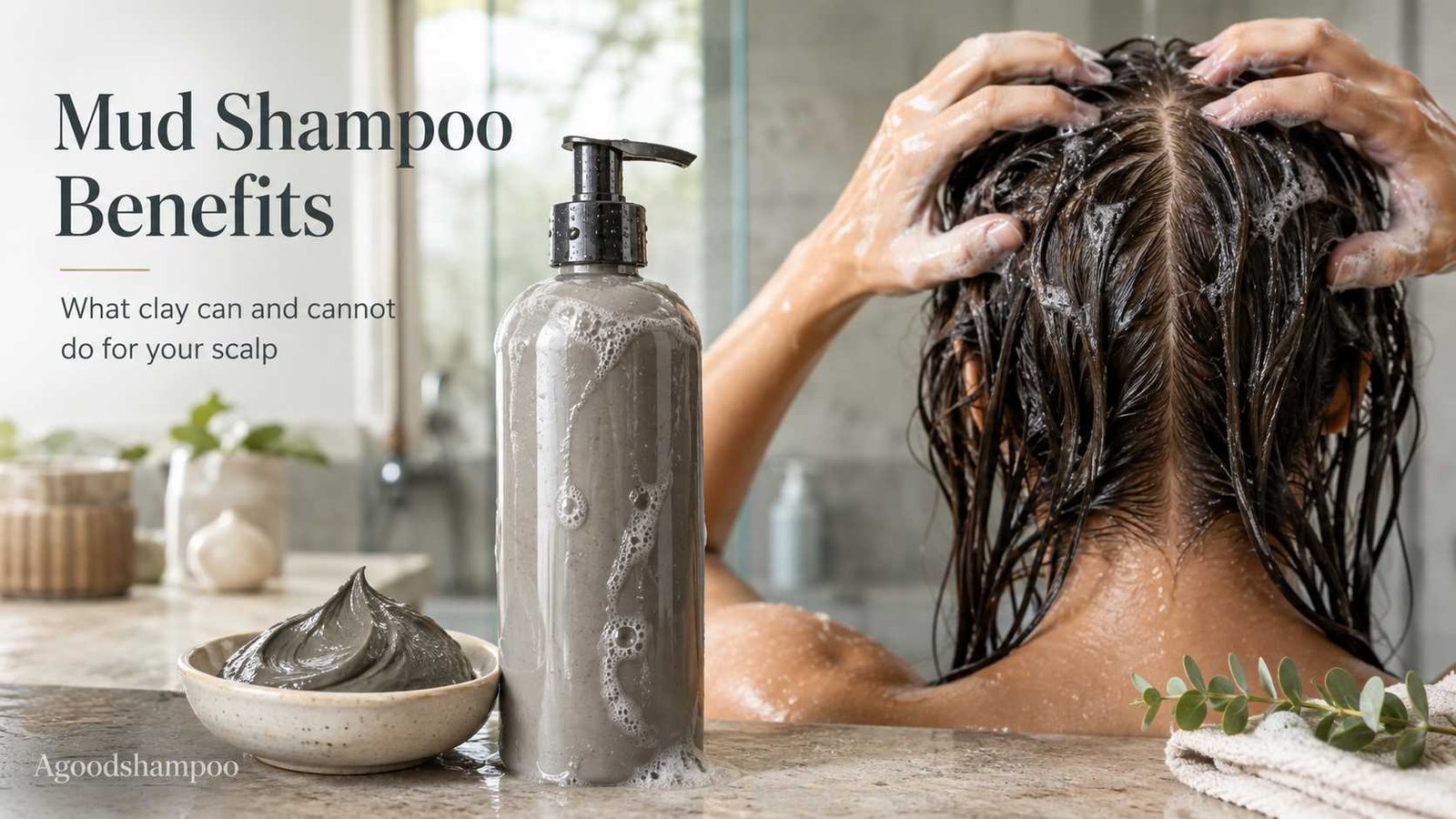
 Mud shampoo can be good for you if your main problem is an oily scalp, greasy roots, or product buildup. The mud or clay in these shampoos can help take up surface oil, while the shampoo’s surfactants do the main job of washing away sebum, sweat, dirt, and styling residue.
That does not mean every mud shampoo is automatically better than a regular shampoo.
The whole formula matters much more than the word mud on the bottle. Some mud shampoos contain strong cleansers. Others use milder surfactants and add conditioners, silicones, oils, proteins, or humectants. Two bottles called mud shampoo can behave very differently on your hair.
There is also a limit to what the research supports. Cosmetic clays have well-established absorbent and adsorbent properties, but direct clinical research on finished mud shampoos for hair growth, dandruff, or stronger follicles is limited.
Quick answer: Mud shampoo makes the most sense as a cleansing and oil-control product. It may leave greasy hair feeling fresher and lighter, but it should not be treated as a proven hair-growth treatment, scalp detox, or dandruff medicine.
What Is Mud Shampoo?
Mud shampoo is regular shampoo that contains a mud, silt, or clay ingredient as part of its formula.
You may see terms such as Dead Sea mud, Dead Sea silt, mineral mud, maris limus, kaolin, bentonite, or another cosmetic clay on a product label.
Dead Sea mud and cosmetic clay are not exactly the same thing. Dead Sea mud is mineral-rich silt from the Dead Sea area. Kaolin and bentonite are specific types of clay minerals with their own physical properties.
Still, they are often used in cosmetics for a similar reason: their surfaces can interact with water, oils, and other materials.
A scientific review of clay minerals in dermocosmetic products describes clay minerals as useful absorbents and adsorbents. They may also help control product texture and stability.
That sounds promising for oily hair, but there is an important detail.
Mud is usually only one part of the shampoo.
For example, current commercial mud shampoos may contain surfactants such as sodium laureth sulfate, cocamidopropyl betaine, disodium laureth sulfosuccinate, decyl glucoside, or other cleansers. Some also contain dimethicone, polyquaterniums, panthenol, plant oils, proteins, glycerin, or aloe.
Those ingredients can change the way the shampoo cleans and how your hair feels after rinsing. Current listings for similarly named Dead Sea mud shampoos even show noticeably different ingredient systems across brands and markets.
So asking whether mud shampoo is good is a little like asking whether vegetable soup is healthy. You still need to know what else is in the bowl.
Why Is Mud Shampoo Good for You?
Mud shampoo may be useful because it combines conventional shampoo cleansing with an oil-absorbing mineral ingredient.
For someone whose roots look greasy soon after washing, that combination can feel especially effective.
But the science works in two separate steps.
Clay or Mud Can Interact With Surface Oil
Clay minerals have absorbent and adsorbent properties.
Absorption means a substance takes another material into itself. Adsorption means material sticks to its surface.
Both properties are useful in cosmetics designed for oily skin.
A 2023 study of a clay mask containing kaolin and bentonite found improvements in measures related to oily skin. That study involved facial skin rather than hair or scalp, so it cannot prove that a mud shampoo will produce the same result. It does, however, support the basic idea that cosmetic clays can be useful in oil-control formulations.
This distinction matters. We have reasonable evidence for clay as an oil-handling cosmetic material. We have much less direct evidence that simply adding mud to shampoo gives special benefits to hair follicles.
Surfactants Do Most of the Actual Washing
Your scalp produces sebum, which is oily and does not rinse away well with plain water.
Shampoo solves that problem with surfactants.
Surfactant molecules have an oil-attracting part and a water-attracting part. They interact with oily residue and help suspend it in water so it can rinse away.
Dermatology reviews describe removal of sebum, sweat, skin scales, environmental dirt, and hair-product residue as the main purpose of shampoo.
So mud does not replace shampoo chemistry.
A better way to think about it is this:
The clay can support oil control, while the surfactant system performs the main cleansing job.
That is why reading the full ingredient list tells you much more than judging a product by its mud content.
What Benefits Can Mud Shampoo Really Provide?
The realistic benefits depend on your scalp and on the complete formula.
| Possible benefit | Why it may happen | What the evidence really supports |
|---|---|---|
| Less greasy-feeling roots | Clay may interact with surface oils while surfactants remove sebum | Reasonable cosmetic benefit |
| Cleaner scalp feel | Shampoo removes oil, sweat, scales and residue | Well-established shampoo function |
| Less product buildup | Surfactants can remove styling residue and oily deposits | Depends strongly on cleanser system |
| More apparent volume | Removing excess oil may stop strands from clumping flat against the scalp | Cosmetic effect, not new hair growth |
| Softer hair | Conditioners, silicones, oils or polymers may reduce roughness | Depends on the rest of the formula |
| Better scalp comfort | Possible if the formula removes excess oil without irritating the skin | Highly formula- and person-dependent |
Mud Shampoo May Help With Oily Roots
This is probably its strongest use.
Fine or straight hair can show scalp oil quickly because sebum can spread along the hair shaft more easily. Hair near the scalp may begin to separate into greasy sections even while the ends still feel normal.
A well-formulated mud shampoo may help remove that greasy coating.
You may notice that the hair looks lighter or fuller afterward because clean individual strands do not stick together as much.
That is a cosmetic volume effect. It is not evidence that the shampoo increased the number of hairs growing from your scalp.
It May Help Remove Styling Buildup
Hair oils, pomades, serums, leave-in products, waxes, sprays, and dry shampoo can leave residue behind.
A mud shampoo with a suitable surfactant system may remove some of that buildup.
But mud is not essential for this job. A conventional clarifying shampoo can also remove buildup, sometimes more effectively.
If your only goal is a deep cleanse, compare the complete formulas rather than assuming that mud automatically makes one shampoo stronger.
It Can Leave the Scalp Feeling Fresher
People often describe freshly washed oily hair as lighter and cleaner.
That feeling usually comes from removing sebum and residue.
Mud may contribute, but the cleanser system still matters most.
If a formula removes too much oil, the same shampoo that makes one person’s scalp feel fresh may make another person’s scalp feel tight, itchy, or dry.
That is why stronger cleansing is not always better cleansing.
Does Dead Sea Mud Strengthen Hair?
This is where marketing claims often run ahead of the evidence.
Dead Sea mud contains various minerals, and brands commonly highlight minerals such as magnesium, calcium, potassium, and others. Some mud-shampoo sellers then connect those minerals with stronger hair, faster growth, better circulation, or reduced hair loss.
Those are manufacturer claims. They should not automatically be treated as clinical facts.
Finding a mineral in mud does not prove that the mineral travels through a rinse-off shampoo, reaches a hair follicle in a useful amount, and changes hair growth.
Hair that has already emerged from your scalp is made largely from keratinized tissue. Shampoo can change its surface feel, cleanliness, friction, shine, and manageability. That is very different from medically changing the biological process that produces new hair.
Direct clinical evidence showing that ordinary Dead Sea mud shampoo causes meaningful human hair growth is lacking.
If a mud shampoo makes your hair look fuller after washing, a simpler explanation is often better: cleaner roots separate more easily and sit with more lift.
Does Mud Shampoo Detox Your Scalp?
“Detox” is common beauty language, but it can be misleading.
Your scalp does not need a cosmetic shampoo to pull mysterious toxins out of your body.
A shampoo can do something much more ordinary and useful: remove oil, sweat, loose skin cells, environmental debris, and hair-product residue.
Calling that process cleansing is clearer than calling it detoxification.
If a mud shampoo leaves your roots less greasy and removes yesterday’s styling cream, that is a genuine cosmetic benefit. There is no need to turn it into a toxin-removal claim.
Is Mud Shampoo Good for Dandruff?
Mud shampoo may wash away loose flakes and excess surface oil, but mud alone is not a proven dandruff treatment.
Dandruff has several contributing factors and is closely related to seborrheic dermatitis. A cosmetic shampoo that simply contains clay or Dead Sea mud should not automatically be treated like a medicated dandruff shampoo.
The American Academy of Dermatology recommends choosing dandruff shampoos with established active ingredients such as ketoconazole, selenium sulfide, salicylic acid, sulfur, coal tar, or zinc pyrithione where available and appropriate.
Some companies market mud shampoo for flaky or itchy scalps. That does not mean mud itself has been proven to treat the underlying condition.
If your flakes are mainly related to an oily scalp and product accumulation, simply washing more effectively may make the scalp look cleaner.
Persistent flaking is different.
If you have strong itching, redness, thick scaling, sores, pain, or flakes that continue despite normal care, a dermatologist can help determine whether you are dealing with dandruff, seborrheic dermatitis, psoriasis, contact dermatitis, or another scalp problem.
Who Is Mud Shampoo Best For?
Oily Hair and Oily Scalps
Mud shampoo makes the most sense for people who regularly struggle with greasy roots.
Look for a product that cleans well without leaving the lengths stiff.
If your scalp becomes oily within a day but your ends are dry, focus shampoo mainly on the scalp. Let the rinse water clean the lengths rather than aggressively rubbing shampoo through your ends.
Fine Hair
Fine hair often loses volume quickly once oil causes strands to clump together.
Removing that oil can give the hair more movement and apparent body.
Still, check the rest of the formula. A mud shampoo loaded with heavy oils, butters, silicones, or conditioning polymers may feel too rich for some fine hair.
“Mud shampoo” does not tell you whether a formula will be light or heavy.
Curly and Coily Hair
Curly and tightly coiled hair often needs more help retaining lubrication along its length.
A strong cleanser that feels wonderful on very oily straight hair may leave curls rough or difficult to detangle.
Research on shampoo formulation shows why. Stronger sebum removal can leave hair dry, rough, and more prone to friction, while milder surfactant combinations and conditioning agents can improve feel and manageability.
If you have curly or coily hair, choose mud shampoo for a specific reason, such as occasional buildup, rather than assuming it should replace your regular moisturizing shampoo.
Dry, Bleached, or Chemically Treated Hair
Proceed more carefully.
Bleaching, coloring, relaxing, heat styling, and other chemical or physical stresses can leave hair more vulnerable to roughness and breakage.
If you want to try mud shampoo, look beyond the mud ingredient.
Pay attention to the surfactants and conditioning ingredients. A formula containing humectants, conditioning polymers, silicones, or suitable oils may behave very differently from a strong clarifying formula.
If your hair becomes squeaky, tangled, stiff, or unusually frizzy after washing, the shampoo may simply be too cleansing for regular use.
Sensitive Scalps
Natural-looking packaging does not make a shampoo automatically gentle.
Shampoos can contain fragrance, preservatives, botanical extracts, and surfactants that irritate some people. Dermatology literature notes that contact reactions can occur with shampoo ingredients, including certain surfactants and preservatives.
If you already have a dry, reactive scalp, a simple fragrance-free gentle shampoo may be a better starting point than a product marketed for deep purification. The AAD likewise advises switching to a gentle non-medicated shampoo when ordinary hair products are contributing to scalp dryness.
How to Use Mud Shampoo Without Drying Out Your Hair
You do not need to coat every inch of your hair in a thick layer of mud shampoo. The scalp is where most oil accumulates.
- Wet your hair thoroughly. Give water enough time to saturate the scalp and roots.
- Apply a modest amount to the scalp. Add more only if your hair length or density requires it.
- Massage gently with your fingertips. Focus on oily areas rather than scratching with your nails.
- Follow the product’s contact-time directions. Some brands recommend around a minute, while others give different instructions. There is no universal mud-shampoo contact time.
- Rinse very well. Clay particles, cleanser, oil, and loosened residue all need to leave with the rinse water.
- Condition the lengths if needed. This is especially useful for long, curly, bleached, dry, or damaged hair.
- Adjust frequency according to results. If your roots stay greasy, you may need more frequent cleansing. If your scalp feels tight or your hair becomes rough, reduce use or switch to a milder formula.
There is no scientifically correct rule that everyone should use mud shampoo every day, once a week, or exactly twice a week.
Even manufacturers differ. One current Dead Sea mud shampoo listing recommends two or three uses per week, while other brands market their products for regular or daily washing.
Your scalp oil level, hair type, styling habits, and the actual formula matter more than the product category.
Mud Shampoo vs Dry Shampoo
These products may both make oily hair look fresher, but they do not work the same way.
| Mud shampoo | Dry shampoo |
|---|---|
| Used with water | Used on dry hair |
| Contains cleansing surfactants | Mainly uses particles or powders to absorb oil |
| Washes away sebum and residue | Temporarily reduces the appearance of greasiness |
| Can remove accumulated dry shampoo | Can build up when used repeatedly |
| Part of normal washing | Best used between wet washes |
The American Academy of Dermatology makes this distinction clearly: dry shampoo absorbs oil but does not actually clean the hair in the same way as regular shampoo and water.
So, is dry shampoo good for you?
It can be useful between washes, especially when you need a quick refresh. It should not completely replace washing your scalp with water and shampoo.
Mud shampoo and dry shampoo are therefore not direct substitutes.
Mud Shampoo vs Caffeine Shampoo
A caffeine shampoo targets a very different concern.
People usually choose caffeine products because they are worried about hair thinning or hair loss rather than excess scalp oil.
Topical caffeine has attracted real scientific interest. A 2025 systematic review identified nine clinical trials of topical caffeine products. The results generally favored caffeine, but the authors rated much of the evidence as low or very low quality because of limitations such as weak controls, missing concentration information, and study-design problems.
Some individual shampoo trials have also reported encouraging findings. That still does not make every caffeine shampoo a proven hair-loss treatment.
If your question is why caffeine shampoo is good for you, the answer is therefore different from mud shampoo.
Mud shampoo mainly makes sense for cleansing and oil control. Caffeine shampoo is marketed toward thinning and hair-loss concerns, where evidence is emerging but remains less certain than established medical treatments.
Sudden, patchy, or unexplained hair loss deserves medical assessment rather than endless shampoo switching.
Mud Shampoo vs Oatmeal Shampoo
Oatmeal shampoo is another product people may consider when the scalp feels uncomfortable.
Colloidal oatmeal has a much stronger research history for soothing and supporting irritated or dry skin than mud has for stimulating hair growth.
Research has found skin-barrier, moisturizing, and anti-inflammatory effects from colloidal oatmeal preparations. Oatmeal is also used in shampoo products, although much of the strongest clinical evidence comes from skin-care formulations rather than scalp-specific shampoo trials.
That gives the two ingredients different strengths.
If excess oil and buildup are your main problems, a clay or mud formula may make more sense.
If dryness, sensitivity, or itch is the main concern, a gentle oatmeal-containing formula may be worth considering, provided the rest of its ingredients are also suitable.
Neither ingredient can rescue a poorly matched shampoo formula.
Why Do You Need a Good Shampoo?
A good shampoo is not the one with the trendiest ingredient.
It is the one that removes enough unwanted oil and residue without leaving your scalp uncomfortable or your hair needlessly rough.
That balance is the heart of shampoo formulation.
Dermatology literature describes modern shampoo as a combination of cleansers, conditioning agents, thickeners, pH adjusters, preservatives, and other ingredients. The goal is not to remove every trace of oil. Excessive cleaning can leave hair rough, frizzy, dull, and hard to manage.
This is why shampoo is good for hair when it is matched to your needs.
It helps remove material that plain water cannot easily remove, including sebum and oily product residue. But using a cleanser that is too harsh for your hair can create another set of problems.
The label on the front of the bottle matters less than the performance of the whole formula.
Is Using a Variety of Shampoos Good for You?
You do not need a collection of shampoos simply because people say your hair will “get used to” one product.
But using different shampoos for different jobs can make sense.
For example, someone may use a mild regular shampoo for routine washing and a stronger clarifying shampoo occasionally after heavy styling-product use.
A person with dandruff may use a normal cosmetic shampoo on some wash days and a medicated dandruff shampoo according to its directions.
The AAD even notes that people treating dandruff sometimes need to alternate shampoos containing different active ingredients when one approach is not effective enough.
So variety is useful when each product has a clear purpose.
Randomly switching between mud, caffeine, oatmeal, clarifying, moisturizing, and protein shampoos is unlikely to improve hair simply because the bottles are different.
What Mud Shampoo Cannot Promise
The words “mineral,” “natural,” and “mud” can make a shampoo sound almost therapeutic.
Keep the expectations practical.
Mud shampoo can cleanse. It may support oil control. It can make greasy roots look fresher. Depending on the rest of the formula, it may also leave hair soft and manageable.
What the available evidence does not establish is that ordinary mud shampoo reliably grows new hair, stops genetic hair loss, permanently regulates sebaceous glands, cures dandruff, treats psoriasis, repairs follicles, or pulls harmful toxins from the body.
Some manufacturers make versions of these claims.
A manufacturer claim is evidence of what the company says about its product. It is not the same thing as an independent clinical trial proving the effect.
That difference matters most when a cosmetic starts sounding like medicine.
Frequently Asked Questions
Is mud shampoo good for oily hair?
Yes, it can be. Cosmetic clays have absorbent and adsorbent properties, and the shampoo’s surfactants remove sebum and residue. This combination may work especially well for greasy roots.
The formula still needs to suit your hair. A very strong cleanser may be too drying for oily roots with damaged or dry ends.
Can I use mud shampoo every day?
Possibly, but there is no universal rule.
Some mud shampoos are formulated for frequent use, while others are sold as occasional deeper cleansers. Check the product directions and pay attention to your hair.
If your scalp stays comfortable and your hair remains soft and manageable, your schedule may be fine. If you notice tightness, roughness, tangling, or increased dryness, use it less often or choose a milder formula.
Does mud shampoo help hair grow?
There is not strong clinical evidence showing that ordinary mud shampoo causes meaningful new hair growth.
Cleaner roots can make hair appear fuller, but that is different from stimulating follicles.
If you are experiencing ongoing thinning, a dermatologist can help identify the cause and discuss treatments with stronger evidence.
Is mud shampoo good for dandruff?
It may remove some loose flakes and scalp oil, but mud itself is not an established dandruff medication.
For persistent dandruff, look for a shampoo with a recognized dandruff active ingredient and follow the label directions.
Is dry shampoo good for you?
Dry shampoo is useful as a temporary oil absorber between normal washes.
It does not clean the scalp in the same way as shampoo and water, so it should not become your only cleansing method.
Why is caffeine shampoo good for you?
Caffeine shampoos are mainly used by people concerned about thinning hair.
Clinical research is promising, but the overall evidence base still has important limitations. A recent systematic review found mostly favorable results while rating much of the available evidence as low or very low quality.
Caffeine shampoo therefore has a different purpose from a mud shampoo designed mainly for oil and buildup.
Is oatmeal shampoo good for you?
It may be a good option for a dry or easily irritated scalp if the complete shampoo formula is gentle.
Colloidal oatmeal has evidence supporting skin-barrier and soothing effects, although evidence from scalp-shampoo studies is less extensive than evidence from skin-care research.
Is Mud Shampoo Worth Using?
So, why is mud shampoo good for you?
Its most believable advantage is simple: mud or clay can add oil-handling properties to a shampoo that already cleans the scalp with surfactants.
That can make mud shampoo a useful choice for oily roots, a greasy scalp, or product buildup.
It is less convincing as a treatment for hair growth, dandruff, or scalp disease unless the particular product contains an appropriate active ingredient and has evidence supporting that purpose.
Look past the mud on the front label. Check the surfactants, conditioners, fragrance, preservatives, and other ingredients. Then judge the shampoo by what your own scalp actually needs.
For many people, that is the difference between a shampoo that merely sounds impressive and one that genuinely fits their hair.

Michael Chen focuses on the science behind shampoos and hair-care ingredients. He explains how cleansing agents, silicones, proteins, and other formula components work, separating useful evidence from marketing claims to help readers better understand the products they use.