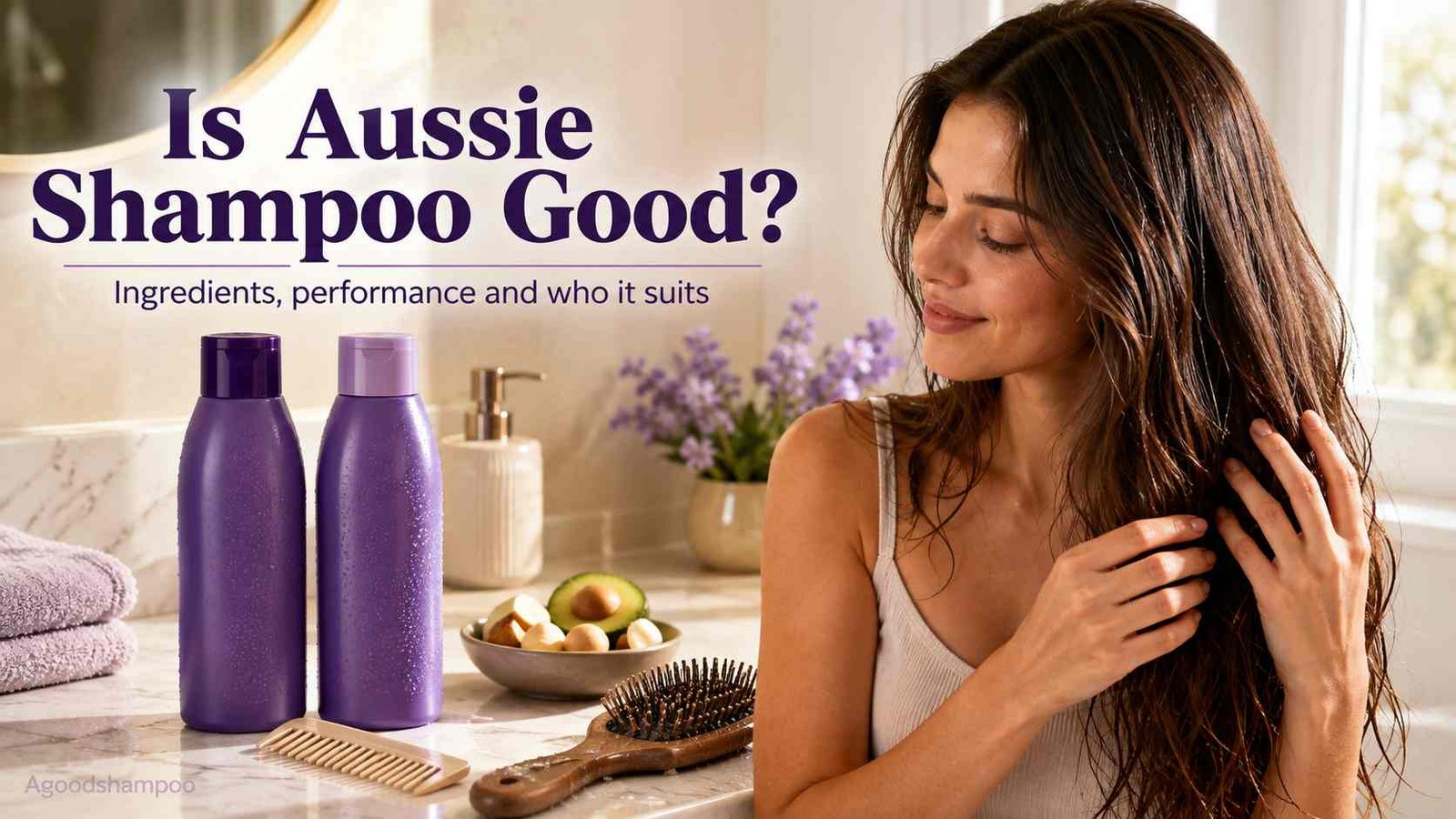
 Aussie is a good shampoo brand if you want affordable, strongly fragranced hair care that cleans well and offers formulas for different hair types. But it isn’t the best match for everyone.
Some popular Aussie shampoos use strong cleansing surfactants, silicones, fragrance, and conditioning ingredients. That combination can leave many people with clean, smooth, easy-to-manage hair. On very dry hair or a sensitive scalp, though, the same formula may feel less comfortable.
There is another important point: you can’t judge every Aussie shampoo by one bottle. Current US Miracle Moist and Miracle Curls formulas use sodium lauryl sulfate, while Miracle Coils is specifically sulfate-free. Aussie also sells different ranges for straight, wavy, curly, and coily hair.
So, is Aussie shampoo good? For many everyday users, yes. The smarter question is: which Aussie shampoo is good for your hair?
Is Aussie Shampoo Good?
| Question | Answer |
|---|---|
| Is Aussie a good shampoo brand? | Yes, for many people looking for affordable everyday cleansing and conditioning |
| Best for | Normal hair, many oily scalps, dry hair when the right range is chosen, and people who enjoy fragranced products |
| May not suit | Very sensitive scalps, people avoiding fragrance, or hair that feels dry after stronger cleansers |
| Does Aussie use sulfates? | Some shampoos do; others, such as US Miracle Coils Shampoo, are sulfate-free |
| Does Aussie use silicones? | Several current formulas contain dimethicone or dimethiconol |
| Is Aussie cruelty-free? | PETA currently lists Aussie as cruelty-free |
| Does Aussie make dry shampoo? | Yes, including Instant Refresh, Instant Volume, and Instant Texture in the current US range |
| Overall verdict | A solid mainstream brand, but formula choice matters more than the brand name |
What Does Aussie Shampoo Do Well?
Aussie’s biggest strength is choice.
The current US range includes products aimed at moisture, volume, curls, coils, waves, damaged hair, smoothing, and general conditioning. The company’s online shop separates products by straight, wavy, curly, and coily hair, which makes it easier to avoid buying one generic shampoo for every hair type.
That matters because hair doesn’t have one universal need.
Someone with oily, fine hair may want a shampoo that removes oil well without leaving too much conditioning material behind. Someone with thick curls may care more about reducing roughness and keeping the hair manageable after washing.
Aussie also tends to build shampoos around a simple idea. Miracle Moist targets dryness. Miracle Curls targets curls. Miracle Coils focuses on coily hair. Miracle Repairer is marketed toward damaged hair.
That doesn’t mean every claim on the bottle is proven by independent clinical research. These are still cosmetic products. But it does make the range fairly easy to shop once you know what your hair needs.
Aussie cleans effectively
Shampoo’s first job is cleansing.
Surfactants are the ingredients that help water lift oil, dirt, styling residue, and other material from the hair and scalp. Scientific reviews of shampoo technology describe surfactants as the core of the cleansing system, while conditioning agents and polymers can modify how the hair feels afterward.
Several current Aussie US shampoos use sodium lauryl sulfate alongside cocamidopropyl betaine. That combination can produce a noticeable lather and effective wash.
If your roots become oily quickly, that can be useful.
If your hair is already very dry, highly porous, bleached, or washed every day, you may prefer a gentler formula or wash less often depending on how your hair responds.
The word sulfate by itself doesn’t tell you whether a shampoo is good or bad. The complete formula, concentration, other surfactants, conditioning agents, your wash frequency, and your own scalp all affect the result.
Aussie Shampoo Ingredients: What Actually Matters?
Ingredient lists can look intimidating. You don’t need to understand every chemical name to judge an Aussie shampoo.
A few groups matter most.
Cleansing surfactants
Current US Aussie Miracle Moist lists sodium lauryl sulfate and cocamidopropyl betaine near the beginning of its ingredient list. Miracle Curls uses a similar cleansing base.
Sodium lauryl sulfate is an effective anionic surfactant. Its presence does not automatically make a shampoo unsafe or poor quality. It does tell you that the formula isn’t designed around a sulfate-free cleansing philosophy.
That distinction matters for people whose hair becomes rough or dry with stronger cleansing.
Aussie Miracle Coils takes a different approach. Its current US ingredient list uses sodium cocoyl isethionate, lauramidopropyl betaine, cocamidopropyl betaine, and sodium lauroyl sarcosinate, and Aussie specifically identifies the shampoo as sulfate-free.
This is a good example of why saying Aussie contains sulfates is too broad.
Some Aussie shampoos contain sulfates. Some don’t.
Silicones such as dimethicone and dimethiconol
You’ll also find silicones in several Aussie formulas.
Current US Miracle Moist includes dimethiconol and dimethicone. Miracle Curls also contains silicone conditioning ingredients, while Miracle Coils lists dimethiconol.
Silicone has gained a strange reputation online. It is often treated as either a miracle ingredient or something that should always be avoided.
Neither view is very useful.
In hair products, silicones can coat parts of the hair surface, reduce friction, increase slip, improve the feel of damaged fibers, and make hair easier to comb. Conditioning polymers serve similar cosmetic goals in modern shampoos.
That can be especially helpful when hair tangles easily or feels rough after cleansing.
The trade-off is feel. Very fine hair may sometimes feel too coated or flat with a highly conditioning routine. Some people also prefer silicone-free hair products because of the way their curls or styling routine responds.
That is a preference and hair-type question, not proof that silicone is inherently harmful.
Oils sound impressive, but the whole formula matters
Aussie often highlights botanical oils.
For example, the current US Miracle Moist formula contains avocado oil. Miracle Curls includes jojoba and coconut oils on its product page, while Miracle Coils contains macadamia seed oil.
These ingredients can contribute to the conditioning profile of a formula, but don’t judge a shampoo by the featured oil on the front label.
Shampoo is mainly a rinse-off cleansing product. An oil listed in a shampoo doesn’t behave the same way as applying pure oil to the hair and leaving it there.
What matters is how the whole formulation leaves your hair after rinsing.
If your hair feels clean, flexible, manageable, and comfortable at the scalp, the formula is doing its job. If it repeatedly feels straw-like, greasy, itchy, or heavy, the attractive ingredient story on the bottle doesn’t matter much.
Fragrance is a bigger issue for some people
Aussie is known for noticeable fragrance, and the current product pages actively promote scents such as citrus, floral, musk, mint, water lily, jasmine, coconut, and other fragrance blends.
For many users, that is part of the appeal.
For a sensitive scalp, it can be a drawback.
A fragrance doesn’t automatically make shampoo irritating, but people who already react to scented skin or hair products may be better served by a fragrance-free shampoo.
If your scalp repeatedly burns, becomes very itchy, develops a rash, or feels sore after shampooing, stop using the product rather than trying to push through the reaction.
What about MCI and MI preservatives?
Some current US Aussie formulas, including Miracle Moist, Miracle Curls, and Miracle Repairer, list methylchloroisothiazolinone and methylisothiazolinone, commonly shortened to MCI and MI.
These preservatives help protect water-based products from microbial contamination.
They also have a documented history of allergic contact dermatitis in people who are sensitized to them. Dermatology research has examined contact allergy to both preservatives, including reactions to rinse-off products.
That doesn’t mean everyone should avoid an Aussie shampoo containing them.
It means someone with a known MI or MCI allergy, unexplained recurring scalp dermatitis, or a history of reacting to these preservatives should check the ingredient label carefully.
Is Aussie Shampoo Good for Dry Hair?
It can be, especially if you choose a moisture-focused range, but don’t expect shampoo alone to repair dry hair.
Aussie markets Miracle Moist specifically for dry hair. The current US version contains avocado oil plus silicone conditioning ingredients, while the UK version sold by major retailers is promoted with Australian macadamia nut oil.
For dry hair, I would judge the result by three simple questions:
- Does your hair feel rough immediately after rinsing?
- Can you detangle it comfortably after conditioner?
- Does repeated use make your ends feel drier?
If your answer to the first and third questions is yes, you may need a gentler cleanser even if the bottle says moisturizing.
Also remember that conditioner usually does more of the heavy lifting for softness and detangling than shampoo. Shampoo must still remove enough oil and residue to keep the scalp clean.
Is Aussie Shampoo Good for Curly Hair?
It depends on the kind of curls you have and the routine you follow.
Aussie Miracle Curls is clearly aimed at curly hair, but the current US shampoo contains sodium lauryl sulfate as well as dimethicone, jojoba oil, and coconut oil.
That can work perfectly well for curls that tolerate a stronger cleanser and silicones.
But someone following a strict sulfate-free or silicone-free curl routine may not consider Miracle Curls a match.
For tighter coils, the current US Miracle Coils Shampoo is more interesting because Aussie formulates it without sulfates and markets it specifically for coily hair. Its ingredient list uses a different surfactant system and includes macadamia seed oil.
So don’t assume the product with curls in its name is automatically the best Aussie shampoo for every textured-hair routine.
Your cleansing preference matters.
Is Aussie Good for Fine or Oily Hair?
Aussie can be a practical option for oily roots because several formulas cleanse quite efficiently.
The bigger question for fine hair is what happens after washing.
Fine strands can look flat when too much conditioning material, styling product, or oil remains on them. If that describes your hair, you may prefer a lighter range such as one aimed at volume rather than a rich moisture routine.
Aussie’s current Miracle Volume range is marketed toward adding moisture and volume rather than heavy moisture alone.
If your roots get greasy in one day but your ends stay dry, don’t keep scrubbing the lengths every time you wash. Concentrate most shampoo at the scalp and let the lather move through the lengths while rinsing.
That simple change can matter more than switching brands every few weeks.
What About Damaged or Color-Treated Hair?
Aussie Miracle Repairer is marketed for damaged hair and currently states that it is suitable for color-treated hair. The US formula contains sodium lauryl sulfate, cocamidopropyl betaine, aloe leaf juice, dimethiconol, dimethicone, and conditioning polymers.
Aussie also makes a manufacturer claim of reduced breakage when the Repairer Shampoo is used with its matching conditioner.
Treat that wording correctly: it is a brand performance claim, not proof that the shampoo permanently rebuilds damaged hair.
Once the hair fiber is severely damaged by bleaching, heat, or chemical treatment, shampoo cannot turn it back into untouched virgin hair.
What a well-formulated cosmetic routine can do is improve lubrication, reduce friction, make the surface feel smoother, help with detangling, and reduce some mechanical stress during grooming.
For heavily bleached hair, I’d place more importance on a good conditioner, careful detangling, lower heat exposure, and an appropriate treatment routine than on the shampoo name alone.
Does Aussie Shampoo Have the Same Formula in Every Country?
No, and this is one of the easiest details to miss in online shampoo reviews.
A product can keep the same familiar name while its formulation or featured ingredients differ by market.
A good example is Aussie Miracle Moist.
The current US official page lists avocado oil in its formula. Current UK retailer listings describe the UK Miracle Moist version as containing Australian macadamia nut oil.
That means an American ingredient review may not perfectly describe the bottle you buy in Britain.
Formulas can also change with time.
Before deciding whether a shampoo meets a specific requirement such as sulfate-free, silicone-free, fragrance-free, or avoidance of a known allergen, read the ingredient list on your own bottle.
That is more reliable than an old blog post, product photo, or review written for another country.
Is Aussie Dry Shampoo Good?
Aussie currently offers at least three dry shampoos in its US range: Instant Refresh, Instant Volume, and Instant Texture. The brand says these formulas absorb oil, and the current product pages describe them as talc-free and butane-free.
So is Aussie dry shampoo good?
It can be useful if you want your roots to look less oily between normal washes. The Volume version also aims to add lift, while the Texture version is meant to refresh texture.
Just don’t confuse dry shampoo with washing.
The American Academy of Dermatology explains that dry shampoo absorbs oil but doesn’t actually clean hair in the same way shampoo and water do. Regular washing is still needed to remove accumulated oil, dead skin, microorganisms, and dry-shampoo residue.
Use dry shampoo as a bridge between washes, not a permanent replacement for them.
Apply a small amount mainly where your roots look oily. Adding layer after layer can leave hair stiff or dull and may irritate the scalp.
Is Aussie Cruelty-Free?
As of this review, PETA lists Aussie, owned by Procter & Gamble, as cruelty-free.
PETA states that Aussie joined its cruelty-free program and says the brand and its suppliers do not test Aussie’s ingredients or finished products on animals under its certification standard. Aussie’s current US product pages also display PETA cruelty-free claims.
Cruelty-free does not automatically mean vegan.
Those terms describe different things. If avoiding animal-derived ingredients is important to you, check the specific product rather than assuming the entire range is vegan because the brand is cruelty-free.
Who Is Aussie Shampoo Best For?
Aussie makes the most sense for someone who wants a mainstream shampoo that is easy to understand and available in several hair-type ranges.
You may like Aussie if you:
- want effective everyday cleansing
- enjoy noticeable fragrance
- like shampoos that produce plenty of lather
- want inexpensive moisture or curl-focused options
- don’t automatically avoid sulfates or silicones
- prefer choosing from a large matching shampoo, conditioner, treatment, and styling range
- want a PETA-listed cruelty-free hair-care brand
You may want another option if you:
- have a very fragrance-sensitive scalp
- have a confirmed allergy to an ingredient in your chosen formula
- need every shampoo you use to be sulfate-free
- follow a strict silicone-free routine
- have very dry hair that consistently feels stripped after stronger cleansing
- need a medicated product for dandruff or another diagnosed scalp problem
The last point matters. Ordinary Aussie cosmetic shampoos aren’t substitutes for medicated dandruff shampoos or treatment for scalp disease.
The American Academy of Dermatology recommends active ingredients such as ketoconazole, selenium sulfide, salicylic acid, zinc pyrithione, sulfur, or coal tar for dandruff depending on the product and need. Persistent scalp problems may need professional assessment.
How to Get Better Results From Aussie Shampoo
You don’t need a complicated washing method.
Use the shampoo where it is needed most.
1. Wet your hair thoroughly
Give the water time to reach the scalp, especially if your hair is thick or dense.
2. Start with a modest amount
More foam doesn’t automatically mean cleaner hair.
Spread shampoo between your hands, then work it mainly through the scalp and roots.
3. Massage with your fingertips
Use your fingertips rather than scratching with your nails.
Your scalp is skin. Aggressive scrubbing can make irritation worse.
4. Let the rinse clean the lengths
Unless your lengths are covered in heavy product, you usually don’t need to scrub your ends as strongly as the scalp.
5. Follow with the right conditioner
This is especially important if you have long, curly, bleached, dry, or tangle-prone hair.
Apply most conditioner from the mid-lengths toward the ends unless the product specifically directs otherwise.
6. Judge the result after several normal washes
Don’t choose a shampoo only because your hair felt unusually silky once.
Look for a pattern.
Does your scalp stay comfortable? Does your hair remain manageable? Are your roots clean without your ends becoming increasingly rough?
Those observations tell you whether the shampoo belongs in your routine.
Final Verdict: Is Aussie a Good Shampoo Brand?
Yes, Aussie is a good mainstream shampoo brand for many people, but it isn’t automatically the right brand for every scalp or hair type.
Its strongest features are straightforward product ranges, effective cleansing, conditioning ingredients, products for multiple hair textures, and relatively simple hair-care routines.
Its weaknesses are just as clear.
Many popular formulas are fragranced. Several current US shampoos use sodium lauryl sulfate, silicones, and preservatives that some shoppers deliberately avoid. People with a very reactive scalp or extremely dry hair may need to be more selective.
The brand also shows why ingredient labels matter more than internet rules. Miracle Curls and Miracle Coils are both designed for textured hair, yet their cleansing systems are different. Miracle Moist isn’t even identical across all countries.
So don’t ask only, Is Aussie shampoo good?
Ask what your hair actually needs.
If you want good cleansing, enjoy fragrance, and choose the appropriate Aussie range, the brand can offer very reasonable everyday hair care. If your scalp is sensitive or your hair needs a very gentle, fragrance-free, sulfate-free, or treatment-specific formula, another shampoo may fit you better.
Frequently Asked Questions
Is Aussie Shampoo good for your hair?
Yes, Aussie Shampoo can be good for your hair when you choose a formula that matches your hair type. Its shampoos combine cleansing agents with conditioning ingredients, and the brand sells ranges for different textures and concerns. A shampoo that leaves your scalp comfortable and your hair manageable is a better match than one chosen only because of its brand name.
Does Aussie Shampoo contain sulfates?
Some do and some don’t. Current US Miracle Moist, Miracle Curls, and Miracle Repairer contain sodium lauryl sulfate. Miracle Coils Shampoo is specifically formulated without sulfates. Always check the ingredient list of the exact product and country version you are buying.
Does Aussie Shampoo have silicone?
Several current Aussie shampoos contain silicone ingredients such as dimethicone or dimethiconol. These can improve slip and smoothness, but shoppers following a silicone-free routine should read individual product labels rather than assuming the whole brand is silicone-free.
Is Aussie Shampoo good for curly hair?
It can be. Aussie sells Miracle Curls for curly hair and Miracle Coils for tighter coily textures. Current Miracle Curls contains sodium lauryl sulfate and silicones, while Miracle Coils is sulfate-free. Choose according to your curl pattern and cleansing preferences rather than relying on the word curls alone.
Is Aussie Shampoo good for dry hair?
A moisture-focused Aussie shampoo may work well for dry hair, especially when paired with a suitable conditioner. However, dry or heavily processed hair that feels rough after sulfate-based shampoos may do better with a gentler cleansing formula.
Can I use Aussie Shampoo every day?
Some people can, but daily shampooing isn’t necessary for everyone. Your scalp oil production, exercise, hair texture, styling products, and formula all matter. If daily use leaves your scalp comfortable and your hair soft, it may work for you. If your lengths become progressively dry, reduce the frequency or choose a gentler shampoo.
Is Aussie Dry Shampoo good?
Aussie Dry Shampoo can help absorb visible oil and refresh roots between washes. Current US options include Instant Refresh, Instant Volume, and Instant Texture. Dry shampoo doesn’t replace regular shampoo and water, though, because it absorbs oil instead of fully cleansing the scalp.
Is Aussie cruelty-free?
Yes, according to PETA’s current cruelty-free database. PETA lists Aussie by Procter & Gamble as cruelty-free, and Aussie also displays PETA certification on its current US product pages.

Marlena Stell makes everyday hair care easier to understand. From choosing a shampoo to managing common hair concerns, she breaks down confusing product claims and practical routines into straightforward advice that helps readers find what works for their needs.