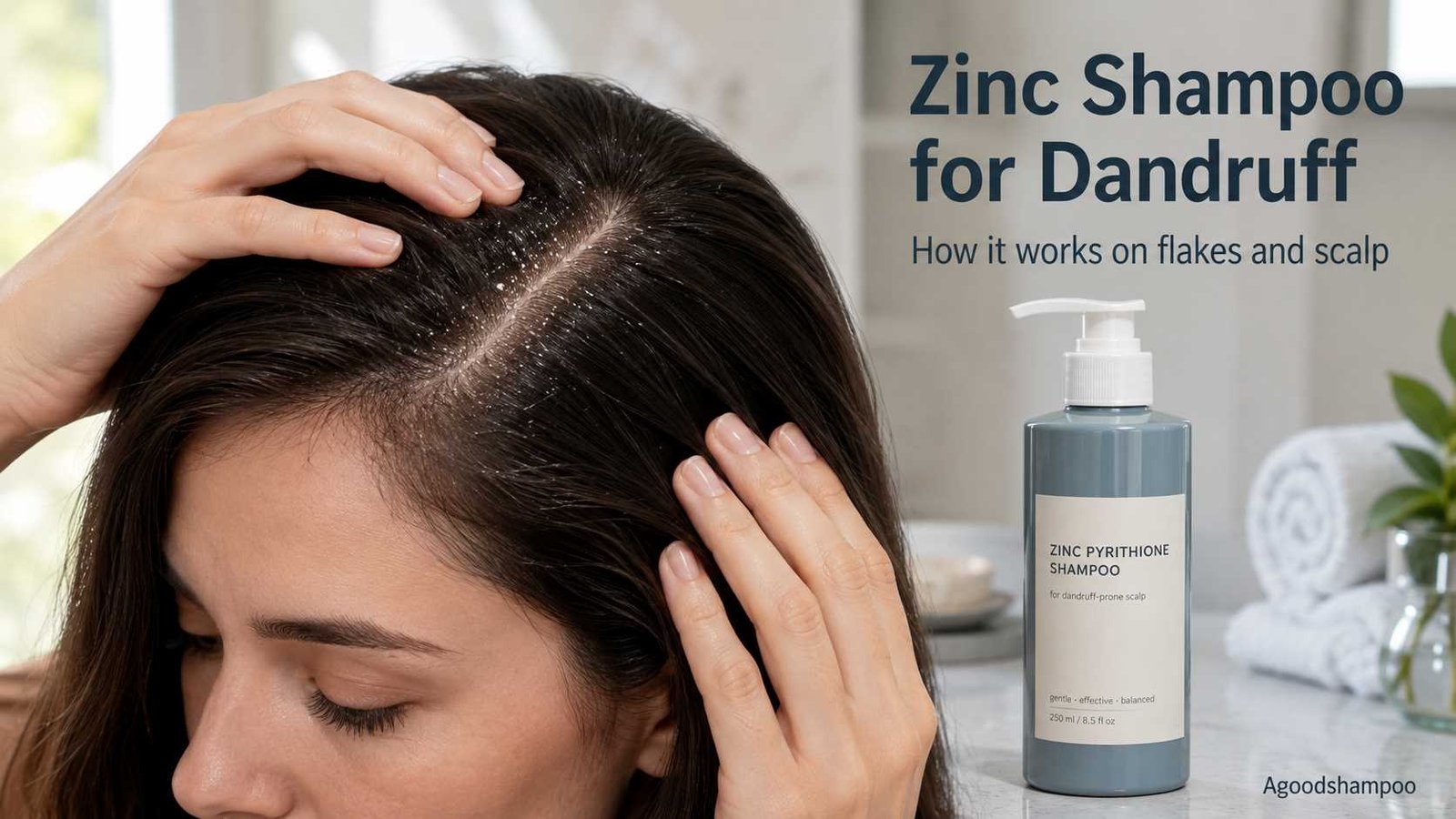
 White flakes on a dark shirt are annoying enough. Add an itchy scalp, and it becomes hard to ignore.
Zinc pyrithione shampoo can be an effective choice for dandruff because zinc pyrithione, also called pyrithione zinc or ZPT, has antifungal activity against Malassezia yeasts associated with dandruff. Clinical studies have found that shampoos containing zinc pyrithione can reduce scalp flaking.
That does not mean every zinc pyrithione shampoo works equally well or that it is the best choice for every scalp.
Your hair type matters. The whole shampoo formula matters. How you use it matters. And where you live now matters too, because zinc pyrithione is permitted in U.S. OTC dandruff products but prohibited in cosmetic products in the European Union and Great Britain.
Quick Answer
Zinc pyrithione shampoo is a well-studied anti-dandruff option that can reduce flakes and help control dandruff-related scalp symptoms. Apply it mainly to your scalp and follow the bottle directions. People with dry, curly, or coily hair may need to use it less often and keep it away from the lengths of the hair to avoid unnecessary dryness. Availability varies by country.
Is Zinc Pyrithione Shampoo Good for Dandruff?
Yes. There is reasonable clinical evidence that zinc pyrithione shampoos can help control dandruff.
One randomized controlled study used a split-scalp design. Thirty-two people washed one side of their scalp with a shampoo containing 1% zinc pyrithione and the other side with the same shampoo without the active ingredient. The zinc pyrithione-treated areas showed progressively less dandruff after repeated washes.
Another study compared 1% zinc pyrithione shampoo with 2% ketoconazole shampoo in people with severe dandruff or seborrheic dermatitis. Both treatments improved symptoms, although ketoconazole performed better in that particular trial.
So zinc pyrithione is not magic, and it is not the only useful dandruff ingredient. But its anti-dandruff reputation is not based only on marketing.
The American Academy of Dermatology also lists zinc pyrithione among the active ingredients people can look for in an over-the-counter dandruff shampoo.
How Zinc Pyrithione Shampoo Works
Dandruff is more complicated than simply having a dry scalp.
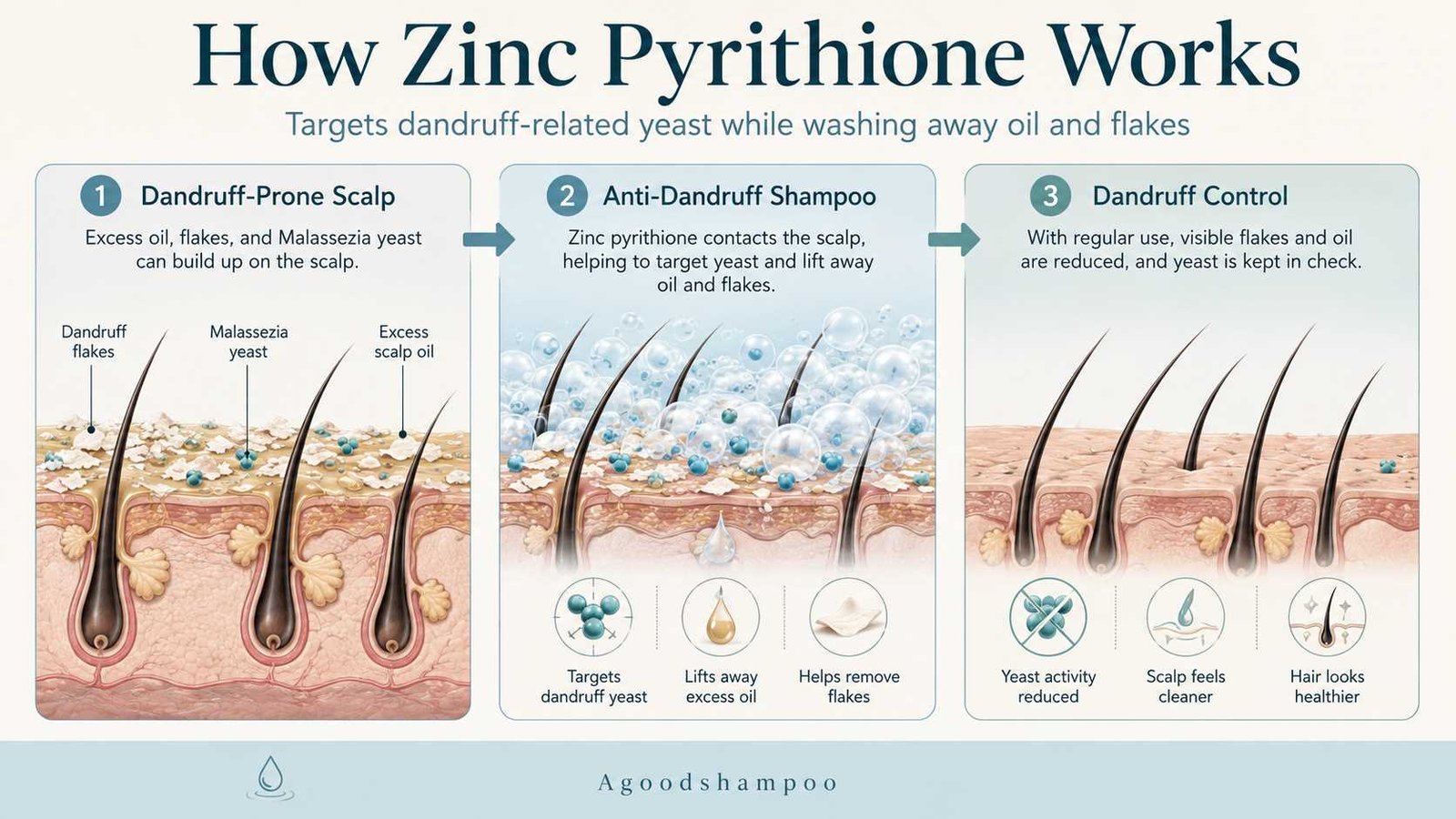
Malassezia yeasts naturally live on human skin. They tend to thrive in oily areas, including the scalp. Dandruff appears to involve an interaction between these microorganisms, scalp oils, skin-barrier responses, and a person’s individual sensitivity.
Zinc pyrithione helps mainly because of its antifungal activity.
Zinc Pyrithione and Malassezia
Laboratory research shows that zinc pyrithione can inhibit Malassezia growth. A 2021 study also included a small human scalp investigation and found a decrease in Malassezia restricta after treatment with zinc pyrithione shampoo.
That makes biological sense, but there is an important detail.
Reducing Malassezia does not mean permanently eliminating dandruff. Malassezia normally lives on human skin, and dandruff often comes back when effective treatment stops.
Think of anti-dandruff shampoo more as control and maintenance than a one-time cure.
The Shampoo Formula Matters Too
Seeing “1% zinc pyrithione” on two bottles does not guarantee they will perform exactly the same.
An anti-dandruff ingredient has to reach the scalp in a useful form and remain there long enough to do its job. Surfactants, suspending agents, particle characteristics, conditioning ingredients, and the overall delivery system can affect how a formula behaves.
A double-blind study involving 53 participants compared zinc pyrithione shampoos designed to deposit different amounts of the active onto the scalp. The formula that delivered more zinc pyrithione to the scalp produced better anti-dandruff results.
A later study also found that shampoo vehicle and delivery affected zinc pyrithione performance. Some of this formulation research has industry involvement, so it should not be treated as completely independent evidence, but it supports an important practical point: judge the finished shampoo, not only one ingredient on its label.
This also explains why claims such as “sulfate-free,” “pH balanced,” or “moisturizing” do not automatically tell you how well a dandruff shampoo will work. They describe parts of the formula, not its total performance.
Is Zinc Pyrithione Shampoo Good for Hair and Scalp?
It can be very useful for the scalp, but zinc pyrithione is not a hair-repair ingredient.
Its main role is helping control dandruff and the flaking and itching associated with it. It does not rebuild damaged hair fibers, repair split ends, or act like a conditioner.
That distinction matters.
If dandruff improves, your scalp may feel cleaner and more comfortable. That can make your whole hair routine easier. But you should not interpret that as zinc pyrithione directly making the hair strand stronger or healthier.
Can Zinc Shampoo Dry Your Hair?
It can, depending on the formula and how often you use it.
A shampoo is a complete cleansing system. Dryness can come from the strength of its surfactants, wash frequency, your hair’s condition, climate, chemical treatments, and other ingredients in the bottle.
The American Academy of Dermatology specifically advises people with curly or coily hair to concentrate dandruff shampoo on the scalp because dandruff-treatment ingredients may dry the hair.
Look beyond the active ingredient if dryness is a concern.
A more hair-friendly dandruff formula may include conditioning agents, silicones, humectants, oils, or milder cleansing systems. Those ingredients do not replace the anti-dandruff active. They help make the shampoo easier for your hair to tolerate.
What If It Makes Your Scalp Itch More?
More itching is not a sign that the shampoo is “working harder.”
Fragrance, preservatives, cleansing agents, or other ingredients may irritate some scalps. Even a useful active ingredient is not a good match if the finished product causes persistent burning, swelling, worsening redness, or severe irritation.
Rinse the product thoroughly. The AAD notes that shampoo residue itself can irritate the scalp.
If symptoms clearly worsen after starting a product, stop using it and consider professional advice.
How to Use Zinc Pyrithione Shampoo for Dandruff
Good technique can make a bigger difference than buying the most expensive bottle.
1. Wet Your Hair and Scalp Thoroughly
You want the shampoo to spread across the scalp rather than sit mainly on the hair.
2. Focus the Shampoo on Your Scalp
Dandruff is a scalp condition.
Part your hair with your fingers and work the shampoo into the areas where you actually have flakes. Do not spend most of your effort scrubbing the ends.
This is especially important for long, dry, curly, color-treated, or chemically processed hair.
3. Give the Shampoo Enough Contact Time
Do not assume every dandruff shampoo should be rinsed off immediately.
The AAD notes that some dandruff shampoos may need to stay on the scalp for around 5 to 10 minutes before rinsing, but directions vary between products and hair types. Follow the instructions printed on your specific bottle.
More time is not automatically better. Longer exposure than directed may simply increase irritation.
4. Rinse Well
Leftover shampoo can make an already sensitive scalp less comfortable.
Rinse until the product is fully removed.
5. Condition the Hair If Needed
If your scalp needs dandruff treatment but your lengths need moisture, treat those as two different jobs.
Use the medicated shampoo mainly where the dandruff is. Then use conditioner mainly through the mid-lengths and ends.
How Often Should You Use It?
There is no universal schedule for every zinc pyrithione shampoo.
Some U.S. 1% pyrithione zinc products instruct consumers to use them at least twice weekly for best results.
Your own product’s directions come first.
Hair type also changes the picture. The AAD says someone with an oily scalp or naturally straight hair may use dandruff shampoo more often, while a person with coarse, curly, or coily hair may use a dandruff shampoo about once weekly if tolerated.
Once dandruff is controlled, some people need ongoing maintenance rather than stopping completely.
Zinc Pyrithione and Dandruff in Curly Hair
Dandruff in curly hair creates an awkward problem.
Your scalp may need stronger cleansing and antifungal treatment, while your curls may be asking for less shampoo and more moisture.
Treating both areas the same way can leave you choosing between flakes and dry curls. You do not have to.
Keep the Treatment on the Scalp
For curly and coily hair, apply your dandruff shampoo as precisely as possible.
Part your curls in several places. Put shampoo on the scalp. Massage gently with your fingertips.
You do not need to pile the full length of your hair on top of your head and scrub it with medicated shampoo.
The lather running through your hair during rinsing is often enough cleansing for the lengths.
The AAD recommends this scalp-focused approach and suggests that people with naturally curly or coily hair may use dandruff shampoo around once a week, depending on tolerance and individual needs.
Choosing the Best Dandruff Shampoo for Curly Hair
There is no one best bottle for every curl pattern.
Look for a combination of:
- An effective anti-dandruff active
- A formula your scalp tolerates
- Enough cleansing to control buildup
- Conditioning ingredients if your hair dries easily
- A wash schedule that works with your curl routine
A moisturizing label can be useful, but do not let it distract you from the active ingredient.
Likewise, a very strong cleanser may remove oil beautifully but leave bleached, heat-damaged, or high-porosity curls rough.
The goal is not the mildest possible shampoo or the strongest possible shampoo. It is enough scalp treatment without unnecessary damage to the hair fiber.
What Is a Good Dandruff Shampoo to Buy?
Start by choosing an active ingredient that fits the problem instead of shopping by bottle color or fragrance.
| Active ingredient | Main role | May suit | Worth knowing |
|---|---|---|---|
| Zinc pyrithione | Antifungal dandruff control | Routine dandruff and itching where available | Availability now varies by country |
| Ketoconazole | Antifungal | Stubborn dandruff or seborrheic dermatitis | Strong clinical evidence; availability and strength vary |
| Selenium sulfide | Helps control dandruff and yeast | Oily, persistent dandruff | Can feel strong on some hair types |
| Salicylic acid | Loosens and removes scale | Thick or stubborn scalp buildup | Does not work in the same way as an antifungal |
| Piroctone olamine | Antifungal active used in many modern formulas | Especially relevant where ZPT is unavailable | Regulatory status and available products differ by market |
The AAD recognizes zinc pyrithione, salicylic acid, sulfur, selenium sulfide, ketoconazole, and coal tar as ingredients found in dandruff shampoos. It also suggests trying another active or rotating shampoos when one option is not giving adequate control.
Is Ketoconazole Better Than Zinc Pyrithione?
Not automatically, but ketoconazole can be a strong option.
In a randomized trial involving people with severe dandruff or seborrheic dermatitis, both 1% zinc pyrithione and 2% ketoconazole shampoos improved the condition, but ketoconazole performed better over the four-week treatment period.
That trial does not prove that every ketoconazole shampoo is better for every person with ordinary dandruff.
Severity, formula, frequency, hair type, availability, and tolerance still matter.
What About Piroctone Olamine?
Piroctone olamine has become more relevant as manufacturers reformulate products in markets where zinc pyrithione cannot be used in cosmetics.
One small double-blind study compared a shampoo containing piroctone olamine plus salicylic acid with a 1% zinc pyrithione shampoo. Both reduced dandruff, while the piroctone olamine/salicylic acid combination performed slightly better in that small group. Because only 19 subjects were involved and the piroctone formula contained two relevant actives, this does not prove that piroctone olamine alone is universally superior to zinc pyrithione.
That is a good example of why ingredient comparisons need context.
Why Can’t I Find Zinc Pyrithione Shampoo in Some Countries?
This is where online hair-care advice becomes confusing.
A U.S. reader may see zinc pyrithione shampoo at a local store while someone in Europe finds that familiar anti-dandruff brands now use a different active ingredient.
Both experiences can be correct.
United States
The current FDA OTC monograph permits pyrithione zinc in rinse-off dandruff products at concentrations from 0.3% to 2%.
Current U.S. drug-label records also show marketed 1% pyrithione zinc dandruff shampoos.
European Union
The EU prohibited zinc pyrithione in cosmetic products from March 1, 2022.
There is an important nuance here.
Before the prohibition, the EU Scientific Committee on Consumer Safety concluded in 2020 that zinc pyrithione could be considered safe at up to 1% when used as an anti-dandruff ingredient in rinse-off hair products under the exposure conditions it evaluated.
However, zinc pyrithione had received a category 1B reproductive-toxicity classification. EU cosmetics law allows only limited exceptions for substances with that classification. Regulators noted that it had not been established that no suitable alternative anti-dandruff ingredients were available, so zinc pyrithione was moved to the prohibited list.
This is why saying simply “Europe banned it because shampoo containing zinc pyrithione was proven unsafe” leaves out important regulatory context.
Great Britain
Great Britain also added pyrithione zinc to its prohibited list for cosmetic products.
That rule is still being enforced. In January 2026, the UK’s Office for Product Safety and Standards reported rejecting an imported anti-dandruff shampoo set because its ingredient list included zinc pyrithione, which is prohibited in cosmetic products.
So always check the current ingredient label in your own country rather than assuming that a formula described in an old review, U.S. article, or YouTube video is the formula sold where you live.
Can Dry Shampoo Help With Dandruff?
Dry shampoo can make oily roots look fresher, but it is not a replacement for dandruff shampoo and water.
Dry shampoo mainly absorbs oil. It does not wash dead skin cells, microorganisms, scalp oil, styling residue, and accumulated dry shampoo away the way regular shampooing with water does.
The American Academy of Dermatology warns that repeated dry-shampoo use without proper washing can lead to scalp buildup. Its dermatologists recommend washing with shampoo and water rather than relying on dry shampoo as your main cleansing method.
If you have dandruff, think of dry shampoo as a styling convenience between washes, not dandruff treatment.
A practical routine might look like this:
Use dry shampoo occasionally when your roots look oily. Then return to your normal wash routine and use your dandruff treatment on schedule.
If each wash gets replaced by another layer of dry shampoo, you may be hiding visible oil while allowing scalp buildup to continue.
Is Dandruff Shampoo Good for the Scalp?
Yes, if you actually have dandruff and choose a product your scalp tolerates.
Medicated dandruff shampoo is designed to address problems such as flaking and itching. Some actives reduce fungi associated with dandruff, while others loosen scale or reduce excessive buildup.
But more treatment is not always better.
If your scalp is already comfortable and flake-free, using a strong medicated shampoo more frequently than necessary may not add any benefit.
Likewise, do not assume every flaky scalp is ordinary dandruff.
Dandruff and dry scalp can look similar. Seborrheic dermatitis, psoriasis, eczema, contact reactions, and certain scalp infections can also cause scaling or itching.
The right shampoo depends on what is actually causing the symptoms.
When Dandruff Shampoo Is Not Enough
Mild dandruff can often be managed at home.
You should be more cautious when the problem is severe, keeps returning despite correct treatment, or does not look like simple dandruff.
Consider seeing a dermatologist or qualified healthcare professional if you have:
- Severe or persistent scalp inflammation
- Pain, bleeding, sores, or crusting
- Thick plaques or heavy scaling
- Patches of hair loss
- Significant swelling
- Severe burning after using hair products
- Symptoms that do not improve with regular dandruff treatment
- A rash extending beyond the scalp
The AAD notes that persistent dandruff-like symptoms can sometimes be related to seborrheic dermatitis, psoriasis, eczema, or scalp infection.
Seborrheic dermatitis deserves particular attention because it can look like severe dandruff but includes inflammation. Dandruff itself is usually limited to scalp flaking and may be considered the mildest end of the same disease spectrum.
Is Zinc Pyrithione Shampoo Worth Using?
Yes, zinc pyrithione shampoo remains a reasonable evidence-based choice for dandruff where it is legally available and your scalp tolerates it.
It has clinical evidence behind its anti-dandruff effect and clear antifungal activity against Malassezia.
But the name on the active-ingredient line is only part of the decision.
A good dandruff shampoo also needs to suit your scalp, your hair texture, your wash schedule, and the regulations in your country.
For oily or straight hair, frequent treatment may be easy to fit into your routine. For curly, coily, bleached, or very dry hair, keep treatment focused on the scalp and protect the lengths with appropriate conditioning.
If zinc pyrithione is unavailable, you are not out of options. Ketoconazole, selenium sulfide, salicylic acid, piroctone olamine, and other anti-dandruff systems can all have a place depending on the problem and the market.
The most useful question is not simply, “Is zinc shampoo good?”
It is: Which dandruff active controls my scalp without creating a new problem for my hair?
Frequently Asked Questions
Is zinc pyrithione shampoo good for hair?
Zinc pyrithione shampoo can be good for your overall hair-care routine when dandruff is the problem, but its main benefit is on the scalp. It is an anti-dandruff active, not a direct hair-repair or conditioning ingredient.
If your hair becomes dry, use the shampoo mainly on your scalp and condition the lengths.
Is zinc shampoo good for hair growth?
Zinc pyrithione shampoo should not be treated as a proven hair-growth treatment.
Its established purpose is dandruff control. Improving an irritated, flaky scalp may make scalp care easier, but that is different from proving that the shampoo causes new hair growth.
If you are experiencing noticeable thinning, sudden shedding, or patches of hair loss, do not assume dandruff shampoo will treat the underlying cause.
What is the best dandruff shampoo for curly hair?
The best option is usually an effective dandruff shampoo that you can apply mainly to the scalp without making your curls excessively dry.
The AAD suggests that people with coarse, curly, or coily hair may use dandruff shampoo about once weekly, if tolerated, and concentrate it on the scalp.
Condition the hair afterward if needed.
Is dandruff shampoo good for your scalp?
Yes, when you have dandruff and use the product as directed.
Different dandruff shampoos work in different ways. Some target Malassezia, while others loosen scale. If the shampoo causes persistent irritation or fails to help, another active or professional evaluation may be more appropriate.
How long should zinc pyrithione shampoo stay on the scalp?
Follow your product’s label rather than using a universal timer.
The AAD notes that some dandruff shampoos need approximately 5 to 10 minutes of scalp contact before rinsing, but directions vary by product and hair type.
Leaving it on longer than directed is not proven to give better results.
Can I use zinc pyrithione shampoo every day?
That depends on the specific product, your scalp, and your hair type.
Some products are labeled for frequent use, while others have different instructions. Someone with oily, straight hair may tolerate frequent shampooing better than someone with dry, curly, coily, bleached, or chemically processed hair.
Follow the product directions and reduce frequency if dryness or irritation develops.
Can dry shampoo make dandruff worse?
Heavy dry-shampoo use without washing can contribute to scalp buildup.
Dry shampoo absorbs oil but does not replace cleansing with shampoo and water. The AAD recommends washing away accumulated dry shampoo, dead skin cells, oil, and microorganisms instead of relying on dry shampoo alone.
What can I use if zinc pyrithione shampoo is unavailable?
Depending on your country and scalp problem, alternatives may include ketoconazole, selenium sulfide, salicylic acid, piroctone olamine, sulfur, or other locally approved anti-dandruff actives.
Choose based on the actual active ingredient and your scalp needs rather than trying to find an outdated version of a familiar brand.

Michael Chen focuses on the science behind shampoos and hair-care ingredients. He explains how cleansing agents, silicones, proteins, and other formula components work, separating useful evidence from marketing claims to help readers better understand the products they use.