 You spend good money on a keratin treatment, walk out of the salon with smooth, glossy hair, and then two days later your roots start looking oily.
Of course they do.
You don’t really want to wash your hair yet. But you also don’t want to spray something onto it that could shorten the life of that expensive smoothing treatment.
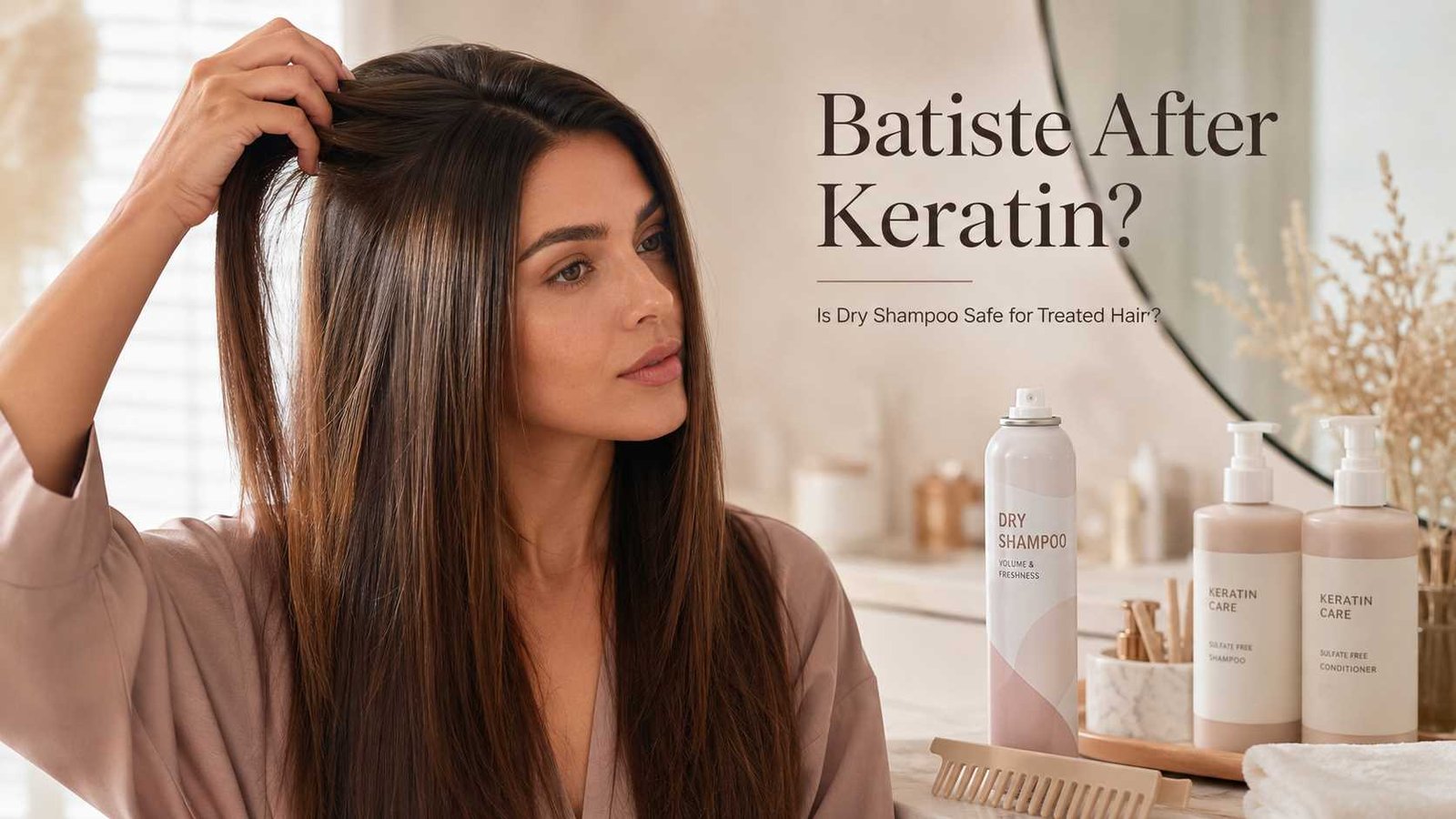
So, is Batiste Dry Shampoo good for keratin treated hair?
Yes, Batiste Dry Shampoo is generally a good choice for keratin-treated hair. Batiste specifically states that its dry shampoo is sulfate and sodium free and can be used on keratin-treated hair. Its Original formula also does not list sodium chloride or traditional sulfate cleansers.
That’s the good news.
But I wouldn’t turn that answer into permission to spray half a can on your roots every morning for a week.
Batiste can help you stretch the time between washes, which can be very handy after a keratin smoothing service. Still, dry shampoo absorbs oil. It doesn’t properly wash your scalp.
And there’s one ingredient I’d keep an eye on if your hair already feels dry after keratin treatment.
Alcohol.
More on that in a minute.
Why Batiste makes sense after a keratin treatment
Keratin aftercare can feel strangely stressful at first.
You get your hair exactly how you wanted it. Smooth. Less fluffy. Easier to blow-dry. Maybe you can finally walk outside on a humid day without watching your hair double in size.
Then you start questioning everything in your bathroom.
Can I use this shampoo?
What about this hairspray?
Does dry shampoo count as shampoo?
Will salt ruin it?
The safest way to look at keratin aftercare is to protect the treatment without becoming scared of your own hair products.
Professional keratin-treatment companies commonly recommend formulas without sodium chloride and, for some treatment systems, without sulfates.
Keratin Complex, for example, says its Color Care Smoothing aftercare products contain no added sodium chloride or sulfates. The company says these products are designed to protect and prolong its smoothing treatments. Its Keratin Care Smoothing Shampoo is also made without sodium chloride specifically for keratin-treated hair.
That puts Batiste in a pretty comfortable position.
Batiste’s own FAQ says its dry shampoos are free from sulfates and parabens. More importantly for this question, the company says Batiste is sulfate and sodium free and suitable for keratin-treated hair.
So this isn’t just me looking at the can and guessing.
The brand addresses keratin-treated hair directly.
Is Batiste Dry Shampoo keratin safe?
For most people, yes.
I’d call it keratin-friendly rather than magically protective.
There’s a difference.
Batiste won’t strengthen your salon treatment or somehow lock the treatment into your hair. What it can do is refresh oily roots without making you wet, shampoo, rinse, and restyle your entire head.
Batiste Original uses ingredients including propellants, rice starch, alcohol denat., fragrance, cocoyl hydrolyzed keratin and conditioning ingredients such as cetrimonium chloride and distearyldimonium chloride. The brand notes that formulas can vary by package size and market.
Rice starch does most of the dirty work you actually notice.
It sits around the oily root area and absorbs some of that excess grease. Suddenly your hair doesn’t look like it has been pasted to your scalp.
No water needed.
No full shampoo needed.
That’s exactly why dry shampoo fits so nicely into many keratin routines.
A quick ingredient check
Here’s what matters most in the current Batiste Original formula.
| Ingredient | What it does | My take for keratin-treated hair |
|---|---|---|
| Rice starch | Absorbs excess oil | Useful between washes |
| Alcohol denat. | Helps the spray dry quickly | Fine for many people, but frequent use may feel drying |
| Cocoyl hydrolyzed keratin | Hair-conditioning ingredient | Not a problem for keratin-treated hair |
| Cetrimonium chloride | Conditioning and antistatic ingredient | Generally useful for manageability |
| Distearyldimonium chloride | Conditioning ingredient | Helps improve hair feel |
| Fragrance | Adds scent | Can bother a sensitive scalp |
| Sodium chloride | Not listed in Original formula reviewed | Good news for keratin aftercare |
| Sulfate cleansers | Not listed | Also good news |
One thing catches people out here.
They see the word chloride in cetrimonium chloride and panic because their stylist told them to avoid sodium chloride.
They aren’t the same ingredient.
Cetrimonium chloride is a conditioning ingredient. It is not sodium chloride, the common salt ingredient keratin aftercare advice usually refers to.
No need to throw your Batiste can across the bathroom.
Is Batiste Dry Shampoo sulfate-free?
Yes.
Batiste labels its dry shampoos as sulfate free, and the company’s FAQ also confirms that its dry shampoo does not contain sulfates.
This matters because many people who get keratin smoothing treatments switch to sulfate-free cleansing products afterward.
Sulfates themselves aren’t some evil ingredient that automatically destroys healthy hair. They’re effective cleansing surfactants, and that can be useful.
The issue is intensity.
Research on hair cleansing has found that strong anionic surfactants can remove sebum and may leave hair feeling drier. Chemically treated hair already tends to have poorer lubrication and can be more vulnerable to breakage, so gentler cleansing often makes sense.
That’s part of the reason sulfate-free hair care has become so common around color treatments, smoothing services, dry hair and fragile hair.
But here’s something even more important.
Batiste isn’t a sulfate-free wet shampoo.
It doesn’t cleanse in the same way at all.
It mainly freshens oily-looking roots by depositing absorbent powders.
That brings us to the question people often miss.
Can I use dry shampoo on my keratin-treated hair?
Yes, and it can actually make your routine easier.
Suppose you normally wash your hair every other day because your roots get oily.
Then you get a keratin treatment.
Your lengths still look smooth on day three, but your scalp is screaming, I need help.
A small amount of dry shampoo at the roots may get you through another day without doing a full wet wash.
That doesn’t mean fewer washes automatically make your keratin treatment last a specific number of extra weeks. I wouldn’t promise that.
But professional keratin aftercare is built around gentle maintenance, and dry shampoo is commonly used between wet washes for exactly that reason.
Research into shampoo and scalp care also reminds us that real shampooing performs an important job. Shampoo removes sebum, dirt and material from the scalp.
Dry shampoo can hide or absorb some oil.
It cannot wash everything away.
That distinction matters.
Use dry shampoo to buy yourself time.
Don’t use it to avoid washing your scalp indefinitely.
The alcohol issue deserves a little attention
I don’t think the alcohol in Batiste makes it automatically bad for keratin-treated hair.
I also don’t think we should pretend it doesn’t exist.
Alcohol denat. appears fairly high on the Batiste Original ingredient list.
Alcohol helps aerosol products dry quickly and keeps them from leaving your roots wet.
Convenient, yes.
But very dry, bleached, fragile or irritated hair may not love frequent exposure to alcohol-heavy styling products.
Dermatology literature has reported that high concentrations of ethanol in some scalp preparations can contribute to drying and hair fragility. That research involves different products and known high alcohol concentrations, so it does not prove that Batiste damages hair. The percentage of alcohol in Batiste isn’t disclosed on the ingredient list.
I’d use that evidence as a reason for moderation, not panic.
If you spray Batiste lightly on your oily roots twice between washes and your hair feels great, fine.
If you coat your scalp every morning and by day five your roots feel rough, stiff and dusty, your hair is telling you something.
Wash it.
Something funny about the Batiste formula
Batiste Original actually contains cocoyl hydrolyzed keratin in the formulas currently displayed on the brand’s US site.
Does that mean spraying Batiste will renew your salon keratin treatment?
No.
Topical hydrolyzed proteins in cosmetics and a professional keratin smoothing service are not the same thing.
Think of it like this.
Putting a protein-containing conditioner on your hair isn’t the same as sitting through a salon keratin service with professional application and heat processing.
So I see the hydrolyzed keratin in Batiste as a formulation detail, not a reason to buy the product specifically for keratin maintenance.
The much more useful facts are that it contains no sulfate cleanser or sodium chloride in the reviewed Original formula and that Batiste itself approves it for keratin-treated hair.
How I’d use Batiste on keratin-treated hair
Less is better.
That’s probably the easiest tip I can give you.
Your goal isn’t to make every strand white with powder and then fight it out with a hairbrush.
You only need enough product to take down the greasy look at the roots.
Batiste recommends shaking the can, sectioning the hair, holding the product about 12 inches away and spraying toward the roots. The brand then recommends massaging the product into the roots and brushing away the excess.
For keratin-treated hair, I’d make that routine a little gentler.
Start with completely dry hair.
Separate two or three oily areas rather than spraying your whole head.
Keep the can away from your scalp as directed.
Spray briefly.
Then stop.
Give the powder a little time to absorb oil before you start touching it.
Massage softly with your fingertips. Don’t aggressively scratch the scalp.
Brush only as much as you need.
And if your ends are still silky and clean, leave them alone. Dry shampoo belongs mainly around oily roots.
That last part is important if your ends are bleached or dry.
They don’t need oil-absorbing powder.
Your roots do.
Don’t use it immediately just because you’re scared to wash
There’s another keratin-treatment wrinkle.
Different professional smoothing systems have different rules about when you can first wash, wet or style your hair.
Some modern systems allow washing quite soon. Others come with a waiting period.
Follow the instructions for the exact treatment your stylist used.
I wouldn’t replace those directions with general internet advice.
Batiste being compatible with keratin-treated hair does not mean you should ignore your salon’s first-day aftercare rules.
If your stylist tells you not to wet, tie, bend or add styling products to the hair during a set period, follow that advice.
After that initial period, dry shampoo can become a useful part of your normal maintenance routine.
How often can you use Batiste after keratin treatment?
There isn’t a scientifically established perfect number of dry-shampoo days for every scalp.
That answer may be less satisfying than saying exactly twice a week, but it’s more useful.
Your scalp type matters.
Your hair density matters.
How much you sweat matters.
The amount of styling product you use matters.
Batiste’s competitor Not Your Mother’s describes dry shampoo as something to use between wash days and specifically mentions refreshing day-two or day-three hair. It also says wet shampooing remains important for removing buildup.
That’s about how I’d think about Batiste too.
One or two refreshes between real washes is reasonable for many people.
When your scalp feels itchy, gritty, tender, coated or generally unpleasant, stop trying to negotiate with it.
Wash your hair.
Use a gentle shampoo that follows the aftercare instructions for your particular keratin treatment.
Your scalp still exists under that beautiful blowout.
It needs cleaning.
What if you have an oily scalp?
This is where Batiste shines.
Someone can have oily roots and dry lengths at the same time. It happens constantly, especially with long, colored or chemically processed hair.
A full shampoo every time the roots look a little greasy can leave already-dry lengths feeling even rougher.
Using dry shampoo only where the oil appears lets you refresh the top of your hair without repeatedly washing the ends.
Batiste Original uses rice starch for this oil-absorbing job.
Just remember that absorbed oil hasn’t vanished into another dimension.
Eventually you’ll have sebum, starch, styling products, skin cells and normal scalp residue sitting there together.
Then you need water and shampoo.
What if your keratin-treated hair is very dry?
I’d be more careful.
Not because Batiste contains sulfates. It doesn’t.
Not because it contains sodium chloride. The Original formula reviewed doesn’t.
I’d be cautious because a powder-and-alcohol aerosol can make already-dry hair feel even drier when you use too much.
Keep the spray around the root area.
Protect the mid-lengths and ends from unnecessary product.
And don’t mistake roughness for cleanliness.
That powdery, squeaky feeling some people get after several dry-shampoo applications isn’t necessarily a sign that the hair is wonderfully clean.
Sometimes it’s just overloaded with product.
What about bleached hair plus keratin treatment?
Now I’d be even more conservative.
Chemical processing can change the hair fiber and make it more vulnerable to breakage. Reviews of hair-cleansing science note that chemically treated hair can have reduced hydrophobicity and lubrication and greater sensitivity to damage from aggressive cleansing and grooming.
If you have bleach, highlights and a keratin treatment all living on the same head, your hair has been through enough excitement.
Gentle handling matters.
Spray Batiste where you need it.
Don’t rough up your roots like you’re trying to scrub a kitchen floor.
Detangle gently.
Use a conditioner suited to processed hair when you wet wash.
And watch your ends.
If they start snapping, tangling or feeling straw-like, your hair care routine needs more than another blast of dry shampoo.
Which is better, Not Your Mother’s or Batiste?
Ah, the drugstore dry-shampoo fight.
Both are solid options.
For this specific question, though, I give Batiste a small edge for keratin-treated hair.
Why?
Because Batiste directly answers the question.
Its official FAQ says Batiste is sulfate and sodium free and can be used on keratin-treated hair.
Not Your Mother’s Clean Freak Original is also sulfate-surfactant free and safe for color-treated hair, according to the company. Its formula contains rice starch and barley seed flour for oil absorption, along with alcohol denat., silica and other ingredients.
Both are waterless aerosol dry shampoos.
Both use starch.
Both contain alcohol denat.
Both avoid sulfate surfactants.
But the companies position them a little differently.
Batiste Original currently includes cocoyl hydrolyzed keratin and conditioning ingredients such as cetrimonium chloride and distearyldimonium chloride.
Clean Freak Original uses rice and barley starches and is marketed as leaving no white residue or powdery buildup.
So my choice would look like this.
For a person asking only which company gives the clearest reassurance for a keratin treatment, I’d pick Batiste.
For someone who already loves Clean Freak and has no problems with it, I see no strong ingredient-based reason to panic and throw it away. It is also sulfate-surfactant free.
If fragrance bothers you, Not Your Mother’s also sells an Unscented Clean Freak version. It is fragrance free and sulfate-surfactant free, although it still contains alcohol denat.
That option may be worth considering for people who dislike strong scents.
Batiste versus Not Your Mother’s at a glance
| Feature | Batiste Original | Not Your Mother’s Clean Freak Original |
|---|---|---|
| Sulfate free | Yes | Yes |
| Rice starch | Yes | Yes |
| Alcohol denat. | Yes | Yes |
| Sodium chloride listed | No in formulas reviewed | No in formula reviewed |
| Brand specifically says keratin safe | Yes | Not stated on the reviewed Clean Freak page |
| Color-treated hair claim | Some Batiste variants target processed or colored hair | Yes |
| Hydrolyzed keratin in current Original formula | Yes | No |
| Fragrance | Yes | Yes |
| Unscented alternative from same brand | Other Batiste variants vary | Yes, Clean Freak Unscented |
Formulas change, of course.
Batiste itself notes formula variations, so always check the can you’re actually buying rather than treating an online ingredient list as eternal truth.
What research says about chemically treated hair
Here’s the part I wish more beauty advice explained.
A keratin treatment doesn’t suddenly turn your hair into delicate glass.
But chemically processed hair deserves gentler treatment because repeated chemical, heat and grooming stress can affect the hair fiber.
Research reviews describe shampoo surfactants, heat and everyday grooming as factors that can contribute to hair-fiber wear. Chemically treated hair can also become more vulnerable to breakage because its surface properties and lubrication change.
Another study looking at shampoo pH tested 123 shampoos and found values ranging from pH 3.5 to 9.0. The researchers argued that more alkaline products can increase negative electrical charge and friction between fibers, which may contribute to cuticle damage and frizz.
That doesn’t tell us whether a can of Batiste will make your salon treatment last 72 days instead of 65.
Beauty science rarely gives us answers that tidy.
What it does tell us is that treated hair benefits from sensible product choices and gentle handling.
That’s why I care more about your whole routine than one can of dry shampoo.
The routine matters more than obsessing over one ingredient
You could buy the perfect keratin-friendly dry shampoo and still wreck the feel of your hair by doing everything else badly.
Very hot tools every morning.
Aggressive brushing.
Never conditioning the ends.
Sleeping with wet hair rubbing around.
Going days and days with heavy scalp buildup.
Then blaming the dry shampoo.
Hair care doesn’t work like that.
Batiste should play a small role.
Use it when roots are oily but the rest of your hair still looks good.
Then wash properly when the scalp actually needs cleansing.
Use the sulfate-free or sodium-chloride-free aftercare products recommended for your treatment when required.
Condition your lengths.
Go easy with heat.
Pretty boring advice, I know.
Also the advice that usually works.
A few signs you may be using too much dry shampoo
Your roots feel stiff even after brushing.
Your scalp starts itching shortly after application.
You can see layers of powder at the roots.
Your hair looks dull rather than fresh.
The scalp has an unpleasant coated feeling.
You keep adding more spray because yesterday’s spray stopped working.
At that point, another cloud of Batiste isn’t the answer.
Wash your hair.
Dry shampoo refreshes. Wet shampoo cleanses.
Those two jobs overlap less than the name dry shampoo makes you think.
Is Batiste good for a sensitive scalp?
Maybe. Maybe not.
The Original formula contains fragrance and alcohol denat.
Plenty of people tolerate both without trouble.
Some don’t.
If you already know fragranced scalp products make you itch, sting or flake, I wouldn’t choose a strongly scented formula just because it happens to be keratin safe.
Keratin compatibility and scalp compatibility are two separate questions.
Your smoothing treatment may love the formula while your scalp hates it.
Listen to your scalp.
If a product repeatedly causes burning, redness or itching, stop using it.
Would I use Batiste after spending money on a keratin treatment?
Yes.
I’d feel comfortable using it.
Batiste has a clear manufacturer statement supporting use on keratin-treated hair, its Original formula is sulfate free, and the ingredient list reviewed does not contain sodium chloride.
That answers the biggest worries.
I’d spray lightly around oily roots, keep it mostly away from dry ends and still wash my scalp normally when it needs cleaning.
I’d also check my actual can before buying again because formulas can change.
Simple.
No hair-care detective board with red string required.
Is Batiste Dry Shampoo good for keratin treated hair in the long run?
It can fit very well into a long-term maintenance routine if you use it as intended.
That means between washes.
Not instead of washes.
The biggest advantage is convenience. It can make day-two or day-three roots look fresher while your smooth lengths are still behaving beautifully.
For someone trying to preserve a salon blowout feel, that’s useful.
The biggest downside is that Batiste Original contains alcohol and fragrance. Heavy or repeated application can also leave your roots feeling coated even when the product initially hides oil.
So the balance is easy.
Use enough.
Not loads.
Wash when you need to.
And choose your wet shampoo with at least as much care as your dry one.
Frequently asked questions
Is Batiste Dry Shampoo keratin safe?
Yes. Batiste specifically says its dry shampoo is sulfate and sodium free and can be used on keratin-treated hair.
Can I use dry shampoo on my keratin-treated hair?
Yes. Dry shampoo can be useful between wet washes because it absorbs excess oil around the roots. It should not replace regular scalp cleansing.
Is Batiste Dry Shampoo sulfate-free?
Yes. Batiste describes its dry shampoo as sulfate free. The reviewed Original ingredient list contains no sulfate cleanser.
Does Batiste contain sodium chloride?
Sodium chloride is not listed in the Batiste Original formulas reviewed on the brand’s US product page. Batiste also describes its dry shampoo as sodium free in its keratin-treatment FAQ.
Does Batiste contain keratin?
The current Batiste Original formulas shown on the US website list cocoyl hydrolyzed keratin.
That doesn’t mean the dry shampoo replaces or restores a professional keratin treatment.
Which dry shampoo is better, Not Your Mother’s or Batiste?
Both have sulfate-free options and both use starches to absorb oil. For keratin-treated hair specifically, I lean toward Batiste because the company directly states that its dry shampoo can be used on keratin-treated hair. Not Your Mother’s Clean Freak is also sulfate-surfactant free and marketed as safe for color-treated hair.
Can Batiste make keratin-treated hair dry?
It may feel drying if you use too much, particularly on hair that is already dry or heavily processed. Batiste Original contains alcohol denat., although the company does not disclose its percentage in the ingredient list.
Keep most of the product around oily roots instead of spraying it through dry ends.
How many days can I use dry shampoo before washing?
There’s no magic number that works for every scalp. I’d think of dry shampoo as a day-two or day-three refresher rather than a way to keep delaying washing indefinitely.
When your scalp feels itchy, coated, uncomfortable or heavily built up, wash it.
My final take
So, is Batiste Dry Shampoo good for keratin treated hair?
Yes.
Among mainstream drugstore dry shampoos, it makes a sensible choice for someone trying to maintain a keratin smoothing treatment.
Batiste says it is suitable for keratin-treated hair. It is sulfate free. The Original formula reviewed does not list sodium chloride. And rice starch gives you a simple way to calm oily-looking roots without immediately doing another wet wash.
I’d still keep expectations normal.
Batiste won’t make a keratin treatment last forever. It isn’t a replacement for proper keratin aftercare shampoo. And using loads of it for days on end won’t magically make your scalp clean.
Use a little when you need it.
Enjoy the extra day of good hair.
Then wash when your scalp asks for it.
That’s probably the nicest thing about Batiste after a keratin treatment. It gives you some breathing room without making the routine complicated.
Sources reviewed
Batiste official FAQ and current Batiste Original Dry Shampoo product information.
Keratin Complex professional keratin-treatment aftercare guidance.
Not Your Mother’s current Clean Freak Original and Unscented Dry Shampoo product information.
Peer-reviewed hair and scalp literature covering surfactants, chemically treated hair, shampooing and hair-fiber care.

Carolina Herrera writes about color-treated, damaged, and chemically processed hair. She focuses on understanding breakage, choosing suitable shampoos, and making sense of repair claims. Her goal is to help readers care for their hair with realistic expectations and informed product choices.