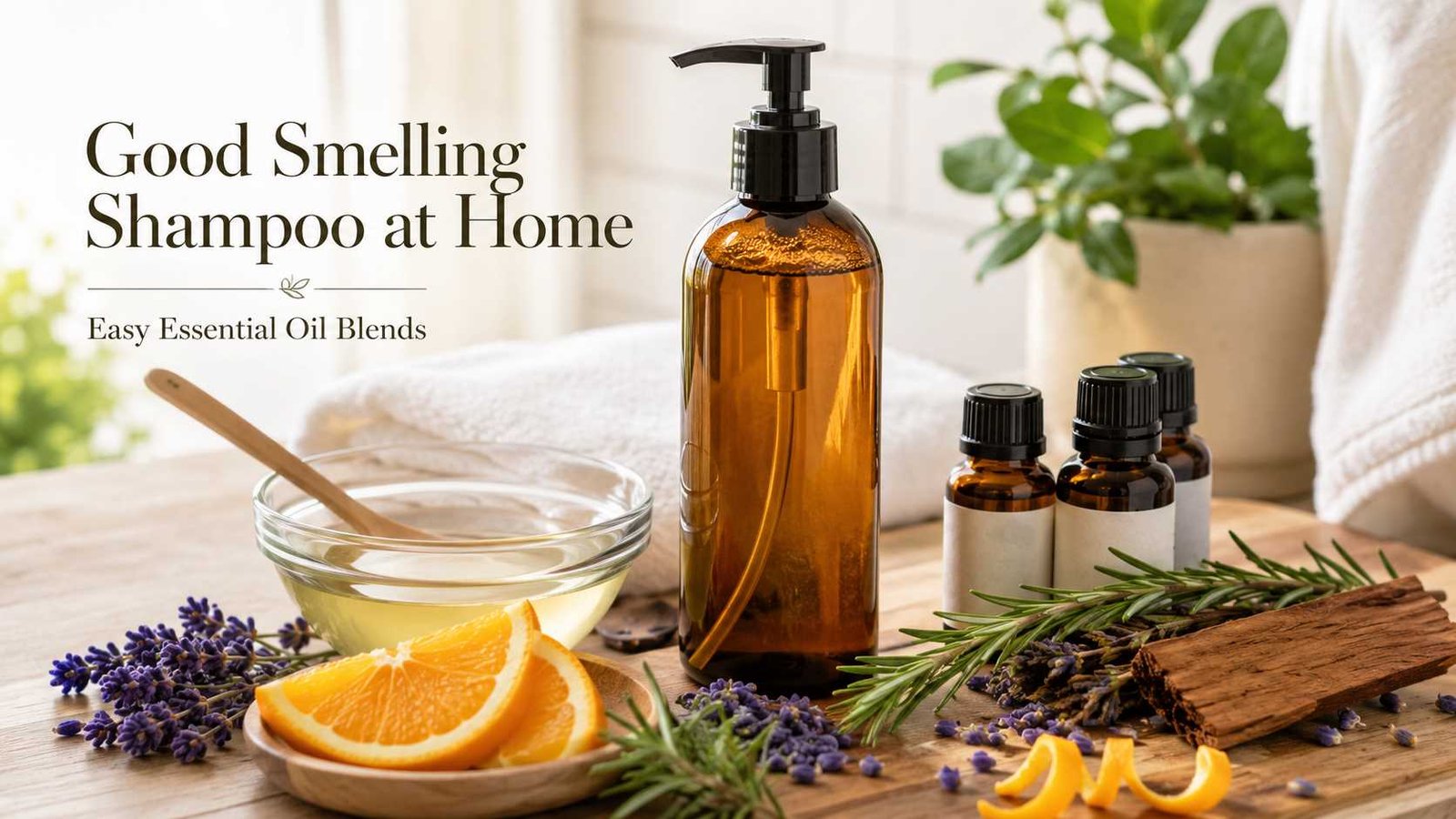
You know that little moment when you open a shampoo bottle, smell it, and instantly think, yes, I want my hair to smell like this all day?
That feeling is surprisingly easy to chase at home.
But making shampoo smell good is not just a matter of pouring lavender oil into whatever bottle is sitting in your shower. I used to think essential oils were that simple too. A few drops, a shake, done.
Not quite.
Essential oils are highly concentrated plant extracts. They can smell gorgeous, but too much can leave your scalp itchy, dry, or angry. And if you start adding water, aloe juice, herbal tea, or random kitchen ingredients to shampoo, you can also mess with the product’s preservative system.
So if you want to learn how to make good smelling shampoo with essential oils at home, I want to show you the version I would actually feel comfortable making.
It smells fresh. It is easy. It does not need a mini chemistry lab in your bathroom. And most importantly, we are going to treat essential oils like real cosmetic ingredients instead of harmless perfume drops.
First, the easiest way to make homemade essential oil shampoo
If you are new to this, start with an unscented cosmetic shampoo base.
Not dish soap.
Not hand soap.
Not a giant mix of water, baking soda, coconut oil, and hope.
A proper unscented shampoo base already contains cleansing ingredients, water, thickeners, pH adjusters, and a preservation system. Look for a base sold specifically for shampoo making and check whether the supplier says it can accept essential oils or fragrance.
This is the easiest way to get a homemade feel without accidentally creating something that goes bad in your shower.
FDA guidance matters here. Cosmetics that contain water can become contaminated with microorganisms, and adding extra water can weaken the preservative system already protecting a product. The FDA also warns that natural products without effective preservation may have shorter shelf lives and a higher contamination risk.
That is why my beginner recipe looks almost boring.
Boring is good when you are putting something on your scalp.
My simple good smelling shampoo recipe
For about 100 grams of shampoo, use this formula.
| Ingredient | Amount | Why it is there |
|---|---|---|
| Unscented fragrance-ready shampoo base | 100 g | Cleans the hair and forms the main shampoo |
| Essential oil blend | 0.3 to 0.5 g | Adds fragrance |
| Optional vegetable glycerin | Only if the base supplier allows it | Can add a softer feel |
Technically, adding the essential oils brings the final weight a little above 100 grams. For normal home use, that tiny difference is not important. If you want cosmetic-formulator precision, subtract the essential oil weight from the shampoo base.
My favorite beginner level is around 0.5 percent total essential oil.
That means roughly 0.5 gram of essential oil for every 100 grams of shampoo base.
I prefer weighing essential oils instead of counting drops because drops are not a standard measurement. One bottle may give tiny drops. Another pours little puddles.
If you have no scale, you can use drops for a small personal batch, but treat the number as an estimate rather than chemistry.
And always check the essential oil supplier’s safety information and applicable fragrance limits. IFRA standards restrict certain fragrance materials when safety concerns require limits, and those limits can depend on the exact oil and type of cosmetic product.
Which fragrance is best for shampoo making?
If someone forced me to choose one essential oil for a first homemade shampoo, I would pick lavender.
Not because lavender magically fixes every hair problem. It does not.
I pick it because the scent is forgiving.
Lavender sits nicely between herbal and floral. It mixes well with citrus, rosemary, cedarwood, and even a tiny amount of peppermint. It also smells familiar enough that your shampoo does not suddenly remind you of cough syrup or floor cleaner.
Sweet orange is another easy choice if you want something cheerful and clean.
Rosemary gives shampoo that spa-like herbal smell. I especially like it when the base smells slightly bland because rosemary covers the raw cosmetic-base smell well.
Cedarwood works differently. It smells warm and woody, and a small amount can make a blend feel less sharp. Think of it as the quiet friend holding the whole group together.
Tea tree is useful when you want a very fresh, medicinal scent, although I would not call it the prettiest shampoo fragrance on its own.
Peppermint smells wonderfully clean, but it can become overpowering fast.
So for smell alone, my beginner ranking would be lavender first, sweet orange second, rosemary third, then cedarwood.
A shampoo scent blend that rarely disappoints
Try this ratio inside your 0.5 gram essential oil allowance.
Lavender makes up about half of the blend.
Sweet orange makes up about one third.
Cedarwood makes up the small amount left over.
The result smells clean, lightly floral, a little citrusy, and much more like a real personal-care product than a jar of mixed essential oils.
For a more herbal shampoo, replace the orange with rosemary.
For a fresher blend, use lavender, rosemary, and only a very tiny amount of peppermint.
That tiny part matters.
Peppermint is one of those oils that walks into the room before everyone else.
How to mix the shampoo without wrecking the texture
Put the amount of shampoo base you want to scent into a clean bowl.
Measure your essential oil blend separately.
Add the oil slowly to the shampoo.
Stir gently.
Do not whisk it like cake batter. You will make a bowl full of foam and then spend the next hour wondering where your shampoo went.
Stir until the mixture looks even.
Then leave it alone for a while.
Check the texture again before bottling. Some essential oils can change the thickness or clarity of a shampoo base. That does not always mean the product is unsafe, but it can mean the base does not tolerate that fragrance level well.
If the shampoo suddenly becomes watery, separates, forms strange clumps, or develops an odd smell over time, stop using it.
This is another reason I like making small batches.
You learn what works without sacrificing an entire bottle.
Why shampoo pH matters more than most DIY recipes admit
This is where homemade shampoo recipes on social media often lose me.
Hair is not just a string growing from your head. Its surface changes with pH.
Research on shampoo pH has found that alkaline conditions can increase the negative electrical charge on hair fibers, increasing friction between strands. More friction can contribute to cuticle damage, frizz, tangling, and breakage. Researchers have also noted that shampoos around the mildly acidic range are generally friendlier to the scalp and hair fiber than strongly alkaline cleansers.
That is one reason I do not love homemade shampoo recipes built around ordinary bar soap or strong castile soap.
Soap can be alkaline.
Your hair may feel squeaky clean at first. Then it dries and you get that rough, fluffy texture that makes you wonder what happened.
A professionally prepared shampoo base has usually already had its pH adjusted.
If you buy one, do not start adding lemon juice or vinegar because someone online says every shampoo needs acid.
You can throw off the formula.
A finished cosmetic formula is a little ecosystem. Change one thing and another thing can move with it.
What are some good essential oils to add to shampoo?
This depends on what you want from the shampoo.
For smell, I care about the aroma first.
For scalp concerns, I become much more cautious because essential oils are not automatically treatments.
Lavender is lovely when you want a soft floral herbal scent.
Rosemary smells crisp and green. Rosemary oil has also attracted attention in hair-loss research. One clinical trial compared rosemary oil with 2 percent minoxidil in people with androgenetic alopecia over six months. The study did not show a significant difference between the groups in hair count at the measured points, although scalp itching increased in both groups. That study involved a specific topical treatment protocol, not rosemary added casually to shampoo, so I would not treat rosemary shampoo as a hair-growth medicine.
Tea tree is the essential oil with one of the more interesting shampoo studies.
A randomized trial involving 126 people with mild to moderate dandruff tested shampoo containing 5 percent tea tree oil for four weeks. The tea tree group showed a 41 percent improvement in the study’s dandruff severity score compared with 11 percent in the placebo group.
That sounds impressive.
But please do not take that number and pour 5 grams of tea tree oil into 100 grams of homemade shampoo.
The researchers used a specifically formulated test shampoo. A clinical formula and a bottle mixed beside your bathroom sink are not the same thing.
For homemade fragrance, I would stay much more conservative.
Peppermint gives a cold, fresh scent. I use very little because the cooling sensation can become uncomfortable.
Cedarwood has a dry, woody aroma that helps floral and citrus blends smell more grown-up.
Sweet orange gives one of the friendliest shampoo smells you can make at home. It smells bright without screaming perfume.
What research says about essential oil safety
Natural does not mean non-allergenic.
This point annoys people sometimes, but our scalps do not care about marketing.
Linalool and limonene are common fragrance chemicals found naturally in many essential oils. When exposed to air, they can oxidize and form compounds associated with allergic contact dermatitis.
A 2022 review of patch-testing research described oxidized linalool and limonene as important fragrance allergens.
Lavender needs the same respect.
Research has shown that lavender oil components can oxidize after exposure to air. In one patch-testing study of patients being investigated for contact dermatitis, 2.8 percent reacted positively to oxidized lavender oil.
That does not make lavender dangerous.
It means lavender is a real ingredient.
Store essential oils tightly closed, away from heat and strong light. Throw away bottles that smell noticeably different, harsh, stale, or strange.
And if an essential oil shampoo starts making your scalp burn, itch, swell, or turn red, stop using it.
Your scalp is not supposed to suffer for the sake of smelling like a spa.
Can I make homemade shampoo with essential oils?
Yes.
The simple answer is absolutely yes.
The better answer is yes, if you choose a suitable shampoo base and use a small, controlled amount of essential oil.
A homemade shampoo does not have to mean that every molecule was cooked in your kitchen.
There is a strange pressure in DIY beauty to make absolutely everything from scratch.
I do not think that is necessary.
Buying an unscented cosmetic shampoo base and customizing the fragrance is still making something personal. You choose the scent. You control how strong it is. You reuse your bottle. You can make tiny batches instead of buying five different scented shampoos because you got bored.
And you avoid one of the biggest problems in amateur cosmetic making.
Preservation.
Water changes everything.
Once you make a water-rich cosmetic, bacteria, yeast, and mold become part of the conversation. Professional cosmetic makers use preservation systems, clean manufacturing procedures, stability testing, and microbial testing for a reason. FDA manufacturing guidance specifically discusses testing whether preservation is adequate against contamination that may occur during normal storage and consumer use.
So yes, make shampoo.
Just do not confuse homemade with unprotected.
Can you make 100 percent natural shampoo at home?
You can make a very simple plant-based hair cleanser at home.
But this is where wording matters.
A modern shampoo usually uses surfactants. Those are the ingredients that lift oil and dirt so they can rinse away.
Some surfactants come from coconut, sugar, or other plant materials, but manufacturers chemically process them. People may call these naturally derived ingredients, yet that is not always the same thing as using a raw plant.
Organizations such as COSMOS have formal standards for natural and organic cosmetics and maintain databases of approved and certified cosmetic raw materials. COSMOS currently reports tens of thousands of certified natural or organic products and ingredients worldwide.
So the phrase 100 percent natural can be much more complicated than it looks on Pinterest.
If you want the most literal homemade plant cleanser, try making a fresh soapnut and shikakai wash.
Use soapnuts, shikakai powder, and water.
Simmer the soapnuts in water, allow the liquid to cool, strain it well, then mix a small amount with shikakai shortly before washing.
If you want fragrance, you can prepare only the amount needed for that wash and add a very small amount of a suitable essential oil blend.
I would not make a large bottle and keep it in the shower.
The moment you create a water-based botanical mixture without a tested preservative system, shelf life becomes uncertain. Plants, water, bathrooms, and warm temperatures are not a combination I trust for long storage. The FDA specifically warns that natural cosmetics without adequate preservation may have a higher contamination risk.
Make it fresh.
Use it fresh.
That may sound less convenient, but it is a far more sensible version of natural DIY hair care.
My favorite essential oil combinations for shampoo
Scent blending becomes easier when you stop trying to use six oils at once.
Three is plenty.
For a clean everyday shampoo, I love lavender with sweet orange and cedarwood.
For something that smells like an herbal salon, rosemary with lavender works beautifully.
For a fresh morning shampoo, rosemary, lavender, and the tiniest touch of peppermint wake up the whole blend.
For a warmer scent, lavender with cedarwood feels soft and comforting.
Tea tree blends better when you soften its medicinal edge with lavender.
You can also smell the essential oils together before they ever touch the shampoo.
Put your planned blend into a tiny closed glass container.
Leave it for an hour.
Smell it again.
Sometimes two oils smell wonderful separately and completely weird together.
I have learned not to argue with my nose.
How much essential oil should I put in shampoo?
More fragrance does not mean better shampoo.
It usually means more risk of irritation.
For a casual home fragrance blend, I prefer starting around 0.3 percent and moving toward 0.5 percent only if needed, assuming the individual oils are suitable at that level and the shampoo-base supplier allows it.
For 100 grams of shampoo, 0.3 percent means about 0.3 gram of essential oil.
At 0.5 percent, it means about 0.5 gram.
Sensitive scalp?
Go lower or skip fragrance entirely.
There is no prize for creating the strongest-smelling shampoo in the neighborhood.
Remember that each oil has its own chemical composition. A total fragrance percentage that works for one blend may not automatically be suitable for another. IFRA standards exist precisely because safe-use limits can vary by fragrance material and exposure type.
A quick ingredient breakdown
Shampoo base
This does the actual cleaning. Choose one designed for cosmetic shampoo making, preferably already preserved and pH balanced.
Lavender essential oil
Soft, floral, herbal, and easy to blend. Lovely for fragrance, but still capable of causing contact allergy in sensitive people, especially as the oil oxidizes.
Sweet orange essential oil
Bright and cheerful. It helps an herbal blend smell more like shampoo and less like a medicine cabinet.
Rosemary essential oil
Sharp, green, and spa-like. Interesting hair research exists, but shampoo containing a little rosemary should not be presented as a treatment for hair loss.
Tea tree essential oil
Fresh and medicinal. A 5 percent professionally formulated tea tree shampoo performed well in a dandruff trial, but concentrated tea tree oil can irritate skin and may cause allergic reactions in susceptible people.
Peppermint essential oil
Powerful and cooling. Use sparingly. A tiny amount can take over the entire fragrance.
The mistakes I would avoid
The first is adding water to commercial shampoo because it feels too thick.
Do not.
You may dilute the preservation system. FDA consumer guidance specifically says not to add water to cosmetics because doing so can introduce microorganisms and weaken preservatives.
The second mistake is using essential oils undiluted on your scalp.
Essential oils are fragrance concentrates, not scalp perfume.
The third is assuming irritation means the shampoo is working.
Nope.
Burning is not cleansing.
Redness is not detoxing.
And itching is not proof that rosemary has activated your follicles.
The fourth mistake is keeping old essential oils forever.
Oxygen can change fragrance compounds over time. Oxidation of oils containing linalool and limonene matters because some of the resulting compounds can become more allergenic.
The fifth is throwing kitchen oils into shampoo.
Coconut oil, olive oil, and castor oil do not automatically make shampoo moisturizing. Too much can kill the foam, weigh down fine hair, interfere with cleansing, or destabilize a finished formula.
Save your shampoo experiment from becoming salad dressing.
What about making shampoo with castile soap?
I know. This recipe is everywhere.
Castile soap plus water plus essential oil.
Very natural. Very simple.
Also not my first choice for regular hair washing.
Traditional soap is alkaline. Research on hair fibers shows that alkaline conditions can increase swelling, surface charge, and friction, all things that can make hair feel rougher and increase the chance of cuticle damage.
Some people use soap-based hair cleansers and love them.
Fine.
Hair type, water hardness, styling habits, and expectations all make a difference.
But if you have bleached hair, curls that tangle easily, long dry ends, or chemically treated hair, I would not start my DIY adventure with an alkaline soap wash.
A mild pH-balanced shampoo base is much more forgiving.
How to make the scent last longer
Here is the slightly disappointing truth.
Essential oil shampoo will probably not perfume your hair for twelve hours the way a strongly fragranced commercial product can.
Essential oils are volatile. They evaporate.
And shampoo is rinsed away.
That is actually one reason I enjoy homemade essential oil shampoo. The smell feels fresh in the shower and lightly stays around afterward rather than announcing itself across the room.
You can make the scent feel fuller by blending different aroma styles.
A bright oil such as sweet orange gives the first hit of fragrance.
Lavender or rosemary forms the main body.
Cedarwood gives a deeper background note.
Do not simply keep adding more essential oil because the scent fades after rinsing.
Your scalp gets the extra exposure. Your nose may still stop noticing the fragrance anyway.
A word about sustainable essential oils
This is the Emily part of me that cannot ignore the bottle behind the bottle.
Essential oils need plant material, farming, processing, energy, packaging, and transport. Natural ingredients still have an environmental footprint.
So I would rather own three good oils that I actually use than fifteen half-forgotten bottles.
Buy small sizes.
Keep them properly closed so they do not oxidize before you finish them.
Reuse your shampoo container when practical.
And if environmental sourcing matters to you, look for suppliers that provide clear botanical names, origin information, production methods, and recognized certification where relevant.
COSMOS certification, for example, includes standards around natural and organic cosmetics, responsible use of natural resources, biodiversity, processing, and ingredient requirements. Ecocert describes COSMOS-certified cosmetics as following environmental and natural-resource criteria as part of the certification system.
A green-looking label is not the same thing as evidence.
Which essential oil is best for dry hair?
For dryness, I would not choose an essential oil as the main solution.
Dry hair usually needs conditioning, lubrication, reduced friction, and gentler cleansing.
Essential oils mostly give fragrance. Some have interesting biological properties, but a few drops of lavender cannot replace a good conditioner.
Hair science reviews note that shampooing and strong cleansing can remove surface lipids and contribute to friction and damage, especially in already vulnerable hair.
So if your hair is dry, focus first on a gentle shampoo base and a conditioner.
Then choose lavender or cedarwood because you like the smell.
That order makes much more sense.
Which essential oil is best for dandruff?
Tea tree has the strongest shampoo-specific evidence among the common oils we have discussed.
Again, the best-known clinical trial used a professionally formulated 5 percent tea tree shampoo and showed a clear improvement in dandruff severity after four weeks.
But dandruff can overlap with seborrheic dermatitis and other scalp conditions.
If you have thick scaling, sores, bleeding, major inflammation, sudden hair loss, or persistent symptoms, homemade fragrance shampoo is not where I would keep experimenting.
Use a proven dandruff treatment and get medical advice when needed.
There is a difference between making your shower smell nice and treating a scalp disorder.
Which fragrance is best for shampoo making if I want a luxury smell?
Lavender, sweet orange, and cedarwood.
That is my pick.
It smells clean without smelling childish.
Rosemary can replace orange if you prefer something greener and more spa-like.
If you want the blend softer, use more lavender.
If you want it brighter, add a little more orange.
If you want it warmer, let cedarwood show up slightly more.
Keep the total essential oil amount within your planned safe percentage. Change the balance of the oils, not the total amount.
That tiny trick makes home scent blending much easier.
Can I add essential oils to my normal store-bought shampoo?
You can, but I usually would not alter the whole bottle.
A commercial shampoo has already been formulated and tested as a complete product. Adding another ingredient can change viscosity, fragrance stability, and potentially the preservative balance.
If you really want to experiment, take a small amount into a separate clean container and scent only that portion.
Never add water to help the oil mix.
And never assume the preservative system will still perform exactly as designed after you start changing the formula.
For regular use, a fragrance-ready unscented shampoo base gives you much more control.
The version I would actually make tonight
If I wanted a nice-smelling homemade shampoo without turning my bathroom into a cosmetic factory, I would buy a mild, unscented, fragrance-ready shampoo base.
I would make only 100 grams.
I would scent it at around 0.3 to 0.5 percent with lavender, sweet orange, and cedarwood, staying within the individual safety guidance for those oils.
I would stir slowly.
I would put it into a clean bottle.
I would label it with the date and fragrance blend.
Then I would use it normally and pay attention to my scalp.
Simple.
That, to me, is the sensible answer to how to make good smelling shampoo with essential oils at home.
You do not need twenty ingredients.
You do not need a huge dose of essential oil.
You definitely do not need baking soda, three kitchen oils, a cup of water, and a mysterious TikTok recipe that promises your hair will grow four inches by Friday.
A good shampoo should clean your scalp, rinse easily, leave your hair manageable, and make washing your hair feel a little nicer.
The fragrance is the fun part.
The formulation is what keeps the fun from turning itchy.
Frequently asked questions
Can I make homemade shampoo with essential oils?
Yes. The easiest and safest beginner method is to add a small, measured amount of essential oil to a cosmetic shampoo base designed to accept fragrance. Avoid adding water or other unpreserved ingredients to a finished shampoo.
What are some good essential oils to add to shampoo?
Lavender, sweet orange, rosemary, cedarwood, tea tree, and small amounts of peppermint are popular choices. Pick oils according to scent first unless you are using a product specifically formulated and tested for a scalp condition.
Which fragrance is best for shampoo making?
Lavender is probably the easiest essential oil for beginners. For a richer scent, blend lavender with sweet orange and cedarwood. Rosemary and lavender make a fresh herbal combination.
How can I make 100 percent natural shampoo at home?
A fresh soapnut and shikakai cleanser is one simple plant-based option. Make only enough for immediate use because a water-based herbal mixture without a tested preservative system can become contaminated. For easier daily use, a properly preserved naturally derived shampoo base is more practical.
Can I put essential oils straight into shampoo?
Only if the shampoo base is designed to accept fragrance and you measure the amount carefully. Check the base supplier’s instructions and the safety limits for each essential oil. Do not assume every shampoo formula will remain stable after essential oils are added.
How much essential oil should I use in homemade shampoo?
For simple home fragrance, I prefer beginning around 0.3 percent total essential oil and staying around 0.5 percent unless qualified formulation guidance supports another level. Individual oils can have different safety restrictions, so the percentage alone does not guarantee safety.
Is essential oil shampoo safe for sensitive scalps?
Not for everyone. Essential oils and their oxidized fragrance components can trigger irritation or allergic contact dermatitis in susceptible people. If you already react to fragranced cosmetics, a fragrance-free shampoo may be the better choice.
Does essential oil make shampoo natural?
Not automatically. The whole formula matters. A shampoo may contain an essential oil while also containing synthetic or naturally derived surfactants, preservatives, thickeners, and conditioning agents. Formal natural and organic cosmetic standards such as COSMOS evaluate much more than fragrance alone.

Emily Turner explores natural hair care, ingredient transparency, and the claims behind clean beauty products. She helps readers look beyond attractive labels, understand what ingredients actually do, and make thoughtful choices without assuming that natural always means better.