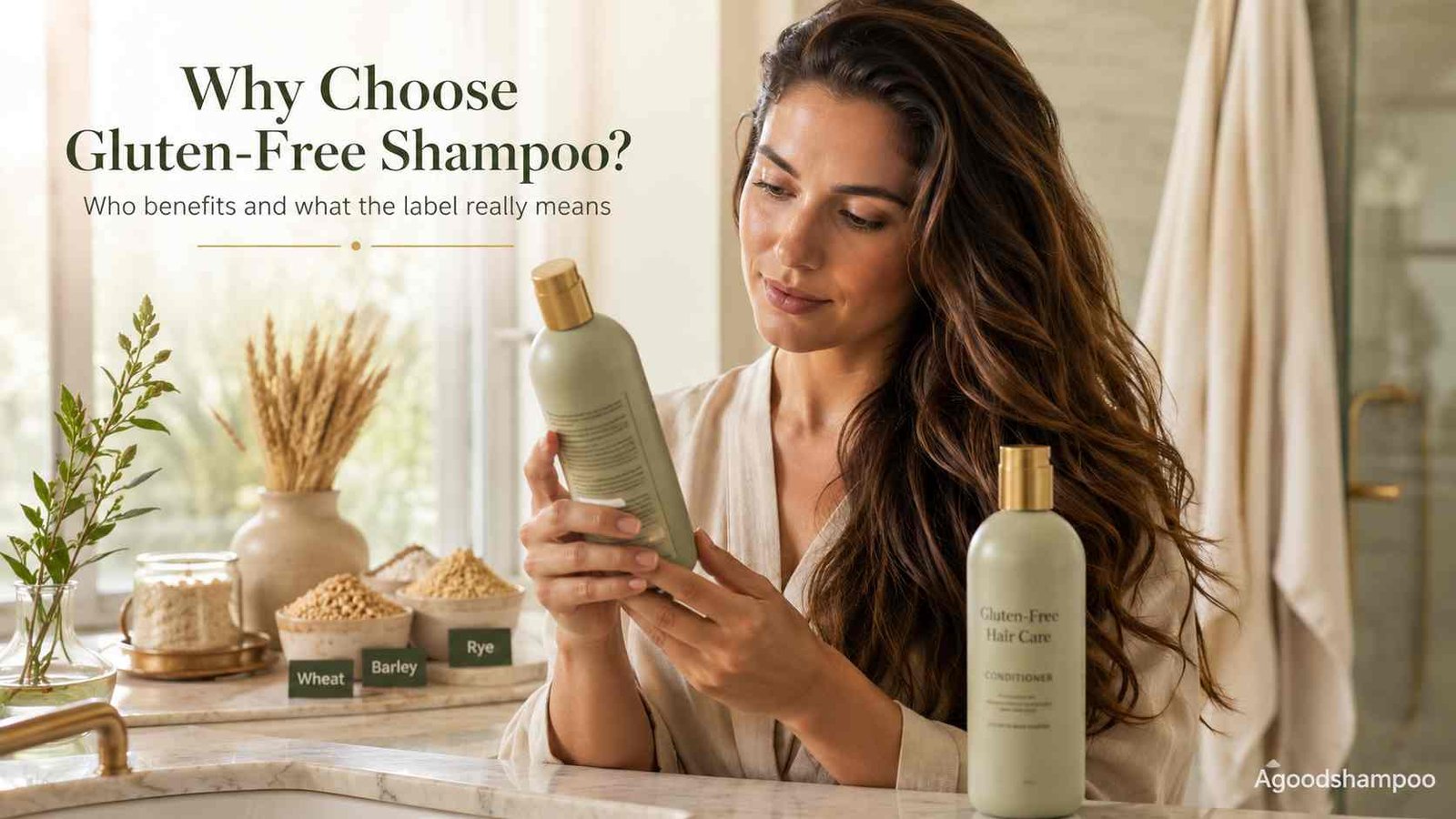
 Gluten-free shampoo can be a smart choice if you need or prefer to avoid gluten-containing ingredients in your personal-care routine. It may be especially useful when accidental swallowing is possible, such as during a child’s bath, or when someone has a separate allergy to wheat-derived cosmetic ingredients.
But here is the part that often gets lost: gluten-free shampoo is not automatically healthier for your hair.
For most people with celiac disease, gluten in shampoo does not create the same problem as gluten in food because celiac disease is triggered when gluten is ingested. The Celiac Disease Foundation says gluten cannot be absorbed through intact skin or the scalp in a way that triggers celiac disease.
So why is gluten free shampoo good? It is good when removing gluten solves a real exposure, allergy, or personal ingredient concern. Your hair’s softness, shine, moisture, cleansing level, and manageability still depend on the whole shampoo formula, not the gluten-free label alone.
Quick Answer
Gluten-free shampoo can be useful for people who want to reduce the chance of accidentally ingesting gluten from hair products or who need to avoid certain wheat-derived ingredients. However, gluten-free shampoo has not been shown to make ordinary hair grow faster, become stronger, or become healthier simply because gluten is absent.
What Does Gluten-Free Shampoo Actually Mean?
A gluten-free shampoo is formulated without ingredients that supply gluten or are derived from gluten-containing grains in a way the manufacturer considers incompatible with its gluten-free claim.
That sounds simple, but cosmetic ingredient lists can make things less obvious.
Hair products may contain grain-derived ingredients for conditioning, texture, moisturization, or other formulation purposes. Examples you may see include terms related to:
- Wheat or Triticum
- Barley or Hordeum
- Rye or Secale
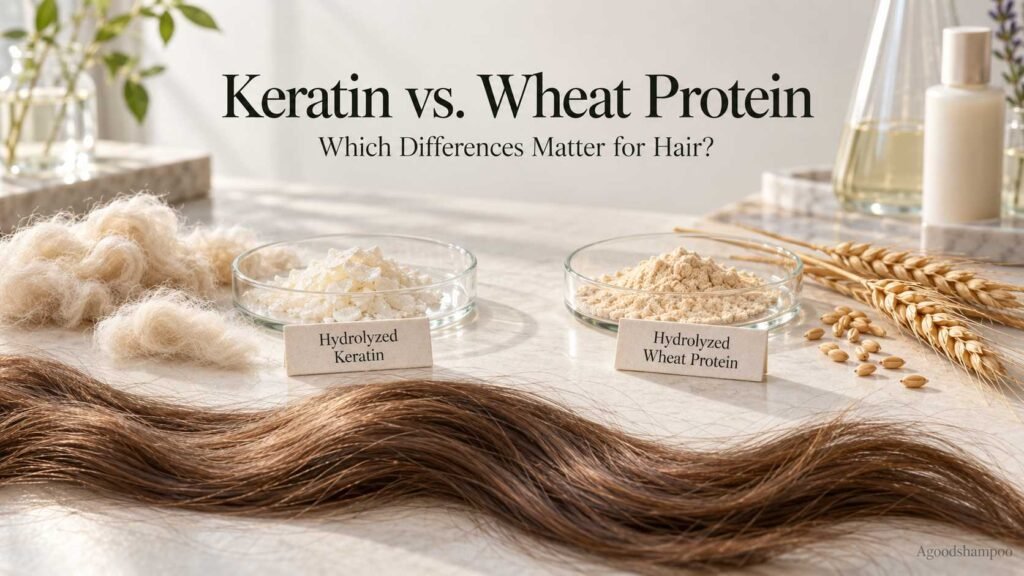
- Hydrolyzed wheat protein
- Wheat amino acids
- Wheat germ ingredients
- Barley extracts
Beyond Celiac advises people seeking gluten-free hair care to check labels for wheat, barley, rye, and related ingredient names. It also recommends checking with the manufacturer if a product’s status is unclear. Formulas can change, so an old online product list should not replace the current bottle label.
Gluten-free does not tell you how the shampoo cleans
This distinction matters.
Gluten is not the ingredient that normally does the cleansing in shampoo. Shampoo removes oil and dirt mainly through surfactants.
A surfactant has one part that interacts with oils and another that interacts with water. During washing, these ingredients help lift sebum, styling residue, sweat, and dirt so they can rinse away.
A dermatology review of shampoos explains that modern formulas combine cleansers with conditioners, preservatives, thickeners, pH adjusters, and other ingredients to balance cleansing with how the hair feels afterward.
That means two gluten-free shampoos can behave very differently.
One may leave oily hair feeling fresh and light. Another may be much more conditioning and suit dry curls. A third may contain a strong cleansing system that leaves your particular hair feeling rough.
The gluten-free claim alone cannot tell you which one you are holding.
Who May Actually Benefit From Gluten-Free Shampoo?
There are several reasons someone may choose a gluten-free shampoo, but they are not all the same.
People with celiac disease who want to reduce accidental ingestion
Celiac disease is an autoimmune disease in which ingested gluten causes an abnormal immune reaction.
For that reason, shampoo is very different from bread, pasta, or another food containing gluten.
The Celiac Disease Foundation states that products such as shampoos and lotions do not generally need to be gluten-free for a person with celiac disease because gluten must be ingested to cause the celiac reaction. The organization does, however, recommend caution with products that have a realistic chance of being swallowed.
This is why lip balm is a more obvious concern than shampoo.
Still, some people prefer gluten-free hair products because they want to reduce avoidable exposure. That preference can be reasonable, especially if it makes a routine simpler.
For example, you may not want to stop during every shower and wonder whether shampoo foam reaching your mouth matters. Choosing gluten-free shampoo removes that particular question.
Just keep the risk in perspective. For an adult using shampoo normally and rinsing it from intact skin, gluten exposure is not equivalent to eating gluten.
Parents of young children
Children do not always use shampoo as carefully as adults.
Bath water splashes. Foam reaches the face. A child may put wet fingers in the mouth or accidentally swallow some shampoo.
Beyond Celiac specifically notes that gluten-free shampoo can provide extra peace of mind for parents of young children with celiac disease because accidental ingestion during bathing is possible.
That does not mean every child with celiac disease will react to ordinary shampoo use. It simply makes accidental ingestion a more realistic consideration.
People with a wheat allergy
This requires a separate explanation because wheat allergy and celiac disease are not the same condition.
Celiac disease is an autoimmune response to gluten after ingestion.
Wheat allergy involves an allergic immune response to wheat proteins. Depending on the person and the allergen involved, reactions can be different from celiac symptoms.
Hydrolyzed wheat protein is especially interesting in cosmetics. It has been used as a hair- and skin-conditioning ingredient.
Rare allergic reactions to hydrolyzed wheat proteins in cosmetics have been reported in medical literature. Case reports describe allergic contact dermatitis and contact urticaria, and a larger Japanese episode linked a particular hydrolyzed wheat protein used in facial soap with sensitization and wheat allergy.
That does not mean hydrolyzed wheat protein is unsafe for everyone.
A Cosmetic Ingredient Review safety assessment concluded that hydrolyzed wheat protein and hydrolyzed wheat gluten can be used safely in cosmetics when their hydrolysates meet specified molecular-size conditions.
This is a good example of why ingredient science needs context. An ingredient can perform a useful cosmetic function and still be unsuitable for a person with a specific allergy.
If you have a diagnosed wheat allergy and have reacted to cosmetics before, talk with your allergist or dermatologist about which ingredient names you need to avoid rather than relying only on the words “gluten-free.”
Does Gluten-Free Shampoo Make Hair Healthier?
For most people, there is no good evidence that removing gluten from shampoo by itself improves hair health.
Gluten-free shampoo does not automatically:
- Speed up hair growth
- Stop ordinary hair shedding
- Repair split ends
- Make hair thicker
- Prevent breakage
- Cure dandruff
- Add moisture
- Reduce frizz
- Protect hair color
A particular gluten-free shampoo may certainly help with some of those cosmetic concerns. But if it does, other parts of its formulation are usually responsible.
Imagine a gluten-free shampoo containing mild surfactants, conditioning polymers, humectants, and ingredients that reduce friction between hair fibers. Your hair may feel noticeably better after using it.
Now imagine another gluten-free shampoo with a cleansing system that is too strong for your dry, bleached hair. It may leave your hair rough.
Both products are gluten-free.
The difference is the formulation.
Research on shampoo science shows that effective formulas need to remove enough oil and residue to clean the scalp while avoiding unnecessary roughness and tangling of the hair shaft. Surfactants form the core of that cleaning system, while conditioning agents change properties such as softness, static, shine, and manageability.
So if your only hair concern is dryness, frizz, oiliness, breakage, or color fading, start by looking for a shampoo designed for that concern. Gluten-free status can be an additional requirement if you need it.
Gluten-Free Shampoo and Conditioner: Should Both Be Gluten-Free?
If your goal is strict ingredient avoidance, checking only your shampoo does not make much sense.
Conditioner stays on the hair longer than shampoo during a normal routine, and leave-in products stay on even longer. Styling products can also get onto your hands and around your face.
A complete gluten-free hair-care routine may include:
- Shampoo
- Rinse-out conditioner
- Leave-in conditioner
- Hair mask
- Dry shampoo
- Mousse
- Gel
- Styling cream
- Hairspray
- Hair oil or serum
- Pomade
Beyond Celiac notes that gluten-free hair styling products are available across categories including hairspray, mousse, pomade, styling gel, dry shampoo, and oils. It recommends checking labels and contacting manufacturers when the status is uncertain.
You do not need to replace every bottle simply because it lacks a big “gluten-free” statement on the front. Start with the actual ingredient list and the manufacturer’s information.
Gluten-Free vs Sulfate-Free vs Silicone-Free vs Paraben-Free
Hair-care labels often stack claims together:
“Gluten-free.”
“Sulfate-free.”
“Silicone-free.”
“Paraben-free.”
That can make them sound like four versions of the same promise. They are not.
| Label | What it mainly describes | What it may matter for |
|---|---|---|
| Gluten-free | Avoidance of gluten-containing ingredients | Celiac-related accidental ingestion concerns, personal avoidance, some wheat-related concerns |
| Sulfate-free | Type of cleansing surfactants used | Cleansing strength, scalp feel, dryness, color-care preferences |
| Silicone-free | Absence of silicone conditioning ingredients | Hair feel, buildup preferences, styling routine |
| Paraben-free | Absence of paraben preservatives | Personal preservative preference |
| Fragrance-free | Absence of added fragrance in an appropriately labeled product | Fragrance sensitivity or allergy concerns |
One claim cannot substitute for another.
A shampoo can be gluten-free and still contain sulfates.
It can be sulfate-free and contain silicones.
It can be silicone-free but contain parabens.
It can be free from all four and still be a poor match for your hair.
Why is sulfate-free shampoo good for some hair?
Sulfates are a family of surfactants. Common examples in shampoos include sodium lauryl sulfate and sodium laureth sulfate.
They can be very effective cleansers.
That is useful when you have an oily scalp or need to remove a lot of styling residue. But strong cleansing can leave some hair types feeling dry or rough, especially when the formula does not contain enough conditioning support.
That is why sulfate-free shampoo has become popular among people with dry, curly, colored, bleached, or easily tangled hair.
Still, sulfate-free does not automatically mean mild.
A modern shampoo normally uses a blend of surfactants, and the behavior of that blend matters more than judging one ingredient name in isolation. A review of shampoo surfactant technology describes cleansing, foaming, skin mildness, and ingredient deposition as properties that formulators balance through the complete surfactant system.
So if you are asking why sulphate free shampoo is good for hair, a better answer is this: a well-formulated sulfate-free shampoo can provide enough cleansing with a feel that suits dry or easily stripped hair. But the label itself does not guarantee that result.
Why is sulfate-free shampoo good for your hair and scalp care?
For someone whose scalp feels tight or whose lengths become rough after washing, changing the cleansing system can help.
That does not mean sulfate shampoos are inherently damaging.
Hair type, washing frequency, oil production, water hardness, styling products, chemical treatments, and the whole formulation all affect how shampoo performs.
An oily scalp covered in dry shampoo may actually need stronger cleansing than a dry scalp with fine, bleached hair.
Choose the formula that fits the job.
Why is silicone-free shampoo good for some people?
Silicones such as dimethicone and amodimethicone are used because they can improve slip, shine, softness, and manageability.
A recent dermatology review explains that silicones can form a film on the hair, reduce friction, help limit moisture loss, and improve cosmetic appearance. The same review notes that some water-insoluble silicones may accumulate depending on the silicone, formula, hair type, and cleansing routine.
So why is silicone free shampoo good for some hair?
It may suit someone who:
- Dislikes a coated feel
- Uses many silicone-rich styling products
- Has very fine hair that becomes weighed down easily
- Follows a routine that avoids certain silicones
But silicones are not simply “bad ingredients.”
For damaged or tangled hair, the slip provided by silicone-based conditioning can be useful because lower friction means easier combing.
A silicone-free shampoo is therefore a preference or formulation choice, not a universal upgrade.
Why is paraben-free shampoo good?
Parabens are preservatives.
Their job is very different from the job of gluten, surfactants, or silicones.
Preservatives help stop bacteria, yeast, and mold from growing in water-containing cosmetics. That matters because shampoo lives in a warm, wet bathroom and gets opened repeatedly.
The FDA states that parabens are used as preservatives in cosmetics and that, based on the information currently available to the agency, it does not have evidence showing that parabens as used in cosmetics affect human health. The FDA continues to review scientific data.
So a paraben-free label simply tells you that the manufacturer chose another preservation system.
It does not prove that the shampoo is safer.
The replacement preservative still has to do its job.
How to Choose a Good Gluten-Free Shampoo
Once gluten-free status is important to you, the next step is finding a formula that actually suits your hair.
1. Check the current ingredient label
Do not rely on a five-year-old blog post, an old photo, or something you remember from a previous bottle.
Cosmetic formulas change.
Beyond Celiac specifically advises checking current labels because formulations may be updated.
2. Look for the manufacturer’s gluten statement
If a company clearly states that a specific product is gluten-free, that gives you more useful information than guessing from the front label.
Be careful with broad claims such as “clean,” “natural,” or “plant-based.”
Those words do not mean gluten-free.
Wheat itself is natural.
3. Contact the company when you need stronger assurance
If you have celiac disease, a wheat allergy, or another diagnosed condition and the label leaves you unsure, contact the manufacturer.
Ask about the specific product, not just the brand.
One brand can sell both gluten-free and gluten-containing formulas.
4. Match the cleansing system to your scalp
An oily scalp usually needs better oil removal.
A dry or easily irritated scalp may feel better with a milder cleanser.
If you use heavy oils, waxes, silicone-rich stylers, or lots of dry shampoo, you may occasionally need stronger cleansing even if your regular shampoo is gentle.
5. Match the conditioning level to your hair
Fine hair can become flat if a shampoo deposits too many rich conditioning ingredients.
Thick, curly, bleached, or damaged hair often benefits from more slip and conditioning.
This matters much more to daily hair feel than whether gluten is present.
6. Consider fragrance separately
If a shampoo makes your scalp itch, gluten may not be the cause.
Fragrance, preservatives, botanical extracts, hair dyes, and other ingredients can trigger irritation or allergy in some people.
If you repeatedly develop burning, swelling, hives, sores, or severe itching after a hair product, stop using it and seek advice from a dermatologist or other qualified healthcare professional.
What Matters More Than a Gluten-Free Label?
The best shampoo label is not the one with the longest list of ingredients it does not contain.
It is the one attached to a formula that fits your actual needs.
If you have celiac disease and want to reduce accidental gluten exposure, gluten-free status may deserve a place near the top of your checklist.
If your main issue is dry, bleached hair, conditioning and cleansing strength may matter more.
If your scalp becomes greasy within a day, you may need effective oil removal.
If you have fine hair, you may want lightweight conditioning.
If you react to fragrance, fragrance status may matter more than whether a shampoo contains silicone.
This is why I would not judge shampoo quality by counting “free-from” claims.
Formulation science rarely works that way.
A shampoo is a system. Surfactants, conditioners, polymers, proteins, oils, humectants, preservatives, fragrance, pH, and dozens of smaller formulation choices affect how it performs.
Michael Chen’s Verdict: Why Is Gluten Free Shampoo Good?
Gluten-free shampoo is good when being gluten-free solves a real problem for the person using it.
For someone with celiac disease, ordinary shampoo applied to intact skin is not considered the same type of gluten exposure as eating gluten. Both the Celiac Disease Foundation and Beyond Celiac emphasize that ingestion is the central concern.
Still, choosing gluten-free shampoo can make sense if accidental swallowing is possible, if you are managing a young child’s bath routine, or if you simply want to reduce avoidable gluten-containing products around you.
A diagnosed wheat allergy is a separate issue and deserves more individual care because certain wheat-derived cosmetic proteins have been associated with uncommon allergic reactions.
For everyone else, there is no strong reason to expect gluten-free shampoo to produce healthier hair simply because gluten was removed.
Choose your shampoo in this order:
Your health needs first, your scalp and hair needs second, and marketing claims last.
If you are comparing several “free-from” formulas, related guides on why sulfate-free shampoo is good, silicone-free hair care, and paraben-free shampoo can help you understand what each label actually changes.
Frequently Asked Questions
Is gluten-free shampoo necessary if I have celiac disease?
Not usually for normal external use. The Celiac Disease Foundation states that gluten must be ingested to cause a celiac concern and cannot be absorbed through intact scalp or skin in the same way. Products that may be accidentally swallowed deserve more attention.
Can gluten in shampoo be absorbed through the scalp?
Gluten is not considered a celiac risk simply from contact with intact skin or scalp. Celiac disease requires gluten exposure through ingestion. If you have broken skin, another skin disorder, or a separate wheat allergy, your situation may require different advice.
What ingredients should I look for in gluten-free shampoo?
People trying to avoid gluten commonly check for wheat or Triticum, barley or Hordeum, rye or Secale, and ingredients such as hydrolyzed wheat protein. Ingredient names can be complicated, so check the manufacturer’s gluten-free statement if you are unsure.
Is gluten-free shampoo also sulfate-free?
Not necessarily. Gluten-free describes gluten-related ingredients, while sulfate-free describes the surfactant system. A shampoo can be gluten-free and contain sulfate cleansers.
Is gluten-free shampoo better for curly hair?
Not automatically. Curly hair often benefits from a cleansing and conditioning balance that limits excessive dryness and improves slip. A gluten-free formula can work very well for curls, but gluten-free status alone does not create those benefits.
Is gluten-free shampoo better for hair growth?
There is no good evidence that simply removing gluten from shampoo stimulates hair growth. If you have ongoing thinning, bald patches, sudden shedding, or scalp inflammation, a cosmetic shampoo should not replace medical evaluation.
Do I need gluten-free conditioner and styling products too?
If you want a fully gluten-free routine, checking your conditioner, leave-in products, dry shampoo, mousse, gel, hairspray, and other styling products is reasonable. Beyond Celiac recommends checking labels and confirming uncertain products with their manufacturers.
Is sulfate-free, silicone-free, paraben-free, or gluten-free shampoo best?
None of those labels is universally best. They describe different parts of a formula. The right shampoo depends on your health requirements, scalp condition, hair type, chemical treatments, styling routine, and personal preferences.

Michael Chen focuses on the science behind shampoos and hair-care ingredients. He explains how cleansing agents, silicones, proteins, and other formula components work, separating useful evidence from marketing claims to help readers better understand the products they use.