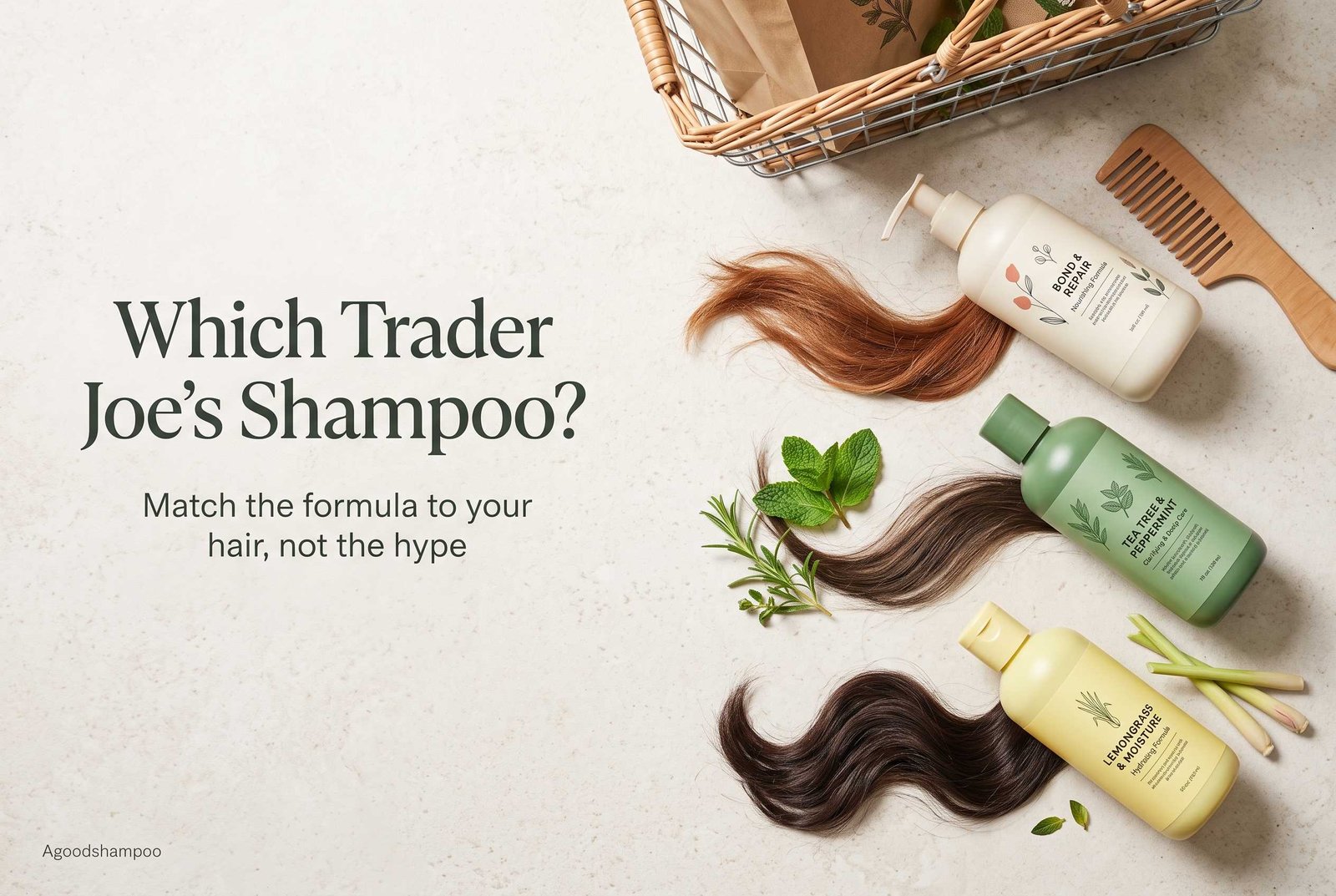
 If you’re wondering which Trader Joe’s shampoo is good, the most useful answer is not one bottle for everyone. Trader Joe’s Bonding Shampoo is the strongest starting choice for damaged, color-treated or frequently heat-styled hair, while Lemongrass Moisturizing Shampoo makes more sense for hair that feels dry or rough. Tea Tree Tingle Shampoo is more suited to people who want a fresh, stronger cleanse, especially around oily roots.
That distinction matters because shampoos aren’t simply good or bad based on the brand name. The cleansing system, conditioning ingredients, proteins, fragrance components and your own hair and scalp condition all affect how a shampoo performs.
Trader Joe’s currently lists its Bonding Shampoo on its official U.S. website at $7.99 for a 12-ounce bottle. Its online catalog doesn’t necessarily represent every product available in every store, so Tea Tree Tingle and Lemongrass availability can vary by location.
Which Trader Joe’s Shampoo Is Good for Most People?
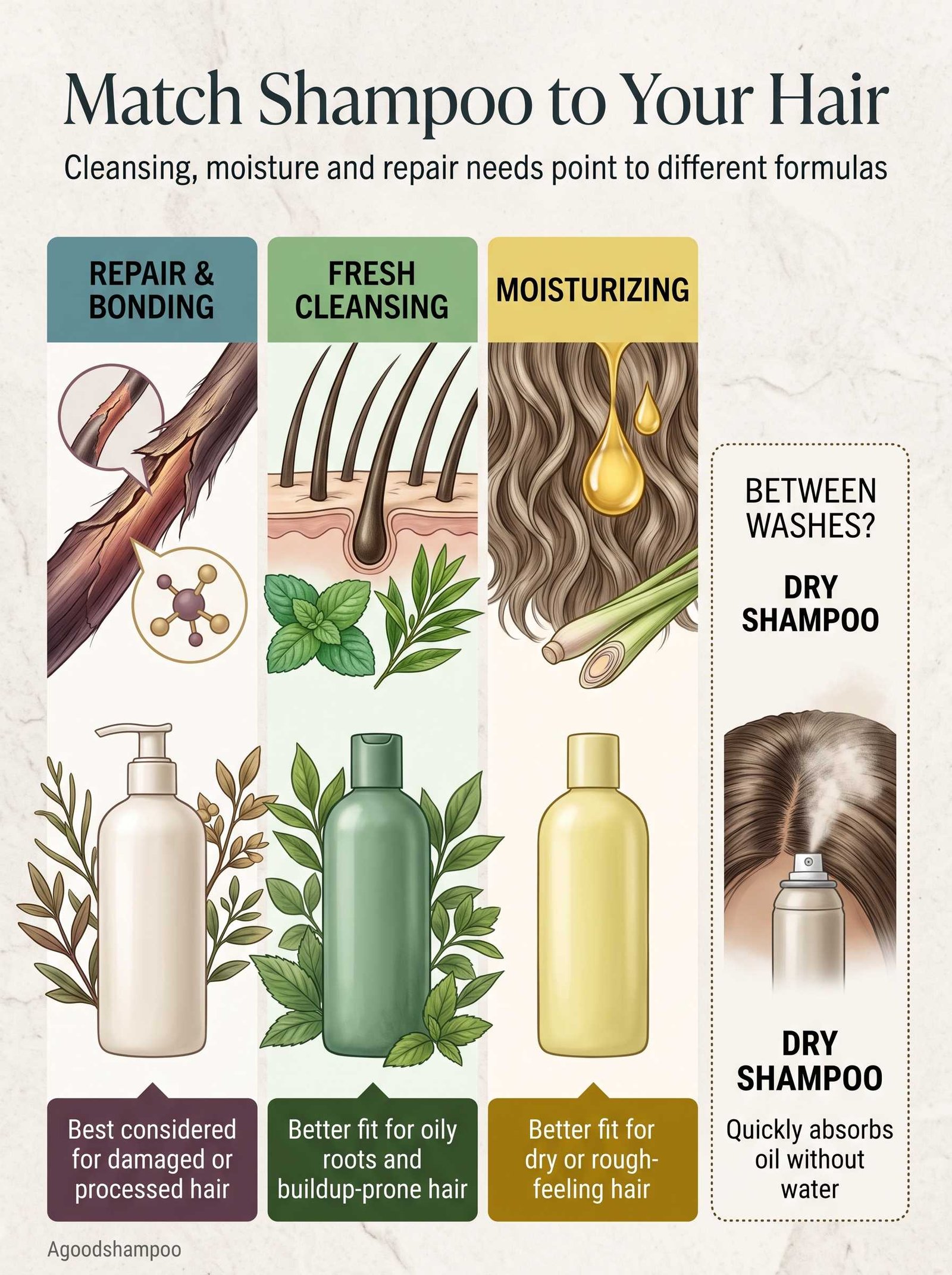
For someone choosing without a very specific scalp problem, I’d start by matching the shampoo to the condition of the hair rather than choosing the most popular Trader Joe’s bottle.
| Trader Joe’s shampoo | Likely best fit | Main strength | Main caution |
|---|---|---|---|
| Bonding Shampoo | Damaged, processed or heat-styled hair | Combines cleansing with humectants, conditioning agents and protein-derived ingredients | May be more cleansing than very dry or sensitive scalps prefer |
| Lemongrass Moisturizing Shampoo | Dry, rough or dull-feeling hair | Uses a different cleansing system alongside oils and conditioning ingredients | Essential oils and citral may not suit fragrance-sensitive scalps |
| Tea Tree Tingle Shampoo | Oily roots, buildup-prone hair, people who like a very fresh wash | Strong cleansing profile and cooling botanical feel | Can feel drying on already dry or highly processed hair |
| Dry shampoo | Oily roots between washes | Temporarily absorbs surface oil | Does not replace shampoo and water |
This is also why asking whether Trader Joe’s shampoo is good for your hair has no universal yes-or-no answer. A shampoo that leaves oily, fine hair feeling clean and light can leave dry, porous hair feeling rough.
Shampoo science supports that approach. A review in the International Journal of Cosmetic Science explains that surfactants form the core of shampoo formulations and influence cleansing, foaming, mildness and the deposition of conditioning ingredients. The entire surfactant blend matters, not merely whether a bottle says sulfate-free or includes a fashionable botanical.
Trader Joe’s Shampoos Compared by Hair Type
Bonding Shampoo Makes the Most Sense for Damaged or Processed Hair
Trader Joe’s Bonding Shampoo is the clearest current choice if your main concern is hair that has been colored, heat styled, chemically processed or simply feels increasingly rough and difficult to manage.
The currently reported formula begins with water followed by sodium C14-16 olefin sulfonate, cocamidopropyl betaine and other cleansing agents. It also includes glycerin, panthenol, a conditioning guar polymer, hydrolyzed keratin, hydrolyzed silk and aloe.
That combination explains the product’s positioning better than the word bonding alone.
Glycerin is a humectant used to help hold water. Panthenol and conditioning polymers can contribute to smoother feel and easier handling, while protein-derived ingredients can temporarily influence the feel of damaged hair fibers.
What shouldn’t be assumed is that seeing keratin, silk or the word bonding on the ingredient list proves permanent structural repair.
Shampoo is a rinse-off cosmetic product. Ingredients can improve the feel, manageability and appearance of damaged hair, but that is different from reversing all chemical or mechanical damage to the hair fiber.
Another detail worth noticing is the cleansing base. Sodium C14-16 olefin sulfonate is an effective anionic cleanser. Despite the way sulfate-free products are sometimes marketed, sulfate-free doesn’t automatically mean extremely mild.
If your scalp becomes tight or your ends already feel straw-like, you may prefer alternating Bonding Shampoo with a gentler wash rather than using it automatically every time.
For a deeper explanation of that distinction, our guide to sulfate-free shampoo explains why the absence of SLS or SLES doesn’t tell you the entire cleansing story.
Lemongrass Moisturizing Shampoo Is the More Logical Pick for Dry Hair
If your biggest complaint is dryness rather than damage, Trader Joe’s Lemongrass Moisturizing Shampoo may be a better match.
The ingredient information currently available lists caprylyl/capryl glucoside, disodium laureth sulfosuccinate and cocamidopropyl betaine among its cleansers. The formula also includes PCA glyceryl oleate, coconut oil, argan oil, vitamin E, hydrolyzed rice protein and sunflower seed oil.
This is a useful example of why ingredient names need context.
Disodium laureth sulfosuccinate sounds similar to sodium laureth sulfate, but they aren’t the same ingredient. You shouldn’t classify a shampoo simply by spotting part of a familiar chemical name.
The oils in this formula also don’t mean the shampoo coats the hair in heavy oil. In a rinse-off formulation, their effect depends on concentration, the rest of the formula and how much material remains on the hair after rinsing.
Trader Joe’s current official Lemongrass Moisturizing Conditioner page says the conditioner is intended to work with Lemongrass Moisturizing Shampoo and describes the pair as suitable for color-treated hair.
For someone with dry waves, coarse hair, rough ends or color-treated lengths, that makes Lemongrass one of the more sensible Trader Joe’s options to consider.
There’s one important limitation. The formula includes peppermint oil, lemongrass oil, lemon myrtle oil and citral. People with fragrance-sensitive or easily irritated scalps shouldn’t assume a botanical formula will automatically be gentler.
Tea Tree Tingle Is Better Suited to Oily Roots Than Very Dry Hair
Trader Joe’s Tea Tree Tingle Shampoo has built much of its reputation around tea tree, peppermint, eucalyptus and a long list of other botanical ingredients.
The more important ingredient for understanding how it cleans, however, is sodium C12-14 olefin sulfonate, accompanied by cocamidopropyl betaine. Current ingredient listings also show soybean protein, vitamin E, tea tree, peppermint, eucalyptus, rosemary, nettle, thyme, chamomile and other botanicals.
This matters because Tea Tree Tingle is sometimes described online simply as a sulfate-free or natural shampoo.
That can create the wrong expectation.
Sodium C12-14 olefin sulfonate is not SLS or SLES, but it is still a cleansing surfactant. A shampoo can therefore avoid traditional lauryl/laureth sulfates and still deliver a fairly noticeable cleanse.
For oily roots, occasional buildup or hair that becomes limp quickly, that may be exactly what you want.
If your hair is bleached, coarse, naturally dry or already prone to tangling, it may feel like too much cleansing unless you follow with suitable conditioning.
This is especially relevant if your scalp is oily while your lengths stay dry. Rather than forcing one shampoo through every inch of hair, concentrate shampoo primarily around the scalp and allow the lather to run through the lengths during rinsing. Our guide to managing an oily scalp with dry hair explores that combination in more detail.
Why the Formula Matters More Than the Trader Joe’s Label
One of the easiest shampoo mistakes is choosing by a single ingredient.
Tea tree sounds cleansing. Argan oil sounds moisturizing. Keratin sounds repairing. None of those names tells you how the finished shampoo will behave by itself.
A shampoo is a formulated system.
Scientific reviews describe shampoos as combinations of cleansing agents, conditioning ingredients, specialty ingredients and additives, with surfactant type and amount influencing cleansing performance. Modern formulations may also use conditioning polymers, proteins, silicones, botanical extracts and other materials to change how hair feels after washing.
That’s why these statements are too simplistic:
Sulfate-free always means gentle.
Natural always means better for sensitive scalps.
Protein always repairs damaged hair.
Oil in shampoo always makes hair greasy.
Tea tree automatically treats dandruff.
The actual formula matters more.
Hair type matters too. Fine hair that collapses under rich conditioning may benefit from a cleaner finish. Coarse or porous hair may prefer more conditioning and less aggressive cleansing. Someone who washes every day can also react differently to a cleanser than someone who washes twice per week.
If your strands are both fine and oily, see our guide to choosing shampoo for fine oily hair for a more specific routine.
Don’t Use Shampoo pH Claims Unless the Actual Product pH Is Known
You may also see advice saying that the best shampoo must have a certain pH.
There is a real scientific basis for considering pH. One published study measured 123 shampoos and found values ranging from pH 3.5 to 9.0. About 38.2% of the shampoos had a pH of 5.5 or below. The authors noted that more alkaline conditions can increase negative electrical charge and friction between hair fibers.
But that study did not test these specific Trader Joe’s shampoos.
Unless Trader Joe’s publishes the pH or the individual finished product is reliably tested, it would be misleading to assign a pH benefit to Bonding Shampoo, Tea Tree Tingle or Lemongrass simply because one contains citric acid.
Citric acid can be used to adjust pH, but its presence doesn’t tell us the finished product’s exact pH.
Is Trader Joe’s Shampoo Good for Your Hair?
Trader Joe’s shampoo can be perfectly reasonable for your hair if you choose a formula that matches your scalp, hair condition and washing habits.
What matters most is the result after repeated use.
A suitable shampoo should clean your scalp without consistently leaving it uncomfortable and should allow your hair to remain manageable once conditioned.
For damaged or processed hair, Bonding Shampoo is the most obvious option in the current lineup because its formula combines cleansing agents with humectants, conditioning materials and protein-derived ingredients.
For dry or coarse hair, Lemongrass Moisturizing Shampoo has the more moisture-oriented formulation.
For oily roots, Tea Tree Tingle may provide the cleaner finish some users want.
For very sensitive scalps, none should automatically be assumed ideal. Fragrance, botanical oils and certain surfactants can all matter when skin is reactive.
Surfactants are common and necessary components of cleansers, but dermatology literature also recognizes that some surfactants can contribute to irritant or allergic contact dermatitis in susceptible individuals.
Persistent itching, burning, scaling, sores or unusual hair shedding deserves more attention than repeatedly switching cosmetic shampoos. Those symptoms can have causes that an ordinary shampoo isn’t designed to treat.
What About Trader Joe’s Dry Shampoo?
Trader Joe’s dry shampoo belongs in a different category from Bonding Shampoo, Lemongrass or Tea Tree Tingle.
Dry shampoo doesn’t wash the scalp.
It mainly uses absorbent materials to pick up excess oil so the roots appear and feel less greasy between normal washes.
That distinction is important because dry shampoo can make hair look cleaner without removing everything that accumulates on the scalp.
The American Academy of Dermatology states that dry shampoo absorbs oil but doesn’t clean hair in the way shampoo and water do. Dermatologists quoted by the AAD recommend continuing to wash with normal shampoo and water and suggest washing after about one or two dry-shampoo applications rather than continuously layering more product.
So, is Trader Joe’s dry shampoo good?
It can be useful if you want to stretch the appearance of clean roots between washes. It should not become your replacement for washing.
Apply it mainly where oil is visible, use a small amount and remove excess according to the product directions.
If dry shampoo regularly leaves your scalp itchy, gritty or uncomfortable, use it less often or choose another formula.
Our broader guide to choosing a dry shampoo explains how hair type and application habits change the result.
Products You May See Online but Shouldn’t Assume Are Current
Trader Joe’s hair-care recommendations online can become confusing because product availability changes.
Older articles, reviews and forum posts may discuss products that no longer appear in the current official catalog, while individual stores can carry products that aren’t obvious on Trader Joe’s website.
That means a five-year-old list of the best Trader Joe’s shampoos isn’t necessarily a reliable shopping list today.
Bonding Shampoo is straightforward: Trader Joe’s currently lists it in its official online product catalog at $7.99 for 12 fluid ounces.
Lemongrass Moisturizing Shampoo also has current official support indirectly through Trader Joe’s Lemongrass Moisturizing Conditioner page, which specifically recommends pairing the conditioner with the shampoo.
Tea Tree Tingle remains widely documented in recent product information, but because Trader Joe’s availability can vary, checking your local store is more reliable than assuming every location currently stocks it.
The same rule applies to older favorites such as Trader Joe’s Cleansing + Conditioning Hair Wash. Don’t choose a shampoo based solely on an old review and then assume it is still part of the permanent range.
Which Trader Joe’s Shampoo Should You Put in Your Cart?
If you want the simplest decision, choose by the problem you’re actually trying to solve.
Choose Bonding Shampoo if your hair is damaged, colored, heat styled or chemically processed. Its current formulation makes the most sense when your priority is cleansing while maintaining better hair feel and manageability. Don’t interpret bonding as a promise that rinse-off shampoo can permanently reverse structural damage.
Choose Lemongrass Moisturizing Shampoo if dryness and roughness are the bigger problems. Its blend of cleansers, conditioning ingredients, plant oils and protein makes it the more logical moisture-focused option, especially for dry or color-treated lengths.
Choose Tea Tree Tingle if your roots become oily quickly or you prefer a stronger, fresher cleanse. Its olefin-sulfonate-based cleansing system is the main reason for that recommendation, not the marketing appeal of tea tree or peppermint.
If your hair is both fine and dry, your scalp is very sensitive, or you have a diagnosed scalp condition, the best answer may be none of these. Trader Joe’s offers good-value cosmetic shampoos, but value alone doesn’t make every formula suitable for every scalp.
That is really the answer to which Trader Joe’s shampoo is good: the best one is the formula that matches your actual hair and scalp needs, not the bottle with the most attractive ingredient story..

Marlena Stell makes everyday hair care easier to understand. From choosing a shampoo to managing common hair concerns, she breaks down confusing product claims and practical routines into straightforward advice that helps readers find what works for their needs.