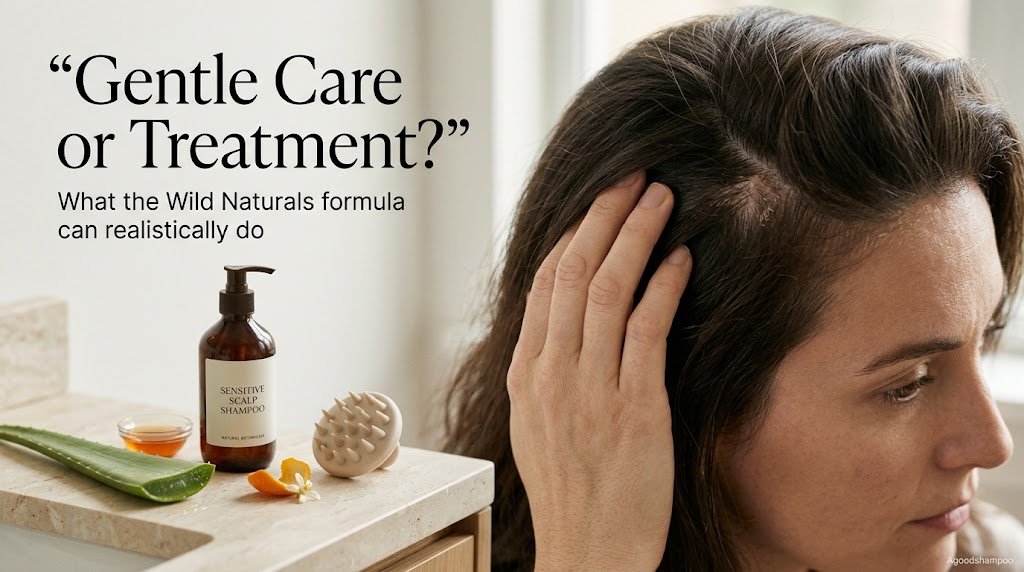
 Wild Naturals Eczema & Psoriasis Shampoo is designed for people dealing with an itchy, dry or flaky scalp, but the name can create an important expectation that needs clearing up.
This is best understood as a gentle, moisture-focused shampoo for sensitive or uncomfortable scalps, not as a medicated psoriasis treatment. Its current ingredient list includes aloe vera juice, cocamidopropyl betaine, decyl glucoside, propanediol, manuka honey, sweet orange oil and Centipeda cunninghamii extract. It does not list established medicated psoriasis ingredients such as salicylic acid, coal tar or prescription corticosteroids.
That doesn’t automatically make Wild Naturals a poor shampoo. For someone whose main problem is dryness, tightness or irritation from overly aggressive cleansing, a mild formula may be useful. But if you have diagnosed scalp psoriasis, thick plaques or significant inflammation, it is important to understand what this shampoo can and cannot realistically do.
Quick Answer: Wild Naturals Eczema & Psoriasis Shampoo may suit some people who want gentle cleansing for a dry, itchy or easily irritated scalp. Its sulfate-free cleansing system and aloe-based formula are reasonable features for sensitive scalp care. However, it is not equivalent to a medicated psoriasis shampoo, and the presence of sweet orange oil may be a concern for people who react to fragrances or essential oils.
Is Wild Naturals Eczema & Psoriasis Shampoo Actually Good?
For the right scalp, Wild Naturals Eczema & Psoriasis Shampoo has several appealing characteristics.
According to the current manufacturer ingredient list, aloe vera leaf juice is the first ingredient rather than water. The shampoo uses cocamidopropyl betaine and decyl glucoside as cleansing agents and does not list sodium lauryl sulfate or sodium laureth sulfate. The brand also includes manuka honey and botanical extracts and describes the shampoo as intended to help dry, tight and flaky scalps feel more comfortable.
The bigger question is whether those features make it appropriate for eczema or psoriasis.
For eczema-prone skin, gentle cleansing and avoiding known irritants can be useful. The American Academy of Dermatology recommends fragrance-free skin-care products for people with atopic dermatitis because fragrance can contribute to flares in susceptible people.
Psoriasis is different. Scalp psoriasis is an inflammatory disease, and dermatologists may use medicated shampoos, scale softeners, corticosteroids and other treatments depending on its severity. A regular moisturizing shampoo may make washing more comfortable, but that does not mean it treats the underlying psoriasis.
So the fairest assessment is this:
Wild Naturals looks more convincing as a sensitive-scalp cleanser than as a psoriasis treatment.
What Is in Wild Naturals Eczema & Psoriasis Shampoo?
A product name tells you what a shampoo is marketed for. The ingredient list tells you much more about how it is likely to behave.
The current Wild Naturals formula lists:
Aloe Barbadensis leaf juice, cocamidopropyl betaine, propanediol, decyl glucoside, xanthan gum, manuka honey, cellulose gum, tapioca starch, mica, titanium dioxide, sweet orange oil, Centipeda cunninghamii extract, gluconolactone and sodium benzoate.
Here are the ingredients that matter most.
| Ingredient | Likely Role | What It Means for the Scalp |
|---|---|---|
| Aloe vera juice | Formula base, moisturizing botanical | May help the formula feel less drying |
| Cocamidopropyl betaine | Cleansing surfactant | Helps remove oil and dirt with relatively mild cleansing |
| Decyl glucoside | Nonionic surfactant | Common in gentle-cleansing formulations |
| Propanediol | Humectant/solvent | Helps support moisture and ingredient delivery |
| Manuka honey | Humectant-rich botanical ingredient | Supports the moisturizing character of the formula |
| Sweet orange oil | Aromatic essential oil | Gives a citrus scent but may bother fragrance-sensitive users |
| Centipeda cunninghamii extract | Botanical extract | Interesting supporting ingredient, but not established psoriasis medication |
| Gluconolactone + sodium benzoate | Formula support/preservation | Help maintain product stability |
Aloe Vera, Manuka Honey and Botanical Extracts
Aloe vera and honey are easy ingredients to market because consumers associate them with soothing skin.
But formulation science requires a little restraint here.
The presence of aloe or manuka honey does not prove that the finished shampoo treats eczema or psoriasis. Ingredient-level research and traditional use cannot automatically be transferred to a rinse-off shampoo containing a mixture of surfactants, preservatives and botanical ingredients.
What we can reasonably say is that these ingredients fit the overall design of a shampoo intended to feel less stripping and more moisture-oriented.
That is useful. It just isn’t the same as medical treatment.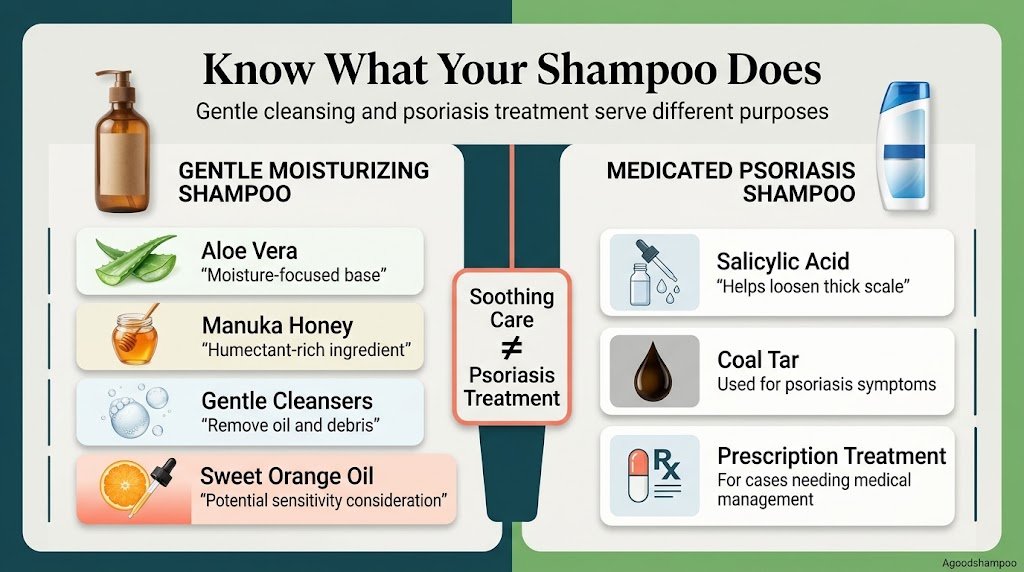
The Cleansing System
Wild Naturals uses cocamidopropyl betaine and decyl glucoside rather than relying on traditional strong sulfate surfactants.
That may appeal to someone whose scalp feels tight or dry after washing.
Still, sulfate-free doesn’t mean allergy-free or irritation-proof.
Cocamidopropyl betaine has been associated with allergic contact dermatitis in susceptible individuals. Published reports describe reactions from rinse-off products including shampoos.
Decyl glucoside is also generally regarded as a mild cleansing surfactant, but mildness and allergy potential are different questions. In a North American Contact Dermatitis Group analysis of people undergoing patch testing, reactions to decyl or lauryl glucoside occurred in a minority of tested patients and were often linked to personal-care products. Importantly, this was a dermatology referral population, not the general public, so those percentages should not be treated as the risk for every shampoo user.
The practical lesson is simple: a cleanser can be mild for most users while still being unsuitable for a particular person.
Sweet Orange Oil Deserves Attention
This is the ingredient I would pay particular attention to if you have eczema-prone or very reactive skin.
Wild Naturals says that no fragrance is added to the shampoo, while also saying users may notice a light citrus smell. The ingredient list contains Citrus sinensis, or sweet orange oil.
That distinction matters.
A product can avoid conventional perfume while still contain an aromatic essential oil. From a sensitive-skin perspective, the fact that a fragrance source is botanical doesn’t automatically make it non-irritating.
A review of essential-oil contact allergy identified orange oil among essential oils capable of producing positive patch-test reactions in susceptible patients. That does not mean everyone using orange oil will react, nor does it establish that this shampoo commonly causes dermatitis. It does mean someone with known fragrance or essential-oil sensitivity should not assume the formula is risk-free simply because the scent comes from a plant ingredient.
DermNet likewise notes that essential oils can cause allergic contact dermatitis in sensitized individuals.
For eczema-prone skin, the American Academy of Dermatology generally recommends choosing fragrance-free products.
That makes sweet orange oil one of the main limitations of this formula for the most reactive users.
Is Wild Naturals Shampoo Good for Scalp Eczema?
Wild Naturals may work as a gentle cleanser for some people with eczema-prone scalps, but there is no shampoo formula that is automatically appropriate for everyone with eczema.
Eczema makes the skin barrier more vulnerable to dryness and irritation. That is why dermatology guidance generally emphasizes mild skin care and avoiding personal triggers. The American Academy of Dermatology specifically recommends fragrance-free products for people with atopic dermatitis.
Wild Naturals has several characteristics that may appeal to someone with a sensitive scalp:
- It does not list SLS or SLES.
- Aloe vera juice is the first listed ingredient.
- It uses a relatively gentle surfactant combination.
- It contains moisture-supporting ingredients.
- It avoids a long conventional perfume listing.
But the sweet orange oil prevents me from describing it as an ideal choice for every fragrance-sensitive eczema user.
If you know essential oils trigger your skin, a genuinely fragrance-free shampoo without aromatic plant oils would be the more cautious choice.
The same applies if you’ve previously reacted to cocamidopropyl betaine or glucoside surfactants.
Another point matters here: not every itchy, flaky scalp is eczema.
Seborrheic dermatitis, psoriasis, allergic contact dermatitis, irritant dermatitis and other scalp conditions can overlap in appearance. Repeatedly changing shampoos without knowing the cause can make the problem harder to understand.
Persistent redness, painful inflammation, sores, substantial scaling or symptoms that keep returning deserve assessment by a dermatologist or another qualified healthcare professional.
Is Wild Naturals Shampoo Good for Scalp Psoriasis?
This is where the product name requires the most qualification.
Wild Naturals Eczema & Psoriasis Shampoo does not currently list a recognized medicated psoriasis active such as salicylic acid or coal tar.
That doesn’t mean you cannot wash psoriasis-prone hair with it. A gentle cleanser may have a place in a broader routine.
It means you should not expect the shampoo to perform the same job as a treatment designed to loosen thick scale or reduce psoriasis inflammation.
The American Academy of Dermatology explains that scalp psoriasis treatment may include medicated shampoos, salicylic-acid scale softeners, topical corticosteroids, vitamin D-related medicines and other therapies. For stubborn scalp psoriasis, prescription clobetasol shampoo may also be used under medical guidance.
What Medicated Psoriasis Shampoos Do Differently
A medicated psoriasis shampoo is selected because of its active treatment role, not simply because it cleans gently.
Salicylic acid can soften thick, stubborn scale. That can help remove buildup and may allow other scalp medications to reach the affected skin more effectively.
Coal tar is another established option used in some psoriasis shampoos. The American Academy of Dermatology notes that coal tar can help with scalp psoriasis, scale and itching, although it is used less often than it once was.
Prescription corticosteroids are commonly used to reduce inflammation, redness, itching and scale in scalp psoriasis.
Wild Naturals does not provide those same treatment mechanisms.
When a Gentle Shampoo Still Makes Sense
A medicated treatment does not necessarily need to be your only shampoo.
Some people find strong treatment shampoos drying, especially when used frequently. A dermatologist may sometimes recommend alternating treatment with ordinary gentle hair care depending on the person’s scalp and treatment plan.
In that role, a moisturizing shampoo can make sense.
Wild Naturals could therefore fit as a regular cleansing shampoo used around a psoriasis treatment routine, provided your scalp tolerates it.
That is a much more realistic expectation than using it as a replacement for psoriasis medication.
Wild Naturals vs a Medicated Psoriasis Shampoo
The difference becomes clearer when the two are compared by purpose.
| Question | Wild Naturals | Medicated Psoriasis Shampoo |
|---|---|---|
| Main purpose | Gentle cleansing and moisture-focused scalp care | Treatment of specific psoriasis symptoms |
| Salicylic acid | Not listed | Available in some formulas |
| Coal tar | Not listed | Available in some formulas |
| Prescription steroid | No | Available in prescription formulations |
| Thick scale removal | Not its main mechanism | Some treatments specifically soften scale |
| Dry or easily stripped scalp | Potentially suitable | Depends on treatment and formula |
| Diagnosed stubborn psoriasis | Supportive cleanser at most | Often more appropriate as targeted therapy |
| Medical treatment replacement | No | May form part of a treatment plan |
So what is the best shampoo for psoriasis?
There isn’t one universal answer.
Someone with heavy scale may need a very different shampoo from someone whose main symptom is itching. A person already using a prescription scalp treatment may need an ordinary gentle shampoo between treatment days.
The best choice therefore depends on the symptoms, diagnosis and existing treatment plan rather than the word psoriasis on the front of the bottle.
Who Is Most Likely to Like Wild Naturals?
Wild Naturals Eczema & Psoriasis Shampoo probably makes the most sense for someone who:
- Has a dry, easily stripped or uncomfortable scalp.
- Wants a sulfate-free cleansing system.
- Prefers an aloe-based formula.
- Wants a shampoo without conventional added perfume.
- Doesn’t react to citrus essential oils.
- Wants an everyday cleanser rather than a medicated psoriasis shampoo.
- Has dry or color-treated hair and wants gentler cleansing.
The manufacturer says the shampoo can be used on all hair types, including color-treated hair. That is a manufacturer product-positioning claim rather than independent evidence of color retention, but the mild cleansing system makes the positioning plausible.
You may want another option if:
- Fragrance or essential oils trigger your eczema.
- You know you’re allergic to cocamidopropyl betaine.
- You’ve reacted to glucoside surfactants.
- You need a medicated psoriasis shampoo.
- Your scalp has thick, stubborn plaques.
- You have bleeding, significant inflammation or open sores.
- Your symptoms are worsening despite changing shampoos.
How to Use It Without Making an Irritated Scalp Worse
Technique matters almost as much as product choice when the scalp is already irritated.
1. Wet the scalp thoroughly
Use comfortable lukewarm water rather than very hot water.
2. Work shampoo mainly through the scalp
Use the pads of your fingertips rather than your nails.
You do not need aggressive massage to make a shampoo work.
3. Avoid scratching off flakes
This is especially important with psoriasis.
The American Academy of Dermatology warns that rubbing, scrubbing and scratching scalp psoriasis can make the condition worse. Scratching can also contribute to bleeding and hair loss.
4. Rinse thoroughly
Residual cleanser can become another source of irritation for a sensitive scalp.
5. Condition the lengths if needed
If your hair is dry, curly, processed or long, conditioner can reduce roughness and tangling without requiring heavier shampoo use.
6. Watch what happens after washing
A shampoo that is technically marketed for sensitive scalps still isn’t suitable for you if each wash leaves your scalp noticeably more itchy, red or uncomfortable.
Stop using a product if you suspect it is causing a reaction.
For recurring reactions to multiple shampoos, a dermatologist may consider whether allergic contact dermatitis is involved. Patch testing can sometimes help identify specific ingredients responsible for repeated reactions.
What Is a Good Shampoo for Eczema or Psoriasis?
The answer depends on which condition you’re actually dealing with.
For an eczema-prone or generally sensitive scalp, the safer starting point is usually a mild cleanser with as few known personal triggers as possible. Fragrance-free formulas are especially worth considering because dermatology guidance specifically identifies fragrance as a potential eczema trigger.
For scalp psoriasis, a medicated treatment may be more important than simply choosing a gentle shampoo. Depending on symptoms, treatment may involve salicylic acid, coal tar, corticosteroids or other medications.
The two goals are not identical.
A shampoo designed primarily to avoid dryness can be useful for comfort, but it may do little to control thick psoriasis plaques.
Is Baby Shampoo Good for Eczema?
Sometimes, but the word baby doesn’t make a shampoo automatically good for eczema.
What matters is the formula.
A fragrance-free baby shampoo with a simple, mild cleansing system may work well for sensitive skin. The National Eczema Association’s current product directory includes several baby shampoos and sensitive cleansers that have received its Seal of Acceptance, including fragrance-free options.
But baby products can still contain ingredients that a particular person reacts to.
The National Eczema Association specifically reminds users that people with eczema or sensitive skin still need to identify their own potential irritants or allergens, even when evaluating products in its accepted-product directory.
So instead of asking only Is this baby shampoo?, ask:
Is it fragrance-free?
Does it contain anything I already know I react to?
Does my scalp feel better or worse after using it?
That is a better way to judge suitability.
Frequently Asked Questions
What shampoo is good for scalp eczema?
A mild, fragrance-free shampoo that doesn’t contain your known triggers is usually a sensible starting point. Eczema-prone skin is highly individual, so a product that works for one person may irritate another. Persistent scalp eczema should be evaluated professionally, especially when symptoms continue despite gentle hair care.
What is a good shampoo for psoriasis?
For diagnosed scalp psoriasis, look beyond ordinary gentle shampoos and consider products or treatments specifically designed for psoriasis symptoms. Salicylic acid can help soften stubborn scale, while coal-tar shampoos remain one treatment option. More severe disease may require prescription therapy.
Is Wild Naturals Eczema & Psoriasis Shampoo medicated?
Based on its current published ingredient list, no. It does not list salicylic acid, coal tar or another conventional medicated psoriasis active. It is better categorized as a gentle cosmetic shampoo marketed toward dry, itchy and flaky scalps.
Can Wild Naturals shampoo replace psoriasis medication?
No. A cosmetic shampoo should not replace treatment prescribed for psoriasis. A gentle shampoo may be useful alongside a treatment routine, but scalp psoriasis often requires targeted therapy.
Can I use Wild Naturals shampoo and conditioner together?
Yes, if your scalp and hair tolerate both products. Conditioner can be particularly useful on dry, curly, long or color-treated lengths. If you are highly sensitive, check the ingredient list of the conditioner separately rather than assuming it has exactly the same formula or irritant profile as the shampoo.
Final Verdict: Is Wild Naturals Eczema & Psoriasis Shampoo Worth Trying?
Wild Naturals Eczema & Psoriasis Shampoo is potentially worth trying if your main goal is gentler cleansing for a dry, itchy or easily stripped scalp.
The formula has several sensible features. Aloe vera juice forms the base, the cleansing system avoids SLS and SLES, and ingredients such as propanediol and manuka honey fit a moisture-oriented formula.
Its biggest limitation is right in the product positioning.
Despite the words Eczema & Psoriasis in the name, the current shampoo does not contain the established medicated ingredients commonly used to target scalp psoriasis. It should therefore not be treated as a substitute for medicated shampoo or dermatologist-directed treatment.
For eczema-prone users, sweet orange oil is also worth considering. Natural fragrance sources can still cause contact allergy in susceptible people, and dermatology guidance generally favors fragrance-free products for eczema-prone skin.
So my practical verdict is:
Good potential fit: dry, tight, itchy or sensitive scalp that responds well to mild cleansing.
Use more cautiously: very fragrance-sensitive or essential-oil-reactive skin.
Look for something more targeted: thick scalp psoriasis, persistent plaques, substantial redness, bleeding or inflammation.
Wild Naturals makes more sense when you judge it as a gentle sensitive-scalp shampoo, not as a medical psoriasis treatment.

Michael Chen focuses on the science behind shampoos and hair-care ingredients. He explains how cleansing agents, silicones, proteins, and other formula components work, separating useful evidence from marketing claims to help readers better understand the products they use.