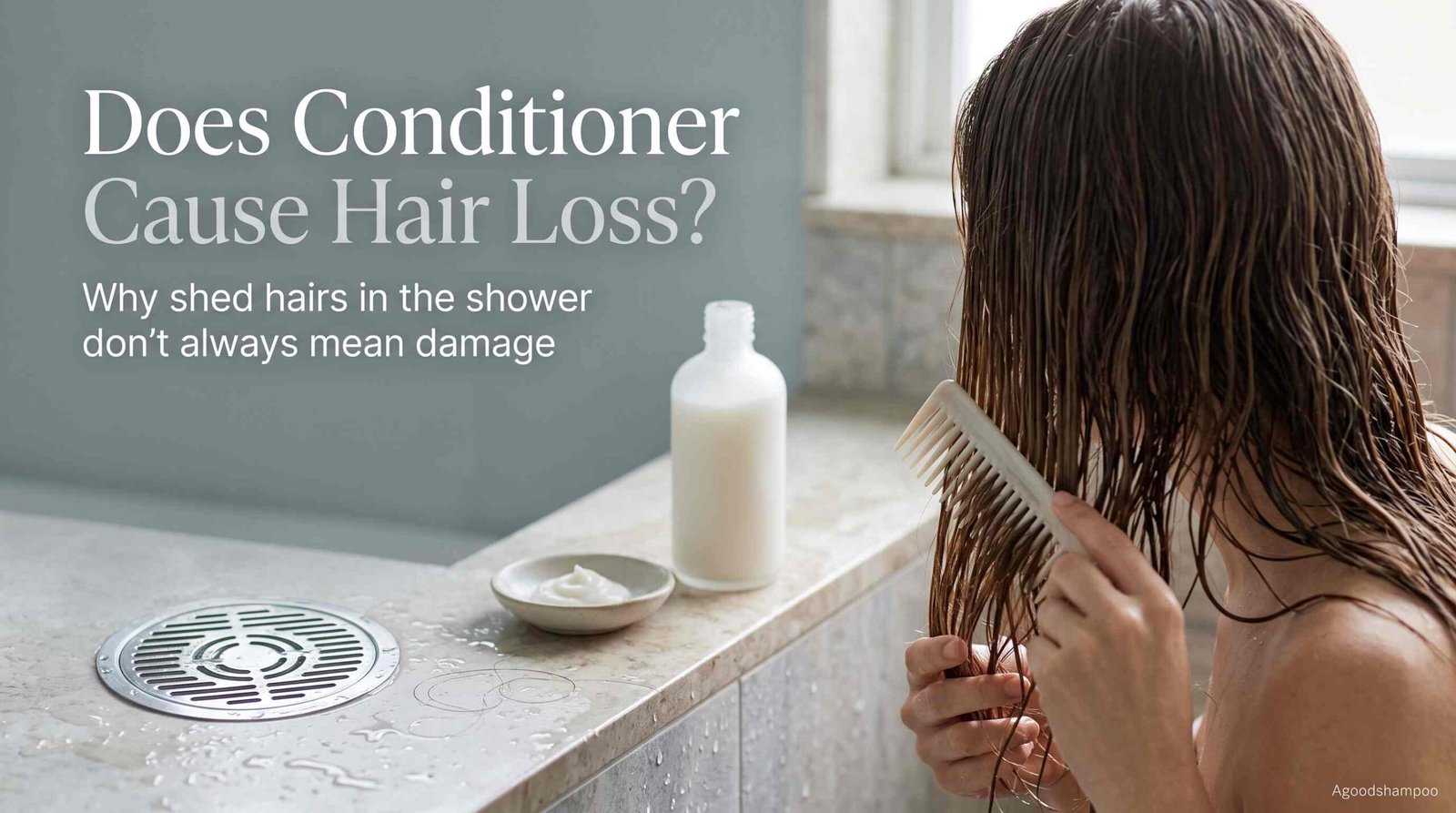
 Using conditioner normally is not considered a typical cause of hair loss. In fact, dermatologists often recommend conditioner when hair is thinning or shedding because conditioned hair has less friction, tangles less easily, and is less likely to break during washing and styling. The American Academy of Dermatology recommends applying a moisturizing conditioner after shampooing for people dealing with hair loss because it coats the strands and helps reduce breakage and split ends.
What makes this confusing is what happens in the shower. You apply conditioner, run your fingers or a comb through your hair, rinse it, and suddenly several strands are sitting in your hand. It is easy to conclude that the conditioner loosened them from the scalp.
That usually is not what happened.
Many of those hairs had already completed their growth cycle and were ready to shed. Washing, conditioning, rinsing, and detangling simply make them more visible.
There are exceptions worth understanding. A conditioner or other hair product can occasionally irritate the scalp or trigger allergic contact dermatitis. Severe scalp inflammation can sometimes contribute to increased shedding. That is very different from saying ordinary conditioner use causes baldness.
Why Conditioner Usually Does Not Cause Hair Loss
Conditioner mainly works on the hair shaft, the part of the hair you can see and touch. It does not normally reach down into the follicle and switch off hair growth.
A rinse-out conditioner commonly contains ingredients designed to improve lubrication, softness, detangling, and manageability. By reducing friction between strands, conditioner can make fragile hair less likely to snap while you brush, comb, dry, or style it.
That matters when someone already has thinning hair.
The American Academy of Dermatology advises people with hair loss to use a moisturizing conditioner after every shampoo and notes that conditioner reduces breakage and split ends. Leave-in conditioner or detangler can provide additional protection for fragile hair.
So the usual relationship is almost the opposite of the fear behind the question: appropriate conditioning may help you keep more of the hair shaft intact, even though it cannot treat the underlying medical cause of hair loss.
This distinction matters.
Conditioner can improve:
- softness
- slip
- detangling
- manageability
- resistance to mechanical breakage
It cannot by itself reverse hereditary pattern baldness, alopecia areata, thyroid-related hair loss, or another follicle-level disorder.
If you are already dealing with thinning, our guide to choosing shampoo and conditioner for hair loss provides additional product-selection context. What Shampoo and Conditioner Is Good for Hair Loss?
Why Does More Hair Seem to Fall Out When You Condition It?
Seeing hair in the shower does not tell you when or why that hair detached from its follicle.
The American Academy of Dermatology says it is normal to shed roughly 50 to 100 hairs per day. Hair shedding becomes easier to notice during washing, brushing, or detangling because loose hairs are collected together instead of falling individually throughout the day.
Imagine someone with medium or long hair who has not washed it for several days. Loose hairs may remain trapped among neighboring strands. Once conditioner adds slip and the fingers or comb move through the hair, those already-released strands can finally slide free.
Conditioner gets blamed simply because it was present when the hairs became visible.
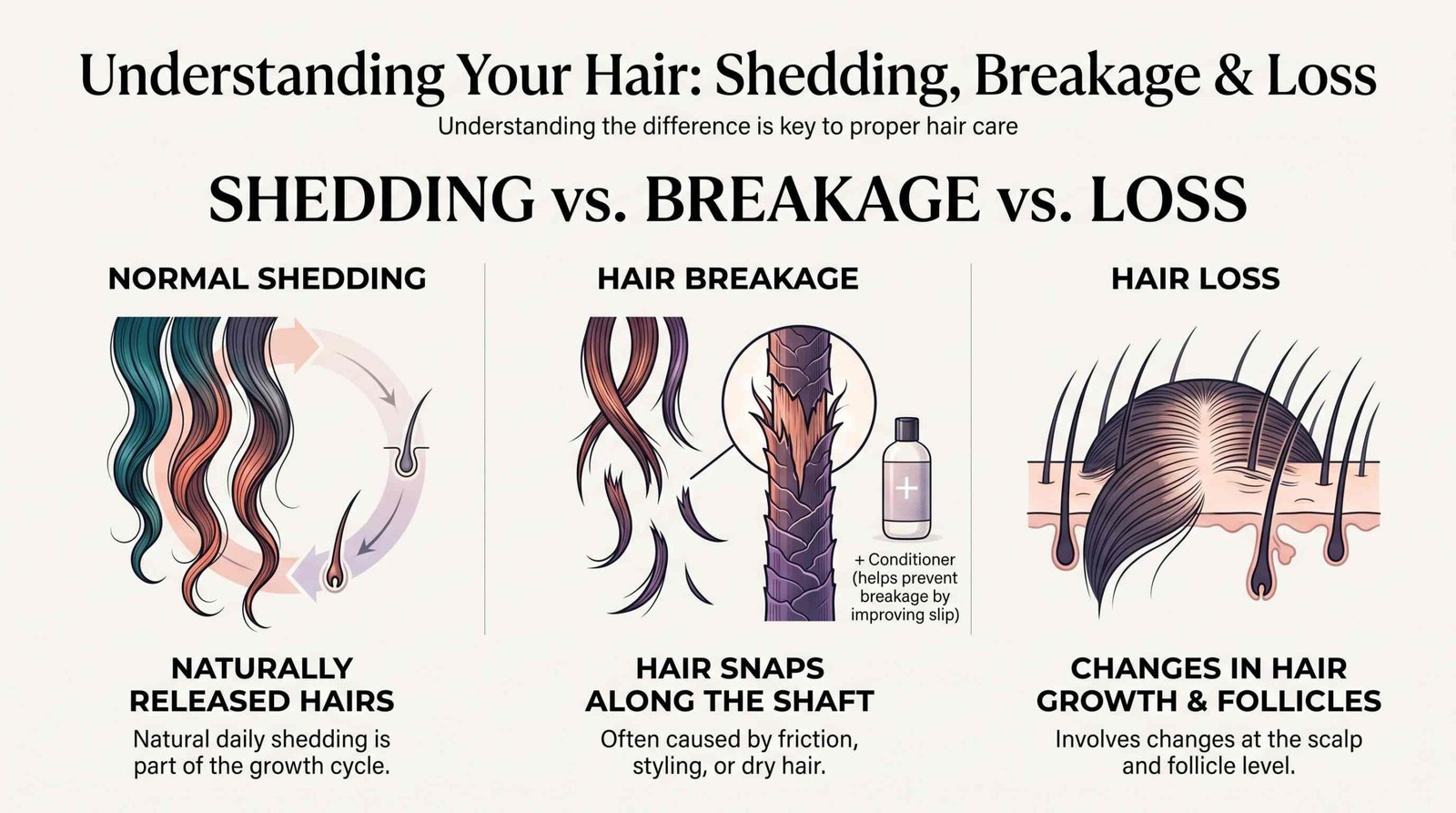
Shedding and breakage do not look exactly the same
This is one of the most useful distinctions to make when you are worried about hair in your hands.
A naturally shed hair tends to be a full-length strand. A broken hair may be noticeably shorter than the rest of your hair because it snapped somewhere along the shaft.
Breakage is more likely when hair is already weakened by factors such as:
- bleaching
- chemical straightening or relaxing
- frequent high heat
- tight hairstyles
- rough brushing
- aggressive towel drying
- repeated coloring
- excessive manipulation
Conditioning can actually be helpful in this situation because reducing friction can make damaged strands easier to detangle.
Wet hair does require careful handling. The American Academy of Dermatology notes that wet hair can break more easily during brushing or combing, although tightly curled and textured hair often benefits from being detangled while damp. A wide-tooth comb and gentle handling are sensible choices.
When a Conditioner or Hair Product Really Can Cause Problems
Saying that conditioner normally does not cause hair loss does not mean every product agrees with every scalp.
Hair-care products contain fragrances, preservatives, surfactants, conditioning agents, botanical extracts, and other substances. Some people can develop irritant or allergic contact dermatitis after exposure to particular ingredients.
A 2022 systematic review of scalp allergic contact dermatitis examined 99 studies involving 3,185 patients. Among the hair-product categories reported in those studies, conditioners accounted for 22% of product associations, behind hair dyes and shampoos. Common reported allergens across scalp-applied products included fragrance mix and certain preservatives and surfactant-related ingredients.
That statistic does not mean 22% of conditioner users develop an allergy. The review looked at patients and reports involving scalp allergic contact dermatitis, not the general population.
Typical warning signs are much more useful than the number:
- persistent itching
- burning
- redness
- eczema-like patches
- irritation around the ears, forehead, neck, or scalp
- worsening symptoms after using the same product
A documented case report has even described allergic contact dermatitis associated with an ingredient suspected in a mint-scented conditioner, with symptoms resolving after the product was discontinued.
Scalp irritation is different from ordinary hair breakage
Contact dermatitis affects the skin. Breakage affects the hair fiber.
Sometimes the two problems overlap. A person with an inflamed, itchy scalp may scratch frequently, handle the hair more aggressively, or experience inflammation significant enough to influence shedding.
There is evidence that severe scalp allergic contact dermatitis can occasionally be followed by telogen effluvium, a form of increased shedding. In a small study of women with confirmed acute scalp contact dermatitis, increased hair loss developed in some participants two to four months after the dermatitis episode.
This is an important exception, but it should not be exaggerated. It does not show that ordinary conditioner use commonly causes telogen effluvium. It shows that significant inflammatory scalp reactions deserve attention.
If scalp inflammation accompanies your shedding, see our guide to scalp inflammation and hair-loss care rather than assuming the conditioner itself is the sole explanation.
Do Hair Products Cause Hair Loss?
Most ordinary cosmetic hair products do not directly cause hereditary or autoimmune alopecia simply because they touch your hair.
But how you use them can affect breakage and, in some situations, hair retention.
The American Academy of Dermatology specifically warns that long-lasting hold styling products can contribute to damage when the hair is combed after the product has stiffened the strands. Repeated breakage can eventually make the hair look noticeably thinner.
That gives us a better way to think about the question do hair products cause hair loss.
Instead of asking only whether a bottle is bad, ask:
What is the product doing to my scalp, hair shaft, and styling routine?
A styling gel that leaves hair stiff is not necessarily destroying follicles. But forcefully combing through stiffened hair every day may increase breakage.
A leave-in conditioner is not inherently harmful. But applying a heavy scalp product that consistently causes itching or irritation is a reason to reconsider that particular formula.
A smoothing serum may reduce friction. Applying very high heat immediately afterward may still damage the hair.
The product and the behavior around it both matter.
Does Hairspray Cause Hair Loss?
Hairspray does not normally cause follicle-level hair loss simply because it is sprayed onto the hair.
The bigger concern is mechanical damage.
Strong-hold hairsprays and similar styling products can leave strands rigid. If you repeatedly brush, tease, or comb through stiff hair, breakage becomes more likely. The American Academy of Dermatology recommends reducing long-lasting hold products when they are followed by combing because this combination can break hair and contribute to hair loss over time.
You do not necessarily have to stop using hairspray.
A more hair-friendly approach is to:
- use only as much as needed
- avoid repeatedly brushing through hardened hair
- wash product out gently
- limit aggressive teasing
- reduce unnecessary heat
- avoid combining stiff styling with very tight hairstyles
Tight ponytails, braids, cornrows, or extensions deserve particular attention because prolonged tension can progress from breakage to traction alopecia. If the tension continues long enough, the resulting hair loss can become permanent.
Does Not Washing Hair Cause Hair Loss?
Skipping a wash for a day or two does not suddenly make your hair follicles stop producing hair.
At the same time, the opposite idea that avoiding shampoo is always healthier is too simple.
Your scalp produces sebum and collects sweat, skin cells, environmental debris, and styling residue. How frequently those need to be removed depends on scalp oiliness, hair type, hairstyle, exercise, product use, and scalp conditions.
Not washing also changes what you see when you finally do shampoo.
If you normally shed 50 to 100 hairs per day, several days of loose strands can remain caught within the rest of your hair. When you finally wash and detangle it, many may appear at once. That can create the impression that the wash itself caused a sudden hair-loss episode even though the hairs accumulated over several days.
This is one reason counting the hair in a single shower drain is a poor way to diagnose hair loss.
Wash according to what keeps your scalp comfortable and your hair manageable rather than deliberately avoiding shampoo because you are afraid of seeing shed hairs.
For more on the relationship between cleansing routines and shedding, see our discussion of routine shampoo and hair loss. Is Routine Shampoo Good for Hair Loss?
Does Head & Shoulders Cause Hair Loss?
There is no good basis for assuming that Head & Shoulders automatically causes hair loss simply because someone notices strands in the shower while using it.
The brand’s current U.S. FAQ explicitly states that Head & Shoulders does not cause hair loss and recommends talking to a dermatologist about sudden, patchy, or continuing loss. That is manufacturer information, so it should be identified as such rather than treated as independent clinical proof.
The practical question is whether a particular Head & Shoulders formula suits your scalp and hair.
Head & Shoulders is primarily an anti-dandruff brand. Different products and regional markets can use different formulas, so broad internet statements about every bottle containing exactly the same ingredients are unreliable.
If a Head & Shoulders shampoo controls your dandruff without causing burning, significant dryness, rash, or persistent irritation, merely finding shed hairs while washing does not establish that the shampoo caused them.
If symptoms begin after changing products, however, pay attention to the complete pattern. Persistent itching, redness, burning, scaling, or irritation suggests a scalp reaction worth investigating.
This same reasoning applies to almost any shampoo brand. The relevant issue is the actual formula, your scalp’s response, your hair-care habits, and the underlying cause of the shedding.
How to Condition Hair When You Are Already Shedding or Thinning
When hair feels fragile, the goal is not to stop touching it altogether. The goal is to reduce unnecessary damage while the cause of the shedding is being addressed.
Start with a gentle shampoo appropriate for your scalp.
Follow with conditioner. The American Academy of Dermatology specifically recommends moisturizing conditioner after shampooing for thinning or falling hair because it reduces breakage and split ends.
Apply rinse-out conditioner according to the product instructions. People with fine or easily weighed-down hair may prefer concentrating it on the lengths and ends. Dry, curly, coily, or chemically processed hair may need more conditioning.
Leave-in conditioner can also improve manageability, but more is not automatically better. AAD guidance recommends using a small amount and applying leave-in conditioner to the hair rather than the scalp because scalp application can create buildup and irritation.
Then handle the hair gently.
A simple routine might look like this:
- Shampoo the scalp without aggressively scratching it.
- Rinse thoroughly.
- Apply conditioner to the areas that need slip and moisture.
- Detangle gently instead of pulling through knots.
- Rinse as directed.
- Blot or wrap wet hair rather than rubbing vigorously with a towel.
- Limit unnecessary high heat and tight styling.
If you are choosing products specifically because your hair is thinning, our guide to shampoo and conditioner options for hair loss may help you separate cosmetic strengthening from genuine hair-loss treatment. Best Shampoo and Conditioner for Hair Loss
When the Hair in Your Drain Probably Isn’t About Conditioner
Conditioner is an easy thing to blame because it is physically in your hands at the moment you notice loose strands.
Actual hair loss has many possible causes.
The American Academy of Dermatology lists hereditary hair loss among the common causes and also notes that illness, high fever, surgery, childbirth, some hair-care practices, tight hairstyles, and diseases such as alopecia areata can lead to increased shedding or loss.
Excessive shedding can also occur after major physical or emotional stress. AAD describes telogen effluvium as excessive hair shedding that can follow events such as childbirth, substantial weight loss, severe stress, high fever, surgery, or recovery from illness.
That means a change in conditioner can coincide with hair loss without causing it.
Pay more attention when you notice:
- a widening part
- gradually decreasing overall density
- bald or patchy areas
- sudden large increases in shedding
- scalp pain or significant inflammation
- persistent itching or burning
- eyebrow or body-hair loss
- continuing shedding without an obvious explanation
Those patterns deserve proper assessment rather than months of repeatedly switching shampoos and conditioners.
Hair-loss treatment also tends to work better when the actual cause is identified early.
For most people asking will conditioner cause hair loss, the practical answer is reassuring: a suitable conditioner used normally is unlikely to be the reason your hair is thinning. It may actually reduce the breakage that makes thinning hair look worse.
If a particular conditioner repeatedly causes itching, burning, rash, or scalp inflammation, stop treating the problem as normal shedding and investigate that product reaction. And if density is clearly decreasing regardless of what conditioner you use, the more useful question is no longer which bottle caused it, but what is affecting the hair-growth cycle or follicles.

Marlena Stell makes everyday hair care easier to understand. From choosing a shampoo to managing common hair concerns, she breaks down confusing product claims and practical routines into straightforward advice that helps readers find what works for their needs.