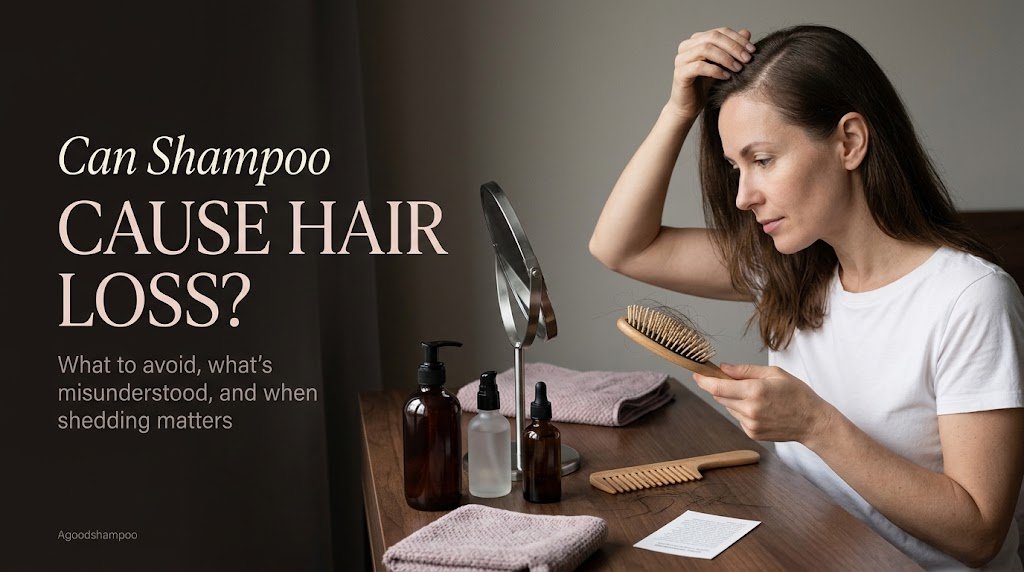
 Searching for the worst shampoos that cause hair loss in women can lead to some frightening lists. You may see sulfates, silicones, fragrance, preservatives, dandruff shampoos, or entire brands blamed for thinning hair.
The evidence is more complicated.
An ordinary shampoo usually isn’t the underlying cause of female-pattern hair loss. What a hair product can sometimes do is irritate the scalp, trigger allergic or irritant contact dermatitis, make already-fragile hair more likely to break, or produce an adverse reaction that coincides with increased shedding. Meanwhile, conditions such as female-pattern hair loss, telogen effluvium, traction alopecia, alopecia areata, and central centrifugal cicatricial alopecia affect the follicle for reasons that changing shampoo alone cannot fix.
The distinction matters. A shampoo that leaves your scalp burning deserves attention. A shampoo you happened to start using around the same time as hormonal or stress-related shedding may be completely innocent.
Can Shampoo Actually Cause Hair Loss in Women?
Shampoo can sometimes be associated with hair and scalp problems, but that isn’t the same thing as saying ordinary shampoo commonly causes permanent alopecia.
The U.S. Food and Drug Administration has received reports involving hair loss, hair breakage, balding, itching, and rash with certain hair-cleansing products. By 2016, the FDA had received more than 1,400 adverse-event reports connected with cleansing conditioners, including reports of significant hair loss. Importantly, the FDA also states that further investigation is required before a firm connection can be established between particular products or ingredients and alopecia.
That difference between a safety signal and proof of causation gets lost in many shampoo articles.
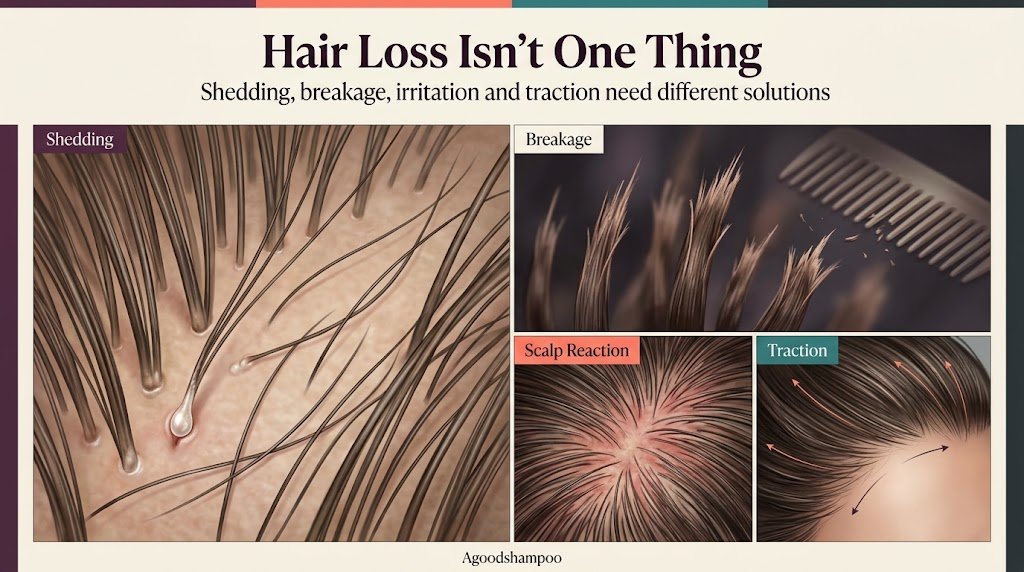
Another source of confusion is that people use hair loss to describe several different things.
| What you’re seeing | What may actually be happening |
|---|---|
| Long hairs coming out from the root | Hair shedding or an alopecia |
| Short, uneven strands | Hair-shaft breakage |
| Itching, burning, redness or rash | Scalp irritation or contact dermatitis |
| Receding areas under tightly pulled styles | Possible traction alopecia |
| A gradually widening part | Possible female-pattern hair loss |
Female-pattern hair loss is the most common cause of hair loss in women, according to the American Academy of Dermatology. It typically produces progressive thinning, often beginning around the part, and has a hereditary component. A shampoo switch doesn’t treat that underlying process.
The AAD also makes a useful distinction about shampoos marketed for hair loss: they may help hair retain moisture or reduce breakage, but they cannot regrow hair or prevent genuine female-pattern hair loss from progressing.
That is why the most useful question isn’t simply Which shampoo causes hair loss? It is What changed in my hair or scalp, and does the pattern point to the product at all?
The Worst Shampoo Is Often One Your Scalp Cannot Tolerate
There isn’t a scientifically reliable blacklist of mainstream shampoos that cause hair loss in every woman.
A more useful way to identify a bad shampoo for you is to look for a repeatable reaction.
A Shampoo That Makes Your Scalp Burn, Itch or Develop a Rash
Hair-care products can cause allergic contact dermatitis and irritant contact dermatitis.
A large retrospective study from the North American Contact Dermatitis Group examined 38,775 people who underwent patch testing between 2001 and 2016. Among them, 3,481 had positive reactions associated with hair-care products. Shampoo and conditioner products were the most frequent source of the relevant hair-care-product reactions in that selected patch-test population.
That does not mean 9% of all shampoo users are allergic to hair products. These were people referred for patch testing, so they were already more likely than the general population to have dermatitis.
It does show something important: reactions to hair products are real.
The same study identified allergens including methylisothiazolinone, methylchloroisothiazolinone/methylisothiazolinone, cocamidopropyl betaine, and p-phenylenediamine among commonly involved substances. Some of these appear in shampoos or other hair products, while p-phenylenediamine is more strongly associated with hair dyes.
If a shampoo repeatedly causes burning, persistent itching, redness, rash, or worsening inflammation, continuing to use it simply because the ingredients look good on paper doesn’t make sense.
A Product Connected With a Consistent Adverse Reaction
Timing alone doesn’t prove a shampoo is responsible for shedding.
Still, timing matters when the reaction is reproducible.
Suppose your scalp is comfortable for months, you introduce a new shampoo, and within several uses you develop intense itching and redness. You stop the product and the symptoms improve. You later use it again and the same reaction returns.
That pattern is more informative than seeing extra hair in the drain once.
The FDA advises consumers experiencing problems such as hair loss, balding, itching, rash, or other reactions after using a hair-cleansing product to stop using it and contact a healthcare professional.
A Shampoo Routine That Makes Fragile Hair Break More Easily
Breakage deserves separate attention because it can look remarkably similar to thinning.
Bleached, relaxed, chemically processed, heavily heat-styled, naturally fragile, or very dry hair may snap along the shaft. Strong cleansing, rough towel drying, repeated heat, aggressive detangling, and tight styling can compound that damage.
Shampoo does not need to kill a follicle to make hair look thinner. If more strands break before reaching their normal length, density through the mid-lengths and ends can fall noticeably.
If your concern is mainly damaged or fragile hair rather than follicular loss, our guide to shampoos for thin, damaged hair covers that problem from the hair-shaft side rather than treating every broken strand as alopecia.
Ingredients Commonly Blamed for Hair Loss Need More Context
Internet advice often reduces shampoo safety to a single ingredient.
That rarely reflects how formulations actually work.
Sulfates
Sodium lauryl sulfate and sodium laureth sulfate are cleansing surfactants. They aren’t automatically hair-loss ingredients.
A strong cleansing system may feel too drying for some people, particularly when the hair is already porous or chemically damaged. But finding a sulfate on an ingredient list doesn’t prove that the shampoo will cause alopecia.
Formula strength, surfactant combinations, concentration, conditioning agents, wash frequency, hair type, scalp condition, and individual sensitivity all matter.
If a sulfate-containing shampoo leaves your scalp comfortable and your hair manageable, the presence of a sulfate alone isn’t evidence that you should stop using it.
Fragrance
Fragrance deserves more individual consideration because fragrance components can trigger allergic contact dermatitis in susceptible people.
The key word is susceptible.
A fragranced shampoo isn’t automatically dangerous, and a fragrance-free shampoo isn’t automatically better for every head of hair. But if your scalp develops itching, redness, or dermatitis after particular scented products, fragrance exposure may be worth discussing with a dermatologist, especially if reactions recur.
Preservatives
Preservatives keep water-based cosmetics from becoming contaminated with microorganisms. They perform an important job.
Some preservatives can also act as contact allergens in certain people.
The North American Contact Dermatitis Group study found methylisothiazolinone and methylchloroisothiazolinone/methylisothiazolinone among frequent allergens associated with hair-care-product reactions in its patch-tested population.
Again, this does not mean everyone using a product containing one of these ingredients will lose hair.
It means a known allergy or compatible scalp reaction deserves more attention than a generic internet list saying one ingredient is universally toxic to hair.
Cocamidopropyl Betaine
Cocamidopropyl betaine is commonly used as a surfactant, often in formulas marketed as relatively mild.
It also appeared among relevant allergens in the contact-dermatitis research.
That illustrates why sulfate-free does not mean allergy-free. A formula can omit SLS and still contain something an individual person’s skin dislikes.
Silicones
Silicones are frequently accused of clogging follicles and causing hair loss.
That claim is usually overstated.
Silicones are primarily used to improve hair-shaft slip, smoothness, manageability, and conditioning. Some formulas or routines may leave certain hair types feeling coated or heavy, but that is not the same thing as proving follicular hair loss.
If buildup is the issue, adjusting cleansing frequency or product choice makes more sense than treating silicone as a universal alopecia trigger.
Does Head & Shoulders Cause Hair Loss?
There is no good reason to classify Head & Shoulders as one of the worst shampoos that causes hair loss simply because it is an anti-dandruff brand.
Head & Shoulders itself states that its products do not cause hair loss. That is a manufacturer statement, so it should not be treated as independent clinical proof. The same company advises people with sudden, patchy, or ongoing hair loss to speak with a dermatologist because many other causes are possible.
More importantly, dandruff and scalp inflammation are reasons people use anti-dandruff shampoo in the first place.
Current Head & Shoulders products differ by formula and market, with anti-dandruff actives including zinc pyrithione or selenium sulfide in some products. The brand recommends following the directions for the specific formula.
Could an individual react badly to a Head & Shoulders formula? Yes. That is true of virtually any cosmetic.
A reaction to one formulation does not establish that the entire brand causes hair loss.
If an anti-dandruff shampoo leaves your scalp increasingly painful, red, raw, intensely itchy, or otherwise worse, stop assuming more treatment is always better. The underlying problem may not be ordinary dandruff.
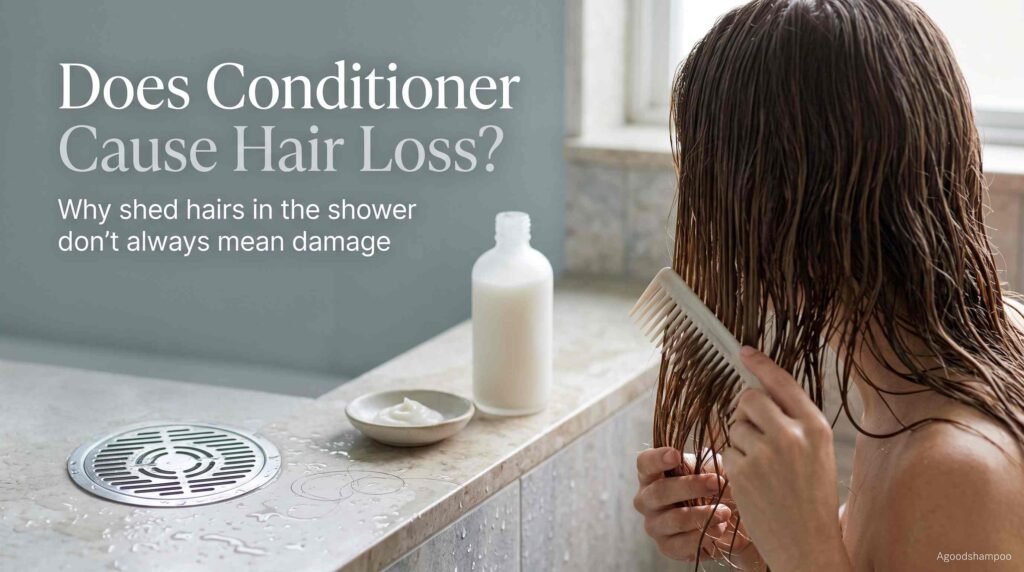
Will Conditioner Cause Hair Loss?
Routine conditioner use is not established as a cause of alopecia.
Conditioner primarily works on the hair shaft. It can reduce friction, improve detangling, smooth damaged areas, and make hair easier to handle.
Why, then, do some women think conditioner causes shedding?
One reason is what happens during rinsing and detangling. Hairs that have already completed their shedding cycle can remain caught among neighboring strands. Conditioner creates slip, so those loose hairs may come away together in the shower or comb.
That can look alarming, especially after several days without washing.
The conditioner may simply be helping already-detached hairs leave the scalp and hair mass rather than causing those hairs to enter the shedding phase.
A conditioner can still be unsuitable if it causes scalp irritation or makes your particular hair excessively coated, but those are different issues from follicular hair loss.
Does Hairspray Cause Hair Loss?
Normal hairspray use has not been established as a common cause of female alopecia.
The more realistic problems involve the way hairspray is used.
Heavy styling-product use may leave some hair stiff or more difficult to manipulate. Brushing forcefully through stiff hair can increase mechanical breakage. Applying an irritating product directly to sensitive scalp skin can also cause discomfort in susceptible users.
The same distinction applies to gels, mousses, waxes, dry shampoos, and styling creams.
A styling product may:
- irritate sensitive skin
- contribute to buildup
- increase dryness in some routines
- make manipulation more difficult
- contribute indirectly to breakage
Those effects shouldn’t automatically be described as medically causing hair loss.
Hairstyle matters too. A perfectly mild styling product used to hold a hairstyle that keeps the hair under constant tension can be less important than the pulling force itself.
Does Not Washing Your Hair Cause Hair Loss?
Going several days without shampooing can make your next wash look as though it caused a dramatic shed.
Imagine that a small number of hairs naturally complete their growth cycle each day. If you wash and detangle frequently, you see those hairs coming out in smaller groups. If you wait several days, detached hairs can remain trapped within the rest of your hair and then appear all at once during shampooing.
Seeing more strands on wash day therefore doesn’t necessarily mean the wash caused them to fall.
On the other hand, there is no universal rule that everybody should stretch wash intervals as long as possible.
An oily scalp, heavy styling-product use, dandruff, seborrheic dermatitis, exercise, hair texture, protective styling, and personal comfort can all affect how often cleansing makes sense.
If your scalp becomes increasingly itchy, flaky, greasy, inflamed, or uncomfortable between washes, extending the interval simply because frequent shampooing has been labelled unhealthy may be counterproductive.
The useful goal is a wash schedule your scalp tolerates and your hair texture can handle, not the longest possible time between shampoos.
Black Female Hair Loss Needs More Than a Shampoo Switch
Hair loss in Black women deserves particular care because several important forms of alopecia can be mistaken for simple breakage or a bad reaction to hair products.
The American Academy of Dermatology identifies several causes that commonly affect Black women, including central centrifugal cicatricial alopecia, traction alopecia, female-pattern hair loss, alopecia areata, and telogen effluvium.
These conditions are not interchangeable.
Traction Alopecia
Traction alopecia develops when hairstyles repeatedly pull on the hair.
Tight braids, tightly secured extensions, tight ponytails, or other styles that consistently place tension on the same areas can damage follicles over time.
In this situation, switching shampoo while continuing the mechanical tension misses the central problem.
Central Centrifugal Cicatricial Alopecia
Central centrifugal cicatricial alopecia, often shortened to CCCA, commonly begins around the center or crown of the scalp.
CCCA is a scarring alopecia, which makes timely diagnosis important. It shouldn’t be treated as a cosmetic dryness issue or something that can reliably be solved with an anti-breakage shampoo.
The AAD emphasizes diagnosis and early intervention for Black women experiencing hair loss.
Female-Pattern Hair Loss
Female-pattern hair loss often begins around the part and progressively reduces density.
The AAD describes it as hereditary and notes that it often begins in midlife, although younger women can develop it too.
A shampoo might improve how the hair looks or reduce breakage, but it does not correct the follicular process behind female-pattern hair loss.
That is why searching only for Black female hair loss treatment shampoos can delay the more important question: What type of hair loss is actually present?
How to Tell Whether Your Shampoo May Really Be Part of the Problem
You don’t need to panic because you saw extra hair after one shower.
Look for a pattern.
A shampoo deserves more suspicion when several of these happen together:
- scalp symptoms began soon after starting the product
- you develop repeated itching, burning, redness, or rash
- symptoms improve when you discontinue the shampoo
- they return when you use it again
- hair becomes noticeably more brittle or difficult to handle
- breakage increases along with dryness
- no other obvious change explains the timing
Even then, self-diagnosing the underlying hair loss isn’t always straightforward.
A product reaction and female-pattern hair loss can exist at the same time. So can breakage and telogen effluvium. Treating one does not automatically solve the other.
Patch testing can sometimes help when allergic contact dermatitis is suspected. The hair-care-product study specifically noted that expanded patch testing may be useful because not every relevant allergen appeared on a standard screening series.
When Changing Shampoo Makes Sense and When It Isn’t Enough
Changing shampoo makes sense when the product clearly makes your scalp or hair worse.
Stop using a shampoo and seek advice when you develop significant itching, rash, burning, swelling, painful inflammation, or another convincing adverse reaction. The FDA specifically advises people experiencing hair loss, balding, itching, rash, or other reactions associated with a cleansing product to stop using it and contact a healthcare provider.
For simple dryness or breakage, a gentler cleansing routine plus appropriate conditioning may be enough to improve how the hair behaves.
But changing shampoos again and again is a poor strategy when the problem looks like true hair loss.
See a dermatologist or qualified healthcare professional if you notice:
- a widening part
- rapidly decreasing density
- smooth bald patches
- hair loss concentrated around the crown
- a receding hairline linked to tight hairstyles
- scalp pain or tenderness
- persistent scaling or inflammation
- scarring or shiny scalp areas
- sudden heavy shedding
- hair loss that continues despite changing products
The American Academy of Dermatology notes that women can develop hair loss for many different reasons and that getting the correct diagnosis matters because different causes require different treatment.
This is particularly important with progressive or scarring forms of alopecia, where waiting for another shampoo to fix the problem may cost valuable time.
What Women Worried About Shampoo-Related Hair Loss Should Actually Avoid
The worst shampoo isn’t necessarily the bottle with a sulfate, silicone, fragrance, or unfamiliar chemical name.
It’s the product that produces a meaningful adverse reaction in your scalp or repeatedly worsens the condition of already-fragile hair.
Avoid treating internet ingredient lists as diagnoses.
Pay more attention to:
- persistent burning or itching
- visible inflammation
- recurring rash
- increased breakage
- a clear product-and-reaction pattern
- progressively widening or patchy hair loss
- hairstyles that keep follicles under tension
- underlying scalp disease that is not improving
And don’t expect an anti-hair-loss label to solve genuine alopecia. As the American Academy of Dermatology explains, hair-loss shampoos may make hair appear fuller by improving moisture or reducing breakage, but they cannot regrow hair or stop female-pattern hair loss from progressing.
That is the most important distinction behind the search for the worst shampoos that cause hair loss in women: shampoo can matter, especially when irritation or breakage is involved, but persistent female hair loss deserves a diagnosis rather than another blacklist of supposedly dangerous bottles.

Marlena Stell makes everyday hair care easier to understand. From choosing a shampoo to managing common hair concerns, she breaks down confusing product claims and practical routines into straightforward advice that helps readers find what works for their needs.