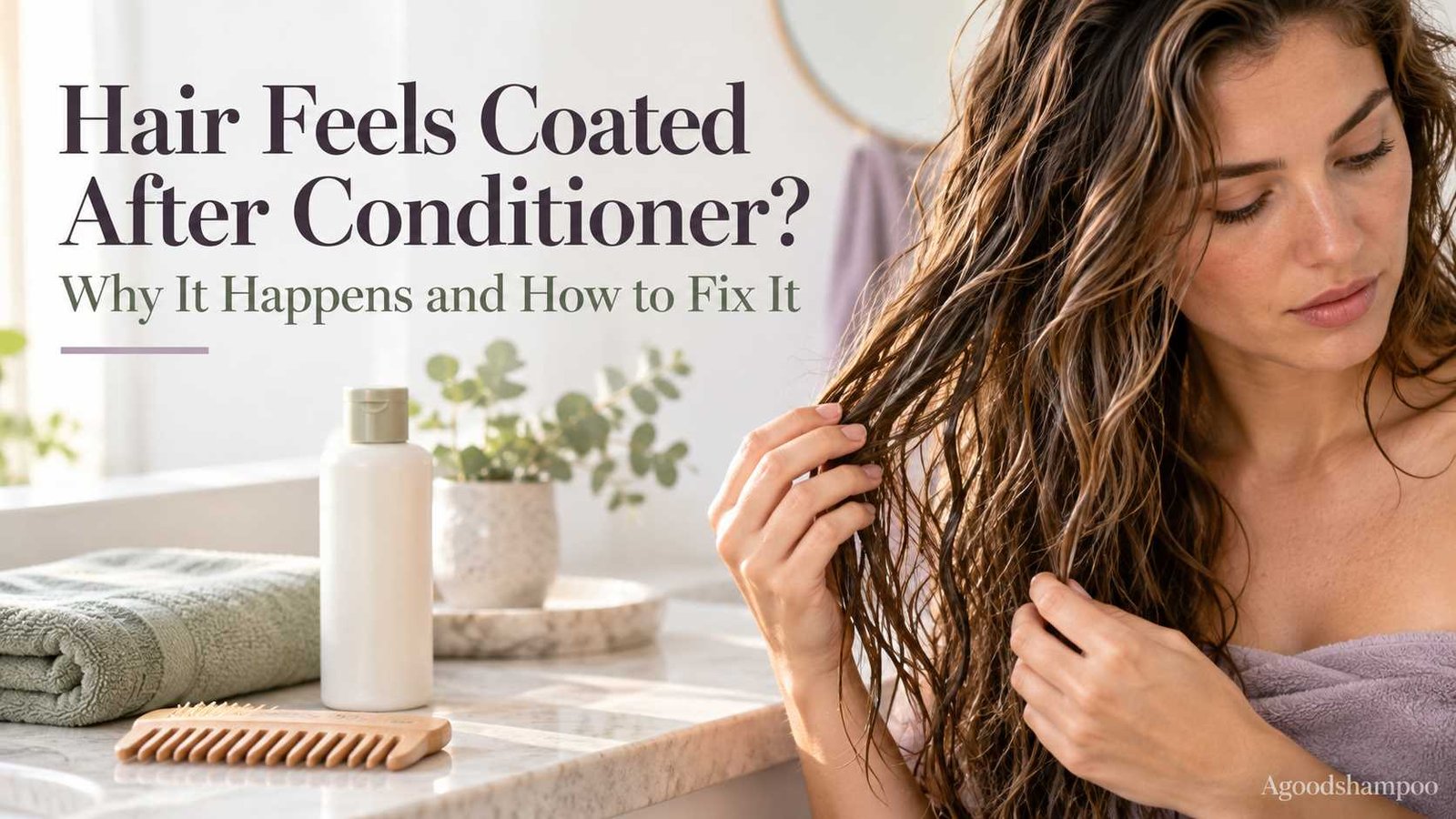
 You rinse out your conditioner, expecting soft, manageable hair. Instead, your strands feel unusually slippery, waxy, or heavy. Sometimes the feeling disappears as your hair dries. Other times, your roots look flat and your lengths seem coated even after a thorough wash.
Hair usually feels coated after conditioner because the formula leaves more conditioning material on your strands than your hair needs for the finish you want. Using too much product, applying a rich formula to fine hair, incomplete rinsing, or layering several conditioning products can contribute.
However, not every coated feeling means something is wrong. Conditioner is designed to leave a thin layer of ingredients on the hair surface. The important difference is whether that layer improves softness and manageability or leaves your hair feeling unpleasantly weighed down.
What Does a Coated Feeling Actually Mean?
Conditioner works partly by depositing ingredients onto the outer surface of your hair. These materials help reduce friction, improve detangling, and make strands feel smoother.
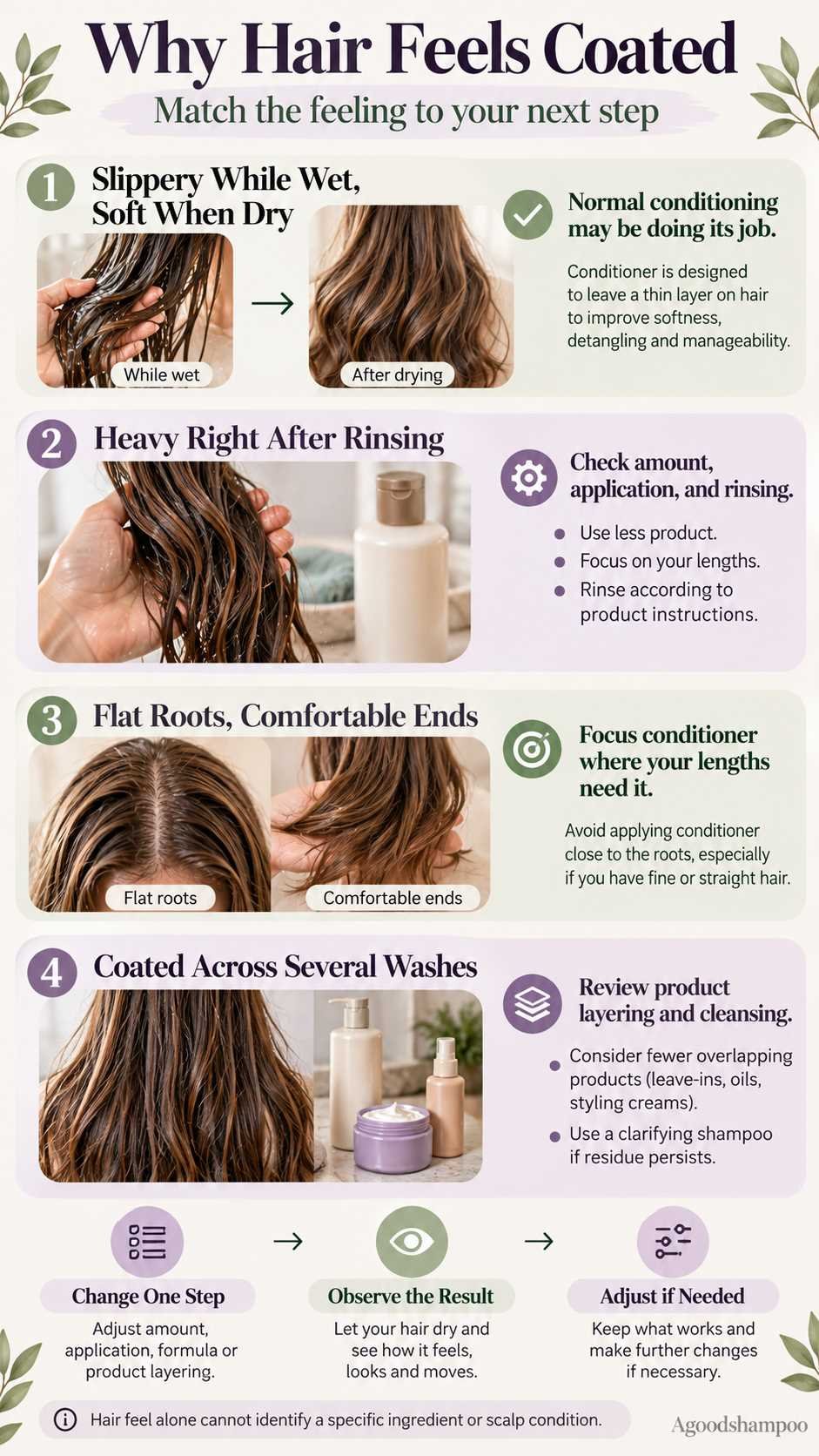
A slippery feeling while your hair is wet can therefore be perfectly normal.
The more useful test is how your hair behaves after drying.
If it feels soft, moves naturally, and detangles easily, the conditioner is probably doing what you want.
If it feels waxy, sticky, unusually heavy, or limp, the conditioning effect may be excessive for your hair or your routine.
There is also an important difference between a smooth coating and accumulated residue. A conditioner can feel too rich after a single use without creating a long-term buildup problem.
Why Conditioner Can Leave Hair Feeling Heavy or Waxy
Several factors can create a similar coated sensation. Knowing which one applies helps you avoid unnecessary product changes.
The Formula Is Too Rich for Your Hair
Conditioners contain combinations of ingredients that improve lubrication and manageability.
Common examples include:
- Cationic conditioning agents, such as behentrimonium chloride, which help conditioning materials adhere to the hair surface.
- Fatty alcohols, including cetyl alcohol and cetearyl alcohol, which contribute to a creamy formula and help soften hair.
- Silicones, such as dimethicone or amodimethicone, which can improve slip, reduce friction, and modify how hair feels.
- Oils and butters, which may contribute to softness and a richer finish.
These ingredients are not inherently harmful. Their effects depend on the complete formulation, the amount used, and the characteristics of your hair.
Fine hair can become noticeably limp when a conditioner deposits more material than needed. Coarse, curly, or chemically treated hair may benefit from a richer formula because its conditioning requirements can be different.
A product that works beautifully for one person may therefore feel too heavy for another.
Too Much Conditioner or Incomplete Rinsing
Applying more conditioner does not necessarily produce better results.
Once your strands have enough product for coverage and detangling, additional conditioner may increase the chance of an excessively coated finish.
Application location also matters.
The American Academy of Dermatology generally advises people with fine or straight hair to concentrate conditioner on their ends. People with dry or curly hair may benefit from conditioning their entire hair length.
Incomplete rinsing creates another possibility. If a rinse-out formula is not removed according to its instructions, excess product may contribute to a sticky or heavy sensation.
Remember that rinsing does not remove every conditioning ingredient. Some are intended to remain on the hair after water rinsing.
Layers of Leave-In and Styling Products
Your rinse-out conditioner may not be the only product contributing to the feeling.
Leave-in conditioner, curl cream, smoothing serum, hair oil, and styling products can all influence the final texture.
Used together, they may leave some hair types feeling heavier than expected.
Repeated product use can also allow certain materials to accumulate, particularly when the cleansing routine does not adequately remove them.
That does not mean you must stop using leave-in products. It means your routine may need fewer overlapping conditioning steps.
How to Tell What Is Causing the Coated Feeling
Pay attention to when the feeling appears and where you notice it.
| What You Notice | Possible Explanation | What to Try |
|---|---|---|
| Slippery while wet, soft when dry | Normal conditioning | Keep your routine |
| Heavy immediately after rinsing | Excess product or incomplete rinsing | Use less and rinse according to directions |
| Flat roots, comfortable ends | Conditioner applied too close to roots | Adjust application area |
| Coated feeling after several washes | Possible accumulated product residue | Review styling products and cleansing |
| Waxy finish after a new conditioner | Formula may be too rich | Compare with a lighter formula |
| Sticky hair after adding leave-in products | Product layering | Reduce overlapping products |
These observations are clues, not definitive tests. Hair feel alone cannot identify a particular ingredient or prove that buildup has occurred.
If your hair feels waxy even when you skip conditioner, the cause may involve shampoo, styling residue, or another part of your washing routine.
What to Change at Your Next Wash
You do not need to replace every product immediately. A controlled wash-day adjustment is more useful.
First, keep your usual shampoo. Cleanse your scalp as you normally would and rinse thoroughly. Changing your shampoo and conditioner simultaneously makes it difficult to identify which adjustment helped.
Next, reduce the conditioner amount. Use enough to cover and detangle the areas that need conditioning, rather than applying an unnecessarily thick layer.
Apply it where your hair needs it. For fine or straight hair, start with the lengths and ends. For dry or curly hair, apply it more broadly if necessary.
Follow the product’s rinsing instructions. A rinse-out conditioner should not automatically be treated as a leave-in product.
Skip extra conditioning layers for this comparison. If practical, avoid your usual hair oil, smoothing serum, or leave-in cream during one wash so you can evaluate the rinse-out conditioner’s finish. Do not skip essential heat protection if using heated tools.
Then let your hair dry and observe its weight, movement, softness, and manageability.
If it feels noticeably lighter, you have a useful reason to continue with the adjusted routine.
If nothing changes, the formula itself may be a poor match.
For broader product-selection guidance, see how to choose a good shampoo and conditioner for your hair.
Should You Clarify, Switch Conditioner, or Use Less?
The best next step depends on the pattern.
Use less conditioner when the heavy feeling begins immediately after application, particularly if your hair otherwise feels healthy and manageable.
Try a lighter conditioner when reducing the amount and adjusting placement still leaves your hair flat or waxy.
Consider clarifying when the coated sensation persists across washes, especially if you frequently use styling creams, oils, sprays, or leave-in products.
Clarifying shampoos are designed to provide more effective removal of certain accumulated materials, but they are not necessary after every conditioning session.
Some can leave dry, bleached, curly, or fragile hair feeling rough if used more aggressively than needed.
For a closer look at cleansing options, read our guide to clarifying shampoo for buildup.
Do not assume that every silicone-containing conditioner requires a special clarifying shampoo. Silicone behavior and removal depend on the specific ingredient, formulation, and cleanser.
When the Problem Involves Your Scalp
A coated hair shaft and an irritated scalp are different concerns.
If your scalp becomes itchy, red, painful, or develops persistent bumps after using conditioner, do not assume the problem is simply excess conditioning.
Fragrance, preservatives, or other ingredients can cause irritation or allergic reactions in susceptible individuals. Scalp symptoms may also have causes unrelated to conditioner.
Stop using a product that appears to trigger a reaction. Seek professional evaluation if symptoms persist, worsen, or recur.
Conditioner is not automatically unsuitable for the scalp, but unnecessary root application may contribute to an unwanted heavy finish, especially on fine hair.
You can also explore why a shampoo and conditioner combination may not work for you when the problem continues despite routine adjustments.
Finding a Conditioner That Leaves the Right Finish
The right conditioner should make your hair easier to manage without creating a finish you dislike.
If your hair becomes heavy immediately after conditioning, begin with a smaller amount and more careful application. If that does not help, try a lighter formula suited to your hair type.
If the coated sensation develops gradually after repeated styling and conditioning, investigate product layering and whether your cleansing routine is adequate.
And if your hair is slippery while wet but soft and comfortable once dry, you may not need to change anything.
Judge your conditioner by how your hair feels and behaves after drying, not by wet slip alone. That distinction can prevent unnecessary clarifying, repeated product switching, and the frustration of treating normal conditioning as a problem.

Marlena Stell makes everyday hair care easier to understand. From choosing a shampoo to managing common hair concerns, she breaks down confusing product claims and practical routines into straightforward advice that helps readers find what works for their needs.