A good drugstore shampoo and conditioner does not have to be expensive, sulfate-free, silicone-free, or filled with trendy extracts. What matters more is whether the shampoo cleans your scalp appropriately and whether the conditioner gives your hair enough slip, softness, and protection without making it feel greasy or flat.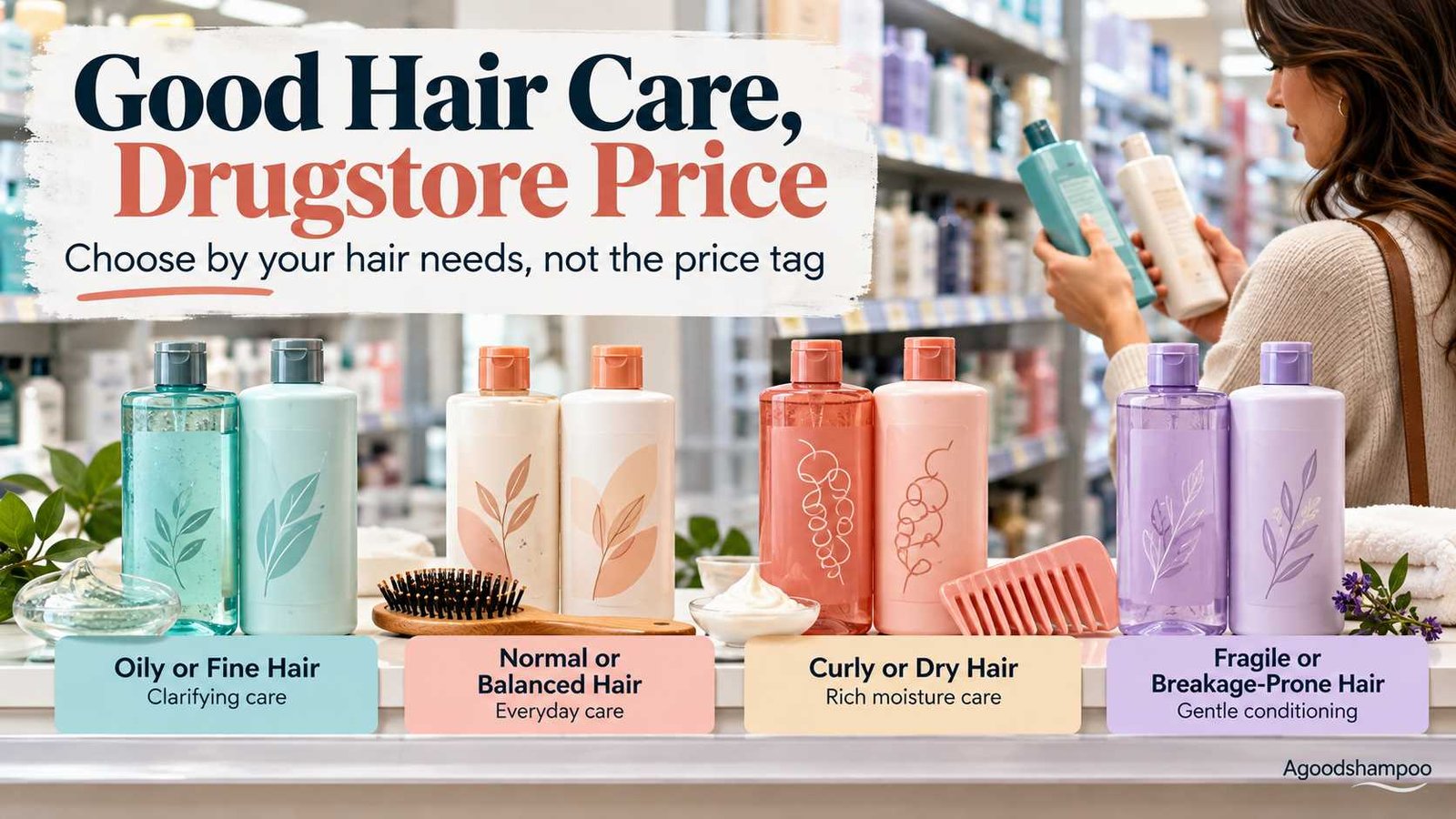
That means the best drugstore pair for oily, fine hair may be completely different from the best choice for thick curls or dry, damaged ends. The smartest way to shop is to match the formula to your scalp and hair rather than picking whichever bottle makes the biggest promise.
What Makes a Drugstore Shampoo and Conditioner Actually Good?
Price tells you surprisingly little about how well a shampoo or conditioner will suit your hair. Drugstore formulas can use many of the same basic categories of ingredients found in more expensive products: cleansing agents, fatty alcohols, conditioning agents, silicones, humectants, proteins, oils, preservatives, and fragrance.
What matters is how those ingredients are combined.
A good shampoo should remove enough oil, sweat, styling residue, and buildup to keep the scalp comfortable without leaving your hair unnecessarily rough. A good conditioner should reduce friction, improve detangling, soften the hair fiber, and make the lengths easier to manage.
This is why judging a shampoo only by whether it contains sulfates is too simplistic. Sulfates can provide effective cleansing, but their presence does not automatically make a shampoo harsh. Likewise, a sulfate-free formula is not automatically gentler for every person.
The same applies to silicones. They can improve slip, smoothness, shine, and combability. Avoiding them may make sense for someone who dislikes the feel of certain formulas or experiences buildup, but silicone-free does not automatically mean healthier.
If you want a deeper framework for comparing bottles, our guide on how to pick a good shampoo explains the selection process in more detail.
Good Drugstore Shampoo and Conditioner Picks by Hair Type
A useful buying shortcut is to choose shampoo mainly around your scalp condition and conditioner mainly around the needs of your hair lengths.
| Hair type or concern | Shampoo direction | Conditioner direction |
|---|---|---|
| Normal or balanced hair | Gentle everyday cleanser | Medium-weight conditioner |
| Oily or fine hair | Lightweight or clarifying cleanser | Light conditioner on lengths |
| Dry or curly hair | Mild moisturizing cleanser | Richer conditioner with good slip |
| Damaged or fragile hair | Gentle cleansing | Conditioning focused on reducing friction and breakage |
Normal or Balanced Hair
If your scalp does not become excessively oily or dry and your hair is not heavily damaged, you usually do not need an aggressive specialty formula.
A balanced, gentle shampoo paired with a moderate conditioner is often enough.
One current drugstore example is CeraVe Gentle Hydrating Shampoo with CeraVe Hydrating Conditioner. The shampoo is marketed as sulfate-free and pH-balanced and includes ingredients such as ceramides, niacinamide, and hyaluronic acid. Those ingredients can make the formula attractive to someone who wants a straightforward, scalp-conscious routine, although their presence alone does not guarantee that the product will suit everyone.
For normal hair, consistency matters more than chasing treatment claims. If the scalp feels clean, the hair detangles easily, and you are not seeing excessive dryness, heaviness, or buildup, the pair is probably doing its job.
Oily or Fine Hair
Oily roots generally need more effective cleansing than dry curls, while fine hair often becomes limp when too much conditioner is deposited near the scalp.
A lightweight or clarifying shampoo can therefore make more sense.
Dove Scalp + Hair Therapy Clarifying Shampoo is one current drugstore example positioned for oily, fine hair. Dove describes the formula as designed to remove excess oil and refresh the scalp. The company’s published testing involves women with thin, fine hair, but those results should be understood as manufacturer testing rather than proof that the product is best for every oily scalp.
For fine hair, conditioner placement can matter just as much as product choice. Apply most of it from the mid-lengths downward instead of coating the roots.
If oiliness is your main problem, see our separate guide to choosing shampoo for oily hair. People dealing with both oiliness and low hair density may also find our guide to shampoo for fine, oily hair more specific.
Dry or Curly Hair
Curly hair tends to benefit from more conditioning because the hair fiber can be harder for natural scalp oils to coat evenly from root to tip.
The American Academy of Dermatology recommends moisturizing shampoo for curly hair and advises conditioning the full length of the hair. For very dry or tightly curled textures, a thicker conditioner can be more useful than the light formulas marketed for fine hair.
Look for conditioners containing useful conditioning ingredients such as fatty alcohols, including cetyl alcohol or cetearyl alcohol, along with humectants such as glycerin and other ingredients that improve slip.
The key word here is slip. A conditioner that allows curls to detangle with less pulling can help reduce mechanical damage.
If you are comparing affordable options, do not automatically assume that a richer conditioner will be too heavy. Coarse curls may need that weight, while very fine waves may need considerably less.
Our guide to shampoo and conditioner for curly hair provides more detail on that tradeoff.
Damaged or Breakage-Prone Hair
Damaged hair needs a slightly different approach.
Once the hair shaft has been bleached, chemically processed, heat-damaged, or repeatedly broken, shampoo cannot return it to untouched virgin condition. What a good routine can do is improve lubrication, softness, combability, and protection from further mechanical damage.
That makes conditioner especially important.
Look for a pair that leaves the hair easier to detangle and less rough after washing. Silicones, fatty alcohols, cationic conditioning agents, proteins, and oils may all have useful roles depending on the formula.
The better question is not whether one ingredient is good or bad. It is whether the finished formula makes fragile hair easier to handle without creating excessive buildup.
What Drugstore Shampoo Is Good for Oily Hair?
For an oily scalp, choose a shampoo that cleans thoroughly enough to remove excess sebum and residue without making the lengths unnecessarily dry.
A clarifying shampoo can be useful when you use a lot of styling products, dry shampoo, or heavy conditioners. It does not necessarily need to be used every day.
Some people do well using a regular lightweight shampoo most washes and a stronger clarifying shampoo occasionally when the hair starts feeling coated or heavy.
Conditioner should usually be concentrated on the mid-lengths and ends rather than the scalp.
If your hair gets greasy quickly after washing, do not assume that washing less often will automatically retrain the scalp. Oil production is influenced by biology, hormones, hair texture, and scalp condition as well as routine.
Choose products based on how your scalp actually behaves.
Curly Hair Usually Needs More From the Conditioner
The best drugstore conditioner for curly hair is usually one that gives enough lubrication to detangle curls without forcing you to tug through knots.
Three things matter most:
- Slip: The hair should separate more easily during detangling.
- Weight: Fine curls may prefer a lighter formula, while coarse curls may tolerate richer conditioners.
- Moisture retention: Dry curls often feel better with more conditioning than straight, oily hair.
Do not judge a conditioner by how thick it looks in the bottle. A rich texture may still rinse cleanly, while a lighter-looking formula can still leave buildup depending on its ingredients and how much you use.
Technique matters too. Distribute conditioner through wet hair, concentrate it where dryness is greatest, and detangle gently rather than forcing a brush through resistant knots.
A Hair-Loss Shampoo Cannot Do What Hair-Loss Treatment Does
The question “What drugstore shampoo is good for hair loss?” needs an important qualification.
A cosmetic shampoo can make thinning hair look fuller, help reduce breakage, clean the scalp, and make fragile strands easier to manage. It cannot reliably regrow hair lost because of conditions such as androgenetic alopecia simply because the bottle says strengthening, thickening, or anti-hair fall.
The American Academy of Dermatology notes that shedding roughly 50 to 100 hairs per day can be normal. Increased shedding beyond your usual pattern can have many causes, and shampoo is not a substitute for identifying the reason.
For fragile or thinning hair, a gentle shampoo and moisturizing conditioner can still be useful because reducing friction may help minimize unnecessary breakage.
If shedding is sudden, patchy, persistent, painful, associated with scalp inflammation, or clearly worsening, professional assessment makes more sense than cycling through cosmetic shampoos.
Our guide to shampoo and conditioner for thinning hair explains this distinction in more detail.
Where Dry Shampoo Fits Into a Drugstore Routine
Dry shampoo can be useful between washes because absorbent powders help reduce the appearance and feel of excess oil.
It does not actually wash the scalp.
If you rely heavily on dry shampoo, product residue can accumulate, so regular cleansing with water and conventional shampoo still matters.
Batiste remains one of the most widely available drugstore dry-shampoo brands, but the right choice depends on scent preference, residue, hair color, and how easily the powder brushes out.
Aerosol dry shampoo also has some historical safety context worth understanding. In 2021 and 2022, specific aerosol dry shampoo and conditioner products were recalled in the United States because of benzene contamination concerns. Those recalls applied to particular products and lots rather than proving that all current dry shampoos are unsafe.
Our guide to choosing a dry shampoo covers the category in more depth.
Which Drugstore Pair Should You Put in Your Cart?
If your hair is fairly balanced, choose a gentle everyday shampoo and medium-weight conditioner rather than paying extra for treatment claims you do not need.
If your roots become oily quickly or your hair is fine, prioritize a lighter cleanser and keep most conditioner away from the scalp.
If your hair is dry, curly, coily, or coarse, give more weight to conditioner quality, slip, and moisture than to how intensely the shampoo foams.
If your hair is fragile or thinning, look for gentle cleansing and good conditioning, but be skeptical of drugstore shampoos promising actual hair regrowth.
A good drugstore shampoo and conditioner is not one specific pair for everyone. It is the pair that cleans your scalp properly, conditions your hair enough, and solves your real problem without creating a new one.

Marlena Stell makes everyday hair care easier to understand. From choosing a shampoo to managing common hair concerns, she breaks down confusing product claims and practical routines into straightforward advice that helps readers find what works for their needs.