 When you finish shampooing, your hair should feel clean and manageable. But sometimes, even after a thorough wash, individual strands seem to cling together, your fingers drag through your hair, or the roots feel strangely tacky.
Hair that feels sticky after shampooing may be caused by incomplete rinsing, remaining styling products, scalp oils, or the way conditioning ingredients interact with your hair. The problem can also become more noticeable when you use a formula that doesn’t suit your cleansing or conditioning needs.
The important detail is when and where the stickiness appears. Hair that feels sticky while wet may need a different approach from hair that becomes tacky only after drying.
Why Hair Can Feel Sticky After Shampooing
Several parts of your washing routine can change how your hair feels. Identifying the most likely cause is more useful than immediately switching shampoos.
1. Shampoo or Conditioner Hasn’t Rinsed Away Completely
If your hair feels slippery, tacky, or unusually coated while still wet, incomplete rinsing is worth checking first.
Thick hair, dense curls, and areas close to the scalp can be difficult to rinse evenly. Shampoo or conditioner may remain in sections that receive less running water.
This is particularly noticeable behind the ears, near the crown, or underneath thick hair.
Try separating your hair into sections while rinsing and directing water through each area. Pay attention to whether the unusual feeling improves before adding more products.
2. Styling Products Are Leaving Residue
Hair gel, wax, mousse, dry shampoo, and some styling creams can leave materials on the hair between washes.
A regular shampoo may remove much of this residue, but the result depends on the styling product, shampoo formulation, amount used, and washing technique.
Repeated application of styling products can make hair feel coated, difficult to separate, or sticky after drying.
If this sounds familiar, review how much styling product you apply between washes. Persistent residue may justify exploring what clarifying shampoos are good for, rather than automatically washing more frequently.
3. Your Shampoo Is Leaving Conditioning Materials on Hair
Not every shampoo is designed to remove everything from the hair surface.
Many formulas contain conditioning polymers or silicones intended to improve smoothness, reduce friction, or make wet hair easier to comb.
These ingredients can remain on the hair by design.
That is not automatically a problem. However, the finished feel may be heavier than expected, particularly when combined with rich conditioners or leave-in products.
If you notice stickiness after switching to a moisturizing or conditioning shampoo, the overall formula may not suit your preferred hair feel.
4. Oil Is Still Present Near the Roots
Your scalp naturally produces sebum, an oily substance that helps lubricate the skin and hair.
If shampoo is spread mainly through the lengths without adequately cleansing the scalp, some oil and styling residue may remain concentrated around the roots.
This can make freshly washed hair feel heavy or slightly tacky.
The American Academy of Dermatology recommends applying shampoo primarily to the scalp, where excess oil and accumulated products are generally concentrated.
There is no need to scrub aggressively. Gentle fingertip massage followed by thorough rinsing is a better starting point.
5. Water Quality May Be Contributing
Hard water contains relatively high levels of dissolved minerals, particularly calcium and magnesium.
Water chemistry can influence how cleansing products behave and may affect the feel of washed hair. However, sticky hair alone is not reliable evidence of hard-water mineral buildup.
If you also notice mineral scaling around faucets, difficulty obtaining consistent washing results, or persistent changes after moving to a new water supply, testing your water hardness may be worthwhile.
Do not assume that every ordinary clarifying shampoo removes mineral deposits effectively. Products specifically formulated for mineral removal may use chelating ingredients.
What the Location and Timing of Stickiness Tell You
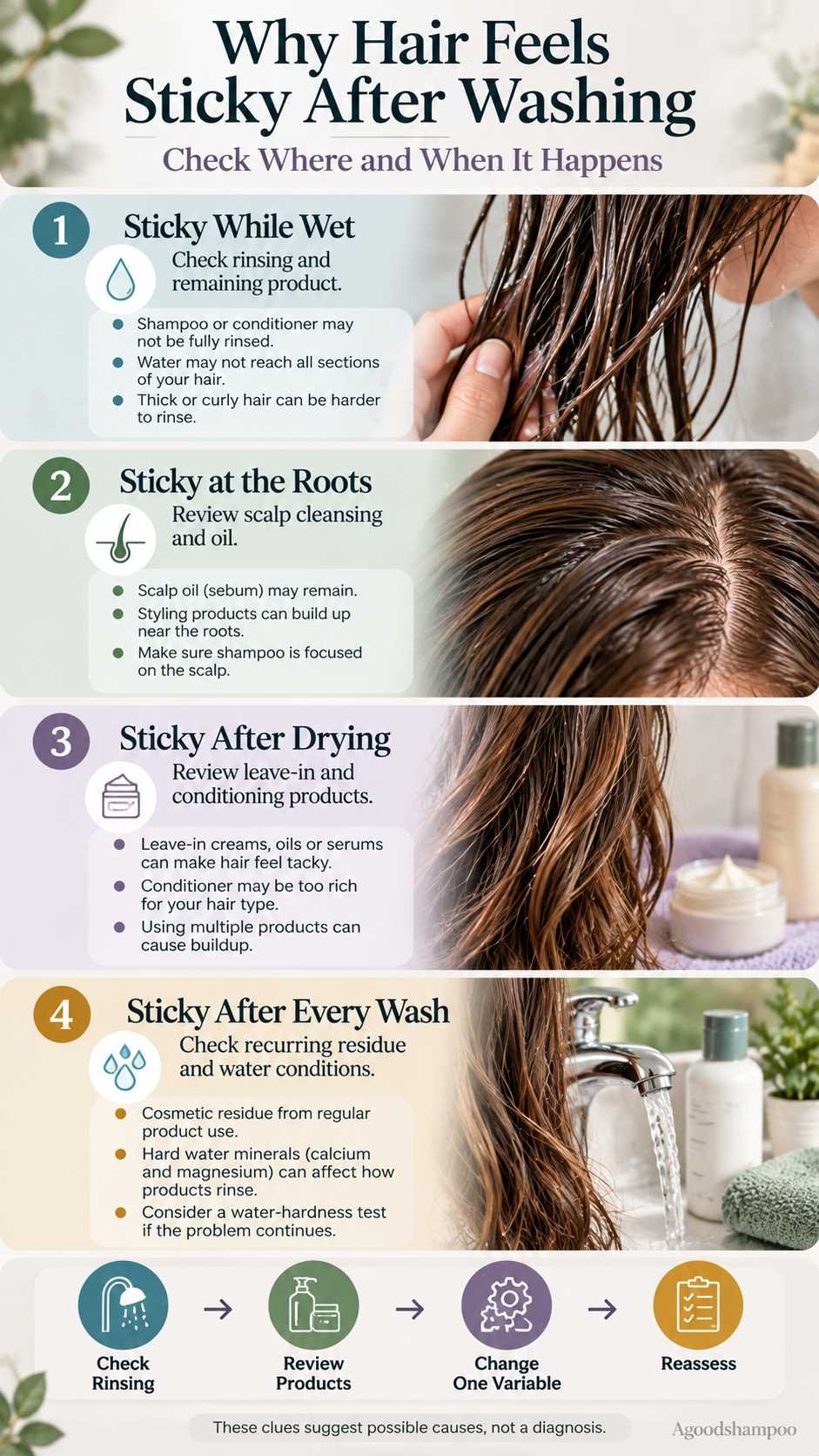
Instead of judging your hair from one wash, compare what it feels like while wet and after drying.
| What you notice | Possible explanation | What to check first |
|---|---|---|
| Sticky immediately after rinsing | Product not completely rinsed away | Rinsing technique |
| Sticky mainly at the roots | Remaining scalp oil or styling residue | Scalp cleansing |
| Soft when wet, sticky after drying | Leave-in products or conditioning formula | Products applied after washing |
| Clumped, coated hair over several washes | Accumulated cosmetic residue | Product use and cleansing routine |
| Sticky feeling after changing shampoos | Different formula performance | New shampoo and conditioner combination |
These patterns provide useful clues, not a definitive diagnosis.
For example, hair that feels sticky only after applying a leave-in cream suggests a different starting point from hair that already feels tacky before conditioner or styling products touch it.
Also, distinguish stickiness from other sensations. Greasy hair usually looks or feels oily, waxy hair may have a more persistent coated sensation, and damaged wet hair may stretch abnormally or feel gummy.
If wet hair becomes unusually stretchy or breaks easily, especially after bleaching or chemical treatment, additional cleansing may not address the underlying damage.
How to Fix Sticky Hair Without Overwashing
The simplest approach is to change one part of your routine and check the result at your next normal wash.
Start With a More Thorough Rinse
Use comfortably warm water and allow it to pass through the scalp and hair lengths.
Lift dense sections gently so water can reach underneath. Continue until shampoo and rinse-out conditioner have been thoroughly removed.
Avoid rubbing the hair harshly or pulling tangles apart while wet.
Concentrate Shampoo on the Scalp
Apply an appropriate amount of shampoo to wet scalp areas, then massage gently with your fingertips.
Allow the lather and rinse water to move through the lengths rather than repeatedly scrubbing the ends.
If you regularly use heavy oils or styling products, assess whether your current cleansing routine removes them adequately.
A second shampoo application is not necessary for everyone. Consider it only when the first wash has clearly not removed substantial oil or product residue, and your hair and scalp tolerate the extra cleansing.
Simplify Your Post-Wash Products
For your next wash, try skipping optional styling creams, oils, gels, and serums.
Keep your normal rinse-out conditioner if your hair needs it, especially if it is dry, curly, or prone to tangling.
For fine hair, applying conditioner mainly to the lengths and ends may reduce an excessively heavy feeling. Drier or tightly curled hair may benefit from conditioning through more of the hair length.
If the stickiness disappears when you omit a leave-in product, reintroduce products individually to identify which one changes the result.
Consider Clarifying When Residue Is Plausible
If your hair repeatedly feels coated and you use several styling products, occasional clarifying may help remove accumulated cosmetic materials.
A clarifying shampoo is intended to provide more thorough cleansing, but its performance depends on the formula.
Choose a product suitable for your hair type, follow its directions, and watch for dryness or irritation.
Color-treated, bleached, or already dry hair may require particular care because unnecessary intensive cleansing can make the hair feel rougher.
Our guide to clarifying shampoos for oily hair explains the considerations for people whose main concern is excess oil.
Check Water Hardness if the Problem Persists
If careful rinsing and a simplified routine do not help, and you have other clues suggesting hard water, consider a water-hardness test.
A measured result is more useful than assuming minerals are responsible because hair feels coated.
If mineral deposits are a genuine concern, choose hair-care products specifically intended for that purpose rather than relying on home remedies such as strong vinegar rinses or baking soda.
Can Shampoo Ingredients Leave Hair Feeling Sticky?
Yes, but the answer depends on the complete formulation rather than a single ingredient name.
Shampoo contains surfactants, ingredients that help water remove oil and other materials from the hair and scalp.
Some shampoos also contain conditioning polymers, which are ingredients designed to attach to the hair surface and improve its feel.
For example, certain polyquaterniums and modified guar ingredients are used for conditioning. Silicones may also be incorporated for smoothness and manageability.
Scientific research on shampoo formulation shows that surfactants and conditioning polymers interact in ways that influence deposition during washing and rinsing.
However, finding one of these ingredients on a shampoo label does not prove that it is responsible for sticky hair.
Likewise, a silicone-free or sulfate-free label does not guarantee that a product will leave every hair type feeling lighter or cleaner.
The full formulation, amount applied, other products used, and individual hair characteristics all matter.
When Sticky Hair Needs a Different Explanation
A sticky feeling limited to the hair lengths is usually best approached as a hair-care concern first.
Persistent scalp symptoms deserve separate attention.
If you develop redness, burning, significant itching, swelling, tenderness, oozing, or crusting, stop using a product you suspect is irritating your scalp and seek medical advice.
Contact dermatitis and other scalp conditions can involve discomfort or inflammation, but sticky hair by itself does not establish any particular medical condition.
If your hair suddenly feels unusually gummy, stretches excessively when wet, or breaks readily after chemical treatment, consider possible hair-shaft damage rather than repeatedly using stronger shampoo.
Make One Change Before Replacing Your Shampoo
At your next wash, focus on thorough rinsing and gentle scalp cleansing. Keep optional leave-in products out of the routine so you can judge how your hair feels without them.
If the stickiness improves, you have a useful clue about what to adjust. If it continues, review the shampoo-and-conditioner combination and your recent product use before considering stronger cleansing.
The best fix is the one that addresses the actual source of the sticky feeling without making your hair drier or your scalp more irritated.

Michael Chen focuses on the science behind shampoos and hair-care ingredients. He explains how cleansing agents, silicones, proteins, and other formula components work, separating useful evidence from marketing claims to help readers better understand the products they use.