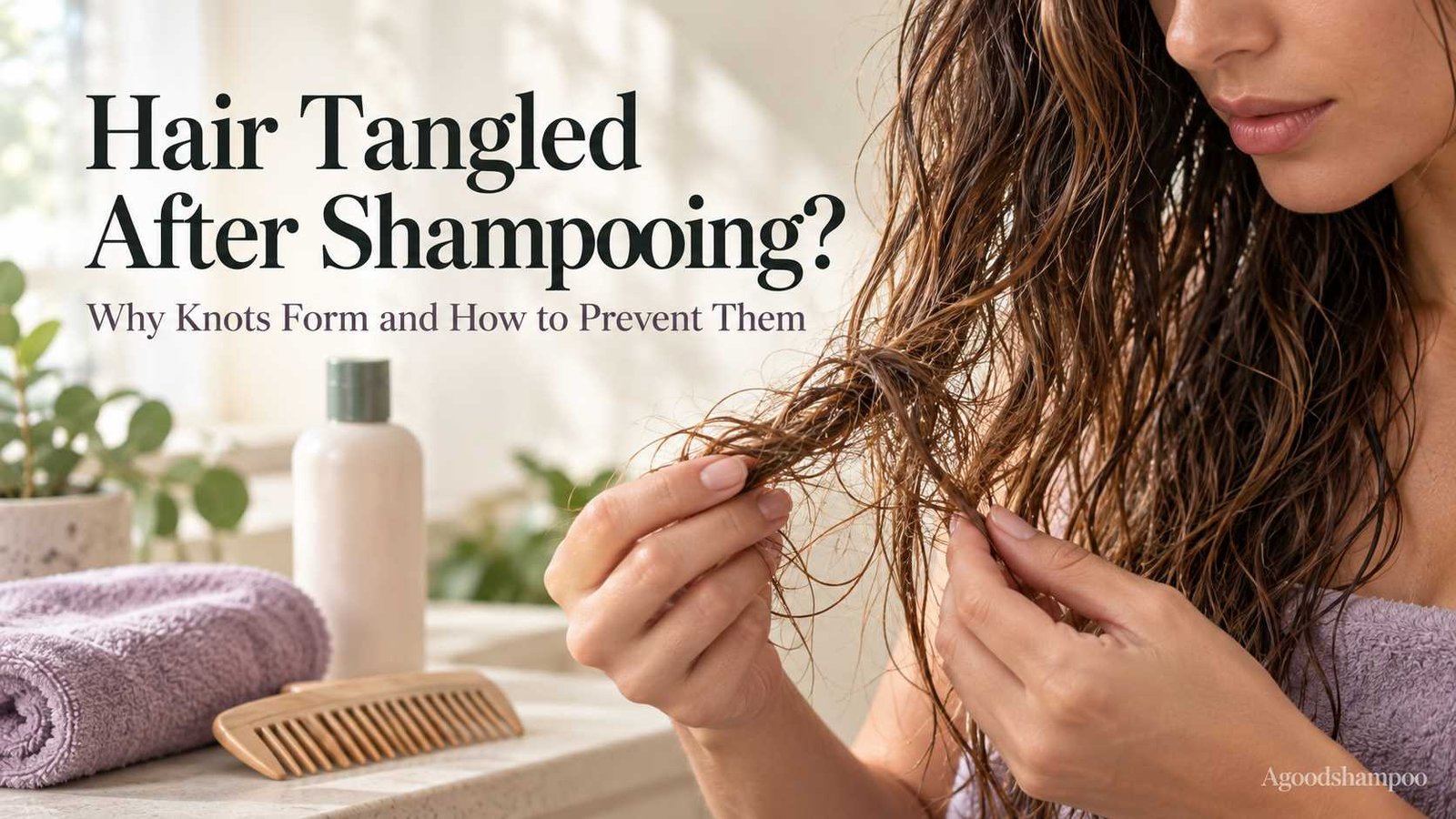
 You finish shampooing, rinse your hair, and suddenly your fingers cannot move through the lengths without catching on knots. Hair that felt manageable before washing now seems tangled, rough, or difficult to comb.
Hair usually gets tangled after shampooing because strands rub against each other, lose some surface lubrication during cleansing, or catch on existing knots and rough areas. Vigorous washing, insufficient conditioner, naturally curly hair, and damaged ends can make the problem worse.
The solution is not necessarily a different shampoo. What matters most is identifying when the tangles form and adjusting the part of your routine responsible for them.
Why Washing Can Make Hair More Tangled
Your hair is covered by an outer protective layer called the cuticle. It consists of overlapping cells that help protect the inner hair fiber. When hair is relatively smooth and well-conditioned, neighboring strands can slide past one another more easily.
Shampoo removes excess oil, dirt, and product residue. During washing, however, strands also move and rub against each other. Once some of the lubricating material on the hair surface is removed, that friction may become more noticeable.
Research on hair friction, including a scientific review published in 2025, explains that cuticle wear, chemical treatments, and mechanical handling can increase resistance between hair fibers. Conditioning ingredients can temporarily improve lubrication and make combing easier.
This explains why hair can feel clean but become harder to separate.
Tangling does not automatically mean shampoo has damaged your hair. Sometimes washing simply tightens existing knots or makes previously unnoticed roughness more apparent.
Find Out When the Knots Start
Before replacing your products, notice exactly when your hair becomes difficult to manage.
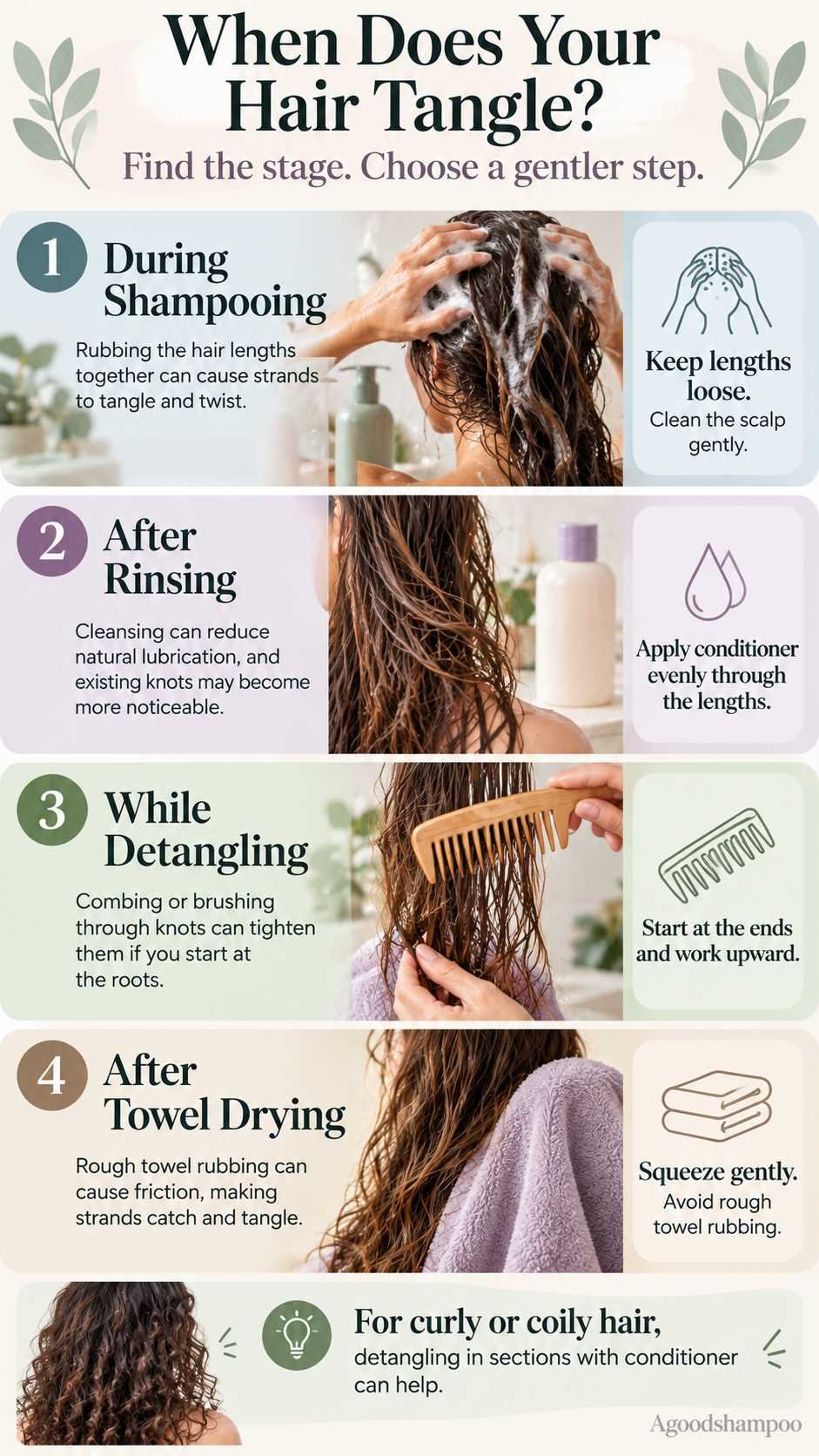
| When tangling occurs | Possible reason | What to try first |
|---|---|---|
| During shampoo massage | Hair lengths are being rubbed or twisted together | Massage the scalp rather than gathering the lengths into a pile |
| Immediately after rinsing | Reduced slip, remaining knots, or inadequate conditioning | Apply conditioner evenly and gently separate the lengths |
| While combing wet hair | Existing knots are being pulled tighter | Use a wide-tooth comb and begin at the ends |
| After towel drying | Rough rubbing has disturbed and intertwined the strands | Gently squeeze or blot away moisture |
| Several hours after drying | Friction, rough ends, or insufficient lasting conditioning | Review leave-in care and the condition of your ends |
These clues are more useful than assuming that every tangled strand needs additional moisture.
For example, hair that becomes knotted during shampoo massage may improve simply by changing how you wash it. Hair that tangles mainly at the ends may need more focused conditioning and less mechanical stress.
Six Reasons Hair Tangles After Shampooing
1. You Rub the Hair Lengths Too Much
One common washing mistake is gathering long hair on top of the head and rubbing it vigorously.
This creates unnecessary movement between strands, allowing them to twist and catch against one another.
Instead, let the lengths hang naturally while gently massaging shampoo into the scalp with your fingertips. As you rinse, allow the diluted shampoo to flow through the rest of your hair.
You generally do not need to scrub the entire length to achieve routine cleansing.
2. Your Shampoo and Conditioning Routine Lack Enough Slip
Hair may feel unusually squeaky, rough, or difficult to separate after cleansing when there is not enough surface lubrication remaining.
That does not prove the shampoo is harsh. The formula, washing frequency, amount used, hair condition, and conditioner all influence the result.
If your hair repeatedly feels tangled after a particular product, review whether it provides an appropriate balance of cleansing and conditioning for your needs.
Our guide to choosing a good shampoo and conditioner for your hair explains how to approach that choice.
3. Your Conditioner Does Not Reach the Areas That Need It
Conditioner helps reduce friction between strands, making hair easier to separate and comb.
But applying a small amount only to the outer surface of thick or long hair may leave sections underneath inadequately conditioned.
Work conditioner through the lengths, paying particular attention to areas that tangle easily. Follow the product’s instructions and distribute it carefully rather than pulling through knots.
Conditioning ingredients such as cationic agents, fatty alcohols, and certain silicones can improve smoothness and combability. Whether a product contains silicones is less important than how well the complete formula suits your hair.
4. Your Ends Are Weathered or Damaged
Hair ends have generally experienced more washing, brushing, styling, and environmental exposure than newer hair near the roots.
Repeated bleaching, coloring, heat styling, and mechanical wear can make the surface rougher. This increases the likelihood that neighboring strands will catch on one another.
If your roots feel comfortable but your ends constantly knot together, pay particular attention to those older lengths.
Conditioners and leave-in products can temporarily improve manageability, but they cannot permanently restore severely damaged or split fibers to their original condition.
If your hair has undergone significant processing, our guide to shampoo choices for dry and damaged hair discusses how different hair concerns call for different care.
5. Your Natural Hair Pattern Encourages Strands to Intertwine
Curly and coily hair naturally follows bends and curves rather than lying in straight, parallel lines.
As strands move during washing, these bends can contribute to intertwining and knot formation.
That does not mean curly hair is unhealthy.
For thick curls or coils, dividing hair into sections and gently detangling while conditioner is present may make wash day easier. Straight hair may be better managed by allowing it to dry slightly before combing.
The important distinction is to use a technique suited to your hair pattern rather than forcing the same routine on everyone.
6. You Roughly Dry or Handle Hair After Washing
The way you handle freshly washed hair can undo the benefits of careful shampooing and conditioning.
Vigorous towel rubbing, forceful brushing, and repeatedly pulling at resistant knots can increase mechanical stress.
Hair is particularly vulnerable to excessive stretching and rough handling when wet. Although it can sometimes be easier to detangle damp, conditioned curls, gentleness remains essential.
Use a soft towel or cotton T-shirt to squeeze out excess water. Avoid twisting, scrubbing, or pulling the lengths aggressively.
How to Wash and Detangle Hair With Less Breakage
A few adjustments can make the entire washing process easier.
Step 1: Remove loose knots before washing.
If your hair can be gently detangled while dry, remove obvious knots before entering the shower. For tightly curled hair, working in sections with suitable conditioning slip may be safer than dry brushing.
Never force a comb through a resistant knot.
Step 2: Wet your hair thoroughly.
Allow water to reach the scalp and lengths before applying shampoo. This helps distribute the cleanser without unnecessary pulling.
Step 3: Concentrate shampoo on the scalp.
Massage gently with your fingertips. Avoid bunching long hair together or repeatedly scrubbing the ends.
Step 4: Rinse without tangling the lengths.
Allow water to flow downward through the hair. Use your fingers gently if needed, rather than twisting or rubbing the strands.
Step 5: Apply conditioner where it is needed.
For fine or straight hair, concentrating conditioner on the ends may be sufficient. Dry, thick, curly, or coily hair may benefit from conditioning more of the length.
Follow the recommended application and rinse instructions.
Step 6: Detangle from the ends upward.
Use your fingers or a wide-tooth comb to work through small sections. Hold the section above a knot to reduce pulling on the scalp, loosen the ends first, and gradually work higher.
The American Academy of Dermatology advises that thick, curly hair can often be combed in the shower before rinsing out conditioner. Straight hair may be easier to comb after it has dried slightly.
Step 7: Dry gently and protect the ends.
Blot rather than rub. If your lengths still catch after drying, a suitable leave-in conditioner or detangling product may provide additional slip.
Start with an amount appropriate for your hair density and texture, increasing only if needed.
When a Different Product or Professional Advice Makes Sense
If your hair started tangling immediately after switching shampoos, compare the new routine with the previous one.
Consider whether you also changed your conditioner, washing frequency, water conditions, or styling products. A difference in manageability does not automatically identify one problematic ingredient.
If changing your handling technique and conditioner coverage makes little difference, trying a more conditioning shampoo-and-conditioner combination may be reasonable.
For bleached, permed, or frequently heat-styled hair, reducing further damage is especially important. Even a well-formulated conditioner cannot eliminate every knot caused by worn or split ends.
Occasional tangling is common. However, severe matting, persistent unexplained breakage, substantial hair shedding, bald patches, scalp pain, or inflammation deserves professional assessment. A dermatologist can help determine whether another hair or scalp concern is contributing.
Make Your Next Wash Easier
At your next wash, change just one or two things: keep shampoo concentrated on the scalp and make sure the lengths receive enough conditioner before detangling.
Notice whether the knots appear during cleansing, after rinsing, or only once your hair dries.
If those changes help, you may not need a new shampoo at all. If the same areas repeatedly tangle despite gentle handling, look more closely at your conditioning routine and the condition of your hair ends.
The goal is not perfectly knot-free hair after every wash. It is cleaner hair that remains manageable without unnecessary pulling, friction, or breakage.

Marlena Stell makes everyday hair care easier to understand. From choosing a shampoo to managing common hair concerns, she breaks down confusing product claims and practical routines into straightforward advice that helps readers find what works for their needs.