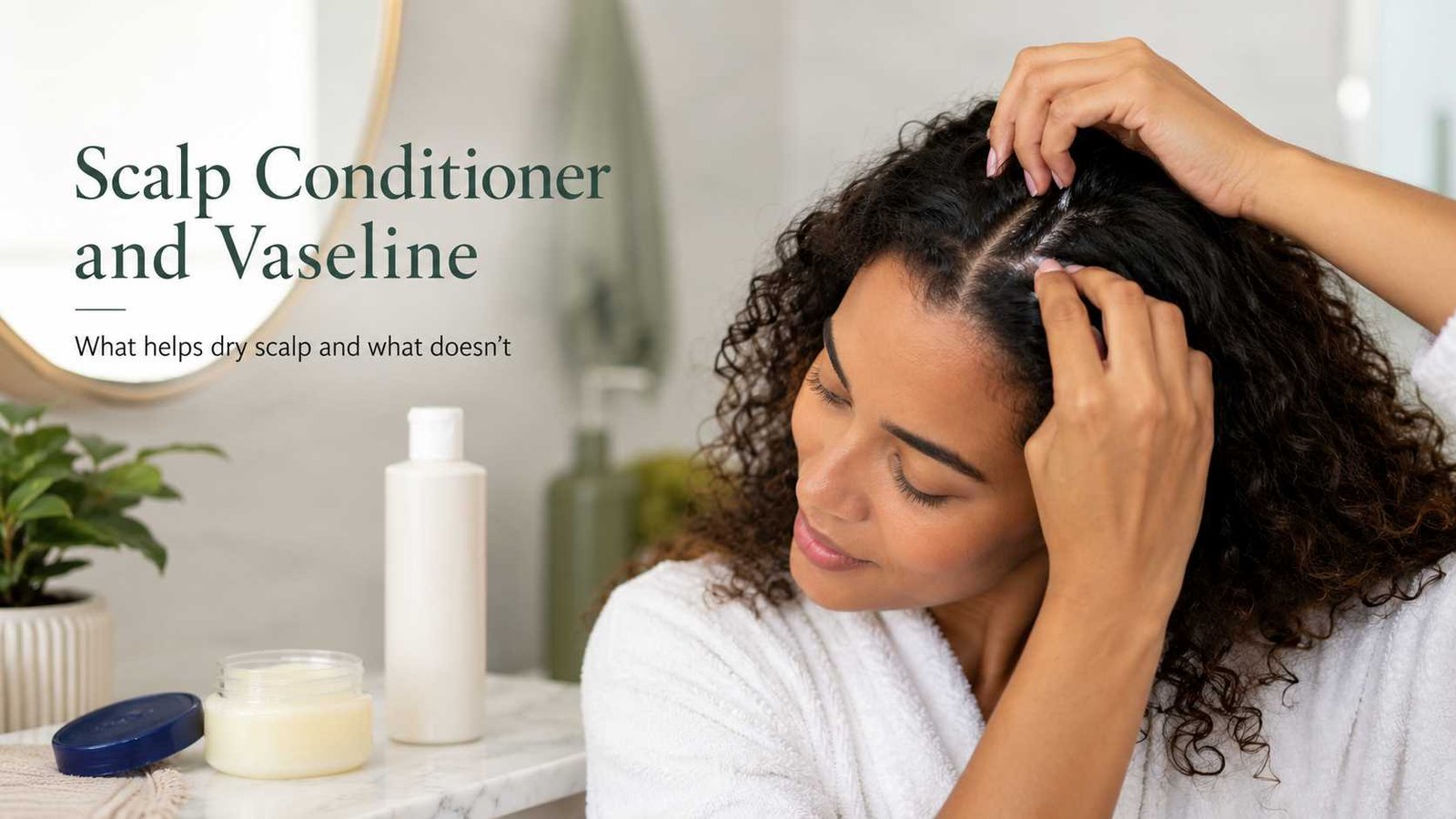
 You condition your hair after shampooing. That part feels normal.
But what about your scalp?
If your scalp feels tight, itchy, flaky, or painfully dry, rubbing a little conditioner into it can seem like the obvious fix. And then there is Vaseline. People have used petroleum jelly on dry skin forever, so it sounds reasonable to think it could help a dry scalp too.
Sometimes it can.
Sometimes it makes a greasy mess without fixing the real problem.
The tricky part is figuring out whether you actually have a dry scalp, dandruff, product irritation, or something else. Those conditions can look almost identical when you see flakes on your shirt.
Scalp conditioner can help in the right situation. Vaseline can also have a place in a dry-scalp routine. But neither product should become a catch-all treatment for every itchy or flaky scalp.
Here is what the science tells us.
What Does Scalp Conditioner Actually Do?
Most people think of conditioner as something that belongs from the middle of the hair down to the ends.
That advice makes sense for many people.
Traditional hair conditioners mainly work on the hair fiber. Shampoo removes dirt, oil, sweat, and product residue, but cleansing also leaves the hair surface rougher. Conditioner deposits lubricating materials onto the hair.
Researchers describe several ways conditioners improve hair. They reduce friction between strands, smooth the cuticle, reduce static electricity, make detangling easier, and improve softness and shine. Many formulas use positively charged conditioning ingredients because damaged hair tends to carry a negative surface charge. Those opposite charges attract each other, helping the conditioning ingredients stick to damaged areas.
Common conditioning ingredients include cetrimonium chloride, behentrimonium chloride, fatty alcohols such as cetyl alcohol and stearyl alcohol, silicones such as dimethicone, oils, polymers, and hydrolyzed proteins. Different combinations produce very different results.
That is great for your hair.
Your scalp is different.
Your scalp is living skin. It contains oil glands, sweat glands, hair follicles, nerves, and its own skin barrier. So a product designed to coat a hair strand is not automatically the best product to leave sitting on scalp skin.
That distinction matters more than most people realize.
What Are the Benefits of Using Conditioner on Your Scalp?
Using the right conditioner on the scalp can feel wonderful when dryness comes from harsh cleansing or a damaged skin barrier.
A moisturizing scalp product may reduce that dry, tight feeling after washing. It may also make the scalp feel softer and less uncomfortable.
But I would not take that as permission to massage any heavy conditioner into your roots.
The American Academy of Dermatology specifically warns that leave-in conditioner should normally go on the hair rather than the scalp because scalp application can cause buildup and irritation.
So the real question is not simply whether conditioner is good for your scalp.
It is whether your specific conditioner was made for scalp use.
A lightweight scalp conditioner, scalp serum, moisturizing scalp treatment, or rinse-out formula labeled for scalp application makes far more sense than taking a thick smoothing conditioner meant for damaged ends and coating your whole head with it.
This becomes especially important if you already have oily roots.
You may technically have dry-feeling scalp skin while still producing plenty of sebum. Adding layer after layer of rich product can leave you with greasy hair, buildup around follicles, and more itching.
That is the frustrating part. More moisture is not always the answer.
Quick Fact
Hair conditioner mainly changes the physical surface of the hair. Research shows that conditioning agents can reduce friction, flatten rough cuticle scales, improve combing, reduce static, and increase softness and shine. Those benefits do not automatically mean that every conditioner will improve a scalp disorder.
Dry Scalp and Dandruff Are Not the Same Thing
This is where a lot of home remedies go wrong.
You notice white flakes.
You think your scalp must be dry.
So you add oil, conditioner, Vaseline, masks, and anything else that sounds moisturizing.
A week later, you have even more buildup and still have flakes.
Dry scalp happens when scalp skin loses too much moisture. Cleveland Clinic notes that weather, aging, hair products, and some skin conditions can contribute to it.
Dandruff works differently.
Dandruff belongs to the same disease spectrum as seborrheic dermatitis. Research links it with several factors, including scalp oil, the skin barrier, individual susceptibility, and Malassezia yeasts that normally live on human skin.
In simple terms, dry scalp needs gentle care and moisture.
Dandruff often needs dandruff treatment.
That one difference can save you months of guessing.
The American Academy of Dermatology says dandruff can usually improve with dandruff shampoo, while a truly dry scalp may improve after switching to a gentle, non-medicated shampoo.
Think about the flakes too.
Very fine, dry flakes with a tight scalp can point toward dryness.
Greasy scaling, persistent itch, repeated flaking, or irritated patches may fit dandruff or seborrheic dermatitis better.
You cannot diagnose every scalp problem just by looking at the flakes, though. Psoriasis, eczema, allergic reactions, fungal infections, and other conditions can also affect the scalp.
If your scalp keeps getting worse despite reasonable home care, it deserves a proper diagnosis rather than another jar of moisturizer.
Can Vaseline Help Dry Scalp?
Now we get to the question everyone seems to have.
Yes, Vaseline can sometimes help very dry scalp skin.
But you need to understand what it actually does.
Vaseline is a brand closely associated with petroleum jelly. The main substance, petrolatum, works primarily as an occlusive.
An occlusive acts like a barrier.
It slows the escape of water from your skin.
That is very different from adding water to the skin.
A major dermatology review describes petrolatum as an anhydrous occlusive moisturizer capable of substantially decreasing transepidermal water loss. Research reviews report reductions ranging from roughly 50 percent to 99 percent depending on the study and testing conditions.
That sounds almost magical, but keep the mechanism in mind.
Petrolatum is more like a lid than a glass of water.
Imagine putting a lid on a dry, empty cup. You have prevented further evaporation, but you did not magically fill the cup.
That is why petroleum jelly often works best on skin that already contains some moisture.
If I were dealing with a small area of genuinely dry scalp, I would rather apply a tiny amount after bathing or after using an appropriate scalp moisturizer than smear a thick coat of Vaseline over a completely dry head.
And I mean tiny.
Petroleum jelly spreads much farther than you expect.
What Research Says About Petrolatum
Scientists have studied petrolatum as a skin barrier ingredient for decades.
One in-vivo study used petrolatum as a positive control when researchers compared the occlusive ability of oils by measuring transepidermal water loss. In other words, petrolatum served as the benchmark because of its strong ability to limit water loss.
Other research has found that petrolatum-containing moisturizers can improve skin barrier function and reduce transepidermal water loss.
That gives us good evidence for its skin-protective role.
It does not give us evidence that Vaseline cures dandruff, makes hair grow faster, repairs damaged follicles, or treats every itchy scalp.
Those are separate claims.
Can Vaseline Be Used to Treat Hair Dandruff?
I would not use Vaseline as my main dandruff treatment.
Dandruff is not simply dry skin that needs to be coated with grease.
Dermatologists commonly manage mild dandruff with shampoos containing active dandruff ingredients. Depending on the product and country, these may include ketoconazole, selenium sulfide, salicylic acid, coal tar, sulfur, or other approved anti-dandruff ingredients. The exact choice depends on what is causing the scaling and how your scalp responds.
Research also supports the role of Malassezia in dandruff and seborrheic dermatitis, which helps explain why antifungal treatments can work.
Petrolatum does not perform that job.
It can soften dry scales and reduce moisture loss from dry skin, but that is symptom management, not the same thing as treating dandruff’s underlying biology.
I also would not automatically say Vaseline feeds dandruff yeast. You will see that claim repeated online, but direct clinical evidence showing that ordinary scalp use of petroleum jelly worsens dandruff through that exact mechanism is not strong enough for me to present it as a fact.
There is a simpler reason to be cautious.
Petroleum jelly is thick.
Put enough of it on your scalp and you may create heavy buildup that takes repeated shampooing to remove. Then you end up shampooing harder to get rid of the Vaseline, which can leave an already sensitive scalp feeling even worse.
A home remedy can turn into its own little problem.
A Simple Way to Tell What Your Scalp May Need
| What you notice | What may make more sense |
|---|---|
| Tight scalp after shampooing with tiny dry flakes | Gentler shampoo and a scalp-friendly moisturizer |
| Dry patches without much oiliness | Small amounts of moisturizing scalp treatment |
| Greasy flakes and recurring itch | Anti-dandruff shampoo |
| Thick scale or inflamed areas | Dermatologist evaluation |
| Burning after a new product | Stop the suspected product and simplify your routine |
| Hair feels dry but scalp feels normal | Condition the hair lengths rather than the scalp |
| Scalp feels dry only in winter | Gentler washing and light seasonal moisturizing |
| Flaking keeps returning despite treatment | Get the condition properly diagnosed |
That table matters because the wrong treatment often comes from treating every flake as dryness.
The Best Kind of Conditioner for a Dry Scalp
If your scalp really does need conditioning, I prefer formulas actually designed for scalp contact.
Look at what the product claims to do rather than getting hypnotized by words such as nourishing, repair, moisture, or intensive.
A conditioner made to smooth bleached ends may contain ingredients that work beautifully on damaged hair and feel terrible around oily roots.
Your scalp usually benefits more from a light formulation that rinses clean.
Humectant ingredients can also be useful in moisturizing products. Humectants attract and hold water, while occlusive ingredients help slow water loss. A well-designed formula can combine both approaches.
Petrolatum sits firmly on the occlusive side.
That explains why putting Vaseline over slightly damp or moisturized skin makes more sense than expecting petroleum jelly itself to hydrate the scalp from nothing.
Should You Put Regular Conditioner Directly on Your Scalp?
For most people, I would start with the lengths and ends.
Your ends are older than the hair close to your scalp. They have survived more brushing, washing, UV exposure, heat, coloring, straightening, and ordinary wear.
They usually need conditioner more.
Your scalp naturally produces sebum, so your roots may already receive more lubrication than your ends.
That balance changes with curly and coily hair because natural scalp oil may not travel easily down bends in the hair shaft. It also changes with age, climate, shampoo frequency, chemical treatments, and individual oil production.
Still, dumping regular conditioner onto the scalp is rarely my first answer to dryness.
The AAD recommends moisturizing conditioner after shampooing for protecting hair strands and reducing problems such as breakage and split ends. At the same time, its leave-in conditioner guidance warns against scalp application because buildup can irritate the skin.
That sounds contradictory until you remember that hair and scalp are two different surfaces.
Condition your hair because the fiber benefits from it.
Condition your scalp only when the formulation and your scalp actually call for it.
Can Vaseline Help Dry Scalp Better Than Conditioner?
They do different jobs.
A regular conditioner mainly improves hair feel and manageability.
Petroleum jelly mainly reduces water loss from skin.
So if you have one small, stubborn dry area, a tiny amount of petroleum jelly may protect that spot better than coating it with ordinary hair conditioner.
But if your scalp feels dry because your shampoo is too harsh, fixing the cleansing routine matters more than endlessly covering your scalp with Vaseline.
Cleveland Clinic specifically notes that changing shampoo may help dry scalp, and the AAD recommends gentle non-medicated shampoo when actual scalp dryness is the issue.
Sometimes the best moisturizer is simply removing the thing that keeps drying you out.
I see this mistake a lot with people who love that squeaky-clean feeling.
Your scalp should feel clean.
It does not need to feel stripped.
What Are the Benefits of Leaving Vaseline on Hair Overnight?
This one needs a reality check too.
Leaving a small amount of Vaseline on dry hair ends overnight may help reduce moisture loss from the surface and give the hair a smoother, glossier feel.
It can also flatten flyaways.
That is the cosmetic benefit.
Petrolatum forms a water-resistant film. Hair conditioning research shows that film-forming substances can reduce friction and improve surface smoothness, although petroleum jelly itself is not the same as a professionally formulated conditioner.
What I would not promise is true repair.
Your visible hair shaft consists mainly of keratinized tissue. Cosmetic products can coat damaged areas, fill surface irregularities, reduce friction, and temporarily improve how the hair looks and feels. They cannot biologically bring a badly split hair shaft back to its original condition. Research on conditioners makes this temporary nature clear, especially with products marketed around protein repair and split ends.
So yes, Vaseline can make dry ends look nicer.
No, waking up after one petroleum-jelly mask does not mean the hair repaired itself overnight.
Is an Overnight Vaseline Hair Mask Worth Trying?
For most heads of hair, I would not cover everything in petroleum jelly.
It is simply too heavy.
If your ends feel rough, put the smallest smear between your fingertips and rub your hands together until there is barely any visible product left. Then touch only the driest ends.
That is enough for experimentation.
A thick overnight layer can be surprisingly difficult to shampoo out. You may end up washing two or three times, which defeats the entire purpose if your hair already struggles with dryness.
Keep it away from pillows too. Petroleum jelly and nice bedding are not a happy couple.
And if you have an oily scalp, active dandruff, follicle irritation, or easily clogged skin around your hairline, I would skip the scalp coating entirely unless a dermatologist has suggested otherwise.
Does Vaseline Make Hair Grow?
There is no good clinical evidence that putting Vaseline on your scalp makes hair follicles produce hair faster.
I wish hair growth were that easy.
Petrolatum can reduce moisture loss from skin and create a protective coating. Those are real properties. They should not get stretched into a hair-growth claim.
Hair growth happens inside the follicle. Genetics, hormones, nutrition, age, illness, medications, scalp disease, and several other factors can influence the growth cycle.
Coating the outside of your scalp with petroleum jelly does not suddenly change that cycle.
Your hair might appear healthier if reduced friction leads to less breakage at the ends. Keeping more length can feel like faster growth because you are not losing as much hair to snapping.
But growth and length retention are different things.
That distinction matters.
What About Vaseline for Split Ends?
Use it for appearance, not repair.
A microscopic amount can coat rough ends and make them feel smoother.
It may reduce friction between strands too.
But once an end has split badly, trimming it remains the cleanest fix. Conditioning products can temporarily hold damaged fibers together or smooth the surface, but the effect disappears with washing and wear.
This is one of those places where a cheap beauty trick actually has value as long as you do not ask it to perform a miracle.
A Better Routine for a Dry, Flaky Scalp
Start with the cause before buying more products.
If the scalp feels dry and tight rather than greasy and inflamed, use a gentle shampoo and avoid very hot water. Shampoo the scalp rather than aggressively scrubbing the lengths. Follow with conditioner where your hair needs it.
If you want scalp moisture, choose something specifically made for scalp application.
You can test a small amount first.
For a tiny area of stubborn dryness, a thin film of petrolatum over slightly damp skin can help slow moisture loss. Remember that research strongly supports petrolatum as an occlusive skin protectant.
If the flakes look more like dandruff, switch your focus.
Use an actual dandruff shampoo according to its directions. Some anti-dandruff products need several minutes of scalp contact before rinsing, and treatment frequency can vary with hair type. The AAD gives different guidance for straight or wavy hair and for curly or coily hair because washing habits and scalp needs differ.
Do not throw six remedies at your scalp at the same time.
If things improve, you will have no idea what worked.
If things get worse, you will have no idea what caused it.
Simple routines tell you more.
Scalp Conditioner Ingredients I Pay Attention To
I care less about the fancy name on the front of the bottle and more about what the formula is trying to accomplish.
For the actual hair, ingredients such as behentrimonium chloride, cetrimonium chloride, fatty alcohols, silicones, oils, polymers, and hydrolyzed proteins can improve softness, detangling, lubrication, and shine.
For scalp comfort, the entire formula matters.
Fragrance can feel fine on one person and irritating on another. Heavy oils may suit one dry scalp and make another person’s roots feel awful. A beautiful ingredient list cannot tell you exactly how your individual scalp will react.
That is why I like patch testing unfamiliar scalp products.
Try a little.
Watch what happens.
Your scalp usually tells you pretty quickly when it hates something.
When Vaseline Makes Sense
Vaseline makes the most sense when you want an occlusive.
Maybe you have a small dry area near the hairline.
Maybe cold weather has left the skin tight.
Maybe you want a microscopic amount on brittle ends before bed.
Those uses match what petrolatum actually does.
It protects.
It reduces moisture escape.
It lubricates.
It does not need a dozen wild claims attached to it to be useful.
A 2024 dermatology review describes petroleum jelly as a widely used topical agent with a long history in dermatology, particularly because of its barrier and occlusive properties.
That is enough reason to keep the little jar around.
Just use it for the right problem.
When I Would Skip Vaseline
I would not make Vaseline my first move when the scalp looks greasy, repeatedly develops dandruff, feels inflamed, has painful bumps, develops thick plaques, or starts losing hair in unusual patches.
Those signs push the problem beyond simple dryness.
I would also stop experimenting if a home treatment creates burning, tenderness, worsening redness, or more itching.
Persistent flaking can come from dandruff and seborrheic dermatitis, but it can also resemble conditions such as psoriasis, eczema, allergic contact dermatitis, and other scalp disorders. The AAD recommends seeing a dermatologist when over-the-counter measures fail or when you are unsure what is causing the problem.
Your scalp does not earn bonus points for suffering quietly.
Sometimes you need a diagnosis.
So, Is Scalp Conditioner Actually Worth Using?
Yes, when you choose it for the right reason.
A scalp-friendly conditioner or moisturizing treatment may help if your scalp feels dry because it has lost moisture or reacts badly to aggressive cleansing.
Regular conditioner remains much more important for your hair lengths, especially if your hair is dry, long, chemically treated, curly, heat styled, or prone to tangling.
Vaseline deserves a smaller role.
Think of it as a moisture-locking tool rather than a scalp cure.
It can reduce water loss from dry skin remarkably well. That makes it useful for small areas of dryness and sometimes for rough hair ends.
But it does not replace dandruff shampoo.
It does not kill the organisms associated with dandruff.
It does not make follicles suddenly grow hair.
And an overnight coating does not permanently repair damaged strands.
Sometimes good hair care becomes much easier once you stop expecting one product to solve five different problems.
If your scalp is dry, protect its moisture.
If your hair is rough, condition the hair.
If you have dandruff, treat the dandruff.
And if your scalp keeps complaining no matter what you try, get someone to actually look at it.
That simple approach beats chasing another viral remedy every week.

Michael Chen focuses on the science behind shampoos and hair-care ingredients. He explains how cleansing agents, silicones, proteins, and other formula components work, separating useful evidence from marketing claims to help readers better understand the products they use.