 Your scalp feels comfortable before a shower, but soon after washing, the skin around your roots starts to feel stretched, dry, or unusually tight. Your hair may look perfectly clean, yet your scalp feels uncomfortable.
A tight scalp after washing is often associated with dryness or irritation from cleansing, hot water, or hair-care products. Sometimes, an existing scalp condition becomes more noticeable after shampooing. The sensation alone cannot tell you exactly what is happening.
The most useful starting point is to notice when the tightness begins, whether other symptoms appear, and what changes when you adjust your washing routine.
What That Tight Feeling May Be Telling You
Scalp tightness is a sensation rather than a diagnosis. Some people describe it as skin pulling across the top of the head. Others notice mild tenderness or discomfort when moving their hair.
Your scalp produces sebum, a natural oil that helps lubricate the skin and hair. Shampoo removes excess oil, sweat, dirt, and product residue. However, repeated washing or a cleanser that irritates your skin can leave the scalp feeling dry and uncomfortable.
That does not mean every tight feeling comes from removing too much oil.
A scalp may feel tight because of irritation even without obvious flaking. Conversely, an oily scalp can develop inflammation or react to an ingredient.
Tightness without itching or visible redness is not automatically harmless, but it also does not automatically indicate a scalp disease. The pattern of symptoms matters more than the sensation by itself.
Five Reasons Your Scalp Feels Tight After Shampooing
1. Cleansing More Than Your Scalp Needs
Shampoos contain surfactants, cleansing ingredients that help water remove oils and debris.
Effective cleansing is necessary, particularly when your scalp produces substantial oil or you use styling products. But washing too frequently, using multiple shampoo applications unnecessarily, or choosing a cleanser your skin does not tolerate may contribute to dryness and irritation.
You might notice that your scalp feels particularly tight after a thorough shampoo session but more comfortable after a gentler wash.
If this sounds familiar, review your washing frequency and cleanser before purchasing additional scalp treatments.
Choosing a gentler formula does not simply mean avoiding every sulfate. A shampoo’s overall formulation matters more than any single ingredient label.
2. Washing With Very Hot Water
A hot shower may feel relaxing, but very hot water can contribute to skin dryness and discomfort.
When your scalp already tends toward dryness, combining hot water with prolonged cleansing may make post-wash tightness more noticeable.
Try using comfortably lukewarm water during your next wash. You do not need ice-cold rinses, and colder water is not a guaranteed treatment for scalp irritation.
The aim is to reduce unnecessary exposure to heat without compromising cleansing.
3. Irritation From a Hair-Care Product
Shampoo is not the only product that touches your scalp.
Conditioners, hair masks, styling creams, dyes, fragrance-containing products, and leave-in treatments may cause irritation in susceptible individuals.
Two reactions are worth distinguishing:
Irritant contact dermatitis: Skin irritation from direct exposure to a substance, sometimes influenced by repeated contact.
Allergic contact dermatitis: An immune reaction to a particular ingredient, which may appear after previous exposures without problems.
Burning, itching, visible changes, or a rash around the scalp, hairline, ears, or neck may suggest a product reaction.
A newly introduced product is an important clue, but an older product can also become problematic. If a product appears to trigger a reaction, stop using it rather than repeatedly applying it to test your tolerance.
If you’re reviewing your routine, our guide to choosing a good shampoo and conditioner offers additional product-selection considerations.
4. Product Residue or Incomplete Rinsing
Shampoo that remains on the scalp after washing may contribute to irritation. Conditioner and styling products can also leave residue.
However, residue does not always explain tightness.
If your scalp feels uncomfortable while your hair seems coated, heavy, or difficult to rinse, consider whether you are using too much product or rinsing inadequately.
Concentrate shampoo application on the scalp, massage gently, and rinse thoroughly. Apply ordinary hair conditioner primarily where your hair needs it, unless the product is specifically formulated for scalp use.
Avoid immediately reaching for a strong clarifying shampoo. More intensive cleansing may aggravate already irritated skin.
5. An Existing Scalp Condition
Sometimes washing reveals discomfort that was already developing.
Conditions such as eczema, seborrheic dermatitis, and psoriasis can affect the scalp. They may cause combinations of itching, scaling, irritation, visible skin changes, or soreness.
Dandruff-related flaking also deserves attention, particularly when symptoms repeatedly return.
These conditions do not all require the same treatment. Adding oils or using stronger shampoos without identifying the issue may be unhelpful.
Persistent flaking or inflammation is a reason to consider professional assessment rather than repeatedly changing ordinary shampoos.
How to Narrow Down the Cause
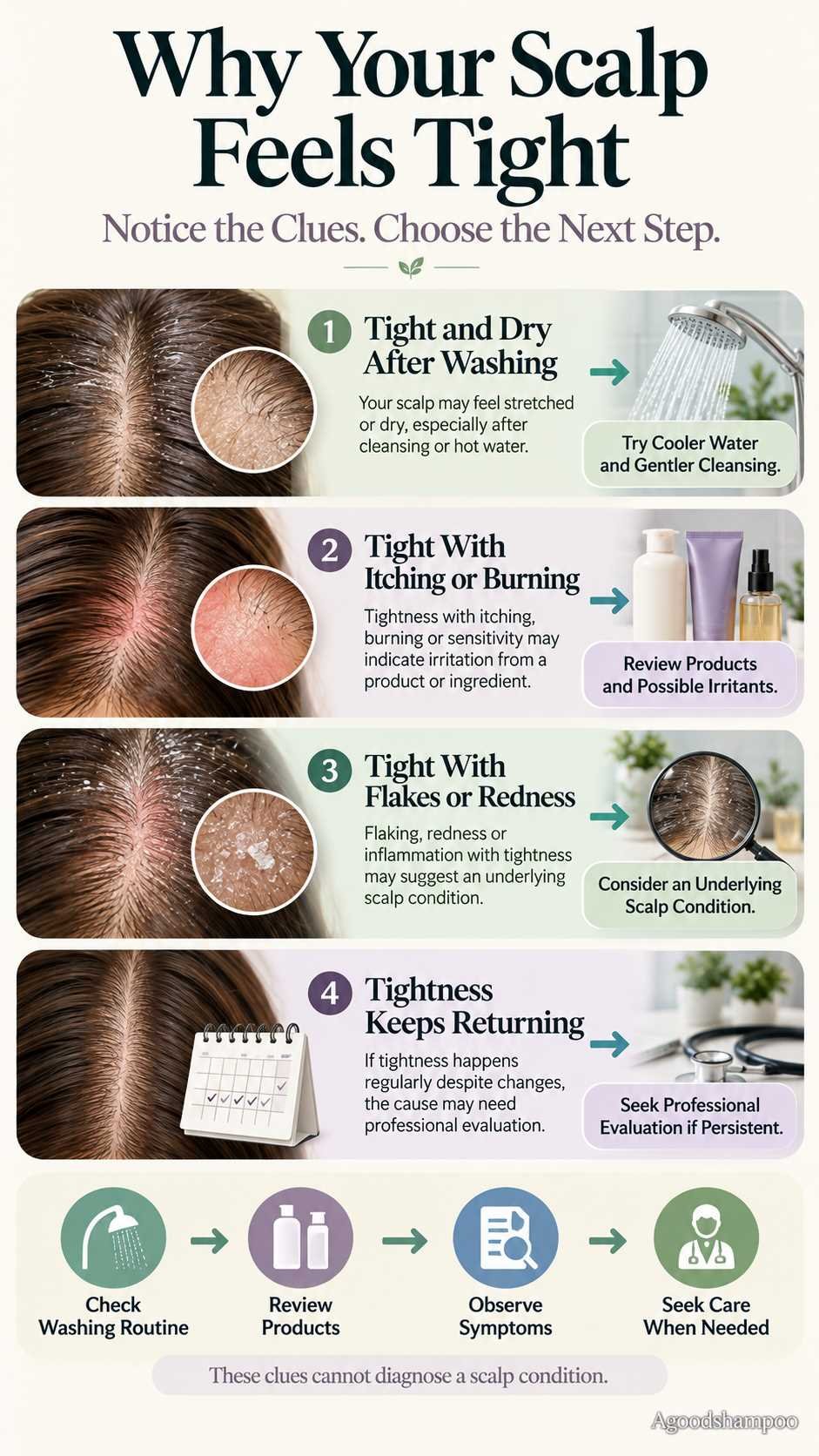
Pay attention to the symptoms accompanying tightness, rather than trying to diagnose your scalp from one sensation.
| What you notice | What it may suggest | Sensible next step |
|---|---|---|
| Tightness mainly after long, hot showers | Heat-related dryness or irritation | Try lukewarm water and shorter washing |
| Tightness after frequent or repeated shampooing | Cleansing-related dryness or irritation | Review washing frequency and cleanser |
| Burning or itching after a new product | Possible product irritation or allergy | Stop the suspected product |
| Tightness with flakes or visible inflammation | Possible underlying scalp condition | Seek advice if persistent or recurring |
| Heavy-feeling hair with scalp discomfort | Possible residue or incomplete rinsing | Rinse thoroughly and review product use |
| Recurring tightness despite routine adjustments | Cause remains uncertain | Arrange a medical assessment |
These are practical clues, not diagnostic tests. Multiple factors may be present at the same time.
For instance, someone with a naturally oily scalp can still experience irritation after washing. Similarly, flakes do not necessarily prove that the skin simply needs more moisture.
Our guide to shampoos for dry scalp discusses different cleansing approaches, but scalp tightness alone is not a reason to start a medicated dandruff shampoo.
What to Change at Your Next Hair Wash
Rather than replacing your entire routine, make a few deliberate adjustments and observe how your scalp responds.
1. Use comfortably lukewarm water. Avoid prolonged exposure to very hot water, particularly if your scalp already feels dry.
2. Choose a shampoo your scalp tolerates. If your current product repeatedly causes discomfort, consider a simpler, fragrance-free alternative. Labels such as natural, botanical, or sulfate-free do not guarantee that a product will be non-irritating.
3. Massage gently with your fingertips. Concentrate cleansing on your scalp without vigorous scratching, abrasive brushes, or aggressive scrubbing.
4. Rinse thoroughly. Remove shampoo carefully around the crown, hairline, and behind the ears. Follow product directions, particularly when using prescribed or medicated shampoo.
5. Reconsider how often you wash. Very frequent washing may aggravate some dry scalps, while oily scalps and certain scalp conditions may require regular cleansing. There is no ideal schedule for everyone.
6. Keep extra products to a minimum. Avoid layering new serums, essential oils, scalp scrubs, and masks onto irritated skin. Introduce changes individually so you can better understand what helps.
If dryness is the main concern, you can also read about whether moisturizing shampoo helps a dry scalp. Remember that a moisturizing claim does not guarantee a product will suit sensitive skin.
If you have been prescribed a medicated shampoo, do not stop or alter its treatment schedule without checking with your healthcare professional.
When Tightness Needs More Than a Shampoo Change
Occasional mild tightness without other symptoms may improve when you remove an irritating product or make gentler washing choices.
However, persistent or recurring tightness deserves attention, especially if you also develop:
Significant itching, burning, or pain.
Redness, swelling, cracking, or oozing.
Thick scaling, persistent flakes, or crusting.
New hair shedding or localized hair loss alongside scalp inflammation.
A rash extending around your forehead, ears, neck, or face.
A dermatologist can examine your scalp and, when appropriate, investigate allergic contact dermatitis through patch testing.
Seek prompt medical attention for severe reactions, rapidly worsening pain, discharge, or signs of infection. Swelling of the tongue or throat, or difficulty breathing, requires emergency care.
Avoid applying strong medicated products simply to suppress tightness when its cause is unknown.
A More Comfortable Wash Starts With the Right Change
The most helpful adjustment depends on what accompanies your scalp tightness.
If it occurs mainly after hot, prolonged washing, start by changing the water temperature and cleansing technique. If discomfort follows a particular product, stop using that product and review its ingredients. If flakes, inflammation, or recurring symptoms are present, a routine change alone may not be enough.
You do not need to make your scalp feel squeaky clean to wash it effectively, and you do not need to cover every uncomfortable sensation with oils or heavy treatments.
Start with the simplest relevant change, watch how your scalp responds, and seek professional advice when discomfort persists. The goal is a clean scalp that also feels comfortable after washing.

Marlena Stell makes everyday hair care easier to understand. From choosing a shampoo to managing common hair concerns, she breaks down confusing product claims and practical routines into straightforward advice that helps readers find what works for their needs.