 A shampoo that produces plenty of foam at one home may behave differently at another. The bottle has not changed, but the water coming out of the shower might have.
Yes, hard water can make some shampoos less effective, particularly by interfering with certain cleansing ingredients and changing how they foam. However, less lather does not necessarily mean that the shampoo has stopped cleaning. Modern formulas respond differently to dissolved minerals, and some are specifically designed to work across a range of water conditions.
Understanding that difference can prevent unnecessary shampoo changes and help you decide whether your water actually needs attention.
What Hard Water Does to Shampoo
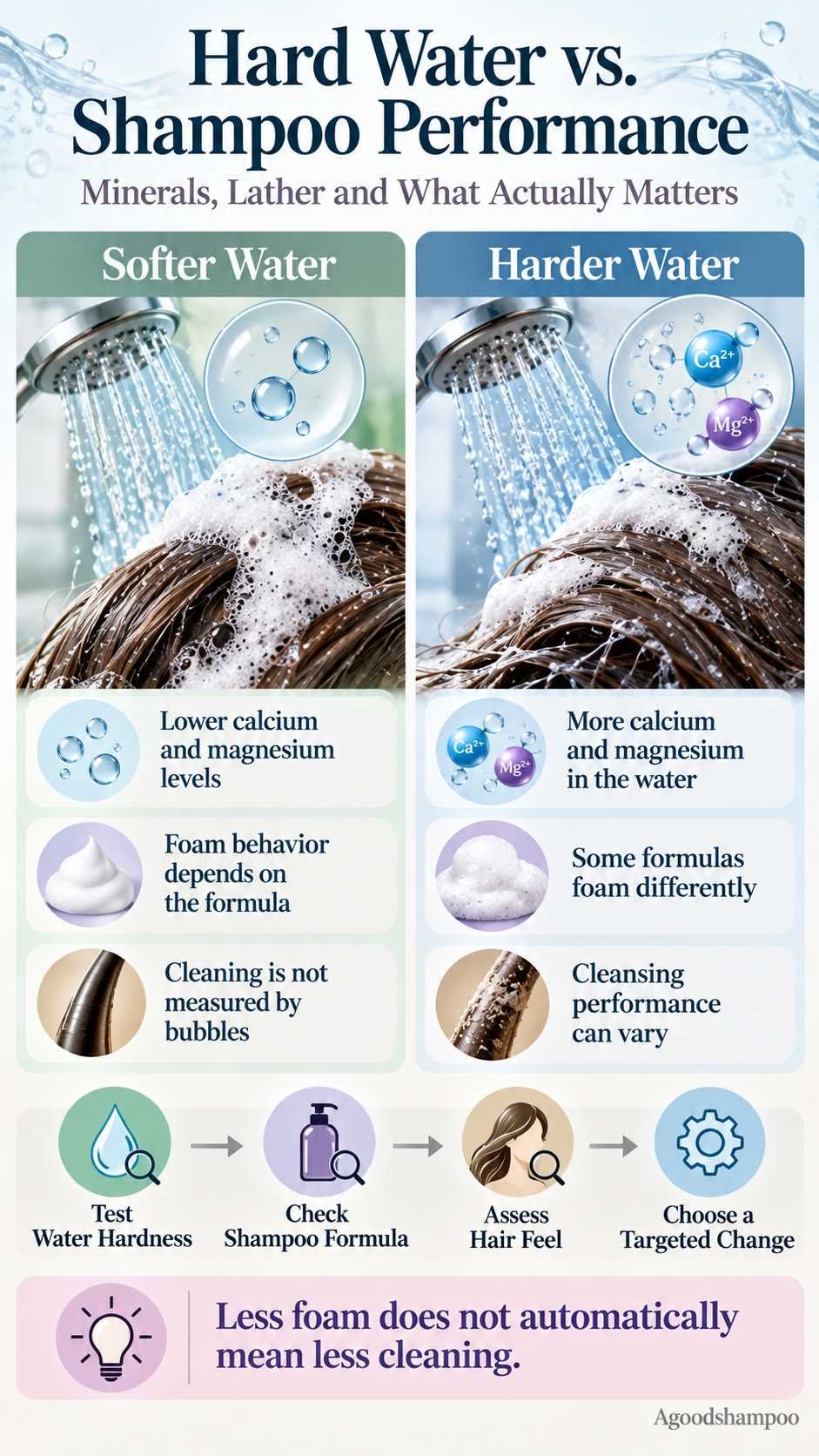
Hard water contains relatively high concentrations of dissolved calcium and magnesium. These minerals occur naturally as water passes through rocks and soil.
The United States Geological Survey classifies water hardness using milligrams per liter (mg/L) of calcium carbonate equivalent:
| Water hardness | Concentration |
|---|---|
| Soft | 0–60 mg/L |
| Moderately hard | 61–120 mg/L |
| Hard | 121–180 mg/L |
| Very hard | Above 180 mg/L |
These measurements describe the water, not how much mineral residue is present on your hair.
How Minerals Interact With Cleansing Ingredients
Shampoos contain surfactants, which are ingredients that help water interact with oils, dirt and other materials so they can be rinsed away.
Calcium and magnesium can interfere with certain surfactants. Traditional soap, for example, readily reacts with these minerals to form poorly soluble deposits commonly called soap scum.
Modern shampoos are different.
Most use synthetic detergent surfactants, including ingredients such as sodium laureth sulfate, sodium lauryl sulfate, amphoteric surfactants or other cleansing agents.
These do not all behave like traditional soap. Their response to hard water depends on their chemistry and the complete formulation.
A shampoo may also contain ingredients that help manage dissolved minerals and maintain acceptable performance during washing.
That is why two shampoos can behave differently in the same shower.
Less Lather Doesn’t Always Mean Less Cleaning
Foam is easy to notice, so people often use it to judge shampoo performance.
But foam volume and cleansing effectiveness are not identical.
A shampoo can produce relatively little foam while still removing oil and residue effectively. Conversely, a shampoo that creates abundant bubbles is not automatically better at cleaning hair.
Laboratory research published in Cosmetics in 2025 found that water hardness affected foam stability in the cleansing systems tested. The results help explain why water chemistry can change the washing experience, but they do not establish that every shampoo loses cleaning effectiveness in hard water.
Three separate properties matter:
- Foaming: How much lather forms and how long it lasts.
- Cleansing: How effectively the formulation removes oil and unwanted residue.
- Conditioning: How the hair feels during rinsing and after drying.
A change in one does not prove a change in the others.
If your shampoo produces fewer bubbles but your scalp feels comfortable and your hair cleans normally, you may not need to change anything.
How to Check Whether Hard Water Is Affecting Your Wash
Hair that feels rough, coated or difficult to manage does not automatically indicate hard water.
Conditioner residue, heavy styling products, damaged hair and incomplete rinsing can produce similar complaints.
A more reliable approach is to check the water before blaming the shampoo.
1. Check Your Water Hardness
Look for a published water-quality report from your local supplier. If hardness information is unavailable, use a suitable hardness test designed to measure calcium and magnesium.
Test strips can provide an approximate reading. More comprehensive tests may offer greater precision.
A bathroom tap with white mineral scaling is another clue, but visible scaling alone cannot establish the exact hardness level.
2. Compare Shampoo Performance
Notice whether the same shampoo behaves differently when you travel or wash in a location with confirmed softer water.
Keep the amount of shampoo and other hair products reasonably consistent.
This comparison may reveal a pattern, although differences in shower pressure, temperature and washing technique can also influence the result.
3. Check for Other Residue
Hair that feels heavy or waxy may have accumulated styling products or conditioning ingredients.
Mineral deposition and cosmetic product buildup are different problems, even though they can produce overlapping sensations.
A guide to what clarifying shampoo removes can help explain when a deeper cleanse is useful.
4. Observe the Hair After Drying
Notice whether the roots are clean, whether the ends feel rough and whether the problem continues after a thorough rinse.
Those observations are useful, but hair texture alone cannot confirm mineral buildup.
Which Shampoo Ingredients Matter in Hard Water?
The complete shampoo formula matters more than a single label such as sulfate-free, natural or deep cleansing.
Several ingredient groups are worth understanding.
| Ingredient or product type | Relevant function |
|---|---|
| Cleansing surfactants | Remove oils and residue; hard-water tolerance varies |
| Chelating agents | Bind metal ions and help manage mineral interactions |
| Conditioning ingredients | Improve softness and combability without necessarily removing minerals |
| Clarifying shampoos | Target oil and cosmetic residue; mineral-removal ability varies |
| Chelating shampoos | Formulated to help address mineral deposits |
Why Chelating Ingredients Matter
Chelating agents bind dissolved metal ions. Common cosmetic examples include disodium EDTA and tetrasodium EDTA.
These ingredients can help reduce undesirable interactions between minerals and other ingredients in a formula.
However, the presence of EDTA does not automatically prove that a shampoo removes substantial amounts of mineral deposits from hair. Concentration, formula design, contact time and directions for use also matter.
Citric acid may help adjust product pH and can contribute to formulation stability or mineral management, but its presence alone does not make a shampoo an effective chelating treatment.
Is Sulfate-Free Shampoo Better for Hard Water?
Not necessarily.
Sulfate-free simply describes the absence of certain sulfate surfactants. It does not establish how well the finished shampoo will work with calcium and magnesium.
Some sulfate-free formulas perform well in hard water. Some sulfate-containing formulas do too.
Choose according to the complete product’s intended use, your scalp’s tolerance and your hair’s conditioning needs rather than assuming either label guarantees better results.
What to Change Before Buying a New Shampoo
If your water is confirmed to be hard and washing results are unsatisfactory, begin with modest adjustments.
First, wet your hair thoroughly. Apply your normal amount of shampoo mainly to the scalp. Massage gently and rinse carefully. Avoid increasing the quantity simply because the foam looks smaller.
Second, review your other products. Heavy leave-in creams, oils and styling products may explain a coated feeling independently of water hardness. If cosmetic residue is the suspected problem, an appropriately formulated clarifier may help. Our guide to clarifying shampoo for product buildup explores this different cleansing need.
Third, consider targeted chelating care. If hardness is confirmed and mineral residue is a plausible contributor, a shampoo specifically formulated and labeled for mineral removal may be worth trying according to its instructions.
Use additional caution with bleached, color-treated, very dry or fragile hair. Repeated intensive cleansing can make already vulnerable lengths harder to manage.
Fourth, condition appropriately. Apply conditioner to the lengths that need it. Conditioning can improve surface smoothness and reduce friction, although it does not necessarily remove mineral deposits.
If shampoo results remain inconsistent, consider why your shampoo and conditioner combination may not work before replacing both products.
When Water Treatment Makes More Sense
A shampoo adjustment cannot change the mineral concentration of all the water entering your home.
If testing confirms very hard water and you also experience persistent scale on fixtures or appliances, a properly selected water-softening system may be worth evaluating.
Conventional ion-exchange softeners reduce hardness by replacing calcium and magnesium ions with other ions, commonly sodium or potassium.
Ordinary shower filters are not necessarily equivalent.
For example, NSF/ANSI 177 certification concerns reduction of free available chlorine in shower water. It does not, by itself, certify hardness removal.
If a product claims to soften shower water, check whether its performance against calcium and magnesium has been independently verified. A filter cartridge advertised for better-feeling hair is not sufficient evidence.
For hair that remains rough despite reasonable cleansing and conditioning, review whether the issue could instead be chemical damage, heat exposure or another hair-care concern. Our guide to shampoo choices for dry, damaged hair explains how those needs differ.
Choose the Fix That Matches Your Water and Hair
Hard water can change shampoo behavior, but it does not make every shampoo ineffective.
If your water tests hard and your hair feels coated, look for a plausible mineral-related problem and consider targeted chelating care. If the concern is oily or styling-product residue, clarifying may be more appropriate. If your hair simply feels dry after washing, review conditioning and existing damage rather than assuming minerals are responsible.
And if your shampoo makes less foam but still cleans comfortably, no correction may be necessary.
Test the water, identify the actual problem, and choose the smallest change that addresses it.

Michael Chen focuses on the science behind shampoos and hair-care ingredients. He explains how cleansing agents, silicones, proteins, and other formula components work, separating useful evidence from marketing claims to help readers better understand the products they use.