 A new shampoo might seem like a small change, but a sensitive scalp can react to ingredients that previously caused no problems. If your scalp is prone to itching, tightness, or redness, the safest practical approach is to review the formula, introduce the shampoo cautiously, and pay attention to how your scalp responds.
You don’t need to replace your entire hair-care routine at once. Keeping other products consistent makes it easier to notice whether the new shampoo is associated with discomfort.
Most importantly, don’t assume that burning or persistent itching is something your scalp needs to get used to. A shampoo should cleanse without causing ongoing irritation.
Before You Try a New Shampoo, Check These Things
Start with the ingredient list, especially if you already know which products bother your scalp.
Fragrance is worth checking first. Fragrance ingredients can cause allergic contact dermatitis in susceptible people. If scented products regularly cause problems, choosing a fragrance-free shampoo may be a sensible starting point.
Certain preservatives can also trigger allergies in some individuals. Methylisothiazolinone and methylchloroisothiazolinone are examples of preservatives associated with contact allergy. Their presence does not mean everyone will react, and ingredient restrictions vary by product type and market.
Cleansing ingredients can sometimes cause irritation without an allergic reaction. That is why a product marketed as natural, sulfate-free, or hypoallergenic is not automatically suitable for every sensitive scalp.
Our guide to fragrance-free shampoos for sensitive hair and scalps can help you explore this product category.
Check your scalp’s current condition, too. If you already have a painful, inflamed, or unusually irritated scalp, introducing another cosmetic product may make it harder to identify what is causing the problem.
If you have a diagnosed scalp condition or a known ingredient allergy, follow the advice of your dermatologist when selecting a replacement.
Should You Patch Test a New Shampoo?
You may have seen advice to leave shampoo on a small patch of skin for 24 or 48 hours before using it. That is not an appropriate general instruction for ordinary rinse-off shampoo.
Shampoo is formulated to be washed away. Leaving undiluted shampoo on the skin for prolonged periods can itself cause irritation, even without an allergy.
The American Academy of Dermatology provides general guidance on checking new skin-care products at home, including using rinse-off cleansers only for their intended contact time and rinsing them away. However, an at-home product check cannot guarantee that a shampoo will never cause a reaction.
A cautious first use on a limited area, following the product’s directions, may help you notice immediate discomfort. It cannot reliably rule out delayed allergic contact dermatitis.
Medical patch testing is different. Dermatologists use standardized testing procedures to investigate suspected contact allergies. The process may involve allergens applied for approximately 48 hours, followed by later readings.
If you’ve previously experienced substantial swelling, blistering, or a serious reaction to hair products, ask a dermatologist for guidance rather than experimenting with the suspected product at home.
How to Use Your New Shampoo for the First Time
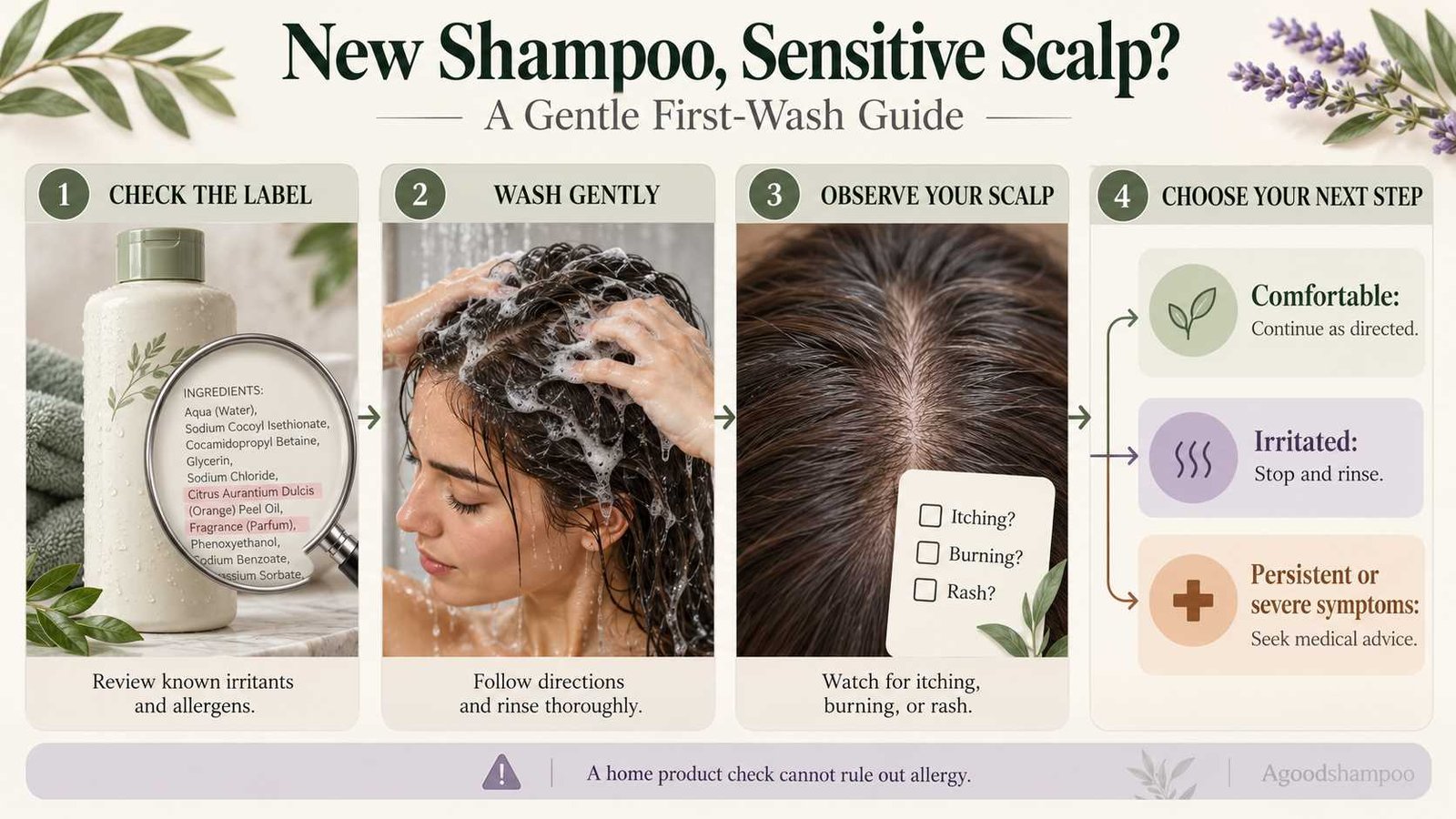 You don’t need a complicated routine. The goal is to introduce one change while minimizing unnecessary friction and product exposure.
1. Keep Other Hair Products the Same
Avoid introducing a new conditioner, scalp serum, styling spray, and shampoo simultaneously.
When several products change together, it becomes difficult to identify which one might be associated with irritation.
If you are replacing a shampoo because your current one appears to cause symptoms, stop using the suspected product rather than continuing it simply to maintain a controlled comparison.
2. Wet Your Scalp and Hair Thoroughly
Use comfortably warm water. Very hot water may worsen dryness or discomfort for some people.
Make sure your scalp is wet before applying shampoo.
3. Apply Shampoo Gently
Use an amount appropriate for your hair, scalp, and the product instructions.
Focus cleansing on the scalp rather than rubbing the entire hair length aggressively.
Massage with your fingertips instead of scratching with your nails. If the shampoo causes noticeable burning or stinging, stop using it and rinse promptly.
4. Follow the Product’s Contact-Time Instructions
Ordinary cosmetic shampoos and medicated shampoos may have different directions.
Some medicated products require a specific contact time to work as intended. Do not shorten or extend that time without appropriate guidance.
Avoid leaving regular shampoo on your scalp longer than directed in the hope of getting a deeper clean.
5. Rinse Thoroughly and Condition as Needed
Rinse your scalp carefully, including the hairline and areas behind the ears.
Apply your usual conditioner according to its directions, concentrating on the lengths if that suits your hair.
Then dry gently with a towel instead of rubbing vigorously.
A consistent washing method makes it easier to evaluate the new product.
What to Watch for After Washing
Some product reactions happen quickly, while others appear after repeated exposure or develop over the following days.
Pay attention to changes around the scalp, hairline, ears, forehead, and neck.
| What you notice | What it may suggest | Sensible next step |
|---|---|---|
| Mild dryness or tightness | Possible irritation or insufficient conditioning | Reassess the product and washing routine |
| Burning or stinging | Possible irritation | Stop using the shampoo and rinse |
| Itching with redness or rash | Possible irritation, allergy, or another scalp condition | Discontinue and seek advice if persistent |
| Rash appearing later | Possible delayed contact reaction | Stop using the suspected product and consider dermatology assessment |
| Swelling or blistering | Potentially significant reaction | Seek prompt medical assessment |
These symptoms cannot establish a diagnosis by themselves.
For example, itching after washing can have several explanations besides shampoo allergy. Product irritation, existing dermatitis, and other scalp conditions may produce similar discomfort.
A comfortable first wash is encouraging, but it does not prove that an allergic reaction cannot occur later.
If your symptoms become severe, spread significantly, or involve substantial facial swelling, seek urgent medical attention. Difficulty breathing requires emergency care.
How Often Should You Use the New Shampoo?
There is no universally correct introduction schedule for sensitive scalps.
Some people wash daily because their scalp becomes oily quickly. Others wash less often because of hair texture, styling practices, or individual scalp needs.
Start with your usual appropriate washing frequency rather than increasing washes simply to test the product.
If you normally wash every few days, there is no reason to add unnecessary shampoo sessions.
Notice how your scalp feels after each use and between washes. Look for a consistent pattern rather than judging the product from a single sensation.
Our article on daily shampoo and conditioner use explores how washing frequency can vary.
If you’re using a prescribed or medicated shampoo, its treatment schedule takes priority over general cosmetic advice.
When a Sensitive Scalp Needs More Than a Shampoo Change
Not every uncomfortable scalp needs a different shampoo.
Seborrheic dermatitis, psoriasis, eczema, and allergic contact dermatitis can all affect the scalp. Some require targeted treatment rather than a simple change in cleansing products.
Consider professional assessment if you experience recurring redness, persistent itching, painful patches, substantial scaling, or symptoms that continue despite stopping a suspected irritant.
A dermatologist may recommend examination or formal patch testing when contact allergy is suspected.
Also remember that changing shampoos frequently does not necessarily solve an underlying problem. Our guide to switching shampoos discusses considerations when changing products.
If the scalp is comfortable but your hair feels rough, flat, or difficult to manage, investigate the conditioner and overall routine rather than assuming the shampoo is causing a scalp reaction.
Deciding Whether to Keep Using the Shampoo
A new shampoo doesn’t need to produce dramatic results to be suitable. For a sensitive scalp, comfortable cleansing without persistent irritation is a meaningful outcome.
Continue using the product as directed if your scalp remains comfortable and your hair-care needs are being met.
If you develop burning, persistent itching, a new rash, or increasing discomfort, stop using it. Don’t repeatedly expose yourself to a suspected trigger simply to see whether your scalp adjusts.
When reactions recur across different products, identifying a shared ingredient or getting professional advice may be more useful than another round of trial and error.
The goal isn’t to force your scalp to tolerate a new shampoo. It’s to find a cleansing routine that works comfortably and consistently.

Marlena Stell makes everyday hair care easier to understand. From choosing a shampoo to managing common hair concerns, she breaks down confusing product claims and practical routines into straightforward advice that helps readers find what works for their needs.