 If you’re trying to work out which shampoo is good for hair loss in Singapore, the first thing to know is that the best choice depends on why your hair appears to be falling out.
A shampoo for fragile strands that snap during brushing is solving a different problem from a shampoo used for dandruff. And neither should automatically be treated as a medical solution for androgenetic alopecia, the common form of genetic pattern hair loss.
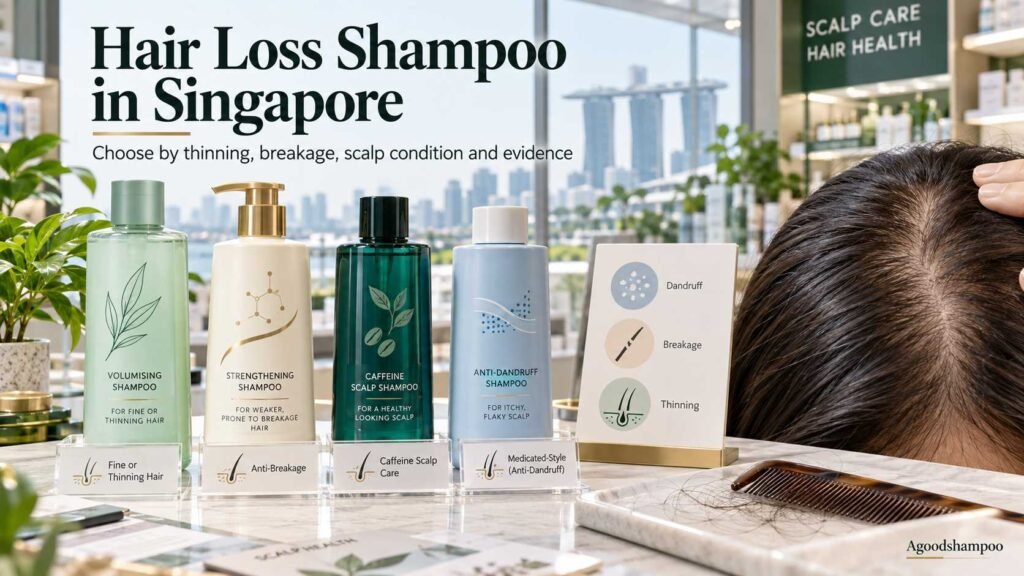
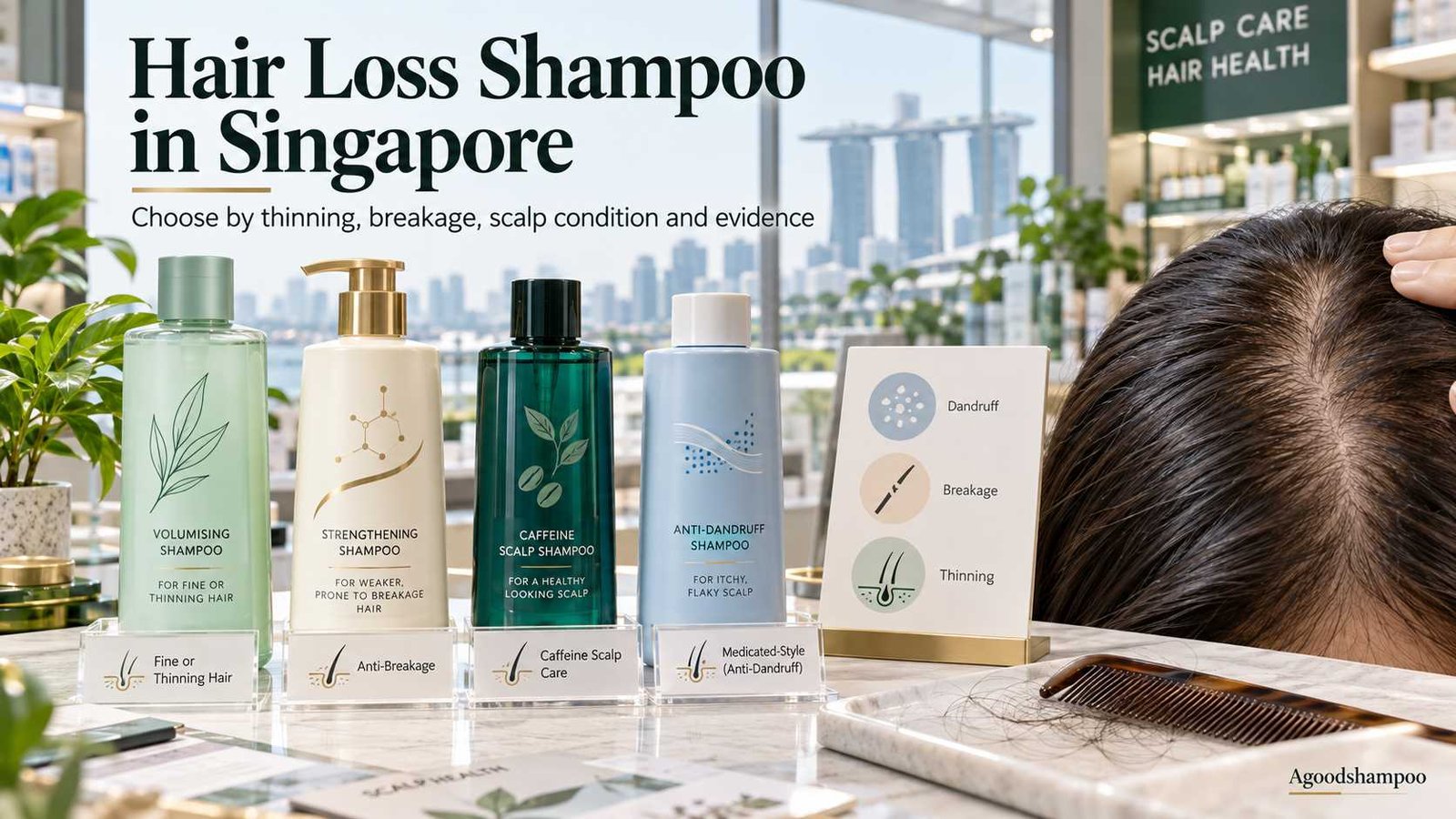
For many people, a sensible shortlist looks like this: Nioxin System 2 for natural hair with progressed thinning and scalp buildup concerns, Kérastase Genesis Bain Hydra-Fortifiant when fine or oily hair is breaking easily, and an appropriate ketoconazole shampoo when dandruff or seborrhoeic dermatitis is part of the scalp problem. Caffeine shampoos are another option worth discussing, but the evidence is not strong enough to promise regrowth.
That distinction matters because Singapore HealthHub lists many possible causes of hair loss, including genetic pattern hair loss, hormonal changes, thyroid disease, autoimmune conditions, scalp infections, medication, stress, nutritional problems and damaging hair practices.
Which Shampoo Is Good for Hair Loss in Singapore?
There isn’t one shampoo that can reasonably be called the best for every person with hair loss.
Start by matching the shampoo to what is actually happening.
| What you notice | Shampoo direction that makes the most sense | Main limitation |
|---|---|---|
| Fine hair with visible thinning and oily scalp | Nioxin System 2 or another lightweight scalp-cleansing/thickening shampoo | Fuller-looking hair is not the same as reversing follicular hair loss |
| Hair snapping during brushing or washing | Kérastase Genesis or another anti-breakage formula | Mainly addresses the hair shaft |
| Fine, fragile hair losing volume through breakage | Nexxus Unbreakable Care | Designed around breakage, not genetic baldness |
| Dandruff, scaling or seborrhoeic dermatitis with shedding | Appropriate anti-dandruff shampoo, including ketoconazole where suitable | Treats the scalp condition, not every cause of hair loss |
| Gradual thinning and interest in caffeine | Caffeine-containing shampoo may be reasonable | Clinical evidence remains limited |
| Sudden patches, rapidly worsening loss or painful/inflamed scalp | Shampoo should not be the main solution | The cause needs professional assessment |
A useful shampoo can keep the scalp clean, reduce excess oil, help manage dandruff, reduce hair-shaft breakage and make fine hair look fuller. What it generally cannot do is diagnose why follicles are shrinking or reliably reverse a medical hair-loss disorder.
Singapore HealthHub makes the same practical distinction indirectly: its hair-loss guidance recommends gentle shampoos and conditioners as part of hair-care management, while treatment options for pattern hair loss include medicines such as topical minoxidil and prescription finasteride in appropriate patients.
The Best Hair Loss Shampoos in Singapore Depend on the Problem
Nioxin System 2: A Practical Choice for Natural Hair With Progressed Thinning
Nioxin System 2 is one of the easier thinning-hair systems to find in Singapore. Watsons Singapore currently lists the System 2 Scalp + Hair Shampoo for natural, untreated hair with progressed thinning.
Its current Watsons ingredient list includes a fairly assertive cleansing system built around sodium laureth sulfate, sodium lauryl sulfate and cocamidopropyl betaine. It also contains salicylic acid, peppermint oils, niacinamide, panthenol and biotin.
That formulation tells us something important.
Nioxin System 2 makes the most sense when scalp cleansing and cosmetic fullness are priorities. The cleansing system can remove oil and buildup effectively, while the complete Nioxin regimen is positioned around improving the appearance of fuller, thicker hair.
Watsons also describes the shampoo as helping minimise breakage. Those are useful cosmetic benefits, but they shouldn’t be translated into a claim that the shampoo regenerates miniaturised follicles.
Another point worth knowing: the shampoo itself is only one part of Nioxin System 2. The Singapore kit also includes conditioner and a leave-in scalp treatment, and Watsons instructs users to apply all three as a system at least three times per week.
If your scalp is very dry or easily irritated, however, a strong cleansing shampoo may not automatically be your best choice simply because your hair looks thin.
Kérastase Genesis: Better Suited to Hair Fall From Breakage
Kérastase Genesis Bain Hydra-Fortifiant is a stronger match when the problem is weak, fine or oily hair that breaks during washing, brushing or styling.
Kérastase describes Bain Hydra-Fortifiant as a fortifying shampoo for weakened hair prone to falling because of breakage. The company specifically positions this version for fine or oily hair.
Its current formula includes sodium laureth sulfate and cocamidopropyl betaine as major cleansing ingredients, together with conditioning polymer Polyquaternium-10, glycerin, salicylic acid, ginger root extract and edelweiss callus culture extract.
This is where marketing language needs careful reading.
Kérastase reports substantial reductions in breakage when Genesis products are used as a system, but its testing concerns broken hair mass and hair fall due to breakage. That is not the same endpoint as growing new hairs from follicles affected by androgenetic alopecia.
So which Kérastase shampoo is good for hair loss?
If you have fine or oily hair that is weakened and snapping easily, Bain Hydra-Fortifiant is the clearer fit. Kérastase says Bain Nutri-Fortifiant is intended for thicker or drier weakened hair.
For a deeper comparison of the range, see our guide to which Kérastase shampoo is good for hair loss.
Nexxus Unbreakable Care: Useful When “Hair Loss” Is Really Breakage
The question “Which Nexxus shampoo is good for hair loss?” needs the same distinction.
Nexxus Unbreakable Care Anti-Breakage Shampoo is the most relevant Nexxus option for fine, thin and breakage-prone hair.
Nexxus describes it as a sulfate-free, silicone-free and paraben-free shampoo designed to cleanse fine hair while protecting it from breakage and creating fuller-looking hair. Its current ingredient list includes cocamidopropyl betaine, sodium methyl cocoyl taurate, glycerin, keratin, hydrolysed keratin, biotin, collagen amino acids, arginine and conditioning ingredients.
The brand also states that its Unbreakable Care shampoo and conditioner can reduce hair fall due to breakage compared with a non-conditioning shampoo.
The important phrase is due to breakage.
If complete hairs are shedding from their follicles because of genetics, hormones, illness or telogen effluvium, an anti-breakage shampoo does not address the underlying trigger.
If your concern is fragile fine hair leaving short broken pieces on your brush, however, the formulation is much more relevant.
You can read our separate analysis of whether Nexxus shampoo is good for hair loss.
Hair Loss, Hair Fall and Breakage Are Not the Same Problem
This is probably the most useful distinction to make before spending money on another shampoo.
Hair breakage happens along the hair shaft. The strand may snap because it is weakened by heat, bleaching, chemical treatments, repeated brushing, tight styling or ordinary mechanical wear.
A strengthening shampoo and conditioner may help here because reducing friction, improving conditioning and protecting weakened fibers can result in fewer broken hairs.
Hair shedding means a complete hair separates from the follicle as part of its growth cycle or because the cycle has been disrupted. Singapore HealthHub estimates that people normally shed roughly 50 to 150 hairs a day, although simply counting strands is not a reliable way to diagnose a hair-loss disorder.
Androgenetic alopecia, or male and female pattern hair loss, involves progressive changes at the follicle. Shampoo can clean the scalp and improve how the remaining hair looks, but cosmetic improvements such as extra volume or reduced breakage should not be presented as evidence that follicular miniaturisation has been reversed.
This is why claims such as “97% less hair fall” need context. If the testing measured breakage, it tells you about stronger hair fibers. It does not automatically tell you anything about new follicle growth.
Our separate guide to shampoo for hair loss prevention goes further into what shampoo can realistically prevent and where its limits begin.
Which Ingredients Actually Deserve Attention?
Hair-loss shampoos often contain long lists of botanical extracts, vitamins, proteins and scalp stimulants. An impressive ingredient list is not the same as clinical proof.
Here’s how several common ingredients deserve to be interpreted.
| Ingredient or ingredient group | What it may reasonably do | What the evidence does not automatically prove |
|---|---|---|
| Caffeine | Has biological activity and has been studied in topical hair-loss preparations | That every caffeine shampoo regrows hair |
| Ketoconazole | Treats dandruff and seborrhoeic dermatitis; may have an adjunct role in androgenetic alopecia | That it replaces established hair-loss treatment |
| Keratin and hydrolysed proteins | Can support conditioning and strengthen fragile hair fibers | New follicle growth |
| Biotin in shampoo | Can be part of a conditioning or marketing formulation | Hair regrowth in people without biotin deficiency |
| Salicylic acid | Helps loosen scalp buildup and scale | Treatment of genetic hair loss |
| Conditioning polymers and fatty conditioners | Reduce friction and improve manageability | Increased follicle density |
Caffeine Is Interesting, but the Evidence Needs Perspective
Caffeine is probably the most heavily marketed “hair-growth” ingredient in ordinary shampoos.
There is enough research to make it more than a purely decorative ingredient, but not enough to treat every caffeine shampoo as proven therapy.
A 2025 systematic review examined clinical trials of topical caffeine preparations for hair loss. Nine studies involving 684 participants met the review criteria. All reported results favouring topical caffeine, but the researchers rated the evidence as medium quality in only three studies, low in one and very low in five. Common weaknesses included poor randomisation, absent placebo or control groups and unclear caffeine concentrations.
There is another limitation: the review looked at topical caffeine preparations as a group, not every shampoo sold in Singapore. Exposure time, concentration, formula design and whether a product is rinsed off or left on can all matter.
So a caffeine shampoo may be reasonable for someone who understands those limitations. It should not be your only strategy if you have progressive pattern hair loss.
For a product-specific example, see our breakdown of whether Alpecin Caffeine Shampoo is any good.
Biotin Is Often More Important as a Deficiency Issue Than a Shampoo Claim
Biotin appears in many shampoos marketed for thinning hair, including current formulas from Nioxin and Nexxus.
Its presence does not establish that the shampoo treats hair loss.
Singapore HealthHub specifically notes that biotin supplementation may help if a person has a biotin deficiency, but it has no proven hair-growth efficacy in healthy people simply because they take more of it.
A rinse-off shampoo containing biotin deserves even more modest expectations.
Proteins Are More Relevant to Breakage Than Follicular Regrowth
Keratin, hydrolysed keratin, collagen amino acids and related protein-derived ingredients can make sense in products designed for fragile hair.
Their strongest practical role is generally at the hair-fiber level. They may contribute to improved feel, reduced breakage or better manageability depending on the formulation.
That can result in more hair remaining on your head because fewer strands snap. It still isn’t the same biological process as generating new hair from an inactive or miniaturised follicle.
Which Shampoo Is Good for Hair Loss and Dandruff?
If dandruff, itching or seborrhoeic dermatitis accompanies the shedding, treating the scalp condition becomes more important than buying a general “anti-hair-loss” shampoo.
Singapore HealthHub states that topical ketoconazole is used to treat fungal skin conditions and seborrhoeic dermatitis, and that ketoconazole shampoo is used for dandruff and seborrhoeic dermatitis.
For someone with obvious dandruff, greasy scaling or an itchy seborrhoeic scalp, that is a much clearer reason to consider ketoconazole shampoo than an unproven promise of regrowth.
There is, however, an interesting hair-loss angle.
A systematic review of topical ketoconazole and androgenetic alopecia included five human studies with a combined 318 participants, plus two animal studies. Human research reported changes including increased hair shaft diameter and improvements in some assessments. The researchers described ketoconazole as a promising adjunct or alternative, but also concluded that randomised controlled trials were still needed.
That is useful preliminary evidence, not permission to call ketoconazole shampoo a proven replacement for minoxidil or other established approaches.
If your main concern is dandruff rather than pattern thinning, our guide to choosing a natural shampoo for dandruff also explains when gentler cosmetic approaches may be enough and when medicated ingredients deserve consideration.
What About Conditioner When Hair Is Thinning?
The best conditioner for hair loss is not a conditioner that promises to “activate follicles.” Look instead for one that reduces the mechanical damage happening to the hair you already have.
Conditioner lubricates the hair surface, improves detangling and reduces friction. That matters if your strands are fragile, chemically processed, long, fine or prone to knotting.
For fine thinning hair, very heavy conditioning can sometimes leave hair looking flatter, so a lightweight formula used mainly through the mid-lengths and ends is often easier to manage.
For breakage-prone hair, matching shampoo and conditioner can make more sense than using a strengthening shampoo alone. Nexxus, for example, positions its Unbreakable Care shampoo together with a thickening conditioner, while Kérastase pairs Genesis shampoos with its reinforcing conditioner as part of the breakage-focused system.
What conditioner cannot do is diagnose or reverse an underlying hormonal, autoimmune, thyroid-related or genetic cause of hair loss.
How Often Should You Wash Thinning Hair in Singapore?
There is no universal rule that people with hair loss should wash less often.
If you have an oily scalp, heavy sweating, frequent product use or dandruff, allowing oil and buildup to accumulate simply because you are afraid of seeing shed hairs in the shower may make scalp care harder.
Washing usually reveals hairs that were already ready to shed. It does not necessarily mean shampoo caused those hairs to enter the shedding phase.
The right frequency depends on scalp oiliness, shampoo strength, hair texture and whether you are using a medicated treatment.
A stronger cleanser such as Nioxin System 2 may be useful for oily buildup but could feel excessive for a very dry or sensitive scalp. Kérastase says its Bain Hydra-Fortifiant is gentle enough for daily use on thin or oily hair, though that is manufacturer guidance rather than proof that everyone needs daily shampooing.
Medicated shampoos should be used according to their label or professional instructions rather than treated like ordinary everyday cleansers.
When Changing Shampoo Is Not Enough
Sometimes the smartest shampoo recommendation is to stop treating shampoo as the main answer.
Singapore HealthHub advises medical assessment for several situations, including sudden or severe unexplained hair loss, patchy loss, changes associated with medical conditions or treatment, and scalp symptoms such as redness, infection, significant itching, pain, scaling or broken skin.
That matters because shampoo cannot tell you whether your shedding is connected to androgenetic alopecia, thyroid disease, alopecia areata, medication, nutritional deficiency, hormonal changes or another cause.
For pattern hair loss, evidence-based treatments operate very differently from shampoo.
Topical minoxidil, for example, is a leave-on scalp medication used to promote hair growth and slow balding. Singapore HealthHub states that hair growth is usually observed after at least three to six months and that benefit lasts only while treatment continues.
That comparison is useful because it sets expectations. A shampoo that touches the scalp for a few minutes before being rinsed away should not casually be given the same status as a medication designed to remain on the scalp.
Which Shampoo Makes the Most Sense for Your Hair Loss?
For most people in Singapore, the best shampoo choice comes down to identifying the problem rather than finding the bottle with the strongest hair-growth wording.
If you have natural, untreated hair with progressed thinning and an oily or buildup-prone scalp, Nioxin System 2 is a reasonable cosmetic option that is currently available through Watsons Singapore. Its strengths are scalp cleansing, breakage support and fuller-looking hair.
If your fine or oily hair is weakened and breaking during brushing, Kérastase Genesis Bain Hydra-Fortifiant is more precisely targeted to that problem. Kérastase itself frames it around strengthening hair and reducing hair fall caused by breakage.
If you want a Nexxus shampoo for fine, fragile hair, Unbreakable Care is the clearest fit, but again, its strongest claim is reducing hair fall caused by breakage, not treating follicular alopecia.
If you have dandruff or seborrhoeic dermatitis together with shedding, an appropriate anti-dandruff shampoo such as ketoconazole may make more sense than a cosmetic thickening shampoo because it addresses the scalp condition itself.
Caffeine shampoo is the more uncertain middle ground. Clinical research is encouraging enough to justify interest, but the evidence is not yet strong or consistent enough to guarantee regrowth from a particular rinse-off shampoo.
And if the thinning is progressive, sudden, patchy or accompanied by scalp inflammation, changing shampoo should not be the end of the investigation.
The best shampoo can protect the hair you have, make the scalp easier to manage and reduce avoidable breakage. The cause of genuine hair loss still determines what happens next.

Michael Chen focuses on the science behind shampoos and hair-care ingredients. He explains how cleansing agents, silicones, proteins, and other formula components work, separating useful evidence from marketing claims to help readers better understand the products they use.