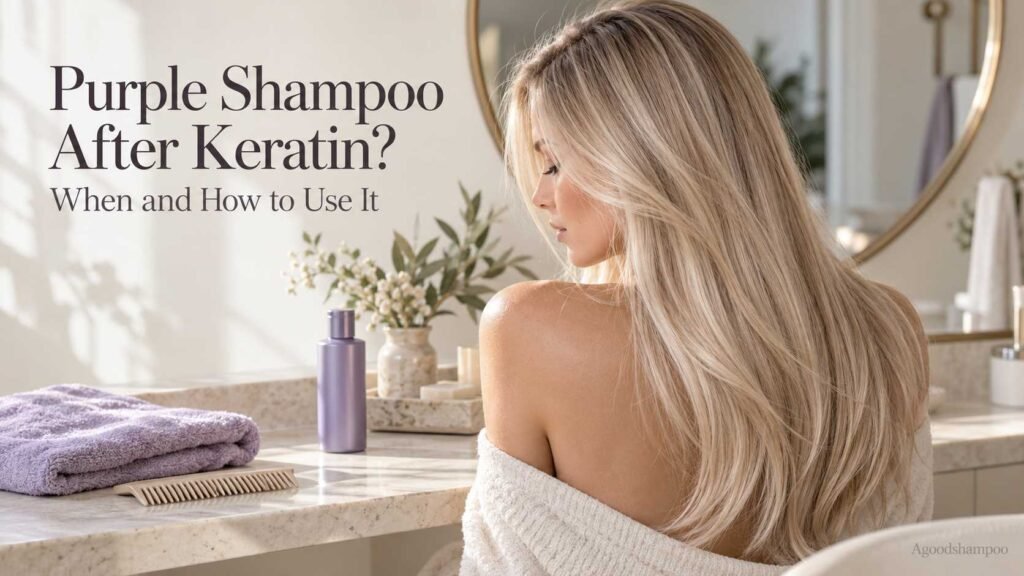
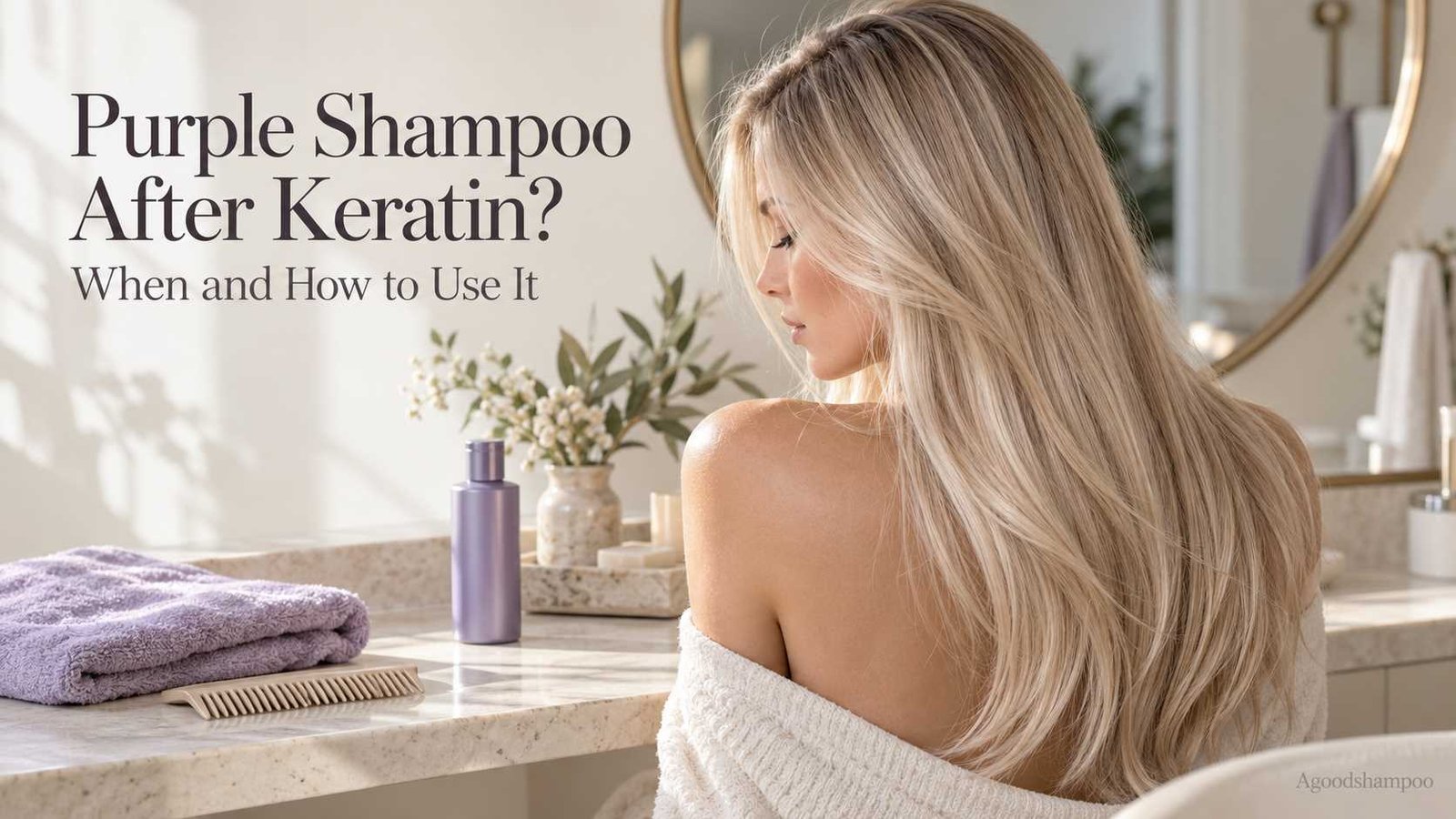
 Yes, you can use purple shampoo after a keratin treatment, provided your smoothing treatment allows shampooing and the purple shampoo is compatible with its aftercare requirements.
The important part is timing. Some professional keratin systems require a waiting period before the first wash, while others allow washing much sooner. There is no universal rule that everyone must wait 72 hours, one week, or two weeks before introducing purple shampoo.
If your blonde, highlighted, silver, or gray hair has developed unwanted yellow tones, purple shampoo can help restore a cooler appearance. But it does not maintain or replace the smoothing treatment itself.
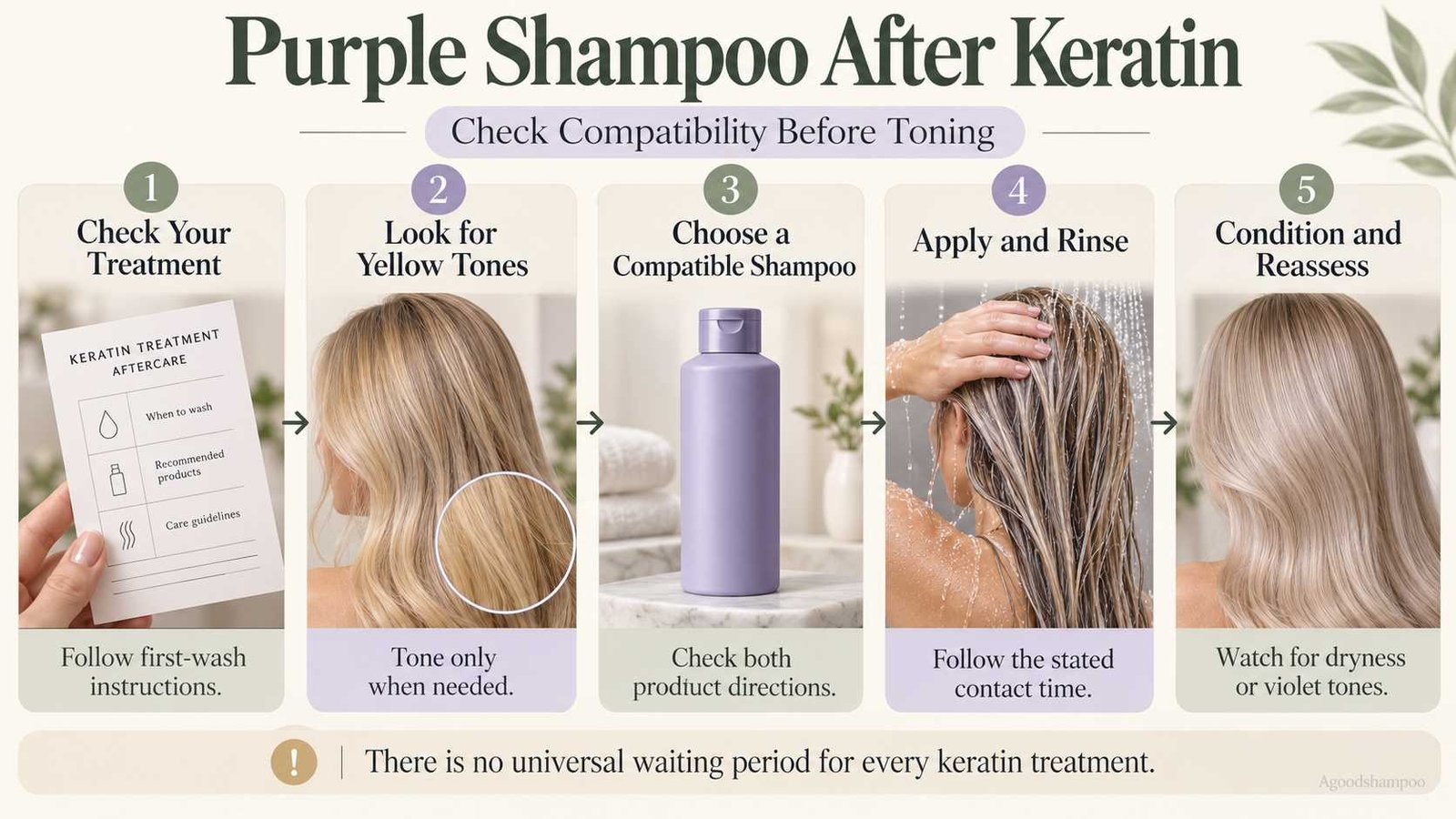
The safest approach is to follow your specific keratin treatment’s instructions first, then introduce a suitable purple shampoo only when toning is necessary.
Why Purple Shampoo and Keratin Treatments Can Work Together
Purple shampoo and keratin smoothing treatments perform two different cosmetic functions.
A professional keratin smoothing service is designed to reduce frizz, make hair more manageable, or create a straighter appearance. The exact results and aftercare requirements depend on the chemicals, application technique, and heat-processing method involved.
Purple shampoo, meanwhile, is a color-maintenance product. It contains violet pigments that help counteract the appearance of unwanted yellow tones in light-colored hair.
Violet and yellow are opposite each other on the color wheel. When violet pigments deposit on pale blonde, white, or gray hair, they can make yellow warmth less noticeable.
This is an optical color-correction effect, not another bleaching process.
Purple shampoo does not permanently lighten hair, rebuild damaged strands, or renew a keratin treatment.
That distinction matters because some people assume a purple shampoo containing the word keratin must be suitable after professional smoothing. A formula containing hydrolyzed keratin or other conditioning proteins is not automatically approved for use after a salon smoothing service.
You can explore the color-correction process further in our guide to why purple shampoo is good for blonde hair.
The two treatments can fit into the same routine, but compatibility depends on the actual products rather than their names.
How Long Should You Wait After a Keratin Treatment?
Wait until your particular smoothing system permits shampooing, then check whether the chosen purple shampoo is appropriate for that system.
Some salon smoothing treatments have a first-wash restriction. Others are designed for washing on the same day or shortly after the service.
A frequently repeated recommendation is to wait 72 hours. Although that period applies to certain treatments, it should not be treated as a universal requirement.
Similarly, a professional hair-care brand may recommend waiting longer before using a toning shampoo. That recommendation should be interpreted in the context of the manufacturer’s products and instructions.
| Situation | Recommended action |
|---|---|
| Treatment was completed today | Follow the salon’s specific first-wash directions |
| You’re still within a required no-wash period | Do not use purple shampoo yet |
| Your treatment allows washing immediately | Confirm purple shampoo compatibility before using it |
| The required waiting period has ended | Introduce a compatible toner when yellow tones need correction |
| You don’t know which keratin treatment was used | Ask your stylist for the product name and aftercare instructions |
| Your hair is already a satisfactory cool blonde | Continue your normal routine; toning may be unnecessary |
If you have recently had both highlighting and keratin smoothing, your stylist may also have given instructions related to the color service.
Follow both sets of directions rather than relying on a general online waiting period.
Does the type of keratin treatment matter?
Yes.
Products sold as Brazilian keratin treatments, smoothing systems, and straightening treatments can differ considerably in ingredients, processing methods, and aftercare.
Some products marketed as keratin treatments primarily aim to reduce frizz, while others produce a stronger straightening effect.
Because the chemistry varies, advice for one system should not automatically be applied to another.
If your stylist cannot identify the exact treatment, avoid experimenting with a strong toning shampoo immediately after the service.
Can Purple Shampoo Make Keratin Results Fade Faster?
Purple pigment itself is not established as an ingredient that automatically destroys keratin smoothing results.
However, purple shampoos are still shampoos. They contain surfactants that cleanse the hair, and their formulas can differ in cleansing strength, conditioning performance, and compatibility with salon treatments.
Repeated washing with a product unsuitable for your treatment may affect how your hair looks and feels over time.
Three factors deserve attention.
The complete shampoo formula: A strongly cleansing product may leave already processed hair feeling rough or dry. A gentler formula may be easier to incorporate into a maintenance routine.
Your smoothing treatment’s aftercare rules: Some manufacturers recommend particular cleansers or restrict certain ingredients. These instructions are more relevant than a generic label claiming that a shampoo is safe for keratin.
How frequently you wash: Every wash exposes the hair to water, cleansing ingredients, and mechanical handling. Unnecessary extra washing may add wear without providing additional color benefits.
Does purple shampoo need to be sulfate-free?
Not universally.
Sulfate-free shampoos are often recommended for color-treated or smoothed hair, but the absence of sulfates does not guarantee that a shampoo is gentle or compatible with every keratin system.
Likewise, the presence of a sulfate surfactant does not establish that a product will immediately remove a smoothing treatment.
Compatibility depends on the complete formulation and the treatment manufacturer’s instructions.
For a specific example, Olaplex states that its Nº.4P Blonde Enhancer Purple Toning Shampoo is compatible with keratin and smoothing treatments. That is a manufacturer statement about that product, not evidence that every purple shampoo has identical compatibility.
How to Use Purple Shampoo on Keratin-Treated Hair
Once your smoothing treatment allows shampooing and you’ve confirmed product compatibility, begin conservatively.
- Check your hair color before washing. Look for unwanted yellow warmth in the blonde, highlighted, gray, or silver sections. If the tone already looks right, purple shampoo may not be necessary.
- Wet your hair thoroughly. Use comfortably warm water rather than very hot water, particularly if your hair is dry or your scalp is sensitive.
- Apply the purple shampoo as directed. Distribute it carefully, paying attention to the sections that need toning. Avoid aggressively rubbing processed or fragile lengths.
- Follow the product’s contact time. Don’t leave the shampoo on longer simply because you want a stronger result. Olaplex, for example, recommends one to three minutes for its Nº.4P formula, but other products have different instructions.
- Rinse completely. Remove the shampoo thoroughly, especially from very light or porous sections where violet color may appear uneven.
- Condition appropriately. Use a conditioner compatible with your smoothing treatment, concentrating on the lengths and ends where needed.
- Assess the result after drying. Check whether the yellow tone has improved and whether your hair still feels manageable.
For the first use after a smoothing treatment, a conservative application is preferable to attempting dramatic color correction in one wash.
If your hair is heavily highlighted, review our guide to purple shampoo for blonde highlights for more information about how lighter sections respond to violet toning.
How Often Should You Use Purple Shampoo?
There is no single frequency that suits every person with keratin-treated hair.
Purple shampoo is most useful when unwanted yellow warmth becomes visible. It is not necessarily required at every wash.
For example, someone with pale platinum hair may notice yellow tones more readily than someone with warmer honey-blonde highlights. The amount of toning needed will therefore differ.
Hair porosity also matters. Highly processed or bleached sections may take on violet pigment unevenly, particularly when the product is concentrated or left on for too long.
Use your regular compatible shampoo for routine cleansing and introduce purple shampoo when the color needs correcting.
If the hair begins looking excessively cool, grayish, dull, or violet, reduce or pause toning.
More frequent applications are not automatically more effective.
What If Your Hair Turns Purple or Feels Dry?
Two common problems after using purple shampoo are unwanted violet tones and increased roughness.
If your hair develops a lavender or grayish cast
This can happen when violet pigment deposits more strongly than intended, particularly on very pale or porous hair.
Stop using the purple shampoo temporarily.
Continue with a gentle cleanser that is compatible with your smoothing treatment. Some temporary toning pigment may gradually diminish with subsequent washing, although the result depends on the product and the hair’s condition.
Avoid immediately using aggressive clarifying treatments, repeated shampoo applications, or untested home remedies to force the color out.
If the unwanted tone persists or appears very uneven, seek professional color correction.
If your hair feels rough or unusually dry
First consider whether the purple shampoo is more cleansing than your usual formula or whether your hair is already vulnerable from bleaching and heat processing.
Reduce the frequency of toning, use an appropriate conditioner, and handle wet hair gently.
Dryness following a purple shampoo application does not, by itself, prove that the keratin treatment has been stripped away.
If your scalp becomes irritated, stop using the product. Persistent burning, redness, or significant itching should be evaluated by a healthcare professional.
How to Protect Your Blonde Color and Smoothing Results
The best aftercare routine protects both your desired hair color and the manageability achieved through smoothing.
Keep these priorities in mind:
- Follow the exact washing and maintenance instructions for your keratin treatment.
- Choose a regular shampoo suitable for your scalp and compatible with the smoothing system.
- Use purple shampoo only when unwanted yellow tones justify it.
- Respect the toning product’s contact time.
- Condition the lengths regularly and avoid unnecessary aggressive cleansing.
- Minimize excessive styling heat, especially on previously bleached hair.
If your main concern is strong orange or copper warmth rather than pale yellow, purple shampoo may not provide the correction you want. A different toning approach may be necessary.
A separate safety consideration also matters when choosing professional smoothing services. The U.S. Food and Drug Administration warns that some hair-smoothing products contain or release formaldehyde when heated. This concern relates to the smoothing treatment and its application, not to ordinary purple-shampoo use. Ask your salon about the ingredients and safety precautions used for your service.
Ultimately, you don’t have to choose between keeping your hair smooth and maintaining a cooler blonde.
Wait until your specific keratin treatment allows washing, select a compatible purple shampoo, and tone only when your color needs it. That approach avoids unnecessary cleansing while respecting both your smoothing results and the condition of your hair.

Carolina Herrera writes about color-treated, damaged, and chemically processed hair. She focuses on understanding breakage, choosing suitable shampoos, and making sense of repair claims. Her goal is to help readers care for their hair with realistic expectations and informed product choices.