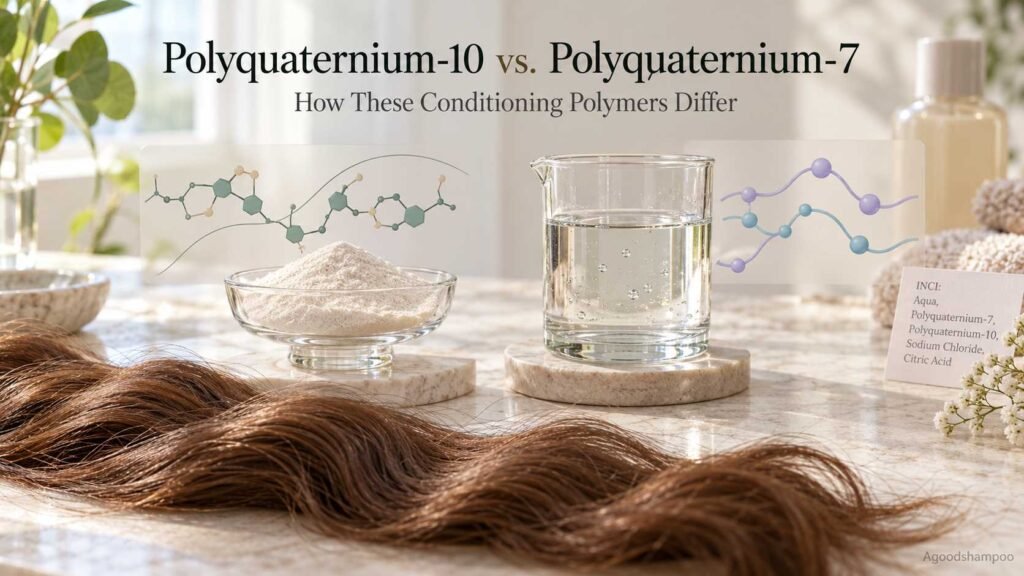
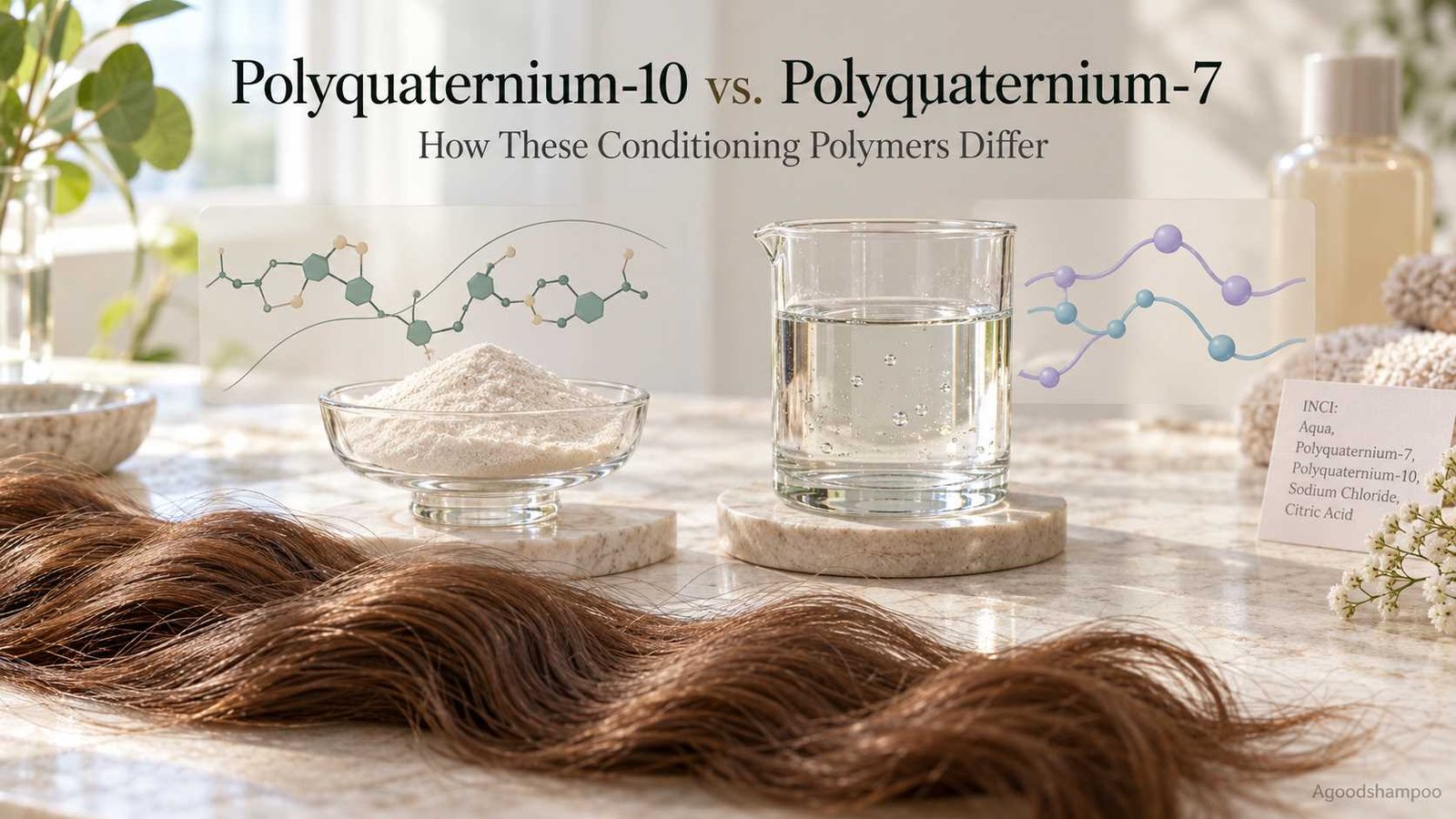
 Polyquaternium-10 and Polyquaternium-7 often appear in shampoos designed to make hair feel softer, smoother, and easier to comb. Their names look almost identical, but they are different conditioning polymers with different chemical structures.
The main difference is that Polyquaternium-10 is derived from chemically modified cellulose, while Polyquaternium-7 is a synthetic copolymer made from acrylamide and diallyldimethylammonium chloride. Both carry positive electrical charges that help them interact with hair, reducing friction and improving manageability.
Does that make one better? Not necessarily. Their effects depend on the particular polymer grade, its concentration, the shampoo’s cleansing ingredients, and how the complete formula behaves during washing and rinsing.
Understanding these differences makes ingredient labels more useful without turning them into unreliable product rankings.
What Makes Polyquaternium-10 and Polyquaternium-7 Different?
Both belong to a broad group called cationic polymers, but their underlying structures are not the same.
Polyquaternium-10: A Modified Cellulose Polymer
Polyquaternium-10 starts with hydroxyethyl cellulose, a cellulose-derived material. Chemical modification introduces positively charged quaternary ammonium groups, allowing the resulting polymer to interact with hair surfaces.
In shampoos, it can serve several purposes:
- Improve hair conditioning and wet combability.
- Help reduce static electricity and friction.
- Contribute to the product’s thickness and texture.
- Support conditioning-polymer deposition during washing.
Its cellulose origin sometimes creates confusion. Polyquaternium-10 is not simply raw plant cellulose added to shampoo. It is a chemically modified ingredient with properties designed for cosmetic formulations.
Different grades can have different molecular weights and charge characteristics. Consequently, two shampoos containing Polyquaternium-10 may produce noticeably different results.
Polyquaternium-7: A Synthetic Conditioning Copolymer
Polyquaternium-7 is produced by combining two monomer components: acrylamide and diallyldimethylammonium chloride, commonly abbreviated as DADMAC.
The resulting polymer contains positively charged groups and is used in hair-care formulations for conditioning, antistatic effects, and film formation.
Its functions may include improving the feel of hair after rinsing, helping strands move past one another more easily, and supporting manageability.
Polyquaternium-7 is not automatically heavier or lighter than Polyquaternium-10. Such comparisons require information about the specific grades and finished products.
The distinction between cellulose-derived and synthetic also does not establish which ingredient is safer or gentler.
How Both Ingredients Condition Hair
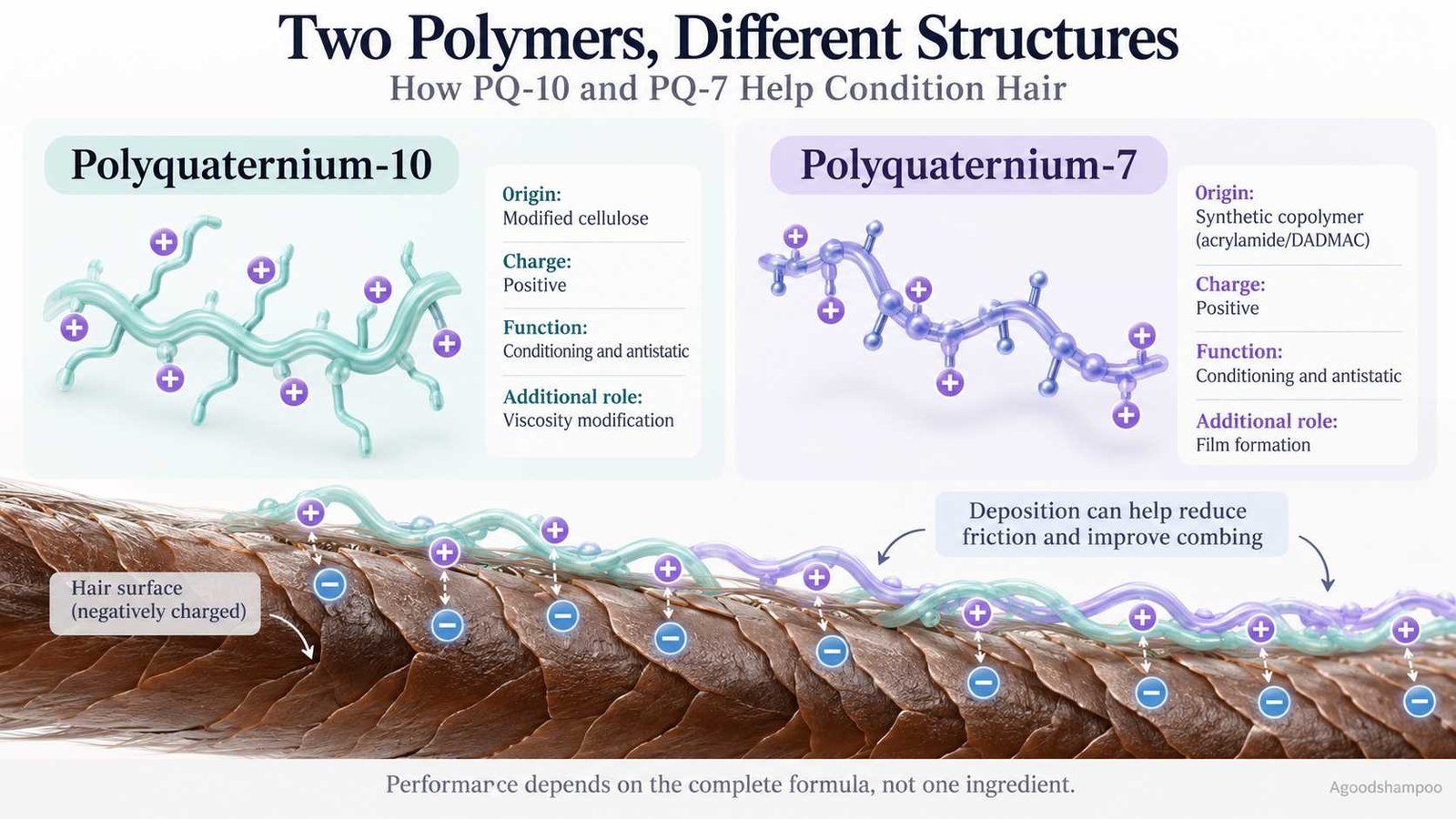
Hair fibers contain negatively charged surface sites. The number and accessibility of these sites can vary with hair condition and treatment history.
Polyquaternium-10 and Polyquaternium-7 carry positive charges, making electrostatic attraction to hair surfaces possible.
During shampooing, conditioning polymers can interact with surfactants, which are the cleansing ingredients that help remove oils and soil. As the shampoo is diluted and rinsed, these interactions can influence how much conditioning material remains associated with the hair.
That remaining material is called deposition.
Depending on the formulation, deposited polymer may:
- Reduce friction between neighboring hair fibers.
- Make wet hair easier to comb.
- Improve softness and manageability.
- Help control static and flyaway strands.
A comparative study published in the International Journal of Cosmetic Science in 2000 examined multiple cationic polymers, including Polyquaternium-7 and Polyquaternium-10. Researchers used combing-force measurements, sensory evaluations, and surface-analysis techniques. The polymers investigated improved shampoo performance under the studied conditions, although their individual results differed.
This supports the conditioning role of these materials without establishing that either polymer will outperform the other in every shampoo.
Importantly, conditioning the hair surface is not the same as permanently repairing damaged hair. These ingredients can improve how hair feels and behaves, but they do not reverse split ends or restore broken hair fibers to their original structure.
Polyquaternium-10 vs. Polyquaternium-7: Side-by-Side Comparison
| Feature | Polyquaternium-10 | Polyquaternium-7 |
|---|---|---|
| Basic structure | Modified cellulose polymer | Synthetic acrylamide/DADMAC copolymer |
| Electrical charge | Positive | Positive |
| Hair conditioning | Yes | Yes |
| Antistatic properties | Yes | Yes |
| Film-forming behavior | Yes | Yes |
| Formulation function | Conditioning and viscosity modification | Conditioning and film formation |
| Potential deposition | Yes | Yes |
| Possible unwanted buildup | Formula-dependent | Formula-dependent |
| Silicone ingredient | No | No |
| Proven better for fine hair | No | No |
| Proven better for damaged hair | No | No |
The important difference is primarily chemical structure, not a guaranteed difference in performance.
A shampoo containing Polyquaternium-10 could feel lighter than another containing Polyquaternium-7, or the opposite could be true. The polymer itself is only one part of the formulation.
Which Ingredient Is Better for Your Hair Type?
Hair type can help identify desirable product characteristics, but it cannot reliably determine which of these two polymers you should choose.
Fine or Easily Weighed-Down Hair
Fine hair often benefits from enough conditioning to reduce tangles without excessive loss of volume.
Either polymer may be suitable. What matters is how much conditioning material the finished shampoo deposits and whether other ingredients also contribute to a coated feeling.
If your hair becomes limp shortly after washing, compare the performance of complete shampoos rather than automatically excluding one polymer.
Dry, Damaged, or Bleached Hair
Damaged hair can experience increased friction, tangling, and roughness.
Conditioning polymers may help improve combability and reduce mechanical stress during grooming. However, neither Polyquaternium-10 nor Polyquaternium-7 is a complete solution for damaged hair.
A suitable conditioner, gentle detangling, reduced heat exposure, and careful handling remain important.
The better product is the one that leaves your hair easier to manage without unacceptable heaviness or irritation.
Curly or Coily Hair
Curly and coily hair can benefit from formulas that provide sufficient slip, particularly during detangling.
Both polymers may contribute to that slip, but their presence alone does not determine whether a shampoo offers enough conditioning.
Look at the entire routine, including rinse-out conditioner and styling products. Curl definition, softness, and residue depend on more than one ingredient.
Oily Scalp With Dry Ends
An oily scalp and dry lengths create different cleansing and conditioning needs.
You may need a shampoo that cleans the scalp effectively without making the lengths excessively rough. Either polymer could be part of such a formulation.
Concentrate shampoo on the scalp and apply an appropriate conditioner mainly to the lengths and ends, rather than selecting a shampoo solely according to which polyquaternium appears on the label.
Do Polyquaternium-10 and Polyquaternium-7 Cause Buildup?
Both polymers can deposit onto hair, but normal conditioning deposition should not automatically be described as harmful buildup.
Some material remaining on the hair is precisely what allows a conditioning polymer to reduce friction.
Unwanted residue becomes relevant when hair repeatedly feels heavier, less manageable, or coated despite washing.
Several factors may contribute:
- The amount and properties of conditioning polymers.
- Surfactant composition and cleansing performance.
- Use of leave-in conditioners and styling products.
- Washing frequency and rinsing habits.
- Interactions among multiple deposited ingredients.
There is no reliable general rule that Polyquaternium-10 accumulates faster than Polyquaternium-7, or that one always washes away more easily.
If your hair starts feeling unusually coated, review the products you are combining before blaming a single ingredient.
Occasional use of an appropriate clarifying shampoo may help when cosmetic residue is the actual problem. Our guide to clarifying shampoo for buildup explores this approach in more detail.
Avoid assuming that every waxy or heavy sensation comes from conditioning polymers. Oils, other styling ingredients, and water-related factors can produce overlapping symptoms.
Are Polyquaternium-10 and Polyquaternium-7 Safe?
Both ingredients have undergone cosmetic safety evaluations.
The Cosmetic Ingredient Review Expert Panel assessed Polyquaternium-10 in 1988 and found it safe under the cosmetic practices and concentrations evaluated. A subsequent CIR assessment reaffirmed its safety conclusion.
The Panel also assessed Polyquaternium-7 in 1995, concluding that it was safe for use in cosmetic formulations under the assessed conditions.
A relevant distinction concerns acrylamide.
Polyquaternium-7 is manufactured using acrylamide as one of its starting materials. Acrylamide monomer and the finished Polyquaternium-7 polymer are not chemically identical.
Residual unreacted acrylamide is a manufacturing-quality and exposure consideration. Its presence should be evaluated in the context of actual residual levels and product use, rather than assuming the polymer has the same toxicological properties as the monomer.
The historical CIR assessment addressed this issue in reaching its conclusion.
Nevertheless, an ingredient’s general cosmetic safety assessment does not guarantee that a particular shampoo will suit every individual.
A finished product may cause irritation because of fragrance, preservatives, surfactants, or other formulation components. If you develop persistent scalp itching, burning, swelling, or a rash, discontinue the suspected product and seek appropriate medical advice.
How to Compare Them on Shampoo Labels
When shopping for shampoo, start by identifying the product’s main purpose.
Is it intended for thorough cleansing, everyday washing, smoothing, detangling, or extra conditioning?
Next, examine the complete ingredient list.
Check the Cleansing System
Surfactants influence how a shampoo removes oil and interacts with conditioning materials.
Two products with the same polymer can behave differently because their cleansing systems differ.
Look for Other Conditioning Ingredients
Silicones, oils, fatty conditioning agents, and additional polymers may all influence the finished result.
Polyquaternium-10 and Polyquaternium-7 are not silicones, although they can perform some overlapping cosmetic functions.
If you’re comparing silicone-free formulas, our guide to silicone-free shampoo provides further context. Remember that silicone-free does not mean conditioning-polymer-free.
Do Not Overinterpret Ingredient Order
Cosmetic ingredient lists generally follow concentration-order rules, with exceptions for ingredients present at low concentrations.
Seeing Polyquaternium-10 or Polyquaternium-7 near the end of a list does not establish that it is ineffective.
Likewise, seeing one ingredient earlier does not prove stronger conditioning. Molecular properties, ingredient interactions, and the actual concentration all matter.
Judge the Finished Product
The most useful test for an everyday consumer is consistent performance.
Consider whether the shampoo:
- Cleans your scalp comfortably.
- Leaves your hair manageable after rinsing.
- Works alongside your conditioner.
- Avoids unwanted heaviness or persistent roughness.
- Remains comfortable with repeated use.
If both products perform well, there is little reason to change shampoos simply because one contains Polyquaternium-10 and the other contains Polyquaternium-7.
What Matters More Than Choosing Between PQ-10 and PQ-7
Polyquaternium-10 and Polyquaternium-7 have different chemical structures but share useful conditioning functions. Neither is universally superior for fine, curly, oily, or damaged hair.
When comparing two shampoos, give more weight to the overall cleansing and conditioning system, your hair’s response, and any persistent scalp discomfort than to the identity of one polymer.
Choose the finished shampoo that cleans comfortably and leaves your hair manageable. The presence of either ingredient should be information for your decision, not the decision itself.

Michael Chen focuses on the science behind shampoos and hair-care ingredients. He explains how cleansing agents, silicones, proteins, and other formula components work, separating useful evidence from marketing claims to help readers better understand the products they use.