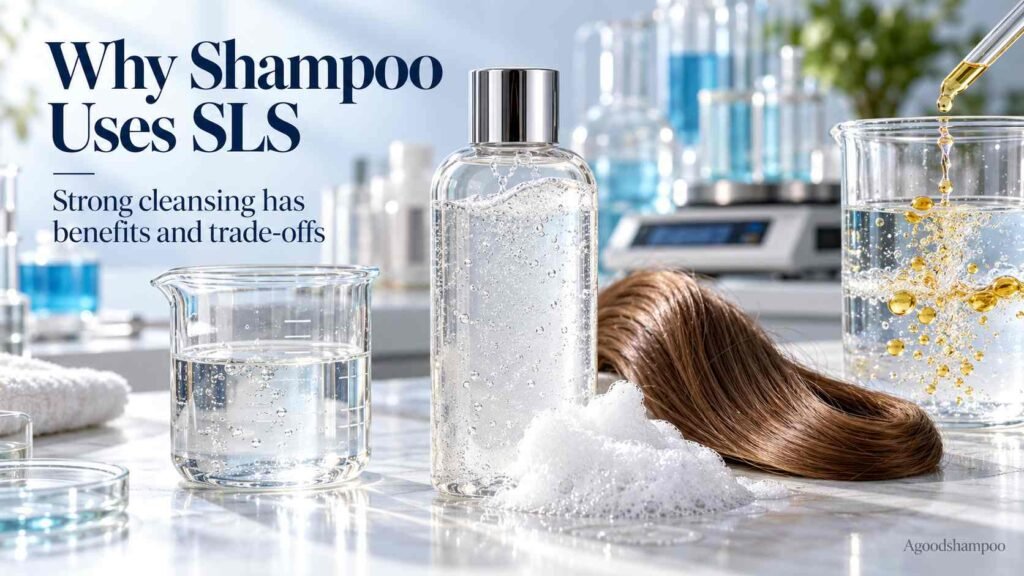
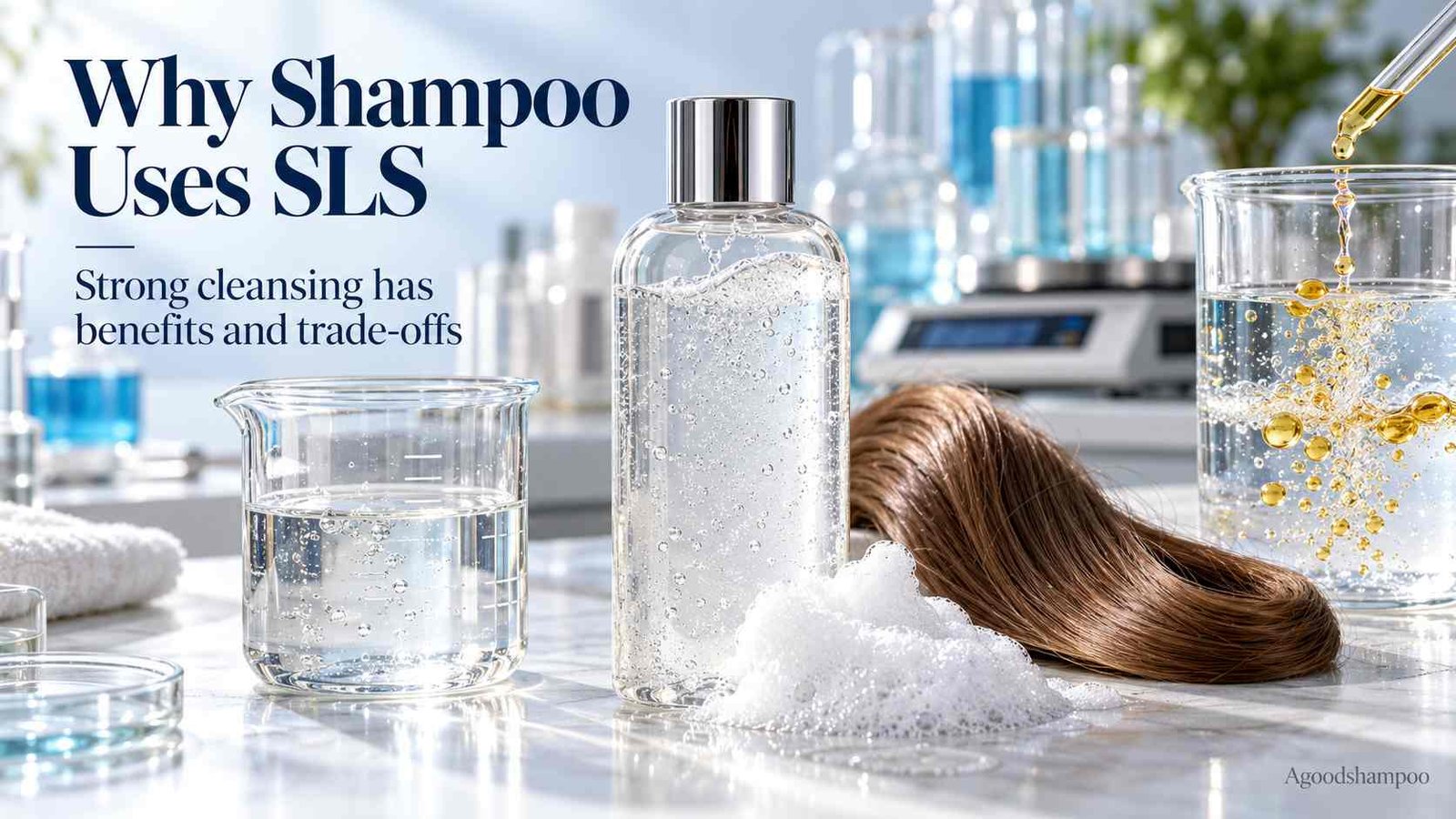
 Shampoos contain sodium lauryl sulfate, or SLS, mainly because it is an effective cleansing surfactant. It helps loosen oil, dirt, sweat and styling residue so they can mix with water and rinse away. It also produces the abundant foam many people associate with a thorough shampoo.
That makes SLS useful, but not automatically better for every head of hair.
A shampoo containing sodium lauryl sulfate may work particularly well when your scalp becomes oily quickly or your hair collects a lot of styling-product residue. The same cleansing strength may feel too drying or irritating if you have very dry hair, chemically processed lengths, wash frequently or have a sensitive scalp.
The useful question is therefore not simply whether sulfate shampoo is good or bad. It is whether the cleansing strength and complete formulation suit your hair and scalp.
Why Shampoo Manufacturers Use Sodium Lauryl Sulfate
Sodium lauryl sulfate is an anionic surfactant, meaning it belongs to a group of cleansing ingredients that help water interact with oily substances it would otherwise struggle to remove.
Your scalp naturally produces sebum. Styling creams, oils, dry shampoo, silicone-containing products, environmental particles and sweat can also collect on the hair and scalp. Plain water does not remove oily material efficiently.
A surfactant helps solve that problem.
One part of the surfactant molecule interacts with oil, while another interacts with water. During shampooing, surfactants help oily material become dispersed into the wash water so it can be rinsed away.
Scientific references on shampoo formulation describe sulfate-based anionic surfactants, including sodium lauryl sulfate and sodium laureth sulfate, as common primary cleansing agents in shampoos.
SLS is also useful because it creates strong lather.
That lather can help shampoo spread through the scalp and gives users a clear sensory signal that the product is working. But foam should not be confused with cleansing power itself. A sulfate-free shampoo can still clean effectively even if its foam feels different.
AGoodShampoo’s guide to why shampoo lather does not tell the whole cleansing story explains this distinction in more detail.
Is Sodium Lauryl Sulfate Actually Good for Hair?
SLS is good at cleaning hair. That is different from saying SLS directly improves the health of the hair fiber.
Hair above the scalp is made largely of keratinized material. Shampoo’s main job is cleansing, not biologically repairing the hair shaft or stimulating hair follicles.
If your scalp produces substantial oil, your hair feels coated after several days, or you use styling products regularly, a shampoo with an effective cleansing system can make the hair feel lighter, fresher and less greasy.
That can be a real cosmetic benefit.
The trade-off is that surfactants do not selectively remove only unwanted dirt. Strong cleansing can also remove some surface oils from the hair and skin.
For some people, that produces a clean, comfortable result. For others, repeated exposure may contribute to roughness, dryness or scalp irritation.
Health Canada describes SLS as a cleansing and foaming ingredient commonly used in rinse-off products such as shampoos. It also notes that high levels can cause skin or eye irritation in some individuals. The same guidance states that the Cosmetic Ingredient Review Expert Panel considers SLS safe in rinse-off products such as shampoos when appropriately formulated.
That distinction matters.
An ingredient can have irritation potential under certain conditions without being inherently unsafe every time it appears on a shampoo label.
Laboratory and human irritation studies frequently use SLS specifically because its effect on the skin barrier can be measured reliably. For example, studies using prolonged or occluded SLS exposure have reported increased transepidermal water loss, a measure associated with disruption of the skin barrier.
Those study conditions should not be treated as identical to washing your scalp with a rinse-off shampoo for a few minutes. They show that SLS can irritate skin under sufficient exposure. They do not prove that every SLS shampoo damages every scalp.
Why SLS Can Feel Great on Oily Hair but Too Strong on Dry Hair
The same cleansing property can be an advantage for one person and a drawback for another.
Someone with oily roots may appreciate a shampoo that removes enough sebum to keep the scalp from feeling greasy again immediately.
Someone with very dry, bleached or curly hair may have a different experience because the lengths already contain relatively little surface lubrication and may be more prone to roughness or tangling.
Oily scalps may benefit from stronger cleansing
If your roots become greasy quickly, gentle cleansing is not automatically better.
A formula that removes too little sebum may leave the scalp feeling coated even after washing. Styling products, dry shampoo and scalp oils may also accumulate over time.
A reasonably formulated sulfate shampoo can therefore be useful for:
- oily scalps
- frequent use of heavy styling products
- noticeable product buildup
- occasional deeper cleansing
- people who simply prefer a stronger clean feeling
This does not mean you need SLS specifically. Many other surfactant systems can provide effective cleansing.
Dry or processed hair may need more conditioning support
Bleaching, permanent coloring, chemical straightening, heat damage and ordinary weathering can increase roughness and friction along the hair shaft.
For hair like this, repeatedly using a very strong cleanser without enough conditioning support may leave the lengths feeling rougher or harder to detangle.
The rest of the shampoo matters enormously.
A sulfate-containing formula can also include conditioning polymers, silicones, fatty ingredients or other components designed to reduce roughness after cleansing. Likewise, a sulfate-free shampoo can still leave hair dry if its total surfactant system does not suit you.
That is why reading one ingredient and declaring a shampoo harsh or gentle is usually too simplistic.
The same whole-formula principle appears in our analysis of how Pureology uses a sulfate-free cleansing and conditioning system. Sulfate-free does not mean cleanser-free; it means other surfactants are doing the cleaning.
Sensitive scalps need more individual judgment
If your scalp becomes itchy, tight, red or uncomfortable after washing, stronger cleansing may be one factor worth investigating.
Research clearly shows that SLS can act as an irritant under sufficient exposure. One study involving 20 healthy volunteers applied a 1% SLS solution under occlusion for 24 hours and found measurable changes in skin hydration and barrier function afterward.
Again, this is an irritation model, not ordinary shampoo use.
The practical point is simpler: if your current shampoo repeatedly leaves your scalp burning, itchy or unusually dry, switching to a milder cleansing system is reasonable.
Persistent redness, significant scaling, sores, pain or unexplained hair shedding deserves professional assessment rather than endless shampoo experimentation.
SLS-Free, Sulfate-Free and Sodium-Chloride-Free Are Different
These labels sound similar enough that they are often mixed together, but they describe different things.
| Label | What it generally means |
|---|---|
| SLS-free | Does not contain sodium lauryl sulfate |
| Sulfate-free | Does not use the sulfate surfactants excluded by that manufacturer’s formulation claim |
| Sodium-chloride-free | Does not contain sodium chloride, ordinary salt |
| Sulfate and sodium-chloride-free | Excludes two different categories of ingredients |
The most important point is this:
Sodium chloride is not sodium lauryl sulfate.
Sodium chloride is ordinary salt. In shampoo formulation it can be used for purposes such as adjusting viscosity in compatible surfactant systems. Published shampoo-formulation references specifically describe sodium chloride as a viscosity booster or viscosity-adjusting ingredient.
Sodium lauryl sulfate is a surfactant used primarily for cleansing and foaming.
Their names both contain the word sodium because both contain sodium ions. That does not make them the same ingredient or give them the same function.
SLS and SLES are also different ingredients
Another common source of confusion is sodium laureth sulfate, or SLES.
SLS and SLES belong to the same broad family of sulfate surfactants, but they are chemically distinct ingredients.
PubChem identifies sodium lauryl sulfate as sodium dodecyl sulfate, while sodium laureth sulfate has an ethoxylated structure and its own chemical identity.
So a shampoo that says SLS-free could potentially still contain another sulfate surfactant unless the product specifically claims to be sulfate-free.
This is why the ingredient list matters more than relying on a single front-label phrase.
Does Sulfate-Free Automatically Mean Better for Your Hair and Scalp?
No. Sulfate-free shampoo can be an excellent choice, but the absence of sulfates does not automatically make a formula milder, safer or healthier.
A shampoo still needs surfactants to clean.
When formulators remove SLS or other sulfate surfactants, they replace them with alternatives such as glucosides, isethionates, sulfosuccinates, amino-acid-derived surfactants or combinations of several cleansing agents.
Those alternatives have different foaming, cleansing and sensory properties.
For someone with dry hair, an easily irritated scalp or frequent washing habits, a carefully formulated sulfate-free shampoo may feel more comfortable.
For someone with a very oily scalp or substantial buildup, a very mild sulfate-free shampoo may not always provide the desired clean feeling in a single wash.
That is why the question why is sulfate-free shampoo good for hair? needs a qualified answer.
It can be good because some sulfate-free formulas use cleansing systems that feel less stripping for particular people. The benefit comes from the finished formulation and how it matches the user, not from the absence of one ingredient alone.
You can read the fuller explanation in AGoodShampoo’s guide to sulfate-free shampoo and scalp care.
There is also no good basis for saying sulfate-free shampoo automatically prevents hair loss.
Changing shampoo may improve dryness, friction, tangling or scalp comfort. Those are cosmetic and skin-surface effects. They are not the same as treating the follicle-level causes of androgenetic alopecia, hormonal shedding or other forms of medical hair loss.
Choose Cleansing Strength, Not an Ingredient Villain
Sodium lauryl sulfate is useful because it cleans efficiently. That is also why some people find it too strong.
If your scalp is oily, you use substantial styling products or you regularly deal with buildup, an SLS-containing shampoo can be perfectly reasonable when the finished formula works well for you.
If your hair is very dry, heavily bleached, chemically processed or your scalp consistently reacts badly to stronger cleansing, a sulfate-free or otherwise milder formula may be a better starting point.
The most useful way to choose shampoo is to look at the result after several washes:
Does your scalp feel clean without persistent tightness or irritation?
Do your roots stay comfortable for a reasonable amount of time?
Can you detangle your lengths without excessive roughness?
Does the formula remove the amount of oil and product you actually accumulate?
Those answers tell you more than a sulfate-free badge by itself.
SLS is neither a miracle ingredient nor an ingredient that everyone needs to avoid. It is a highly effective cleansing surfactant. Whether that makes a shampoo good for you depends on your scalp, hair condition, wash frequency and the rest of the formulation.

Michael Chen focuses on the science behind shampoos and hair-care ingredients. He explains how cleansing agents, silicones, proteins, and other formula components work, separating useful evidence from marketing claims to help readers better understand the products they use.