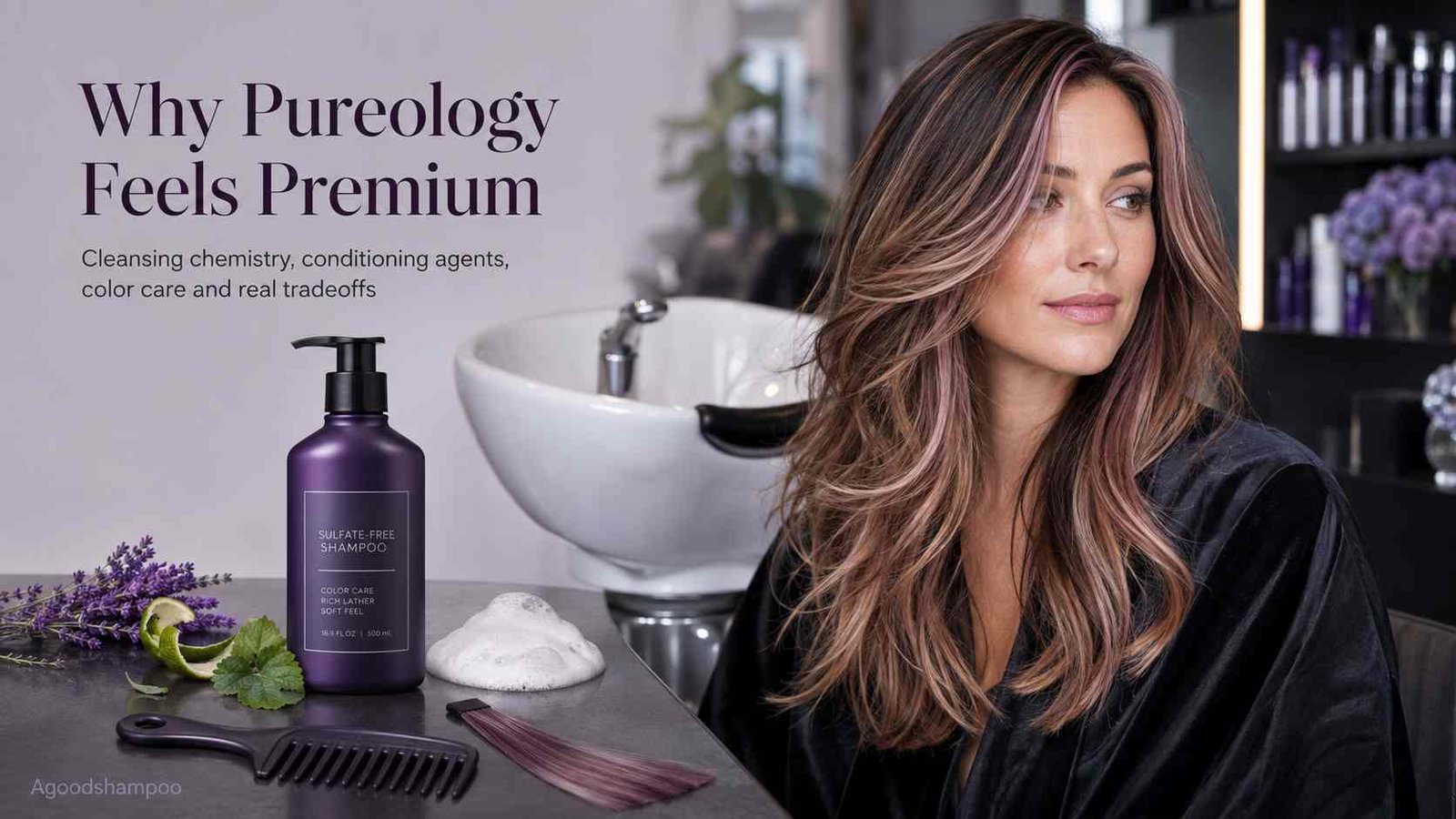
Why is Pureology shampoo so good for your hair?
For many people, especially those with dry, color-treated, bleached, or medium-to-thick hair, the answer comes down to formulation rather than one miracle ingredient.
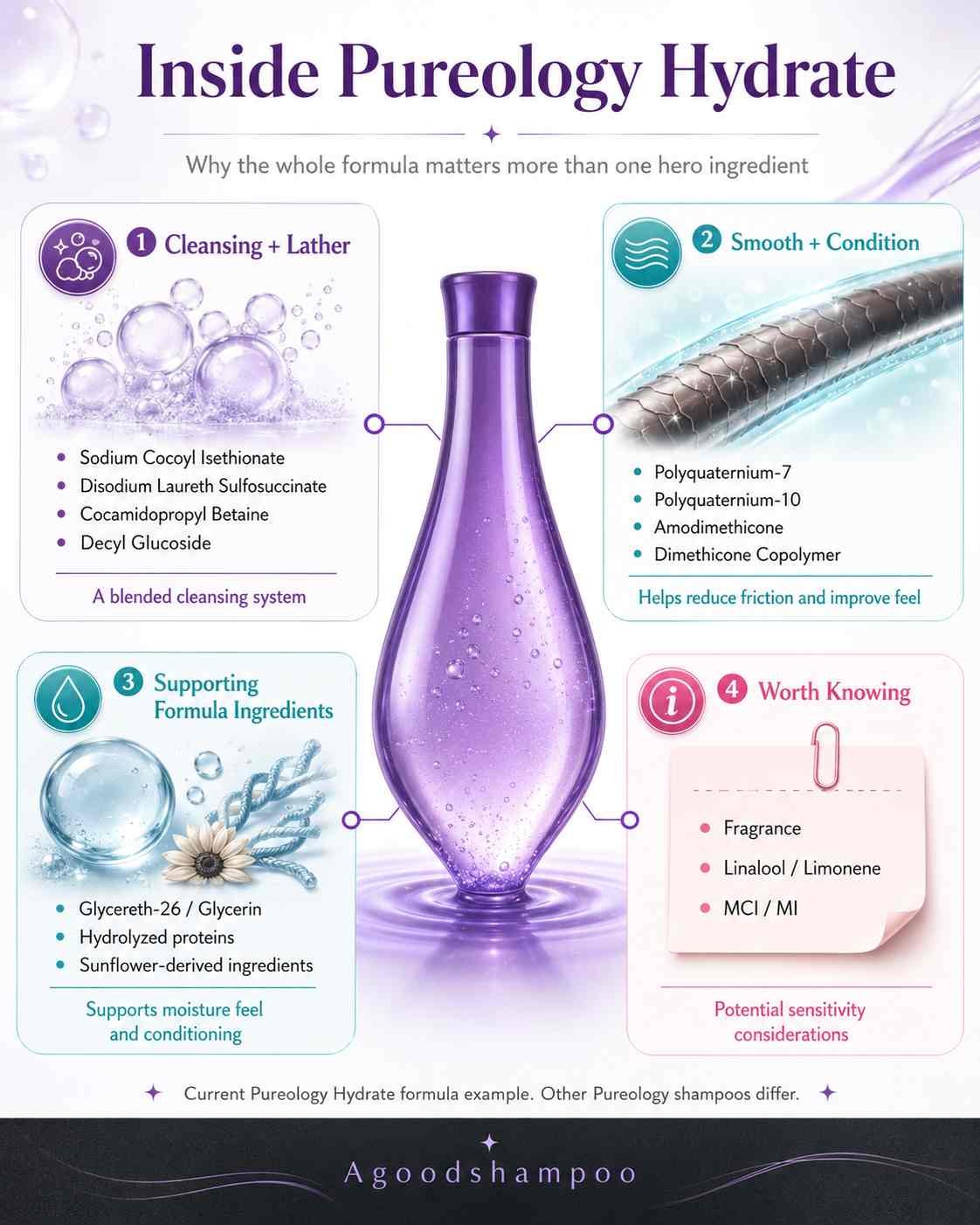
Pureology Hydrate combines several different cleansing agents with conditioning polymers and silicones. That combination can clean the scalp while leaving the hair shaft smoother, easier to comb, and less rough-feeling than a basic shampoo designed mainly to remove oil.
That does not mean Pureology is automatically healthier than cheaper shampoo. It also does not mean sulfate-free shampoo is always gentler, or that Pureology can repair damaged hair biologically.
What Pureology does particularly well is create a polished cosmetic result: rich lather, good cleansing, substantial conditioning, softness, slip, shine, and a strong salon-style fragrance experience.
Quick Answer: Pureology shampoo can be especially good for dry and color-treated hair because products such as Pureology Hydrate combine a sophisticated surfactant blend with conditioning ingredients including Polyquaternium-7, Polyquaternium-10, amodimethicone, and a dimethicone copolymer. These ingredients can improve smoothness, combability, and hair feel. Its biggest drawbacks are the premium price and, in some formulas, strong fragrance and preservatives that may not suit people with known sensitivities.
Why Pureology Shampoo Is So Good for Your Hair
The first thing to understand is that shampoo has two different jobs.
It has to clean your scalp and hair, but the best-feeling formulas also try to control what the hair feels like after that cleaning happens.
That second part matters more than people realize.
Hair that has been bleached, permanently colored, heat styled, or simply allowed to grow long can become rougher and more prone to tangling. Once the cuticle surface becomes irregular, strands rub against one another more easily.
A shampoo that removes oil very effectively but leaves little conditioning behind can make those lengths feel squeaky, stiff, or tangled.
Pureology Hydrate takes a different approach.
Its current U.S. formula uses several surfactants rather than relying on one dominant cleanser. It also includes multiple conditioning ingredients within the shampoo itself. Pureology positions Hydrate specifically for dry, dehydrated and color-treated hair, particularly medium-to-thick hair.
That helps explain the experience many people describe as a salon shampoo feel.
It isn’t that shampoo is somehow restoring a damaged strand to virgin hair.
It is that the formula cleans while leaving behind ingredients that can change the surface properties of the hair.
That distinction matters.
Cosmetic improvement can be very noticeable without being permanent repair.
The Formula Behind the Smooth, Conditioned Feel
If I were trying to understand Pureology Hydrate from the ingredient list alone, I would pay much more attention to its cleansers and conditioning system than to the botanical ingredients printed in larger letters on marketing material.
Here are some of the most relevant components in the current U.S. Hydrate formula.
| Ingredient or Group | Main Role | Why It Matters |
|---|---|---|
| Sodium cocoyl isethionate | Surfactant | Helps remove oil and soil while contributing to lather |
| Disodium laureth sulfosuccinate | Surfactant | Part of the overall cleansing blend |
| Sodium lauryl sulfoacetate | Surfactant | Adds cleansing and foam |
| Sodium lauroyl sarcosinate | Surfactant | Contributes cleansing and lather characteristics |
| Cocamidopropyl betaine and coco-betaine | Co-surfactants | Help modify foam and the behavior of the cleansing system |
| Decyl glucoside | Nonionic surfactant | Adds another cleansing mechanism to the blend |
| Polyquaternium-7 | Conditioning polymer | Can improve slip and reduce friction |
| Polyquaternium-10 | Conditioning polymer | Helps improve combability and hair feel |
| Amodimethicone | Silicone conditioner | Helps smooth and condition the hair surface |
| Divinyldimethicone/dimethicone copolymer | Silicone polymer | Contributes to conditioning and sensory feel |
| Glycereth-26 and glycerin | Humectant-type ingredients | Help support the formula’s moisturized sensory profile |
| Hydrolyzed proteins and amino acids | Supporting conditioning ingredients | May temporarily affect hair feel but should not be treated as permanent repair |
A Multi-Surfactant Cleansing System
Surfactants are the ingredients that allow shampoo to mix oily material with water so it can be rinsed away.
Pureology Hydrate does not simply remove traditional sulfate surfactants and replace them with one cleanser. Its current formula contains a relatively broad blend that includes sodium cocoyl isethionate, disodium laureth sulfosuccinate, sodium lauryl sulfoacetate, sodium lauroyl sarcosinate, cocamidopropyl betaine, coco-betaine, and decyl glucoside.
Why use a blend?
Because shampoo formulation is a balancing exercise.
A review published in the International Journal of Cosmetic Science explains that surfactants influence far more than oil removal. They affect cleansing, foam, mildness, viscosity, and the deposition of other ingredients onto hair and scalp. Formulators therefore choose combinations based on the performance they want from the finished shampoo.
This is one reason judging shampoo from a single ingredient is unreliable.
Two shampoos can both contain sodium cocoyl isethionate and still feel completely different because the rest of their surfactant systems, concentrations, conditioning agents, pH, fragrance, thickeners, and polymers differ.
Pureology’s rich lather also helps explain why some users are surprised by it.
“Sulfate-free” sometimes gets interpreted as “barely foams.”
That isn’t how formulation chemistry works.
A sulfate-free shampoo can still produce plenty of foam when the surfactant system is designed to do so.
Conditioning While You Shampoo
This may be the more important reason Pureology Hydrate feels distinctive.
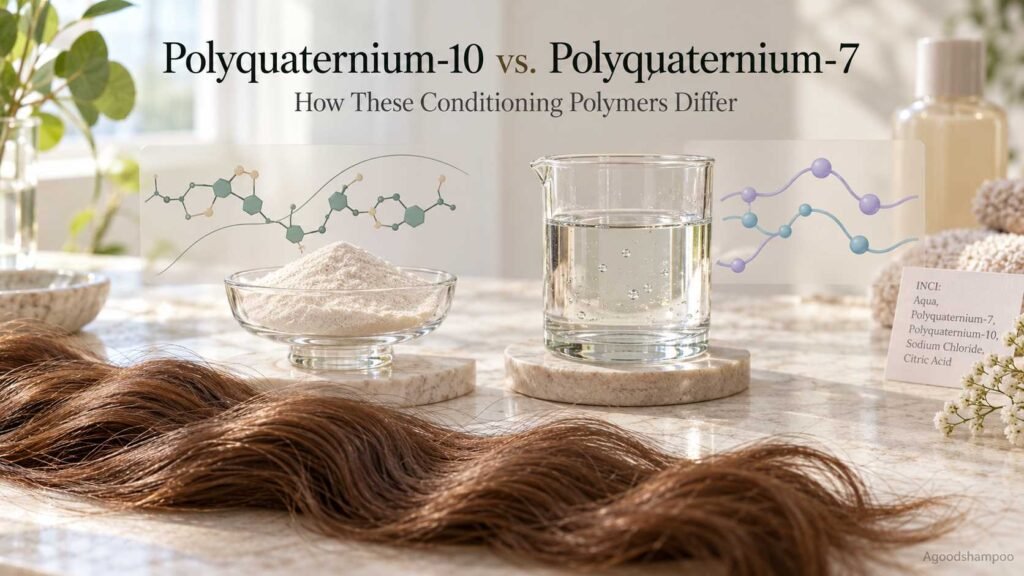
The formula contains Polyquaternium-7 and Polyquaternium-10.
These are cationic conditioning polymers. In simple terms, their electrical properties can help them interact with the hair surface and improve lubrication.
Research on conditioning polymers in shampoo has shown that these materials can reduce combing force and improve sensory properties such as hair feel. That research studied shampoo systems and conditioning polymers rather than Pureology Hydrate specifically, so it supports the formulation principle, not a claim that Pureology has been clinically proven superior.
Pureology Hydrate also contains amodimethicone and divinyldimethicone/dimethicone copolymer.
Silicones often get treated online as either miracle ingredients or ingredients everyone should avoid.
Neither view is very useful.
Silicones are cosmetic conditioning materials. Depending on their chemistry and how they are formulated, they can create a thin film over the hair, reduce friction, improve smoothness, enhance shine, and make damaged hair easier to handle. Modern research reviews continue to describe these as important benefits of silicone-based hair care.
That does not mean silicone heals the living follicle or turns damaged hair back into undamaged hair.
Hair outside your scalp is a nonliving fiber.
Making that fiber smoother and better lubricated can still be valuable. In fact, if your hair tangles less, you may also subject it to less mechanical pulling while brushing.
What About Proteins and Botanical Extracts?
This is where I would be careful with the marketing.
Pureology Hydrate’s current U.S. ingredient list includes hydrolyzed wheat-related material, wheat amino acids, hydrolyzed vegetable protein, hydrolyzed soy protein, sunflower ingredients, green tea extract, rose extract, and aloe.
Those ingredients are real.
What we cannot tell from an ingredient list is their exact concentration or how much each one contributes to the final result.
Seeing hydrolyzed protein in shampoo does not mean the product permanently rebuilds broken hair.
Likewise, seeing green tea or rose does not prove the finished shampoo provides a major biological benefit.
The formula itself is more important than the story around one botanical.
That is one of the biggest reasons Pureology can be misunderstood. The botanical ingredients make the label attractive, but the less glamorous surfactants, polymers, silicones, solvents, and formulation aids are doing much of the heavy lifting.
Is Sulfate-Free the Real Reason Pureology Is Good?
Not by itself.
Pureology Hydrate is marketed as sulfate-free, but sulfate-free does not automatically mean gentle, healthy, color-safe, or better for every scalp.
It simply tells you that certain sulfate surfactants are not being used.
You still need surfactants to wash hair.
The relevant question is therefore not:
“Does this shampoo contain sulfates?”
A better question is:
“How does the complete cleansing system behave on my scalp and hair?”
The scientific literature supports that distinction. Modern shampoo development relies on surfactant blends because cleansing, foam, mildness, ingredient deposition, and sensory properties are all affected by the way those ingredients work together.
This also explains why shampoo is good for hair when it is correctly matched to the person using it.
The primary job of shampoo is to remove excess sebum, sweat, environmental soil, and product residue from the scalp and hair. A well-designed shampoo can combine that cleansing with ingredients that improve manageability and appearance.
But stronger is not always better.
If your scalp becomes oily quickly, you may appreciate more thorough cleansing.
If your lengths are bleached, coarse, curly, dry, or porous, you may care more about reducing roughness after washing.
Pureology has built much of its range around the second group.
Which Hair Types Get the Most From Pureology?
Pureology is a brand, not one formula.
That sounds obvious, but it changes the answer.
Someone with fine hair should not automatically buy the richest Pureology shampoo just because a person with coarse bleached hair loves it.
| Hair Type or Concern | Likely Pureology Fit | What to Consider |
|---|---|---|
| Dry, medium-to-thick hair | Hydrate | Richer conditioning profile is a logical match |
| Color-treated hair | Hydrate or another concern-specific Pureology line | Brand focuses strongly on color care, but choose by texture too |
| Fine, dry hair | Hydrate Sheer | Designed as the lighter alternative |
| Blonde or highlighted hair with brassiness | Strength Cure Blonde | Purple pigment can temporarily neutralize yellow tones |
| Damaged hair | Strength Cure | Choose for conditioning and damage-management goals, not permanent biological repair |
| Frizz-prone hair | Smooth Gloss | More relevant when smoothness and frizz control are priorities |
| Very oily roots | Depends | A richer conditioning shampoo may not give everyone the cleansing feel they want |
| Fragrance-sensitive scalp | Use caution | Several Pureology formulas contain fragrance |
Dry, Medium-to-Thick and Color-Treated Hair
This is where Hydrate makes the most sense.
Pureology currently describes Hydrate as a shampoo for dry, dehydrated, color-treated hair and specifically labels it for medium-to-thick hair types. The company also markets its Antifade Complex and says the shampoo adds moisture and shine.
That product positioning matches the ingredient logic.
Dry, processed lengths are more likely to benefit from a shampoo with substantial conditioning support than healthy, very fine hair that becomes flat easily.
Pureology also reports that the Hydrate system delivered three times more hydration in one use compared with a non-conditioning shampoo. That is a manufacturer claim using the brand’s stated comparison, not evidence that Hydrate is three times more hydrating than competing premium shampoos.
That difference in wording is important.
Fine Hair
If your complaint is “Pureology makes my hair too flat,” you may simply be using the wrong Pureology formula.
Pureology Hydrate Sheer is currently described by the brand as a silicone-free, lightweight shampoo for fine, dry, color-treated hair.
That is a much more logical starting point for someone whose strands lose movement easily.
Fine hair can still be dry.
It just may not tolerate the same amount or type of conditioning that coarse hair enjoys.
This is also why “Is Pureology shampoo good?” has no useful universal answer.
The better question is which Pureology shampoo matches your hair.
Damaged, Blonde and Frizz-Prone Hair
Different concerns point to different ranges.
Strength Cure is the line Pureology positions around damaged hair.
Strength Cure Blonde adds purple toning for lightened or blonde hair.
Smooth Gloss is aimed more directly at frizz and smoothness.
This product segmentation matters because no shampoo can optimize every property at once. A formula built to feel rich on dry, porous hair may not be the best choice for someone chasing maximum volume.
Where Pureology May Not Be So Good
Pureology has real formulation strengths, but there are reasons I would not recommend it blindly.
The first is simple: price.
At the time of this review, Pureology’s U.S. site lists the standard 9 fl oz sizes of Hydrate Sheer and Strength Cure Blonde at $38. Premium pricing can make sense if you love the formula and need only a small amount per wash, but price itself is not evidence of healthier hair.
The second issue is fragrance.
Pureology describes Hydrate’s aromatherapy blend as lavender, bergamot, and patchouli. Fragrance is also explicitly present in the current ingredient list, along with fragrance components including linalool, limonene, and geraniol.
For someone who loves salon fragrance, this may be part of why Pureology feels luxurious.
For someone with fragrance allergy or a scalp that reacts to heavily fragranced products, it can be the exact opposite.
The American Academy of Dermatology notes that fragrance can trigger contact dermatitis in people who are allergic to it, including on the scalp and other areas exposed to personal-care products.
A third detail deserves more attention than it usually gets.
The current U.S. Pureology Hydrate ingredient list also includes methylchloroisothiazolinone (MCI) and methylisothiazolinone (MI).
These are preservatives.
Their presence does not mean everyone using the shampoo will develop a reaction. But MI and MCI/MI are recognized contact allergens, and people with a confirmed allergy to these preservatives are generally advised to avoid products containing them.
So if your scalp becomes itchy, red, sore, or persistently irritated after a shampoo change, do not assume that discomfort means the product is “working.”
Stop using the suspected product and seek medical assessment if symptoms are significant or persistent.
Finally, some people simply do not need this much conditioning from their shampoo.
If your scalp is very oily and your strands are fine and untreated, Hydrate may feel richer than necessary. That is not a flaw in the formula. It is a mismatch between formula and hair type.
Is Pureology Purple Shampoo Good?
Yes, Pureology Strength Cure Blonde can be a useful purple shampoo when your goal is to reduce the appearance of yellow or brassy tones in blonde, highlighted, or lightened hair.
But it is important to understand what purple shampoo actually does.
It does not bleach hair.
It does not make dark hair blonde.
It deposits violet-toned color that visually counteracts yellow because violet and yellow sit opposite each other in basic color theory.
The current Strength Cure Blonde formula contains CI 60730 / Acid Violet 43, the violet colorant responsible for the toning effect. Pureology describes the product as a deep purple shampoo designed to tone brassiness while caring for damaged hair.
That means it solves a different problem from regular Hydrate.
If your blonde is already cool enough, you do not need purple shampoo simply because it is Pureology.
If your ends are very porous, use toning shampoo thoughtfully. Porous areas can sometimes grab pigment more strongly than healthier sections.
Purple shampoo is maintenance, not bleaching.
Pureology vs Olaplex: Why Both Can Feel Premium
Pureology and Olaplex often appear in the same shopping decision because both sit in the professional-premium hair-care space.
But the brand stories are different.
| Pureology Hydrate | Olaplex No.4 Bond Maintenance |
|---|---|
| Strong focus on hydration and color-treated hair | Strong focus on damage and bond-maintenance positioning |
| Multi-surfactant sulfate-free cleansing system | Also uses a multi-surfactant sulfate-free system |
| Contains Polyquaternium-7 and Polyquaternium-10 | Contains conditioning polymers including Polyquaternium-10 and Polyquaternium-11 |
| Contains amodimethicone and dimethicone copolymer | Current formula also contains amodimethicone and dimethicone copolymer |
| Strong aromatherapy/fragrance identity | Uses Olaplex signature fragrance |
| Best choice depends on hair type and goal | Best choice also depends on hair type and goal |
Olaplex No.4 currently lists bis-aminopropyl diglycol dimaleate, the ingredient closely associated with the brand’s bond-building technology, along with its surfactants, conditioning polymers, silicones, humectants, oils, and other supporting ingredients.
So why is Olaplex shampoo so good for some people while Pureology is better for others?
Because neither bottle exists in isolation from your hair.
If your main priority is the feel of dry, color-treated hair, Pureology Hydrate makes a logical case.
If you are specifically building an Olaplex damage-care routine around the brand’s bond-maintenance system, No.4 may make more sense.
There is no chemistry rule saying every damaged head of hair must prefer one of them.
How to Get Better Results From Pureology
Pureology’s directions for Hydrate are simple, and this is one place where using more shampoo is unlikely to improve the result. The company recommends starting with about a dime-sized amount on wet hair.
- Wet your hair thoroughly so the shampoo can distribute easily.
- Start with a small amount and emulsify it with water.
- Concentrate most of the massage on your scalp, where oil and buildup accumulate.
- Let the lather move through the lengths rather than aggressively scrubbing fragile ends.
- Rinse thoroughly.
- Repeat only if your scalp, styling-product use, or wash interval makes a second cleanse necessary.
- Follow with conditioner mainly through the mid-lengths and ends unless your particular conditioner is designed for scalp use.
If Hydrate leaves your hair heavy, do not immediately conclude that the entire Pureology brand is wrong for you.
Hydrate Sheer may be a more sensible option for fine hair.
Likewise, if you are buying Pureology only because you have colored hair but your real problem is oiliness, brassiness, breakage, or frizz, choose the line that addresses the problem you actually have.
Frequently Asked Questions
Is Pureology shampoo actually good?
Yes, Pureology makes well-formulated shampoos that can be particularly good for color-treated, dry, damaged, or processed hair when you choose the correct range.
Pureology Hydrate stands out because it combines multiple surfactants with conditioning polymers and silicones instead of behaving like a very basic cleanser. That helps explain its smooth, salon-like after-feel.
It is not automatically better for every person simply because it is expensive or sulfate-free.
Why does Pureology shampoo make hair feel so soft?
With Hydrate, the likely explanation is the combination of cleansing and conditioning ingredients.
Polyquaternium-7, Polyquaternium-10, amodimethicone, and a dimethicone copolymer can improve lubrication, combability, smoothness, and sensory feel on the hair shaft.
That softness is a cosmetic conditioning effect. It should not be confused with permanently reversing structural hair damage.
Does Pureology shampoo contain silicones?
Some Pureology shampoos do.
The current U.S. Pureology Hydrate formula contains amodimethicone and divinyldimethicone/dimethicone copolymer.
Pureology Hydrate Sheer, on the other hand, is currently marketed as silicone-free.
This is another reason you should check the exact product rather than applying one ingredient rule to an entire brand.
Is Pureology worth the price?
It can be if you have dry or color-treated hair, enjoy the sensory experience, and notice that the formula gives you better manageability than cheaper alternatives.
It may not be worth it if your current shampoo already cleans comfortably and leaves your hair easy to manage.
Premium price does not automatically equal better hair health.
The real question is whether the improvement you notice is large enough to justify the extra cost.
Why does Pureology shampoo smell so strong?
Fragrance is a deliberate part of the Pureology experience.
For Hydrate, Pureology describes an aromatherapy blend of lavender, bergamot, and patchouli, and fragrance appears in the ingredient list.
Some people consider that lingering salon fragrance one of the best parts of the product. Others find it overpowering.
If you have a known fragrance allergy, the scent is more than a preference issue and a fragrance-free shampoo may be a better choice.
Final Verdict: Is Pureology Really That Good?
Pureology is good, but not because it contains a secret ingredient that ordinary shampoo does not.
The strongest explanation for why Pureology shampoo is so good for your hair is formulation.
Pureology Hydrate combines a broad sulfate-free surfactant system with conditioning polymers and silicones that can leave dry, processed, and color-treated hair feeling smoother, softer, and easier to comb after cleansing.
That makes Hydrate a particularly logical option for dry, medium-to-thick or color-treated hair.
Fine hair may do better with Hydrate Sheer. Blonde hair with unwanted yellow tones has a more specific option in Strength Cure Blonde.
The biggest limitations are price and formula compatibility. Hydrate contains fragrance as well as MCI/MI preservatives, which deserve attention if you have a known allergy or sensitive scalp.
So I would not buy Pureology simply because someone says it is the “best shampoo.”
Buy it when the formulation matches your hair.
That is a much better reason.

Michael Chen focuses on the science behind shampoos and hair-care ingredients. He explains how cleansing agents, silicones, proteins, and other formula components work, separating useful evidence from marketing claims to help readers better understand the products they use.