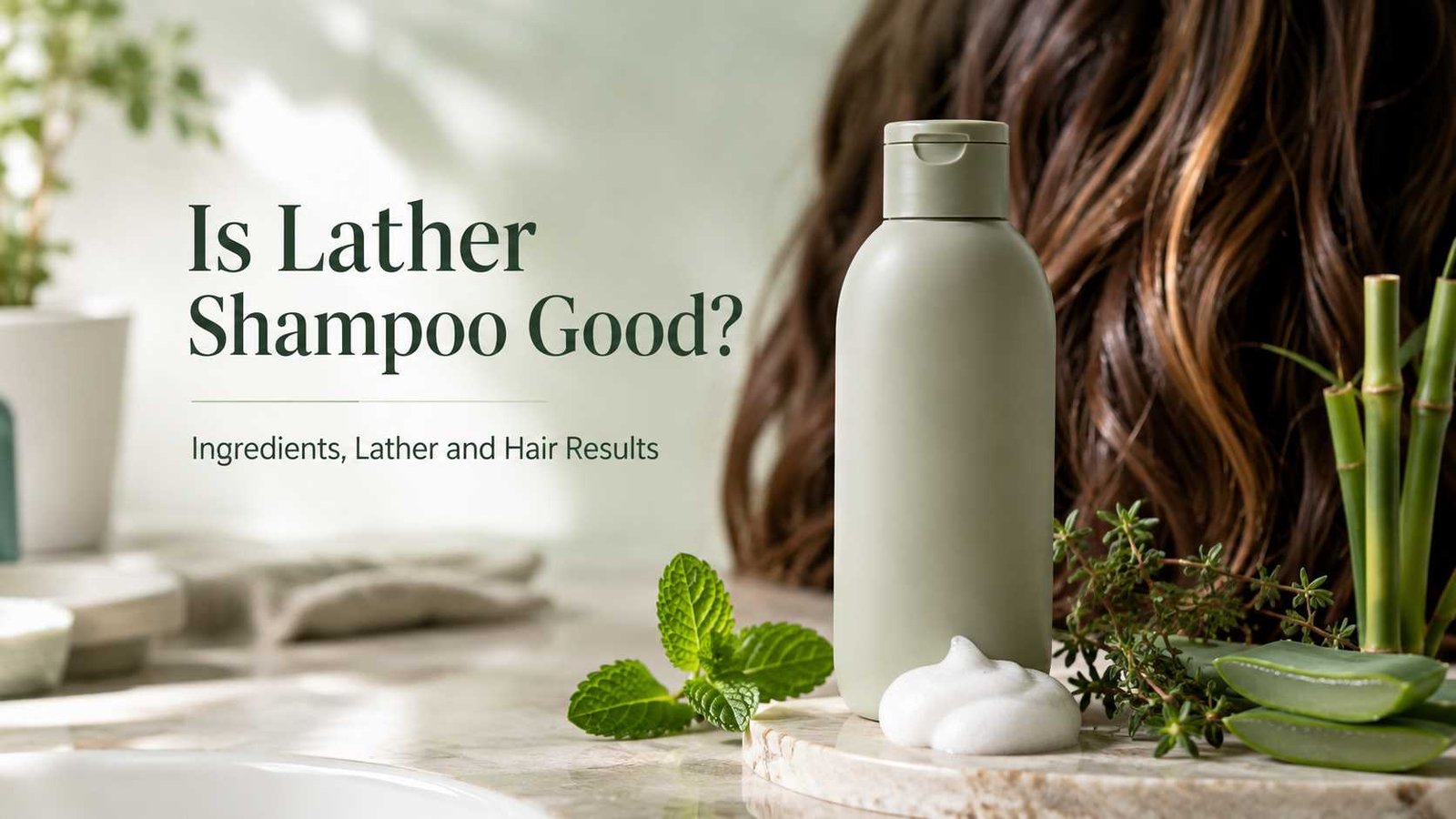
 Yes, LATHER shampoo is good for many people, especially if you want a sulfate-free cleanser that feels gentle and does not leave your hair heavily coated.
But there’s one thing you should know before buying it.
LATHER shampoo does not depend on the strong sulfate cleansers that often make shampoo explode into a mountain of bubbles. Instead, several LATHER formulas use cleansers such as lauryl glucoside and decyl glucoside. These can clean the scalp without giving you the same aggressive foam you may get from a traditional clarifying shampoo.
So if you squeeze it into your palm, wash your hair, and think, “Why isn’t this foaming like my old shampoo?” that does not automatically mean the shampoo is weak.
Foam and cleansing are related, but they are not the same thing.
That little detail changes the whole review.
I looked at LATHER’s current shampoo formulas, ingredient lists, brand claims, customer ratings, and published research on surfactants and hair cleansing. This is an ingredient-based review rather than a claim that I personally tested every bottle.
And for readers wondering about the name itself, yes, we also need to talk about actual shampoo lather because a shampoo called LATHER naturally makes people wonder how much foam really matters.
My quick verdict on LATHER shampoo
I’d put LATHER in the gentle, plant-focused shampoo category rather than the heavy-duty cleansing category.
The brand currently says its products contain no sulfates, parabens, artificial colors, or synthetic fragrance, and it markets its hair products around milder cleansing systems and botanical ingredients.
What I like most is not the long list of plant extracts. Those look nice on a label, but shampoo stays on your scalp for such a short time that I would never buy one only because it contains rosemary, cucumber, aloe, elderflower, or green tea.
What interests me more is the cleansing system.
For example, LATHER Mint Thyme Hair Wash starts with water, lauryl glucoside, propanediol, and decyl glucoside. The Mountain Fir and Elderflower Shampoo uses a very similar surfactant base.
These are the ingredients doing the boring but important work.
That matters much more than whether the bottle has a pretty picture of a plant on it.
My overall rating would land around 8 out of 10 for the right hair type.
Someone with a sensitive or dry scalp may enjoy its gentler approach.
Someone with very oily hair, heavy styling-product buildup, hard-water deposits, or lots of silicone residue may occasionally want something stronger.
That is not a failure of the shampoo. It is simply a matter of matching the cleanser to the job.
Is LATHER brand shampoo good?
Yes, the LATHER brand makes several shampoos with thoughtful formulas, but I would not say every LATHER shampoo is perfect for every head of hair.
The easiest way to see the difference is to compare a few current products.
| LATHER shampoo | Best suited to | Main cleansing approach | Current brand rating |
|---|---|---|---|
| Mint Thyme Hair Wash | Fine and oily hair | Lauryl glucoside and decyl glucoside | 4.8 from 132 reviews |
| Bamboo Crème Hair Wash | Dry or damaged hair | Decyl glucoside, lauryl glucoside and additional mild cleansing agents | 4.8 from 39 reviews |
| Yuzu Bergamot Hair Wash | General use and tired-looking hair | Lauryl glucoside and decyl glucoside | 4.7 from 33 reviews |
| Mountain Fir and Elderflower Shampoo | All hair types, including dry or color-treated hair | Lauryl glucoside and decyl glucoside | 4.5 from 31 reviews |
These ratings come from LATHER’s own product pages, so I treat them as useful consumer feedback rather than independent clinical proof.
Still, the pattern is encouraging.
Mint Thyme Hair Wash had a 4.8 out of 5 rating from 132 reviews when checked, with 95 percent of reviewers saying they would recommend it. LATHER describes that formula as suitable for fine, oily hair.
That actually makes sense when I read the formula.
It contains cleansing glucosides without loading the product with rich conditioning oils near the top of the ingredient list. So it has a better chance of leaving fine hair light rather than flat.
The Bamboo Crème formula takes a different route.
It contains jojoba oil, panthenol, oat amino acids, aloe, botanical extracts and several cleansing agents. LATHER positions this one toward dry hair. At the time checked, it carried a 4.8 rating from 39 reviews and a 97 percent recommendation rate on the brand’s site.
That is the kind of formula I would look at if my hair felt rough after every wash.
What actually makes shampoo clean your hair?
This is where shampoo science becomes surprisingly simple.
Your scalp makes sebum. You also collect sweat, dead skin, pollution, styling products and whatever else your hair meets during the day.
Oil does not rinse away easily with plain water.
Shampoo solves that problem with surfactants.
A surfactant molecule has a part that interacts with oil and another part that interacts with water. This allows oily material and dirt to be lifted away and rinsed from the hair and scalp. Dermatology literature describes surfactants as the primary cleaning agents in most shampoos.
Different surfactants behave differently.
Some cleanse aggressively.
Some feel mild.
Some create lots of bubbles.
Some barely foam.
Some combinations are designed to give you a balance between cleaning, foam, skin comfort, viscosity and rinse feel.
That is why two shampoos can both clean your hair even though one gives you a giant handful of bubbles and the other gives you only a creamy layer of foam.
Is it good to lather your shampoo?
Yes. Working shampoo into a lather can help spread the product across your scalp.
But you do not need to chase bubbles.
You are washing your scalp, not competing in a foam-making contest.
Massage the shampoo gently through wet hair and concentrate mainly on your scalp. As you rinse, the cleanser travels through the lengths of your hair.
There is rarely a reason to aggressively scrub shampoo into the dry ends.
Those ends are already the oldest and most weathered part of your hair.
LATHER itself tells users to apply its shampoos to wet hair, gently work them into a lather, and rinse with warm water.
That is sensible.
The mistake happens when people assume more lather means more cleaning.
It doesn’t work that neatly.
Research on cleansing products has shown that consumers strongly associate visible foam with cleansing performance even though effective cleansing does not require huge amounts of foam.
That psychological effect is powerful.
When a shampoo gives you a thick cloud of bubbles, it feels like it is doing something dramatic.
Your brain goes, “Yep. Clean.”
But your hair does not grade shampoo by bubble volume.
Quick fact about shampoo foam
Lather is mainly a collection of air bubbles held inside a thin liquid film containing water and surfactant.
The surfactant helps stabilize those bubbles.
That is why changing the surfactant type, concentration, water hardness, oil level on the scalp and even the amount of product can change how much foam you see.
Foam can make shampoo easier and more pleasant to spread, but it should never be your only measure of shampoo quality. Research into surfactant systems shows that foam behavior depends strongly on surfactant chemistry and concentration.
Think about your first shampoo after several days without washing.
Sometimes it barely foams.
You rinse.
Then you apply a small amount again.
Suddenly it foams like crazy.
The shampoo did not magically become stronger during the second wash. The first wash simply removed some of the oil and residue that interfered with the foam.
That is why people with oily hair often notice much more lather during a second cleanse.
Which shampoo has the best lather?
There is no scientifically meaningful winner for “best lather” because the biggest foam does not automatically make the best shampoo.
Traditional shampoos made with strong anionic surfactants often create abundant lather and remove oil efficiently. Dermatology reviews describe anionic detergents as important cleansing agents because of their strong ability to remove sebum and dirt.
That can be great when your scalp is oily.
It may feel less great when your hair is bleached, very dry, tightly curled, or already fragile.
This is why I prefer asking a better question.
Does the shampoo clean your scalp without leaving your hair uncomfortable?
If yes, the lather is good enough.
For LATHER specifically, Mint Thyme Hair Wash looks like the most logical starting point for fine or oily hair. The brand specifically recommends it for that group.
If your hair is dry, the Bamboo Crème Hair Wash makes more sense because its formula includes jojoba oil, panthenol and oat amino acids alongside its cleansers.
If you want a simpler everyday option for a broad range of hair types, Yuzu Bergamot Hair Wash is marketed for all hair types. Its current formula also uses lauryl glucoside and decyl glucoside near the beginning of the ingredient list.
So I would choose by scalp and hair type, not by bubble size.
The ingredients I like in LATHER shampoo
Lauryl glucoside and decyl glucoside deserve most of the attention.
Both appear near the top of multiple LATHER shampoo ingredient lists.
They belong to a family of nonionic surfactants commonly used in personal-care cleansers.
This is one reason LATHER can make sulfate-free shampoos that still wash away oil and dirt.
I also like seeing ingredients such as glycerin, aloe and propanediol in these formulas.
They do not magically repair every damaged hair shaft, but they can contribute to the feel and moisture balance of a cosmetic formula.
Bamboo Crème gets more interesting because it includes panthenol.
A 2026 study on panthenol and hair fibers reported measurable tensile-strength benefits and proposed hydrogen bonding as part of the mechanism.
That does not mean one wash with a panthenol shampoo will turn damaged hair into virgin hair.
Hair products cannot reverse every structural change caused by bleach, heat or chemical processing.
But ingredients that improve fiber feel or reduce mechanical stress can still be useful.
That is a much more realistic promise.
What about all those botanical extracts?
This is the part of beauty marketing where I keep my expectations under control.
Mint Thyme Hair Wash contains a long group of plant ingredients including cucumber, olive leaf, chamomile, green tea, rosemary, aloe, lemon balm, peppermint and thyme.
Mountain Fir and Elderflower contains aloe, elderflower, edelweiss, shea butter and aromatic plant ingredients.
They sound lovely.
They may contribute to the sensory feel, scent, antioxidant profile or cosmetic character of the product.
But shampoo gets rinsed away.
So when I judge shampoo, I put much more weight on its surfactants, conditioning agents, overall formulation, scalp compatibility and how the hair feels afterward.
A shampoo bottle can contain twenty herbs and still be wrong for your scalp.
Another could have a plain ingredient list and work beautifully.
Your scalp does not care how romantic the ingredient story sounds.
What research says about sulfate-free shampoo
Sulfate-free has almost become a synonym for gentle.
That is too simple.
Sulfates are surfactants, and surfactants come in many strengths and combinations. A formula can contain sulfates and still be perfectly suitable for many people. A sulfate-free formula can also irritate someone if another ingredient does not agree with their skin.
So I would not call sulfate-free shampoo automatically healthier.
LATHER simply takes a route that will appeal to people who prefer to avoid sulfates. Its website currently states that its formulas contain no sulfates.
That may be attractive if your hair feels stripped easily or you simply prefer this style of cleanser.
But oily scalps sometimes need stronger cleansing.
That is okay too.
Hair care does not need ingredient villains.
It needs appropriate formulas.
A small warning about glucosides
Here is something that gets left out of many clean-beauty conversations.
Gentle does not mean impossible to react to.
Medical literature contains reports of allergic contact dermatitis caused by alkyl glucosides, including ingredients used in cosmetic cleansers and shampoos.
That does not make decyl glucoside or lauryl glucoside bad ingredients.
Most users will not develop an allergy.
It simply means “natural-derived,” “sulfate-free,” and “gentle” should never be interpreted as “nobody can react to this.”
If a shampoo repeatedly gives you itching, redness, swelling or a rash around your scalp, ears, neck or hairline, stop using it and speak with a dermatologist if symptoms continue.
Your scalp gets the final vote.
Not the marketing label.
What about essential oils and fragrance?
This is another area where LATHER may be wonderful for one person and annoying for another.
Mint Thyme Hair Wash contains peppermint and thyme oils. Yuzu Bergamot contains several citrus and aromatic oils. Mountain Fir and Elderflower includes a plant-derived fragrance mixture with numerous aromatic components.
Some people love this.
The scent can turn an ordinary morning shower into something that feels almost spa-like.
Others have reactive scalps and do better with very simple, fragrance-free products.
Also notice the wording carefully.
LATHER says it uses no synthetic fragrance. That is not the same thing as fragrance-free. The Mountain Fir formula, for example, includes natural fragrance and lists its aromatic components on the product page.
That distinction matters if fragrance bothers you.
Does LATHER shampoo work for oily hair?
Mint Thyme is the one I would look at first.
LATHER specifically identifies it for fine and oily hair, and the formula avoids the heavy conditioning profile you would expect from a rich shampoo for coarse, dry hair.
The customer feedback is also strong on the brand’s site.
At the time I checked, it had 132 reviews, a 4.8 out of 5 average, and a 95 percent recommendation rate.
Still, very oily scalps are tricky.
If you wash and your roots already look greasy again within a few hours, using more and more shampoo is not always the answer.
You might need a stronger periodic cleanse, a different washing schedule, less conditioner near the roots, or help figuring out whether scalp buildup is part of the problem.
No shampoo can change your genetics or permanently switch off sebaceous glands.
Does LATHER shampoo work for dry hair?
Bamboo Crème is the obvious choice from this range.
LATHER says it is designed for dry hair, and the formula includes jojoba oil, panthenol and oat amino acids.
The review data also looks positive, although again, it comes from the brand’s own website.
The product showed a 4.8 rating from 39 reviews, with 97 percent saying they would recommend it when checked.
One detail caught my eye in those reviews.
A reviewer with dry, wavy hair said the shampoo cleaned well but felt a little too strengthening for frequent use and was not quite moisturizing enough for her particular hair. That is a good reminder that even a shampoo labeled for dry hair will not satisfy every dry-haired person.
Hair porosity, strand thickness, chemical damage and the conditioner you use afterward all change the result.
Does LATHER shampoo work for color-treated hair?
It may be a sensible option.
The Mint Thyme page says the shampoo is safe for color-treated hair, while Mountain Fir and Elderflower is promoted for all hair types and specifically discusses dry and color-treated hair.
The lack of sulfates will appeal to many people trying to use gentler cleansers after coloring.
Still, color fading depends on more than one ingredient.
Water temperature, wash frequency, dye type, UV exposure and the overall cleansing system all matter.
So I would never promise that any shampoo can completely stop color fade.
Use lukewarm rather than very hot water and avoid washing more often than your scalp actually needs.
Those boring habits often matter more than buying another fancy bottle.
What is lather used for?
Lather mainly improves the washing experience.
It helps distribute shampoo, gives your fingers some slip while massaging the scalp, and gives you sensory feedback that the cleanser is spreading.
What it does not do is prove that your hair is cleaner.
This matters because people sometimes keep adding shampoo until they see a massive foam cloud.
Now you have used three times as much product, and your scalp is not necessarily three times cleaner.
With a gentle shampoo such as LATHER, start with thoroughly wet hair.
Use a modest amount.
Massage your scalp.
Rinse.
If your hair was extremely oily or coated in dry shampoo, repeat once.
That second cleanse will often produce much more foam because the first wash has already removed some oil.
Does more shampoo make more lather?
Usually, yes.
But that does not mean you should keep adding shampoo.
Water matters too.
Shampoo needs enough water to spread properly.
If your hair is only damp, you may use far more product than necessary while still getting poor distribution.
This is especially noticeable with dense or curly hair.
Spend another 20 or 30 seconds soaking the scalp before you reach for the bottle.
It sounds ridiculously simple.
It works.
What about shampoo pH?
Here is another feature I care about more than dramatic foam.
Hair responds to pH.
A published review of shampoo pH found that higher-pH shampoos may increase friction, static electricity, frizz and fiber damage, while lower pH can reduce static and frizz.
Unfortunately, I would not guess the exact pH of a LATHER shampoo simply from its ingredient list.
Unless a brand publishes or verifies the finished formula’s pH, you cannot accurately calculate it by looking at ingredients on a webpage.
This is where ingredient analysis has limits.
A list tells me what is present.
It does not tell me every detail of the final product.
Where LATHER shampoo falls short
The first downside is price.
LATHER is not positioned like a supermarket shampoo.
For example, the Mountain Fir and Elderflower Shampoo was listed at $29 for 12 fluid ounces when checked on August 12, 2026.
Yuzu Bergamot Hair Wash was listed at $20 for 8 fluid ounces, while Bamboo Crème Hair Wash was $22 for 8 fluid ounces.
That may be perfectly reasonable if you enjoy the formula and fragrance.
But you do not need to spend that much money to get clean, healthy-looking hair.
The second downside is fragrance and essential oils for sensitive users.
The third is cleansing strength.
If you use waxes, heavy silicones, pomades, lots of dry shampoo, mineral-heavy water, or thick styling creams, one mild cleanser may not always remove everything as quickly as you want.
And finally, I would not buy LATHER shampoo expecting it to treat medical hair loss.
A rinse-off shampoo can support a clean scalp and improve cosmetic feel. That is different from treating androgenetic alopecia, alopecia areata, thyroid-related shedding, iron deficiency or another medical cause of hair loss.
Who should try LATHER shampoo?
LATHER makes the most sense if you prefer sulfate-free cleansers, enjoy botanical scents, and want a shampoo that feels less aggressive than a traditional deep-cleansing formula.
I particularly like the logic of Mint Thyme for fine or oily hair and Bamboo Crème for hair that leans dry.
Mountain Fir and Elderflower looks like a nice middle ground for someone who wants an everyday shampoo with a richer fragrance experience and a formula marketed for all hair types.
I would be more cautious if your scalp reacts easily to essential oils or fragrance.
And if your hair gets coated with styling products quickly, I would keep a stronger clarifying shampoo available rather than forcing a gentle cleanser to do every job.
So, is Lather Shampoo good?
Yes.
LATHER shampoo is a good sulfate-free option, particularly if you value gentler cleansing and botanical formulas.
Its strongest point is not that it contains a garden full of extracts.
It is the surfactant system.
Products such as Mint Thyme, Yuzu Bergamot and Mountain Fir use lauryl glucoside and decyl glucoside near the top of their formulas. Bamboo Crème combines similar glucoside cleansers with ingredients such as jojoba oil and panthenol for a more conditioning approach.
Just remember the one lesson that matters most.
Good shampoo does not have to create huge lather.
Your scalp needs effective cleansing without unnecessary irritation or dryness.
If a modest amount of shampoo leaves your scalp clean, your hair comfortable and your roots fresh, the foam has done enough.
That is a much better test than counting bubbles.

Michael Chen focuses on the science behind shampoos and hair-care ingredients. He explains how cleansing agents, silicones, proteins, and other formula components work, separating useful evidence from marketing claims to help readers better understand the products they use.