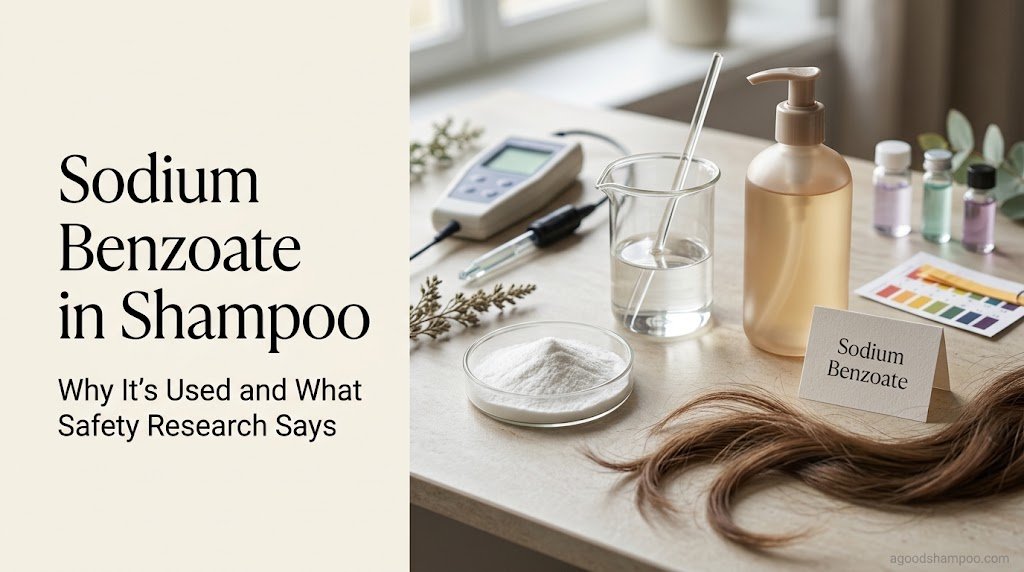
 Sodium benzoate appears on the ingredient lists of many shampoos, usually without much explanation of what it actually does. If you’ve noticed it near the bottom of your shampoo label, you may wonder whether it benefits your hair or poses a risk to your scalp.
Sodium benzoate is primarily a preservative. It helps control microbial growth in suitable shampoo formulas, protecting the product from contamination during storage and use. It does not directly clean, moisturize, repair, or stimulate hair growth.
The Cosmetic Ingredient Review (CIR) Expert Panel concluded in its 2017 safety assessment that sodium benzoate is safe under the reported conditions and concentrations of cosmetic use. However, its effectiveness as a preservative depends on formulation details, particularly pH, and individual skin reactions remain possible.
Understanding these distinctions makes it easier to evaluate the ingredient without unnecessary concern.
What Is Sodium Benzoate in Shampoo?
Sodium benzoate is the sodium salt of benzoic acid, a substance used in food, pharmaceuticals, and cosmetic products.
Its chemical formula is C₇H₅NaO₂, and its CAS identification number is 532-32-1.
In shampoo, sodium benzoate primarily functions as an antimicrobial preservative. This means it helps prevent certain microorganisms from multiplying in the finished product when the formulation conditions are suitable.
It is important not to confuse sodium benzoate with other sodium-containing ingredients.
Sodium chloride is ordinary salt and may help adjust shampoo thickness. Sodium laureth sulfate is a cleansing surfactant. Sodium benzoate has a different role: preservation.
It also isn’t a protein, silicone, hair-growth ingredient, or exfoliating treatment.
Although sodium benzoate can be manufactured from benzoic acid, the word synthetic does not establish whether a cosmetic ingredient is harmful. Safety depends on the substance, concentration, exposure, and how it is used.
Why Shampoo Needs Preservatives
Shampoo contains water, and water-based cosmetic products can provide conditions in which bacteria, yeast, and mold may survive or multiply.
Contamination can occur through raw materials, manufacturing equipment, unsuitable packaging, storage conditions, or consumer handling.
The U.S. Food and Drug Administration explains that microbiologically contaminated cosmetics can potentially harm consumers. Manufacturers are responsible for ensuring that their products are safe during their intended use.
Preservatives help reduce this risk.
Sodium benzoate may be used alone in some suitable systems, but it is frequently part of a broader preservation strategy involving other antimicrobial ingredients, pH adjustment, and appropriate packaging.
A shampoo without sodium benzoate is not necessarily preservative-free. It may use phenoxyethanol, organic acids, or another preservation system instead.
The objective is not to add as many preservatives as possible. It is to develop an effective, appropriately evaluated formula that remains microbiologically safe throughout its intended shelf life.
How Sodium Benzoate Works and Why pH Matters
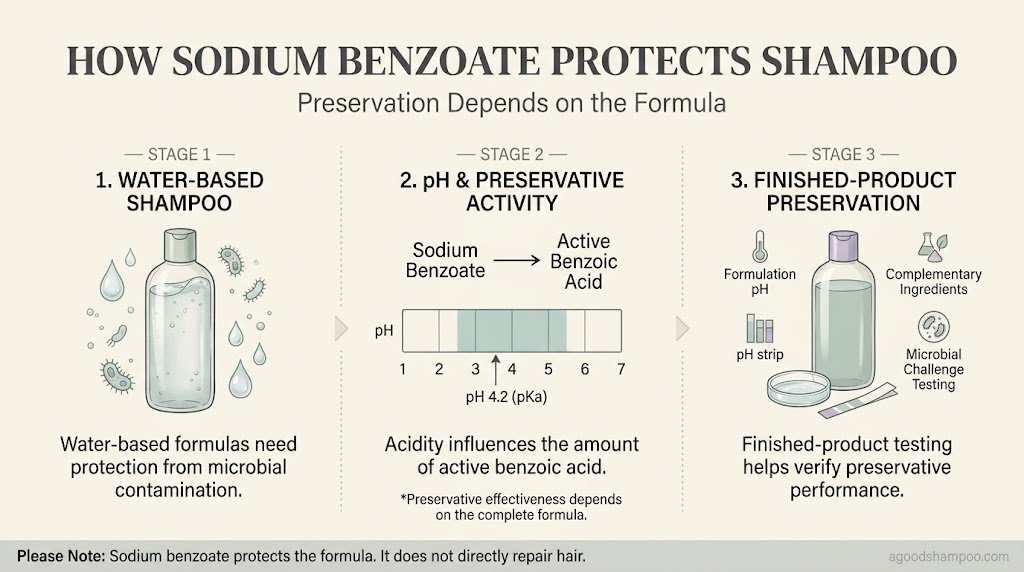
One of the most important facts about sodium benzoate is that its antimicrobial effectiveness is influenced by the shampoo’s pH.
In water, sodium benzoate dissociates into sodium ions and benzoate ions. Depending on the acidity of the formula, some benzoate can exist as benzoic acid.
The undissociated form of benzoic acid is particularly important for antimicrobial activity because it can interact with microbial cells and interfere with their normal functioning.
As the formulation becomes more acidic, a greater proportion exists in that form.
Benzoic acid has a pKa of approximately 4.2. At a pH around this value, the acid and benzoate forms are present in roughly equal proportions. At higher pH levels, the proportion of undissociated benzoic acid decreases.
This helps explain why sodium benzoate is generally more useful in acidic preservation systems.
However, that does not mean every shampoo with a pH below 5 is adequately preserved, or that sodium benzoate becomes completely ineffective above a particular number.
Real-world preservation depends on several factors working together, including ingredient concentration, complementary preservatives, formula composition, packaging, and microbial challenge testing.
Consumers cannot verify preservative effectiveness simply by checking the ingredient list or measuring a shampoo’s pH at home.
Is Sodium Benzoate Safe in Shampoo?
Scientific safety assessments generally support sodium benzoate’s use in cosmetics under evaluated conditions.
In 2017, the Cosmetic Ingredient Review Expert Panel published an updated safety assessment covering sodium benzoate, benzoic acid, and related ingredients.
The Panel concluded that the evaluated ingredients were safe in the reported practices of use and concentration.
European cosmetic regulations also permit sodium benzoate as a preservative, subject to limits that vary according to product type.
The European Union’s maximum permitted concentrations for benzoic acid and its sodium salt are:
| Cosmetic product type | Maximum concentration |
|---|---|
| Rinse-off products, excluding oral products | 2.5% |
| Leave-on products | 0.5% |
| Oral cosmetic products | 1.7% |
These values are expressed as benzoic acid equivalents. They are regulatory maximums, not typical shampoo concentrations or recommended amounts for homemade formulas.
Ordinary rinse-off shampoo falls within the rinse-off cosmetic category.
A regulatory maximum also does not guarantee that a particular concentration will preserve every shampoo adequately. Manufacturers must consider both product safety and the effectiveness of the finished preservation system.
What About Sodium Benzoate and Benzene?
Some concerns about sodium benzoate come from discussions of benzene formation in certain beverages containing benzoates and ascorbic acid.
Benzene is a separate chemical substance with serious health concerns, but sodium benzoate and benzene are not the same ingredient.
Under certain chemical conditions, reactions involving benzoates may contribute to benzene formation. However, those findings cannot automatically be applied to every shampoo containing sodium benzoate or vitamin C derivatives.
Actual formulation chemistry, ingredient concentrations, metal contamination, storage conditions, and testing results matter.
There is no sound basis for assuming that an ordinary shampoo contains benzene simply because sodium benzoate appears on its ingredient list.
Can Sodium Benzoate Irritate Your Scalp?
Most consumers can use appropriately formulated shampoos containing sodium benzoate without experiencing a reaction specifically attributable to that preservative.
Nevertheless, skin sensitivity varies.
Some individuals may develop irritation or contact reactions to an ingredient in a cosmetic product. Possible symptoms include itching, redness, burning, or a rash.
These symptoms do not automatically identify sodium benzoate as the cause.
Shampoos contain multiple ingredients, including surfactants, fragrance components, preservatives, botanical extracts, and sometimes colorants. Any suspected reaction needs to be considered in the context of the complete product.
If a new shampoo repeatedly causes discomfort, stop using it. Persistent or significant symptoms deserve assessment by a dermatologist, who may recommend patch testing when allergic contact dermatitis is suspected.
People with known preservative allergies should follow their clinician’s advice and check ingredient labels carefully.
A history of sensitive skin alone does not establish that sodium benzoate must be avoided.
Does Sodium Benzoate Damage Hair or Cause Hair Loss?
Sodium benzoate is not used in shampoo to alter the internal structure of hair fibers.
There is insufficient evidence to conclude that normal use of appropriately formulated, sodium-benzoate-containing shampoo directly causes hair loss.
It is also not a recognized hair-growth stimulant, strengthening treatment, or solution for hair breakage.
The distinction between hair-shaft damage and scalp conditions matters here.
Hair breakage concerns the physical condition of existing hair fibers. Hair shedding and hair loss can involve follicles, health conditions, medications, hormones, or other factors.
A severely irritating product may aggravate the scalp, but that does not establish sodium benzoate as a direct cause of follicular hair loss.
If you experience sudden, patchy, or unexplained hair loss, investigate the underlying cause rather than assuming that a preservative is responsible.
How to Recognize Sodium Benzoate on a Shampoo Label
Look for its standard ingredient name:
Sodium Benzoate
It often appears among ingredients present at relatively low concentrations, but ingredient order alone does not reveal its exact amount.
For example, a shampoo might list:
Water, Sodium Laureth Sulfate, Cocamidopropyl Betaine, Glycerin, Sodium Chloride, Citric Acid, Sodium Benzoate, Fragrance.
This is an illustrative formula, not a claim about a particular commercial product.
Here, sodium laureth sulfate and cocamidopropyl betaine contribute to cleansing. Glycerin functions as a humectant. Citric acid may help adjust pH, while sodium benzoate contributes to preservation.
Seeing citric acid alongside sodium benzoate does not prove that the shampoo’s preservative system is effective. Finished-product testing and actual concentrations still matter.
An existing product example appears in our Wild Naturals Eczema & Psoriasis Shampoo review, where sodium benzoate and gluconolactone are included among the listed ingredients.
Our Luseta shampoo ingredient review also explains why alternative preservation systems are important when brands market shampoos as paraben-free.
A product’s entire formula deserves more attention than one ingredient near the end of its label.
Should You Avoid Shampoo Containing Sodium Benzoate?
For most consumers, there is no evidence-based reason to reject an otherwise suitable shampoo solely because it contains sodium benzoate.
It serves a practical purpose by helping protect water-based formulas from microbial contamination. Scientific safety assessments and cosmetic regulations support its appropriate use.
If you have a confirmed sensitivity to sodium benzoate, avoiding it is reasonable. If you develop scalp discomfort after trying a product, investigate the complete formula rather than assigning blame without evidence.
When choosing shampoo, prioritize comfortable cleansing, suitable conditioning, ingredient transparency, and a product that performs consistently with your hair and scalp.
A well-preserved shampoo containing sodium benzoate may be a better choice than a poorly preserved product marketed as free from synthetic preservatives.

Carolina Herrera writes about color-treated, damaged, and chemically processed hair. She focuses on understanding breakage, choosing suitable shampoos, and making sense of repair claims. Her goal is to help readers care for their hair with realistic expectations and informed product choices.