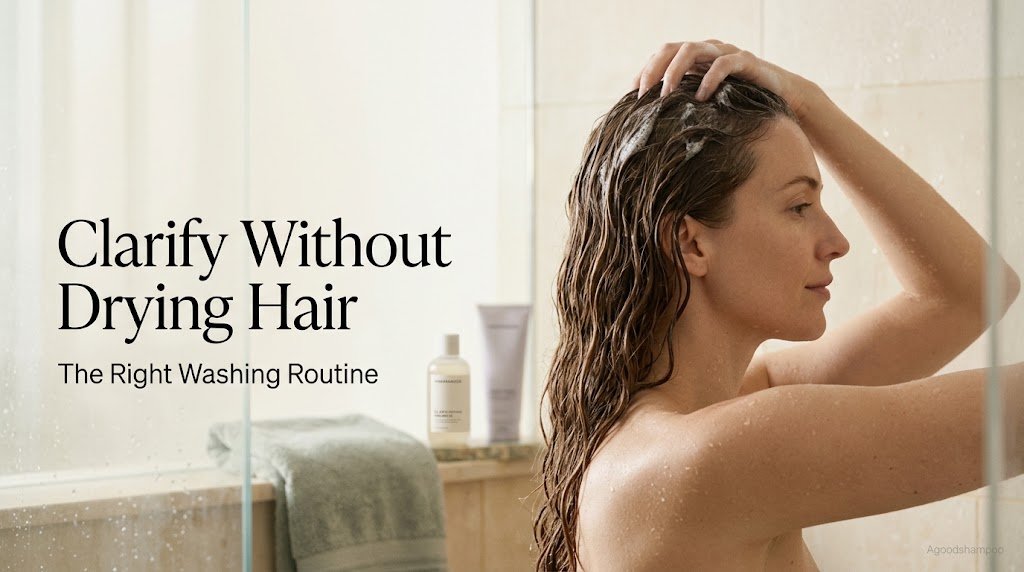
 Clarifying shampoo can make hair feel noticeably cleaner, but an overly strong or poorly timed wash may leave the lengths rough, tangled, or unusually dry. The goal is to remove unwanted residue without giving fragile hair more cleansing than it needs.
To use clarifying shampoo without excessively drying your hair, concentrate cleansing where buildup occurs, avoid aggressive scrubbing, rinse thoroughly, and follow with an appropriate conditioner. Use it when your routine calls for additional cleansing rather than automatically applying it every week.
The American Academy of Dermatology recommends applying shampoo mainly to the scalp to remove oil and accumulated products while minimizing unnecessary drying of the lengths.
That approach is a useful starting point, although some situations require cleansing the hair lengths as well.
Check Whether Your Hair Actually Needs Clarifying
Clarifying shampoos are designed to remove oil and accumulated residue that a regular shampoo may not adequately remove.
You may benefit from a clarifying wash if your hair:
- Feels persistently coated or weighed down after ordinary washing.
- Has accumulated styling creams, waxes, gels, or dry-shampoo residue.
- Looks unusually flat or separates into heavy strands.
- Feels greasy despite a reasonable washing routine.
These signs are clues, not definitive proof of buildup.
Hair can feel rough because of chemical damage, environmental conditions, or inadequate conditioning. A stronger cleanser will not necessarily improve those problems.
If you are uncertain whether clarifying is appropriate, our guide to what clarifying shampoos are good for explains their main uses and limitations.
Once you have a reason to clarify, the next step is using the shampoo carefully.
How to Use Clarifying Shampoo Without Overdrying Hair
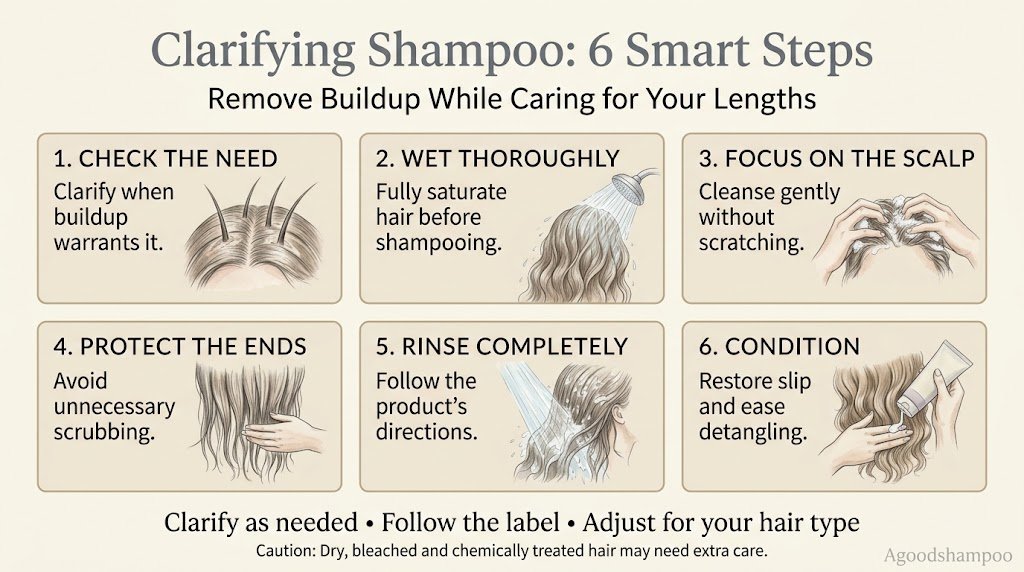
A good clarifying wash does not require vigorous scrubbing, excessive product, or unusually long contact times.
Follow these six steps, adjusting them to your shampoo’s instructions and your hair’s condition.
Step 1: Wet Your Hair Thoroughly
Begin by saturating your scalp and hair with comfortably warm water.
Make sure water reaches the roots, particularly if you have thick or dense hair.
Thorough wetting helps distribute shampoo and reduces the temptation to keep adding more product to sections that are not fully saturated.
There is no need to use very hot water. Choose a temperature that feels comfortable against your scalp.
Step 2: Apply an Appropriate Amount of Shampoo
Dispense the amount recommended on the bottle, adjusting as needed for hair density and the product’s consistency.
Apply the shampoo mainly around the scalp, where sebum and many styling residues accumulate.
Distribute it across the roots rather than pouring most of the product onto one area.
If you have long hair with dry ends, avoid automatically coating the entire length with concentrated shampoo.
However, when styling residue is actually present throughout the lengths, follow the product’s directions for cleansing those areas.
Step 3: Massage the Scalp Gently
Use the pads of your fingertips to distribute the shampoo and loosen accumulated oil and residue.
Work around the hairline, crown, temples, and back of the head.
You do not need to scratch with your nails or rub the hair aggressively to achieve effective cleansing.
Excessive friction can contribute to tangling, particularly when hair is bleached, curly, or already fragile.
If the shampoo specifies a particular contact time, follow that instruction. Do not extend it simply because you want a deeper clean.
Step 4: Avoid Unnecessary Scrubbing of the Ends
The older lengths of your hair may be more weathered or chemically damaged than the roots.
Repeatedly bunching long hair together and rubbing it during shampooing can increase friction and make detangling more difficult.
For an ordinary scalp-focused wash, allow the lather and rinse water to travel through the lengths without aggressive handling.
If your ends carry substantial styling-product deposits, they may need direct cleansing. Use the technique recommended for the specific shampoo and handle fragile sections carefully.
The aim is to clean the areas that need attention without treating every strand as though it has the same amount of buildup.
Step 5: Rinse Thoroughly
Rinse until the shampoo has been adequately removed from the scalp and hair.
Pay particular attention to dense areas near the crown, nape, and behind the ears.
Remaining cleanser or loosened residue may contribute to an unpleasant hair feel.
There is no requirement to finish with cold water to seal the cuticle. That claim oversimplifies hair-fiber behavior.
A comfortable water temperature and thorough rinsing matter more.
You also do not automatically need a second shampoo immediately afterward. If the clarifying wash has cleaned your hair adequately, another cleansing step may be unnecessary.
Step 6: Follow With a Suitable Conditioner
Conditioning is particularly important when clarifying leaves your hair with less lubrication or slip.
For straight or fine hair, apply conditioner mainly to the lengths and ends unless the product directs otherwise.
For dry, curly, or coily hair, conditioning more of the hair length may be appropriate.
Leave the conditioner on for the time recommended by its manufacturer, then rinse as directed.
A richer conditioner or hair mask may help hair that is especially difficult to detangle, but a deep mask is not mandatory after every clarifying wash.
Conditioning ingredients can improve softness, reduce friction, and make hair more manageable. They do not permanently reverse bleaching damage or repair split ends.
Adjust the Routine for Your Hair Type
The same clarifying shampoo may produce different results depending on hair texture, condition, and styling habits.
| Hair type or concern | Practical adjustment |
|---|---|
| Fine hair with oily roots | Concentrate on scalp cleansing; choose conditioner that does not leave the lengths heavy |
| Dry or coarse hair | Clarify only when needed and use adequate conditioning afterward |
| Curly or coily hair | Avoid unnecessary friction and prioritize gentle detangling |
| Bleached or fragile hair | Choose a compatible product and minimize repeated strong cleansing |
| Color-treated hair | Check the product’s color-care instructions and potential effects on fading |
| Sensitive scalp | Avoid repeated clarifying when irritation is present |
People with oily roots may benefit from more frequent ordinary shampooing, but that does not mean they automatically need more frequent clarifying.
For additional guidance, see our article on using clarifying shampoo for oily hair.
How Often Should You Clarify?
There is no universal clarifying schedule.
Your ideal frequency depends on the formula, how much styling residue accumulates, your washing habits, and how your hair responds.
Cleveland Clinic suggests that people who use considerable styling product may consider clarifying approximately once or twice per month.
That is an example of conditional guidance, not a requirement for everyone.
Someone who rarely uses styling products and cleanses effectively with a regular shampoo may not need a separate clarifying routine.
Someone with frequent product accumulation may find occasional additional cleansing useful.
Use the following observations to guide your decision:
- Hair feels clean and manageable: There may be no reason to clarify again yet.
- Residue returns despite ordinary washing: An occasional clarifying wash may be appropriate.
- Hair becomes rough or difficult to detangle: Reconsider the product, technique, or frequency.
- Scalp becomes irritated: Stop using the irritating product and assess the cause.
Following your individual shampoo’s instructions is more reliable than treating every clarifying formula as interchangeable.
Why Hair Sometimes Feels Rough After Clarifying
Roughness after clarifying does not necessarily mean the shampoo has permanently damaged your hair.
Several factors may contribute.
Reduced surface lubrication: Removing oil and cosmetic deposits can change the way strands slide against each other.
Existing hair damage: Bleached or weathered sections may feel rougher when previously deposited conditioning materials have been washed away.
Excessive cleansing: Repeating a strong wash unnecessarily can make some hair harder to manage.
Inadequate conditioning: Hair that tangles easily may require a more effective conditioner or leave-in product.
Mechanical friction: Scrubbing, towel rubbing, or forceful brushing can make already fragile strands more difficult to handle.
If your hair repeatedly feels unpleasant after clarifying, reduce unnecessary use and review your conditioner and washing technique.
If problems continue, a different clarifying formula or a return to your usual shampoo may be more sensible than adding increasingly heavy treatments.
When Clarifying Shampoo Is Not the Right Answer
Not every scalp or hair concern requires stronger cleansing.
Persistent Dryness or Breakage
Hair that feels brittle because of bleaching, repeated heat styling, or other chemical treatments may need better conditioning and gentler handling.
Clarifying does not reconstruct damaged hair fibers or permanently join split ends.
Hard-Water Mineral Deposits
Hard water contains dissolved minerals, particularly calcium and magnesium.
Some cleansing formulas contain chelating agents that may help address mineral-related deposits. However, a product labeled clarifying does not automatically provide effective mineral removal.
If you suspect hard-water buildup, consider checking your water hardness and choosing a product specifically suited to the issue.
Itching, Flaking, or Scalp Inflammation
A flaky scalp is not necessarily a dirty scalp.
Seborrheic dermatitis, contact dermatitis, and other conditions may cause itching or visible flakes.
Ordinary clarifying shampoo is not automatically a suitable treatment for these concerns. Repeated strong cleansing may worsen discomfort in some individuals.
Our discussion of clarifying shampoo for a dry, flaky scalp provides related context, but persistent redness, burning, pain, or scaling should be assessed by a qualified healthcare professional.
Your Next Clarifying Wash Should Have a Purpose
The most effective way to avoid unnecessary dryness is to make clarifying a response to a genuine cleansing need.
Before your next wash, decide what you want to remove. Choose a suitable formula, wet the hair thoroughly, cleanse gently, and follow the product’s directions.
Then condition according to your hair’s needs and pay attention to how the strands feel afterward.
If your regular shampoo already leaves your scalp clean and your hair manageable, you do not need to clarify simply because a calendar says it is time.

Carolina Herrera writes about color-treated, damaged, and chemically processed hair. She focuses on understanding breakage, choosing suitable shampoos, and making sense of repair claims. Her goal is to help readers care for their hair with realistic expectations and informed product choices.