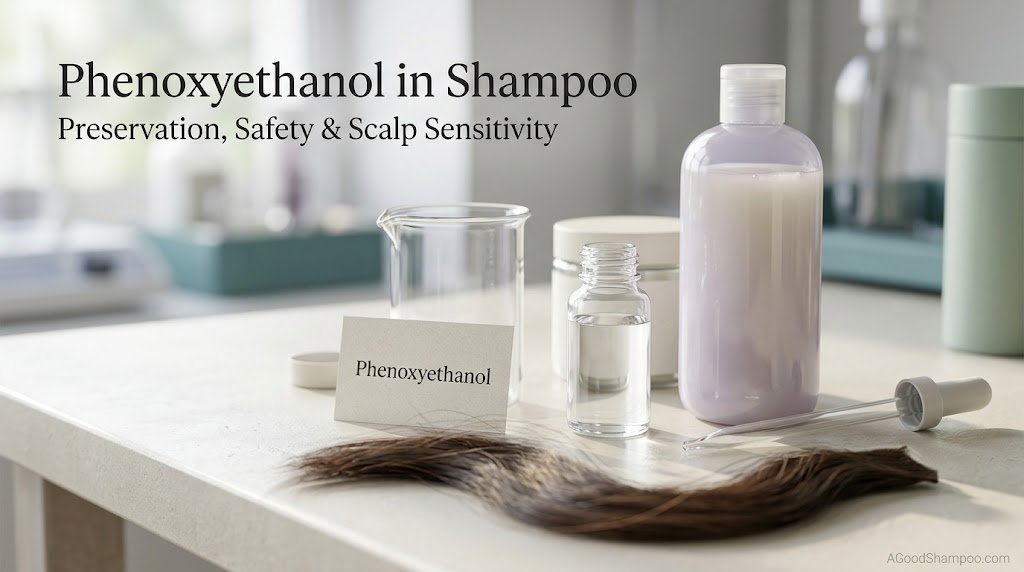
 A shampoo needs to do more than remove oil and leave hair feeling clean. It also needs to remain safe to use while sitting in your bathroom, sometimes for months after opening. That is one reason phenoxyethanol appears on so many cosmetic ingredient lists.
Phenoxyethanol is an antimicrobial preservative that helps protect shampoo from microbial contamination. It does not directly moisturize hair, repair damage, or stimulate growth. Its main job is to help keep the product microbiologically stable.
The European Commission’s Scientific Committee on Consumer Safety (SCCS) concluded in 2016 that phenoxyethanol is safe as a cosmetic preservative at concentrations up to 1%. That conclusion applies to the exposure conditions evaluated, not to unlimited amounts or every possible use.
For someone choosing shampoo, the more useful question is whether the complete formula is safe, properly preserved, and comfortable for their scalp.
What Is Phenoxyethanol in Shampoo?
Phenoxyethanol, also called 2-phenoxyethanol, is a synthetic organic compound belonging to the glycol ether family. Its chemical formula is C₈H₁₀O₂, and its CAS number is 122-99-6.
In cosmetics, it can function as a preservative and solvent, although preservation is its most relevant purpose in shampoo.
Manufacturers use it to help control microorganisms that might otherwise multiply in water-containing formulas.
Phenoxyethanol is not a surfactant, so it does not perform shampoo’s primary cleansing function. It is also not a silicone, protein treatment, or conditioning polymer.
Unlike many ingredients promoted for softness or shine, phenoxyethanol usually does not contribute a benefit consumers can directly feel in their hair.
Its value lies in protecting the formula.
The fact that it is synthetic does not automatically make it unsafe. Likewise, a preservative derived from a natural source is not automatically safer. What matters is the ingredient’s toxicological profile, concentration, exposure, and formulation.
Why Shampoo Formulas Use Phenoxyethanol
Water-based shampoo can become contaminated by bacteria, yeasts, or molds during manufacturing, storage, or use.
Microorganisms may enter through contaminated raw materials, inadequately cleaned equipment, unsuitable packaging, or contact with the environment after opening.
The U.S. Food and Drug Administration recognizes microbial contamination as an important cosmetic safety concern. An ineffective preservation system can allow harmful microorganisms to survive or multiply.
Phenoxyethanol helps reduce that risk through antimicrobial activity.
It is particularly useful against various bacteria, although its activity and effectiveness against other microorganisms depend on the formulation and testing conditions.
Why It Often Appears With Other Ingredients
Phenoxyethanol may be combined with ingredients such as ethylhexylglycerin.
Ethylhexylglycerin has several cosmetic functions and can enhance the performance of certain preservation systems. Together, these ingredients may provide useful antimicrobial protection in a properly developed formula.
However, the presence of that combination on a label does not prove the product has passed preservative efficacy testing.
Formulators must consider the complete preservation system, including pH, water availability, packaging, ingredient interactions, and microbial challenge testing.
A shampoo can be paraben-free while still containing phenoxyethanol. Similarly, a formula labeled phenoxyethanol-free may rely on another preservative.
Removing one preservative does not eliminate the need for effective microbial protection.
Is Phenoxyethanol Safe in Shampoo?
Current regulatory evaluations support the safety of phenoxyethanol in cosmetic products at authorized concentrations.
In October 2016, the SCCS adopted a final scientific opinion concluding that phenoxyethanol is safe as a cosmetic preservative at a maximum concentration of 1%.
The European Union authorizes phenoxyethanol under Annex V, entry 29, of its Cosmetics Regulation, subject to that limit.
This is a maximum permitted concentration, not a requirement that manufacturers use exactly 1% in every shampoo.
The SCCS assessment considered toxicological data, absorption, metabolism, exposure estimates, and potentially susceptible age groups.
Why High-Dose Toxicity Studies Can Be Misleading
Some online discussions describe toxic effects observed in experimental studies and then assume that ordinary shampoo exposure produces the same risks.
That interpretation leaves out two important factors: dose and exposure.
A substance can produce harmful effects at sufficiently high doses without presenting the same level of risk under carefully evaluated cosmetic-use conditions.
Scientists distinguish between hazard, meaning the potential to cause harm, and risk, which also considers how much exposure occurs and under what circumstances.
Shampoo is generally rinsed away after a relatively short period of contact. That differs from prolonged exposure to a leave-on product or ingestion of a substance.
Rinse-off use does not mean exposure is zero, but it affects the overall assessment.
The SCCS concluded that phenoxyethanol met its safety criteria under the evaluated cosmetic conditions, including consideration of children’s exposure. Its opinion did not cover every possible non-cosmetic source of exposure.
Is Phenoxyethanol Safe in Children’s Shampoo?
Concerns about phenoxyethanol in children’s cosmetics received particular attention after the French medicines agency ANSM proposed tighter restrictions for certain products intended for children under three, especially products used on the diaper area.
These historical recommendations should not be confused with a general prohibition on phenoxyethanol in children’s shampoos.
The subsequent SCCS opinion considered children’s exposure and supported the 1% maximum for cosmetic preservation.
Parents should still choose age-appropriate, properly formulated products and avoid using shampoos that cause irritation.
Can Phenoxyethanol Cause Scalp Irritation?
Phenoxyethanol can cause contact reactions in susceptible individuals, even though published research describes allergy to the ingredient as uncommon.
A 2019 scientific review in the Journal of the European Academy of Dermatology and Venereology examined phenoxyethanol’s safety and discussed reports of allergic contact dermatitis and contact urticaria.
Such reactions are possible, but they should not be presented as typical outcomes of ordinary shampoo use.
Potential symptoms after using a product include itching, redness, burning, or a rash.
These symptoms do not establish that phenoxyethanol is responsible.
Fragrance compounds, cleansing surfactants, botanical extracts, and other preservatives may also trigger irritation or allergic reactions. Existing scalp conditions can complicate the picture.
If a particular shampoo repeatedly causes discomfort, discontinue it and monitor whether symptoms improve.
Seek medical advice for persistent, worsening, or significant reactions. A dermatologist may recommend patch testing when allergic contact dermatitis is suspected.
If testing confirms phenoxyethanol allergy, avoiding products containing it is a sensible precaution.
Otherwise, eliminating this ingredient without investigating the complete formula may not solve the problem.
Does Phenoxyethanol Damage Hair or Cause Hair Loss?
There is insufficient evidence that phenoxyethanol in appropriately formulated shampoos directly causes hair loss.
It is not designed to interact with hair follicles as a growth inhibitor or treatment.
Hair breakage and hair loss also describe different problems.
Breakage occurs when existing hair fibers fracture. Hair loss involves shedding or changes in hair production and may have numerous causes, including medical conditions, medications, genetics, and scalp disorders.
Phenoxyethanol’s main purpose is preservation, not changing the internal structure of hair.
If a shampoo causes irritation, it may be unsuitable for your scalp. However, that does not prove its phenoxyethanol content causes follicular damage.
Sudden shedding, patchy hair loss, or persistent scalp inflammation deserves proper medical assessment rather than speculation based on one ingredient label.
Phenoxyethanol vs. Other Shampoo Preservatives
Phenoxyethanol is one of several preservatives used in cosmetic formulations.
Different preservatives have different chemical properties and conditions under which they work effectively.
| Preservative | Main function | Important consideration |
|---|---|---|
| Phenoxyethanol | Helps inhibit microbial growth | Effectiveness depends on formulation; EU maximum is 1% |
| Sodium Benzoate | Helps preserve against microbial contamination | Activity is strongly influenced by acidity |
| Parabens | Antimicrobial preservation | Properties and regulatory restrictions vary by individual paraben |
| Ethylhexylglycerin | Multifunctional ingredient that can support preservation | Often combined with other preservatives |
This comparison does not establish that one preservative is universally safer or more effective.
For example, sodium benzoate relies substantially on an acid-dependent preservation mechanism, while phenoxyethanol has different chemical properties.
Parabens are another family of preservatives, with individual compounds evaluated and regulated according to their respective evidence.
The preservation strategy must suit the finished formula.
A product marketed as paraben-free may use phenoxyethanol instead, but that substitution alone does not prove improved safety.
How to Read Phenoxyethanol on a Shampoo Label
Look for the standard ingredient name:
Phenoxyethanol
It may appear toward the lower portion of an ingredient list, although its exact position varies.
Consider this illustrative shampoo formula:
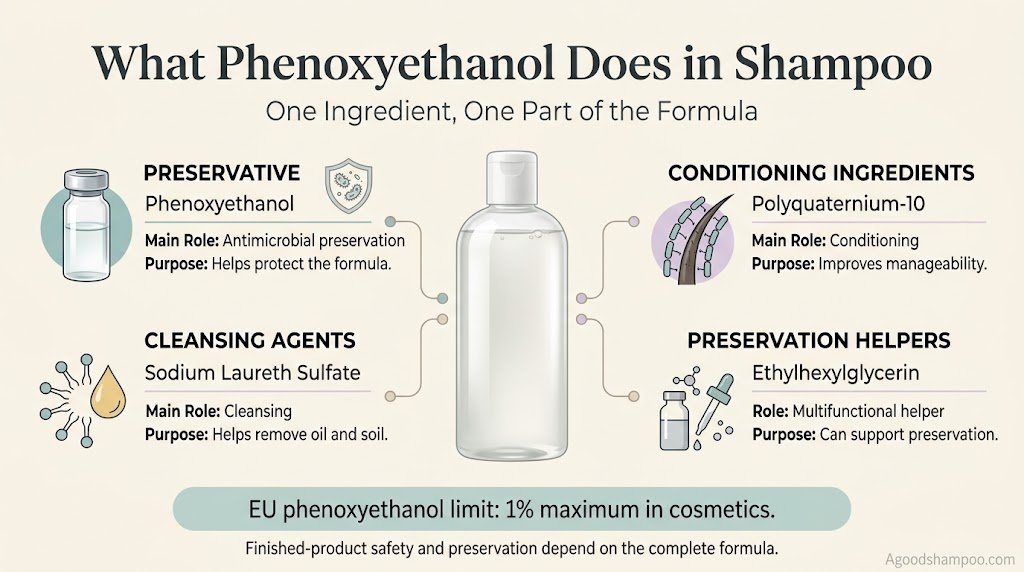
Water, Sodium Laureth Sulfate, Cocamidopropyl Betaine, Glycerin, Sodium Chloride, Polyquaternium-10, Phenoxyethanol, Ethylhexylglycerin, Citric Acid, Fragrance.
The ingredients perform different functions.
Sodium laureth sulfate and cocamidopropyl betaine contribute to cleansing. Glycerin helps retain moisture within the product and may contribute humectant properties. Polyquaternium-10 provides conditioning functions.
Phenoxyethanol contributes antimicrobial preservation, while ethylhexylglycerin can support the preservation system.
Citric acid may help adjust pH.
An ingredient list is useful for understanding these roles, but it cannot reveal the finished formula’s exact preservative concentration or prove its microbiological stability.
You can see how other formulation ingredients influence product selection in our Luseta shampoo review and our analysis of LATHER shampoo.
If you want a broader understanding of ingredient functions, our guide to shampoo ingredients and potential concerns offers additional context. Individual ingredient claims should always be judged against current evidence and the complete formula.
When a Phenoxyethanol-Free Shampoo Makes Sense
Avoiding phenoxyethanol is reasonable if you have a confirmed allergy or a healthcare professional has advised you to exclude it.
You may also choose a different shampoo if a particular formula repeatedly irritates your scalp, even when the responsible ingredient remains uncertain.
For most people, however, phenoxyethanol’s presence alone is not a sound reason to reject an otherwise suitable shampoo.
It performs an important preservation function, and scientific safety evaluations support its use at permitted cosmetic concentrations.
When comparing products, consider cleansing performance, scalp comfort, appropriate conditioning, and the manufacturer’s responsibility to produce a properly preserved formula.
The practical choice is not between shampoo with chemicals and shampoo without chemicals. It is between complete products with different ingredients, performance characteristics, and individual suitability.

Carolina Herrera writes about color-treated, damaged, and chemically processed hair. She focuses on understanding breakage, choosing suitable shampoos, and making sense of repair claims. Her goal is to help readers care for their hair with realistic expectations and informed product choices.