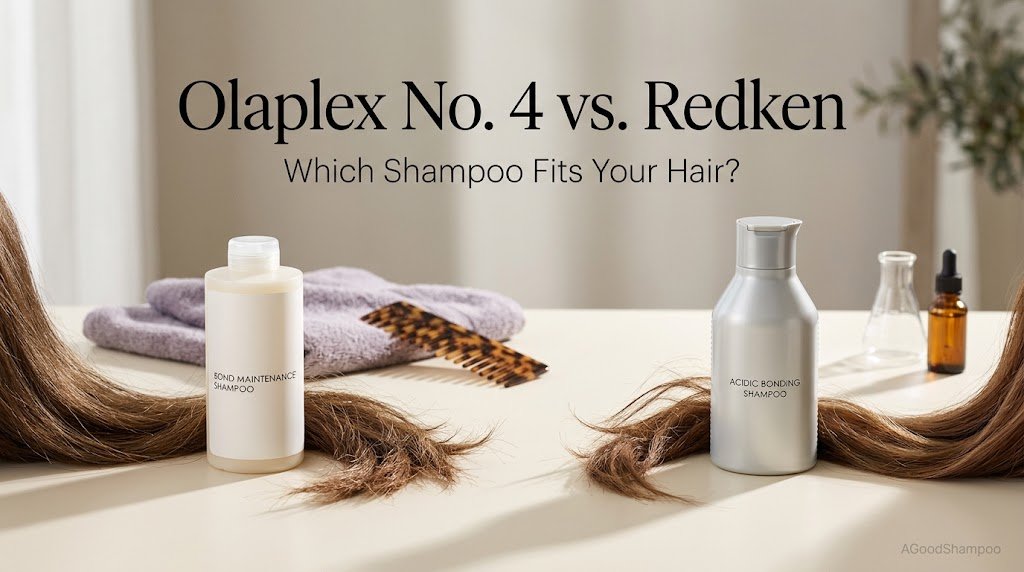
 Olaplex No. 4 and Redken Acidic Bonding Concentrate are both premium shampoos marketed for damaged hair. Yet they approach hair care with different signature ingredients: Olaplex uses Bis-Aminopropyl Diglycol Dimaleate, while Redken emphasizes citric acid and its Bonding Care Complex.
Which is better? Olaplex No. 4 is worth considering if you want a bond-maintenance shampoo with a combination of conditioning agents, while Redken Acidic Bonding Concentrate is a reasonable choice if you prefer an acidic, conditioning-focused formula for chemically treated or damaged hair. Neither has been independently established as the superior shampoo in a reliable head-to-head clinical comparison.
Both contain sulfate-free cleansing systems, silicones, and conditioning ingredients. Their differences matter, but the best choice depends on your hair’s condition, how each formula feels after washing, and what you expect a shampoo to accomplish.
Olaplex No. 4 vs. Redken Acidic Bonding at a Glance
These shampoos compete in the same premium damage-care category, although their brands emphasize different technologies.
| Feature | Olaplex No. 4 | Redken Acidic Bonding Concentrate |
|---|---|---|
| Product type | Bond Maintenance Shampoo | Acidic Bonding Concentrate Shampoo |
| Signature technology | Olaplex Bond Building Technology | Redken Bonding Care Complex |
| Highlighted ingredient | Bis-Aminopropyl Diglycol Dimaleate | Citric acid |
| Cleansing system | Sulfate-free | Sulfate-free |
| Conditioning ingredients | Amodimethicone and conditioning polymers | Dimethicone, amodimethicone and conditioning polymers |
| Main positioning | Strengthening and bond maintenance | Acidic conditioning and strength care |
| Color-treated hair | Marketed as suitable | Marketed as suitable |
| Fragrance | Contains fragrance | Contains fragrance |
| Common bottle size | 250 mL | 300 mL |
| Independent comparative winner | Not established | Not established |
The comparison concerns the standard shampoos, not Olaplex No. 3, Redken’s intensive treatment, or either brand’s complete hair-care system.
It is also worth noting that neither shampoo is silicone-free according to the manufacturer ingredient lists reviewed. Silicones can reduce friction, improve detangling, and make damaged hair feel smoother. Their presence is not automatically a disadvantage.
How Their Formulas Actually Differ
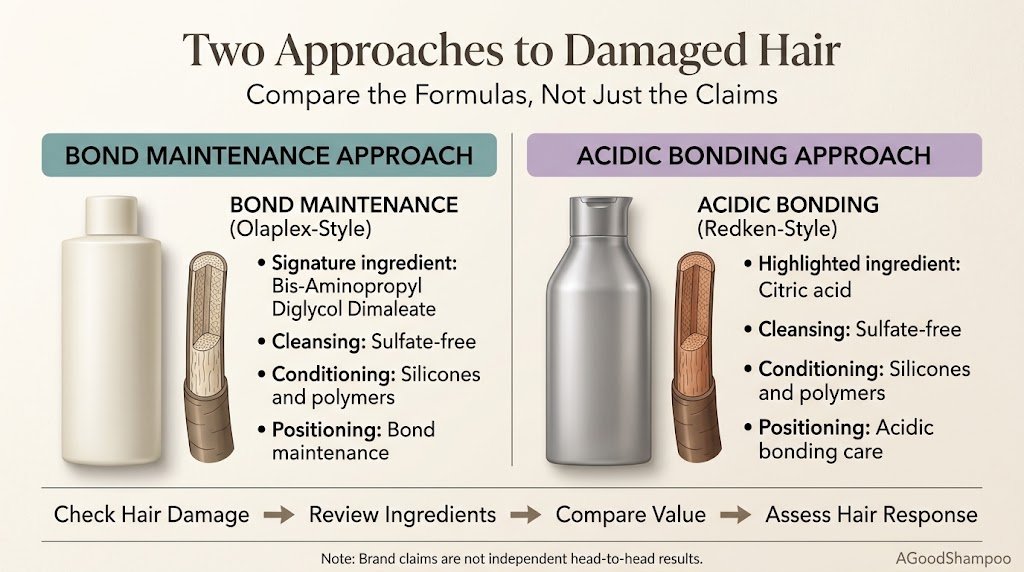
The most useful differences become clearer when we move beyond the words bond repair and examine the ingredients.
Olaplex No. 4: Bond-building technology and conditioning
Olaplex No. 4 contains Bis-Aminopropyl Diglycol Dimaleate, the ingredient associated with the brand’s patented bond-building technology.
Olaplex markets this technology as helping address damage involving disulfide bonds, which contribute to the structural strength of hair.
The shampoo also contains cleansing surfactants such as Sodium Lauroyl Methyl Isethionate, Cocamidopropyl Hydroxysultaine, and Potassium Cocoyl Glycinate in its published formula.
These ingredients remove oil and soil without relying on Sodium Lauryl Sulfate or Sodium Laureth Sulfate.
Other ingredients, including amodimethicone, polyquaternium conditioning agents, panthenol, and humectants, help explain its broader conditioning design.
Amodimethicone is a silicone used to improve lubrication and manageability. Conditioning polymers can also reduce friction between strands.
Consequently, any improvement in softness or combability should not automatically be attributed solely to Olaplex’s signature bond-building ingredient.
For a closer look at the individual formula, see our article explaining why Olaplex shampoo may work well for damaged hair.
Redken Acidic Bonding: Citric acid and conditioning agents
Redken Acidic Bonding Concentrate Shampoo uses citric acid as a highlighted component of its Bonding Care Complex.
Citric acid can serve several functions in cosmetic formulations, including pH adjustment. Redken also makes specific manufacturer claims about how its bonding system helps reinforce weakened hair.
The published shampoo formula contains cleansing ingredients such as Decyl Glucoside, Sodium Cocoyl Isethionate, and Cocamidopropyl Betaine.
It also includes panthenol, glycerin, dimethicone, amodimethicone, and Polyquaternium-67.
These components contribute to the formula’s conditioning properties.
Redken describes its shampoo as acidic, but the presence of citric acid alone cannot tell consumers the exact finished-product pH. That requires a product-specific measurement or reliable manufacturer disclosure.
An acidic formulation may help manage hair-fiber surface behavior, but lower pH does not automatically mean better performance.
Does one have better ingredients?
Not on the basis of an ingredient list alone.
Olaplex emphasizes its proprietary molecule. Redken combines acidic formulation positioning with conditioning technology.
Both contain ingredients capable of affecting friction, hair feel, and manageability.
The listed ingredients do not reveal every concentration, interaction, or performance characteristic of the finished formula. That makes a universal ingredient-based winner difficult to justify.
Do They Repair Damaged Hair in the Same Way?
Not exactly, although neither shampoo’s full mechanism can be established from marketing descriptions alone.
Hair damage involves several different changes. Bleaching can alter hair proteins and protective surface lipids. Heat and repeated mechanical friction can increase brittleness, roughness, and breakage.
The resulting problems do not all respond to the same cosmetic approach.
Olaplex focuses its messaging on bond maintenance. Redken emphasizes acidic bonding care and reinforcement of weakened hair.
Both may improve the cosmetic condition of damaged hair, but neither should be presented as restoring severely damaged hair completely to its original structure.
What do the performance claims actually show?
Redken reports a 56% reduction in breakage when its Acidic Bonding Concentrate Shampoo and Conditioner are used together, compared with a non-conditioning shampoo.
The brand also reports an 11-times improvement in smoothness for a three-product regimen that includes shampoo, conditioner, and leave-in treatment, using a non-conditioning shampoo as the comparator.
These are manufacturer-reported claims about specific product combinations, not evidence that Redken shampoo alone produces those results.
They also do not establish that Redken outperforms Olaplex.
Likewise, Olaplex’s bond-building claims should be understood as manufacturer claims unless supported by relevant independent testing of the specific finished shampoo.
For consumers, the most realistic goals are improved cleansing comfort, easier detangling, manageable texture, and reduced friction during everyday styling.
Which Shampoo Fits Your Hair Better?
Hair type matters, but existing damage and the complete routine are often more informative than texture labels alone.
Bleached, highlighted, or chemically damaged hair
Both shampoos are reasonable candidates for chemically treated hair.
Olaplex may appeal if you specifically want a formula built around its signature bond-maintenance technology.
Redken may appeal if you want an acidic, conditioning-focused shampoo designed for chemically treated hair.
However, severely bleached hair often needs a suitable conditioner or leave-in product as much as it needs shampoo.
If your hair stretches excessively, snaps easily, or develops persistent tangles, switching between these shampoos alone is unlikely to solve every problem.
Our guide to shampoos for dry, damaged hair explains broader product-selection considerations.
Color-treated hair
Both shampoos are marketed as suitable for colored hair.
Color retention depends on the dye chemistry, cleansing formulation, washing frequency, water exposure, and other factors.
Redken emphasizes color-fade protection as part of its product positioning. Olaplex is also promoted for chemically processed and colored hair.
That does not prove either one maintains color longer in a direct comparison.
If preserving an expensive hair-color service is your priority, combine a compatible shampoo with sensible washing habits and conditioning.
See our guide to shampoo for color-treated hair for additional considerations.
Fine or easily weighed-down hair
Fine hair may become flat when a cleansing or conditioning formula leaves more material behind than the user prefers.
Both shampoos contain conditioning agents, so neither can automatically be declared the lighter option.
Start with a small amount, concentrate cleansing on the scalp, rinse thoroughly, and assess the result after several normal washes.
If your roots feel heavy while the ends remain rough, consider whether the entire routine is depositing too much product rather than assuming bond-building technology is responsible.
Olaplex also sells a separate No. 4 Fine shampoo, but it is not the standard No. 4 product being compared here.
Curly, coarse, or naturally textured hair
Curly and coarse hair frequently benefits from good lubrication and manageable detangling.
Either shampoo could form part of a suitable routine, especially when followed by an effective conditioner.
The best result will depend on how the cleansing system and conditioning ingredients work with your hair.
Neither curl pattern nor hair porosity provides a scientifically reliable reason to select one brand automatically.
Price, Bottle Size and Everyday Value
The common standard bottles are 250 mL for Olaplex No. 4 and 300 mL for Redken Acidic Bonding Concentrate.
Because the sizes differ, comparing bottle prices alone can be misleading.
Price per 100 mL = Bottle price ÷ Bottle size in mL × 100
For example, if a hypothetical 250 mL shampoo costs $30, its price per 100 mL is $12. A hypothetical 300 mL shampoo costing $33 would cost $11 per 100 mL.
These are calculation examples, not verified current prices for either brand.
Also consider how much product you use per wash, whether you need a separate conditioner, and whether the product consistently leaves your hair manageable.
A cheaper bottle per milliliter is not necessarily better value if you dislike the results or routinely use more product.
What to Check Before Switching
Before replacing your current shampoo, check the product label and consider what problem you actually want to solve.
For scalp irritation: Both shampoos contain fragrance. Neither should be treated as automatically suitable for highly sensitive skin. Stop using a product if it causes persistent irritation or an allergic reaction.
For stubborn dryness: A different conditioner or leave-in treatment may be more relevant than another premium shampoo.
For product residue: Review your washing and styling routine. A rich conditioning formula is not necessarily the best choice when hair already feels heavily coated.
For regional purchases: Ingredient lists may change. Check the packaging of the exact bottle you receive, especially when purchasing from different countries.
For severe breakage: Reduce damaging heat, chemical processing, and mechanical stress. Products may improve manageability, but they cannot restore every damaged fiber.
Choosing Between Olaplex and Redken
Choose Olaplex No. 4 if its bond-maintenance positioning appeals to you, you prefer its overall ingredient combination, and you want a conditioning shampoo for damaged or chemically treated hair.
Choose Redken Acidic Bonding Concentrate if you prefer an acidic, conditioning-focused approach and want a shampoo designed around Redken’s Bonding Care Complex.
Neither is an evidence-established winner for every hair type. Both use conventional cosmetic conditioning technology alongside their signature ingredients.
If you already have a shampoo that cleanses comfortably and a conditioner that keeps your lengths manageable, there is no compelling reason to switch solely because another bottle promises bond repair.
For damaged hair, choose the formula that delivers comfortable cleansing and manageable strands, then protect those results with appropriate conditioning and gentler styling.

Carolina Herrera writes about color-treated, damaged, and chemically processed hair. She focuses on understanding breakage, choosing suitable shampoos, and making sense of repair claims. Her goal is to help readers care for their hair with realistic expectations and informed product choices.