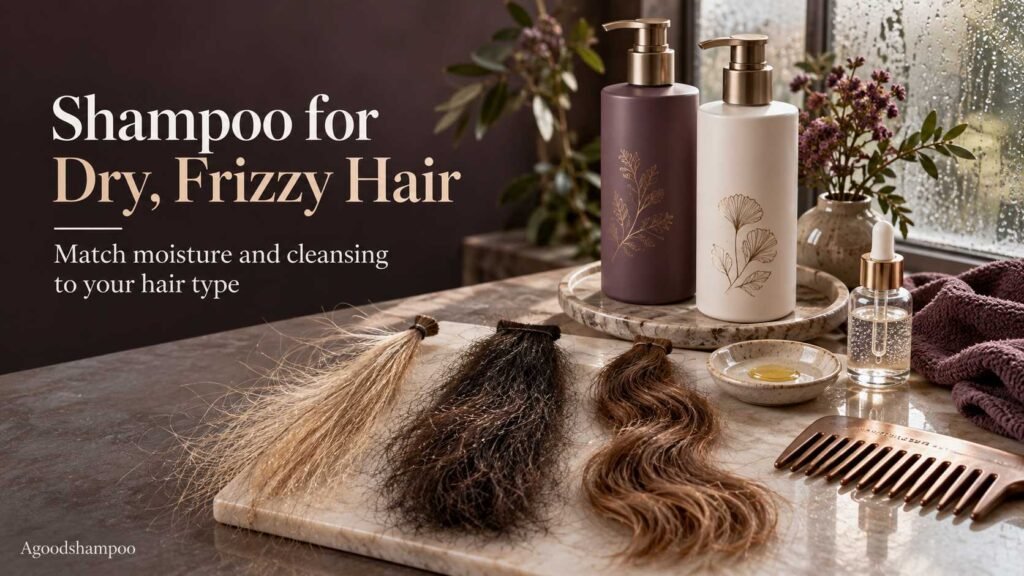
 If your hair feels dry, rough and frizzy, a good shampoo should clean the scalp without leaving the lengths feeling even drier. For many people, that means choosing a moisturizing or conditioning shampoo and pairing it with a proper conditioner rather than searching for one shampoo that promises to eliminate frizz by itself.
There isn’t one best shampoo for every person with dry, frizzy hair. Fine hair usually needs lighter conditioning than thick or coarse hair. Bleached or heat-damaged hair has different priorities from naturally dry hair. And if your roots become oily while your ends stay dry, an extra-rich shampoo across the whole head can create another problem.
The most useful approach is to match the shampoo to your hair texture, scalp condition and level of damage.
| Hair situation | What usually matters most | Useful shampoo direction |
|---|---|---|
| Fine, dry and frizzy | Moisture without excessive weight | Lightweight moisturizing shampoo |
| Thick or coarse and frizzy | More conditioning and smoothing | Richer nourishing shampoo |
| Bleached or heat-damaged | Gentle cleansing plus conditioning support | Damage-focused or moisture-rich shampoo |
| Color-treated and dry | Cleansing that respects color plus conditioning | Color-care moisturizing shampoo |
| Oily roots with dry ends | Effective scalp cleansing without overworking the lengths | Balanced shampoo used mainly on scalp |
| Dehydrated hair | Water-binding and conditioning ingredients | Hydrating shampoo |
Why Dry Hair Often Becomes Frizzy
Dryness and frizz often appear together, but they’re not exactly the same thing.
Dry hair lacks enough lubrication and conditioning at the hair surface. Frizz describes strands that do not lie smoothly with the rest of the hair. Damage, rough handling, heat, chemical processing, hair texture and humidity can all contribute.
A rougher hair surface creates more friction and makes strands harder to align. Hair that has been bleached, repeatedly heat-styled or chemically processed can become particularly difficult to keep smooth.
That is why a shampoo can help with frizz without literally repairing every source of damage. A well-matched formula can clean while depositing conditioning ingredients that improve softness, slip and manageability. Those are cosmetic hair-fiber effects, not permanent biological repair.
Washing technique matters too. The American Academy of Dermatology recommends concentrating shampoo mainly on the scalp instead of repeatedly rubbing it through the entire length of the hair. This removes oil and buildup where cleansing is needed while helping limit unnecessary drying of the lengths.
That small change can matter when your scalp needs cleaning but your ends already feel rough.
For a more specific guide for lightweight hair, see our guide to choosing a shampoo for thin, frizzy hair. If your hair is dense or coarse instead, our guide to shampoo for thick, frizzy hair covers the opposite problem: getting enough conditioning without simply chasing the word anti-frizz on the bottle.
What to Look for in a Shampoo for Dry Hair
The label moisturizing is useful, but it does not tell you everything.
What matters is the complete formula and how your hair responds to it.
Cleansing strength should fit your scalp
Shampoo’s first job is cleaning. If a formula cleans too aggressively for your routine, your lengths may feel rough or tangled afterward. But the answer is not necessarily to avoid every sulfate.
Sodium laureth sulfate, sodium C14-16 olefin sulfonate, cocamidopropyl betaine and other surfactants are cleansing ingredients. Their real-world effect depends on the complete surfactant system, concentrations, conditioning agents, how often you wash and your individual hair.
A shampoo containing a sulfate is therefore not automatically bad for dry hair, just as a sulfate-free formula is not automatically moisturizing.
That distinction becomes clear when we look at actual dry-hair shampoos. L’Oréal Paris Extraordinary Oil Nourishing Shampoo sold in India currently lists sodium laureth sulfate near the beginning of its ingredient list, but it also contains dimethicone, amodimethicone, polyquaternium-6, glycerin and several oils. The manufacturer markets the product specifically toward dry, dull and frizz-prone hair.
Formula context matters more than judging one ingredient in isolation.
Conditioning ingredients can improve smoothness
Ingredients such as dimethicone, amodimethicone and conditioning polymers can reduce friction and help strands feel smoother and easier to comb.
Silicone isn’t automatically a problem for dry or frizzy hair. For someone whose main concern is roughness and difficult detangling, the smoothing effect can be useful.
That doesn’t mean everyone needs a silicone-rich formula. Fine hair can sometimes feel flatter with richer conditioning systems, while coarse or damaged hair may tolerate considerably more.
Humectants can support hydration
Glycerin and sodium hyaluronate are examples of ingredients used in moisturizing formulas.
L’Oréal Paris Hyaluron Moisture Shampoo currently contains sodium hyaluronate as well as conditioning ingredients including dimethicone and amodimethicone. L’Oréal positions the range for dehydrated, dry and frizz-prone hair.
The brand reports up to 72 hours of hydration, but that figure comes from an instrumental test involving the shampoo-and-conditioner system. It should therefore be understood as a manufacturer performance claim, not independent proof that every person will experience 72 hours of hydration.
Oils can support softness, but more isn’t always better
Oil-containing shampoos may suit thick, coarse or very dry hair when the overall formula provides enough conditioning.
But seeing argan oil, coconut oil or almond oil on a label doesn’t automatically make a shampoo superior. Ingredient concentration isn’t normally disclosed on cosmetic ingredient lists, and the performance of the whole formula matters more than the presence of one fashionable oil.
This is especially important with herbal shampoos. Botanical ingredients can be part of a pleasant formula, but a natural-looking label does not tell you how gently the shampoo cleans or how well it conditions your particular hair.
Match the Shampoo to Your Type of Dry, Frizzy Hair
Two people can both describe their hair as dry and frizzy while needing very different shampoos.
Fine Hair That Gets Dry and Frizzy
Fine hair needs a careful balance. Too little conditioning can leave it fluffy and rough, but an overly rich formula can make it look flat or greasy.
Look for a moisturizing shampoo that doesn’t rely on an unusually heavy conditioning feel. Conditioner can then be concentrated mainly from the mid-lengths to the ends.
The American Academy of Dermatology similarly recommends adjusting conditioner placement according to hair type. For fine or straight hair, it suggests applying conditioner mainly toward the ends rather than automatically covering everything from the roots downward.
If your current rich anti-frizz shampoo leaves the roots limp by lunchtime, that is a sign to move toward lighter hydration rather than assuming your hair needs even more oil.
Thick, Coarse or Curly Dry Hair
Thick, coarse and curly hair often tolerates richer conditioning better.
Here, a shampoo that leaves a little more slip may be preferable to one that produces an extremely squeaky-clean finish. Conditioner is particularly important.
AAD guidance notes that people with dry or curly hair can apply conditioner through the full length of the hair, while people with fine or straight hair generally need less.
Leave-in conditioner can also help when regular conditioner isn’t enough. Dermatologists cited by the AAD recommend choosing leave-in products according to hair type: thick hair generally needs more product while fine hair needs less. Leave-in conditioners can help reduce frizz, static and flyaways and make hair easier to detangle.
Bleached, Colored or Heat-Damaged Hair
Hair that has been repeatedly bleached, colored or exposed to high heat may feel dry because its structure has been damaged.
Shampoo cannot restore damaged hair to its untouched biological state. What good hair care can do is reduce additional stress and improve the way damaged fibers feel and behave.
Use moderate water temperature, avoid aggressive towel rubbing and reduce unnecessary high heat. The AAD recommends limiting heat styling and using low or medium heat settings where possible.
For dry color-treated hair, a color-oriented moisturizing formula may also make sense.
In the United States, L’Oréal Paris currently sells EverPure Sulfate-Free Moisturizing Shampoo specifically for dry, dehydrated, frizzy and color-treated hair. The current ingredient list includes sodium C14-16 olefin sulfonate, glycerin, cocamidopropyl betaine, sodium lauroyl sarcosinate and conditioning polymer polyquaternium-7.
Notice another useful lesson here: sulfate-free does not mean surfactant-free. The formula still needs cleansing agents because shampoo still needs to clean.
Readers specifically comparing that range can see our separate discussion of L’Oréal sulfate-free shampoo.
Oily Roots With Dry, Frizzy Ends
This is one of the easiest hair types to mistreat.
If the scalp becomes oily quickly but the lengths feel dry, coating everything in a very rich shampoo may leave the roots heavy. Going in the opposite direction with harsh repeated washing can make the ends feel worse.
A better approach is to shampoo primarily where oil and buildup occur: the scalp. Let the lather rinse through the lengths instead of vigorously rubbing shampoo into the ends.
Then use conditioner strategically where the hair actually needs it.
Our guide to an oily scalp with dry hair goes deeper into this combination.
Which L’Oréal Shampoo Is Good for Dry Hair?
For shoppers in India, two current L’Oréal Paris ranges stand out for different kinds of dryness.
L’Oréal Paris Hyaluron Moisture Shampoo is the more logical starting point when your hair feels dehydrated and you want lightweight hydration. L’Oréal currently describes it as suitable for dry, dehydrated and frizzy hair, and the formula contains sodium hyaluronate plus silicones and conditioning ingredients.
The manufacturer’s current instructions recommend using it two to three times a week depending on scalp type and hydration needs, followed by conditioner.
L’Oréal Paris Extraordinary Oil Nourishing Shampoo makes more sense when dryness comes with roughness, dullness and a preference for a richer smoothing feel.
Its current India formula lists sodium laureth sulfate and coco-betaine as part of the cleansing system, along with dimethicone, amodimethicone, polyquaternium-6, glycerin and oils including coconut, argan, camelina, jojoba and sweet almond.
That combination illustrates why sulfate-free should not be your only shopping criterion.
For a fuller formula discussion, see our review of L’Oréal Extraordinary Oil Shampoo.
If your hair is fine and becomes limp easily, Hyaluron Moisture may be the more obvious first option of these two. If your hair is thick, rough, dull and strongly frizz-prone, the richer Extraordinary Oil direction may appeal more.
Those are practical suitability judgments based on the current formulations and positioning, not guarantees about how either shampoo will perform on every head of hair.
Which Biotique Shampoo Is Good for Dry Hair?
Biotique currently positions Soya Protein Intense Repair Shampoo & Conditioner for dry and damaged hair.
The Indian product page highlights soya protein, almond oil, amla oil and wild turmeric. Biotique says the formula cleanses gently, protects permed hair, helps repair dry and damaged hair and promotes shine.
Those repair and performance statements come from the manufacturer. The product page does not establish that the finished shampoo biologically repairs damaged hair in the medical sense.
For shoppers specifically wanting a Biotique option, Soya Protein is therefore the clearest current match from the brand’s own range for dry or damaged hair.
But don’t choose it simply because the ingredients sound herbal. Pay attention to what happens after several washes. Your hair should feel clean and manageable rather than increasingly rough, tangled or coated.
That response matters more than whether a shampoo belongs to a herbal, salon, sulfate-free or oil-infused category.
Choosing Shampoo in India, the USA or Another Market
Product recommendations don’t always transfer neatly across countries.
Brands can use different names, ranges, ingredient lists and sizes in different markets. Even when the bottle looks familiar, the current local formula is the one that matters.
In India, the current L’Oréal Paris site promotes Hyaluron Moisture for dry and frizzy hair and Extraordinary Oil as a nourishing option for dry, dull and frizz-prone hair.
Biotique’s Indian store currently offers Soya Protein Intense Repair Shampoo & Conditioner for dry and damaged hair.
In the United States, L’Oréal’s current range includes EverPure Sulfate-Free Moisturizing Shampoo for Hydrating Dry Hair, marketed for dry, dehydrated, frizzy and color-treated hair.
So the answer to which shampoo is good for dry hair in India is not necessarily identical to the answer for the USA.
Check the manufacturer’s current local product page or the ingredient list on the bottle you’re actually buying rather than relying on an old article, an imported product image or a formula discussed in another country.
Shampoo Alone Usually Won’t Fix Persistent Frizz
This is the part many shampoo roundups miss.
Shampoo matters, but shampoo is mainly a cleansing product. If dry hair keeps looking rough after washing, the rest of the routine can make as much difference as switching shampoo brands.
The AAD recommends using conditioner after washing because conditioner moisturizes, detangles and improves manageability. It also advises being gentle with wet hair, using a wide-tooth comb and avoiding aggressive towel rubbing.
A simple routine for dry, frizzy hair is:
- Shampoo mainly at the scalp. Massage gently rather than scrubbing the lengths together.
- Rinse thoroughly and condition according to your hair type. Fine hair may need conditioner mainly toward the ends, while dry or curly hair often benefits from more complete coverage.
- Detangle gently. A wide-tooth comb can reduce pulling and breakage compared with rough brushing.
- Use leave-in conditioner if rinse-out conditioner isn’t enough. Apply it to the hair rather than the scalp, particularly where the hair is dry, tangled or frizzy.
- Limit excessive heat. Use lower temperatures and heat protection when heat styling is necessary.
If hair remains unusually brittle, keeps breaking, or becomes impossible to manage despite gentler care, a dermatologist can help determine whether there is more going on than ordinary cosmetic dryness. Persistent scalp itching, inflammation, sores or significant shedding also deserve professional assessment rather than repeated shampoo experimentation.
Which Shampoo Should You Choose for Your Dry Hair?
For most people asking which shampoo is good for dry and frizzy hair, the best starting point is a moisturizing formula that leaves the scalp clean without making the lengths feel stripped, followed by conditioner suited to the hair’s thickness and texture.
If your hair is fine and easily weighed down, start with lighter hydration.
If it is thick, coarse and persistently frizzy, a richer conditioning or smoothing formula may make more sense.
If it is bleached, colored or heat-damaged, gentle handling and conditioning matter as much as the shampoo itself.
If you have oily roots and dry ends, shampoo the scalp rather than treating the entire head as uniformly dry.
For L’Oréal shoppers in India, Hyaluron Moisture currently makes the most straightforward choice for dehydrated, dry or frizz-prone hair, while Extraordinary Oil Nourishing Shampoo offers a richer smoothing direction for dry, dull and rough-feeling hair.
For Biotique shoppers, Soya Protein Intense Repair Shampoo & Conditioner is the brand’s current option explicitly positioned for dry and damaged hair.
For US shoppers wanting a sulfate-free, color-conscious option, L’Oréal Paris EverPure Moisture Shampoo is currently marketed for dry, dehydrated, frizzy and color-treated hair.
The important part is not finding the shampoo with the longest list of moisture claims. It is finding the level of cleansing and conditioning your particular combination of scalp, texture and damage actually needs.
Editorial Note: AGoodShampoo researches hair-care topics independently and distinguishes current manufacturer claims from independent hair-care and dermatology guidance. Product formulas can change, so current regional ingredient information should be checked when making a purchase decision.

Marlena Stell makes everyday hair care easier to understand. From choosing a shampoo to managing common hair concerns, she breaks down confusing product claims and practical routines into straightforward advice that helps readers find what works for their needs.