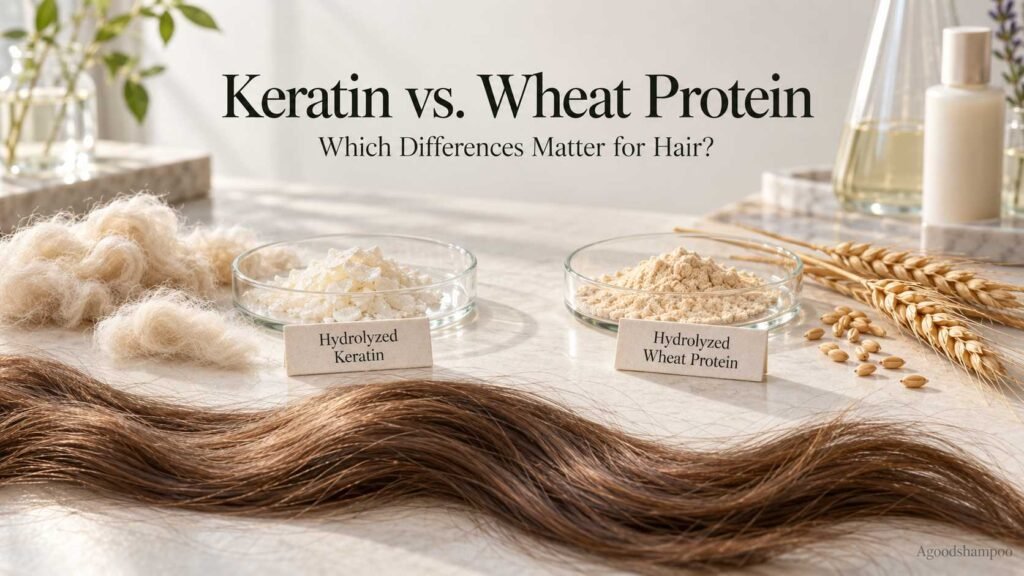
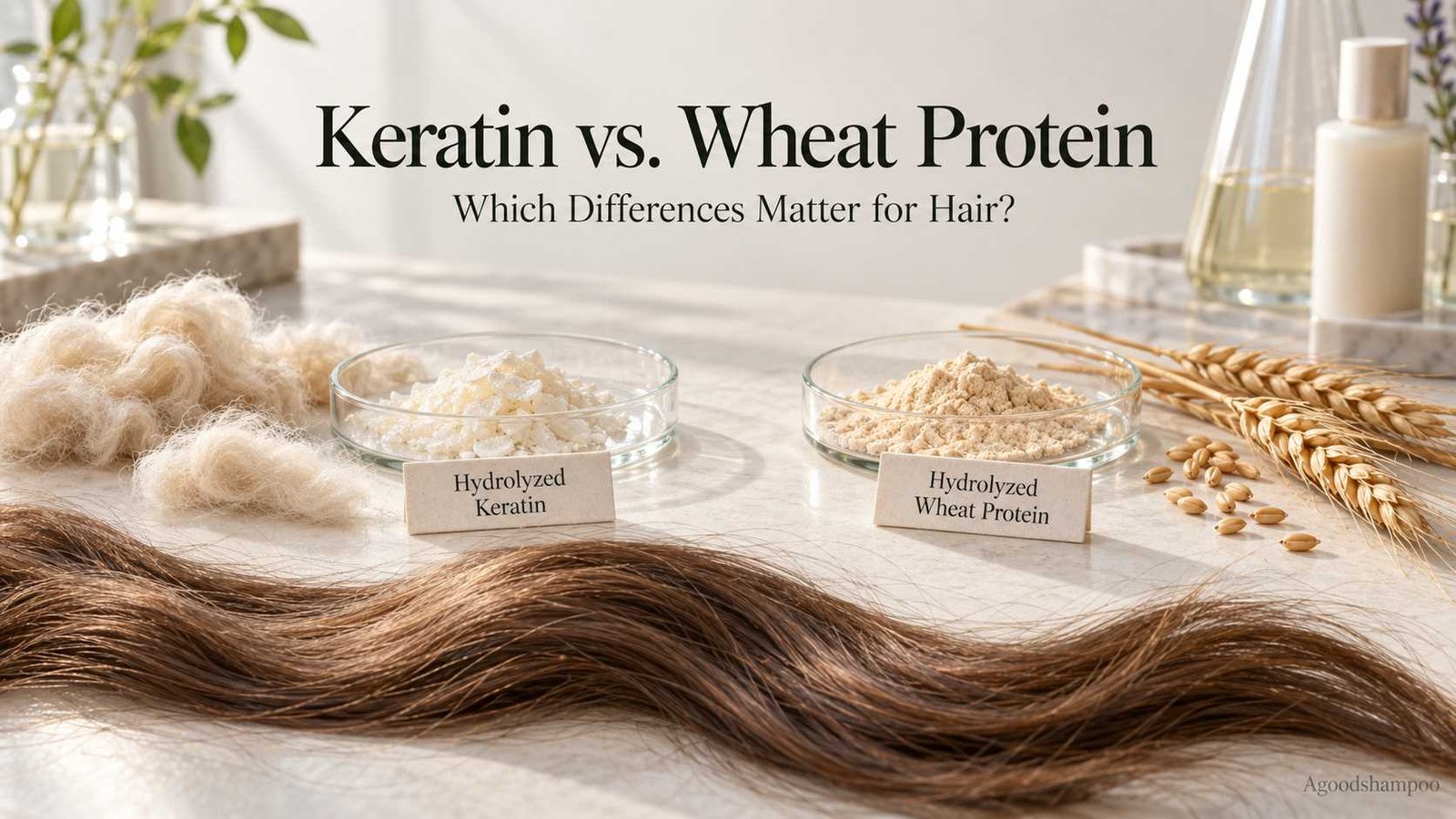
 A shampoo labeled keratin repair and a conditioner containing wheat protein may promise similar results: stronger-feeling hair, fewer tangles, and improved manageability. But the proteins behind those claims are not interchangeable, even if both appear under the broader label of hydrolyzed protein.
Hydrolyzed keratin comes from keratin-rich materials, commonly animal sources such as wool, while hydrolyzed wheat protein comes from wheat. Both are proteins broken into smaller fragments called peptides, which can interact with hair and contribute to conditioning.
Neither is universally better for damaged, fine, or curly hair. Their performance depends on peptide size, processing, concentration, the surrounding formula, and the condition of your hair.
The most useful comparison isn’t simply which protein sounds stronger. It’s what each ingredient can realistically do in a finished hair product.
What Are Hydrolyzed Keratin and Hydrolyzed Wheat Protein?
Hair itself consists largely of keratin, a structural protein responsible for much of the fiber’s mechanical behavior.
Cosmetic manufacturers use hydrolyzed proteins because breaking larger proteins into smaller fragments can change their solubility and ability to interact with hair.
Hydrolyzed Keratin: Protein Derived From Keratin-Rich Materials
Hydrolyzed keratin is produced by breaking down keratin-containing materials into smaller peptide fragments.
Wool is one common source, although other animal-derived keratin materials may be used.
The resulting ingredient isn’t necessarily a single, uniform molecule. Depending on the manufacturing process, it may contain peptides with different molecular weights and chemical characteristics.
Some keratin-derived fragments can attach to hair surfaces, while others may penetrate parts of the fiber under suitable experimental conditions.
Conventional animal-derived hydrolyzed keratin is not vegan. If a brand markets a keratin-like ingredient as vegan, check its actual INCI name and source rather than assuming it is identical to traditional hydrolyzed keratin.
Hydrolyzed Wheat Protein: Plant-Derived Conditioning Peptides
Hydrolyzed wheat protein is produced by breaking down proteins obtained from wheat.
Like hydrolyzed keratin, it contains a mixture of smaller protein fragments rather than one fixed peptide size.
In cosmetic formulations, it can contribute to hair conditioning, manageability, and surface properties such as friction and feel.
Its plant origin makes it a potential choice for vegan hair-care formulations, provided the other ingredients and the finished product meet the relevant vegan requirements.
However, plant-derived doesn’t automatically mean safer, gentler, or better suited to every person.
Hydrolyzed wheat protein also has specific allergy considerations that are important when assessing its use in cosmetics.
Hydrolyzed Keratin vs. Wheat Protein: Key Differences
| Feature | Hydrolyzed Keratin | Hydrolyzed Wheat Protein |
|---|---|---|
| Primary source | Keratin-rich materials, commonly animal-derived | Wheat |
| Processing | Protein hydrolysis | Protein hydrolysis |
| Composition | Mixture of keratin-derived peptides | Mixture of wheat-derived peptides |
| Main cosmetic purpose | Hair conditioning | Hair conditioning |
| Surface deposition | Possible | Possible |
| Hair-fiber penetration | Depends on peptide properties and conditions | Depends on peptide properties and conditions |
| Improvement in combability | Possible in suitable formulas | Possible in suitable formulas |
| Permanent damage repair | Not established | Not established |
| Vegan suitability | Usually unsuitable when animal-derived | Plant-derived |
| Important sensitivity concern | Individual ingredient reactions | Documented sensitization concerns for certain wheat hydrolysates |
The differences in source and composition are clear. The differences in performance are more complicated.
For example, hydrolyzed wheat protein isn’t automatically a smaller or lighter molecule than hydrolyzed keratin. Both names cover materials whose molecular-weight distributions may vary.
Likewise, a shampoo containing keratin is not guaranteed to provide greater strengthening benefits than one containing wheat protein.
How Hydrolyzed Proteins Interact With Hair
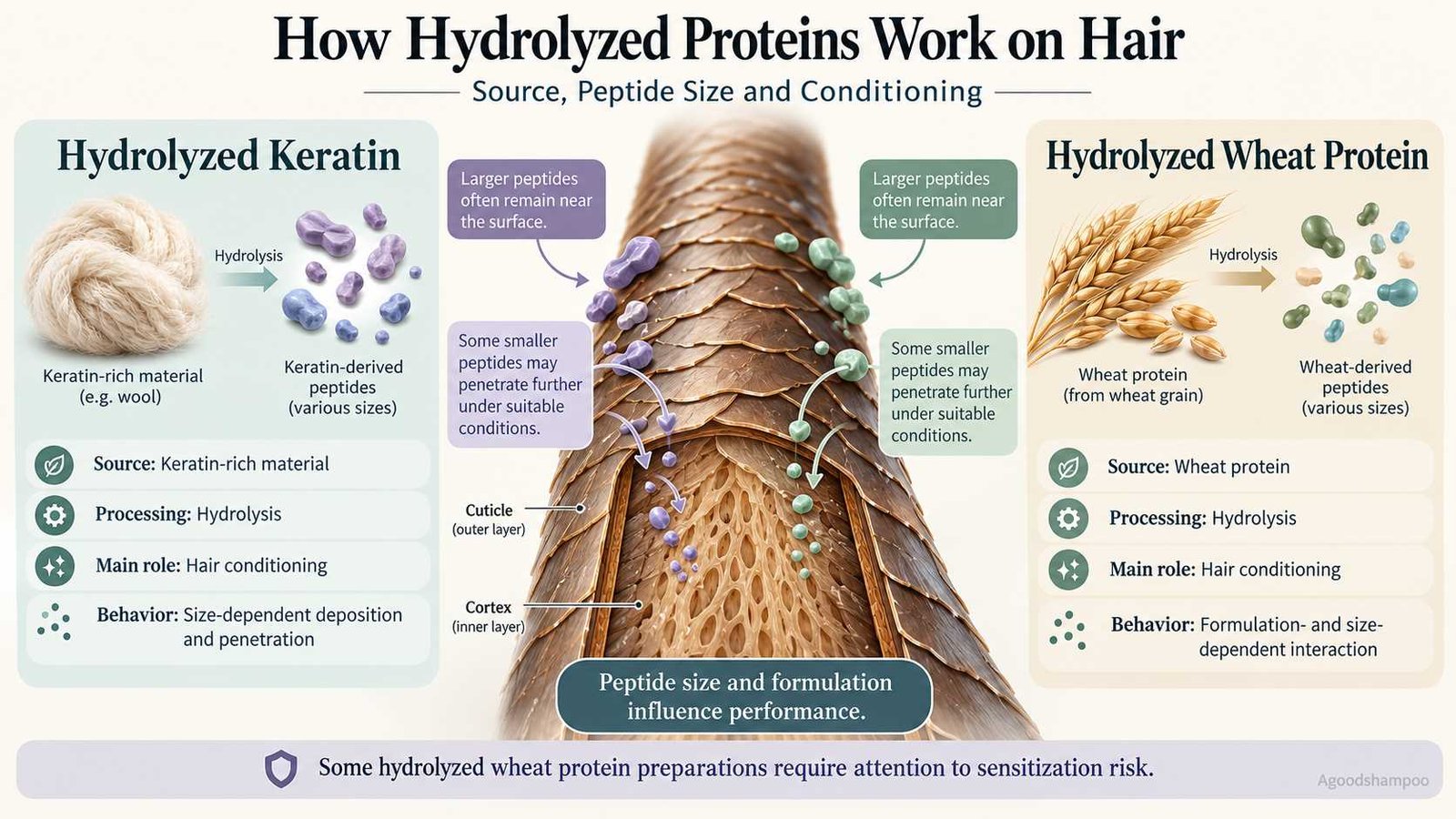
Hair fibers have an outer cuticle and an inner cortex. Chemical processing, heat, and mechanical wear can change the fiber’s surface condition and structural properties.
Hydrolyzed proteins may interact with these structures in different ways.
Why Peptide Size Matters
Molecular weight describes the mass of a molecule. Hydrolysis can produce fragments of varying sizes, often measured in daltons (Da).
A 2021 study published in the International Journal of Cosmetic Science investigated wool-derived hydrolyzed keratin preparations with molecular weights of approximately 221, 2,577, and 75,440 Da.
Researchers treated chemically relaxed, highly textured hair and examined penetration and mechanical behavior.
Under those experimental conditions, smaller and intermediate-sized materials penetrated into the hair cortex, while the highest-molecular-weight material remained predominantly near the surface.
Some treatments also improved measured mechanical properties, including resistance to breakage under the study conditions.
These findings demonstrate why molecular size matters. They don’t establish that every low-molecular-weight protein penetrates every hair type or that smaller always means better.
Surface Deposition Can Also Be Useful
Penetration isn’t the only way an ingredient can improve hair feel.
Protein fragments may associate with the hair surface and influence friction, combability, or the way strands move against one another.
A surface-level effect can be valuable, particularly when hair tangles easily or feels rough after washing.
Hydrolyzed wheat proteins have also been investigated for effects on hair-fiber friction and conditioning.
However, research involving chemically modified wheat protein preparations should not be treated as proof that every ordinary Hydrolyzed Wheat Protein ingredient produces identical results.
The complete formula determines how these materials behave.
Which Protein Is Better for Damaged, Fine, or Curly Hair?
There is no reliable rule that assigns hydrolyzed keratin to one hair type and hydrolyzed wheat protein to another.
What matters more is the condition of the hair and the finished product’s conditioning performance.
Damaged or Bleached Hair
Bleached, chemically relaxed, or repeatedly heat-styled hair may experience increased porosity, roughness, and breakage.
Suitable protein-containing treatments may improve certain measurable properties or help the surface feel more manageable.
Hydrolyzed keratin has experimental evidence involving mechanically and chemically treated hair, but that doesn’t automatically make it the better choice in every shampoo.
A well-formulated wheat-protein conditioner may also provide useful cosmetic conditioning.
For noticeably damaged hair, consider how the protein works alongside lubricating conditioners, fatty alcohols, silicones, and other ingredients that reduce grooming friction.
Fine Hair
Fine hair can become limp when a treatment deposits more conditioning material than the hair needs.
Neither protein is inherently guaranteed to feel lightweight.
A modestly conditioning formula may suit fine hair better than a rich mask, regardless of whether the label lists keratin or wheat protein.
If your hair loses volume or feels coated after a treatment, consider using less product or choosing a different formulation.
Curly or Coily Hair
Curly and coily hair can benefit from adequate conditioning because strand shape and interactions can make detangling more demanding.
Either hydrolyzed protein may be useful in a suitable formula.
However, don’t assume curly hair always needs additional protein or that wheat protein preserves curls better than keratin.
The product’s overall slip, conditioning strength, and compatibility with your styling routine matter more.
Our guide to keratin shampoo for curly hair explores how these products fit into curly-hair routines.
High-Porosity Hair
Highly porous hair is often associated with chemical treatment, weathering, or other changes to the hair fiber.
Protein-containing products may improve some aspects of its feel or mechanical behavior, but a porosity label alone cannot identify which ingredient will work best.
Evaluate tangling, roughness, breakage, and how the hair behaves after conditioning instead of relying on an unverified protein-versus-moisture rule.
Can Either Protein Repair Hair or Prevent Breakage?
Hydrolyzed proteins can sometimes improve measurable properties of damaged hair, but the word repair requires context.
In cosmetic science, repair may describe improved combability, changes in tensile properties, reduced friction, or other temporary improvements.
It doesn’t necessarily mean restoring damaged hair to its original, undamaged structure.
A protein ingredient may deposit on the fiber or interact with certain regions of the hair. Those effects can be useful without permanently rebuilding missing cuticle layers or reversing split ends.
The 2021 hydrolyzed keratin study provides evidence of physical changes in treated hair, but its results should not be generalized to every retail shampoo.
In particular, a rinse-off shampoo usually has a different composition and contact time from a controlled experimental treatment.
If a protein mask leaves your strands unusually firm or rough, that sensation does not automatically mean permanent damage or excessive protein inside the hair.
Our article on why hair feels stiff after a protein treatment explains how to assess this problem.
A balanced hair-care routine may include appropriate conditioning, gentle handling, and reduced heat exposure alongside any protein-containing products.
Are Hydrolyzed Keratin and Wheat Protein Safe?
Both ingredient groups have been evaluated for cosmetic safety, but their sources and sensitization considerations differ.
The Cosmetic Ingredient Review Expert Panel has assessed keratin-derived cosmetic ingredients, including Hydrolyzed Keratin, and concluded that the evaluated ingredients are safe under their reported cosmetic-use conditions.
Hydrolyzed wheat protein requires a more specific explanation because some preparations have been associated with immediate allergic reactions.
Why Wheat Protein Molecular Weight Matters for Safety
Reports of contact urticaria and systemic allergic reactions involving certain hydrolyzed wheat protein preparations led to additional scientific evaluation.
In 2014, the European Commission’s Scientific Committee on Consumer Safety reviewed sensitization concerns and concluded that hydrolyzed wheat proteins were considered safe when the maximum molecular weight of peptides in the hydrolysates was 3.5 kDa.
A 2018 Cosmetic Ingredient Review assessment concluded that Hydrolyzed Wheat Protein and Hydrolyzed Wheat Gluten are safe for cosmetic use when formulated to restrict peptides to an average molecular weight of 3,500 Da or less.
These assessments use different molecular-weight descriptions and should not be treated as identical testing specifications.
The 3,500 Da value concerns allergy-related safety assessment, not a recommended concentration in shampoo or a guarantee of greater hair repair.
What If You Have a Wheat Allergy?
A food allergy to wheat and an allergy to a particular cosmetic wheat-protein hydrolysate are not necessarily identical.
Nevertheless, people with known wheat allergies, previous cosmetic reactions, or unexplained contact urticaria should discuss suitable products with an allergy specialist when appropriate.
A standard ingredient list generally doesn’t disclose the molecular-weight distribution of the hydrolyzed protein.
If you experience hives, swelling, or other immediate reactions after applying a product, stop using it and seek medical advice. Breathing difficulty or throat swelling requires emergency care.
The documented reactions are important, but they do not mean that all hydrolyzed wheat protein products commonly cause allergies.
How to Compare Protein Ingredients on Shampoo Labels
Look for these INCI names:
- Hydrolyzed Keratin
- Hydrolyzed Wheat Protein
Other related protein ingredients may appear under different names and shouldn’t automatically be treated as chemically identical.
A shampoo might contain cleansing surfactants, a conditioning polymer, hydrolyzed protein, preservatives, fragrance, and pH-adjusting ingredients.
The protein is one part of that system.
Ingredient order can provide limited concentration information, but it cannot reveal peptide size, degree of hydrolysis, actual deposition, or proven performance.
Also consider the product format. A rinse-off shampoo, a rich conditioner, and a leave-in treatment expose hair to ingredients under different conditions.
If you’re considering a keratin-containing retail formula, our HASK Keratin Shampoo review provides a product-focused example. Our protein shampoo guide offers broader selection considerations.
Finally, don’t confuse hydrolyzed keratin in shampoo with a professional salon keratin smoothing service. Chemical smoothing treatments can involve different substances, high heat, and separate safety concerns.
Choosing Between Keratin and Wheat Protein
Choose hydrolyzed keratin or hydrolyzed wheat protein according to the finished formula, not a promise that one protein is inherently more restorative.
Hydrolyzed keratin has useful experimental evidence for interactions with treated hair. Hydrolyzed wheat protein can also contribute to conditioning, although certain hydrolysates warrant specific allergy considerations.
For damaged hair, prioritize improved combability and reduced friction. For fine hair, watch for excessive heaviness. For curly hair, assess slip and manageability without assuming a fixed protein requirement.
The better product is the one that suits your hair, scalp, and ingredient sensitivities while delivering realistic conditioning benefits.

Michael Chen focuses on the science behind shampoos and hair-care ingredients. He explains how cleansing agents, silicones, proteins, and other formula components work, separating useful evidence from marketing claims to help readers better understand the products they use.