 Yes, you should usually shampoo before applying a hair mask, especially if you’re using a regular rinse-out moisturizing or conditioning treatment. Shampoo removes scalp oil and product residue, while the mask conditions the hair afterward, helping it feel softer and easier to manage.
There is one important exception: pre-shampoo hair masks are designed to be used before washing. Some treatments are also formulated for multiple application methods, so the instructions on your particular product should always come first.
Getting the order right isn’t about following an elaborate beauty routine. It’s about using your treatment as intended without adding unnecessary steps or leaving your hair feeling heavy.
Why Most Hair Masks Go After Shampoo
Most rinse-out hair masks are designed to work on freshly washed, damp hair.
Shampoo helps remove excess sebum, dirt, and styling-product residue. Once the hair has been cleansed, a conditioning mask can be distributed along the lengths without competing with as much surface residue.
Hair masks often contain conditioning agents, fatty alcohols, oils, silicones, or other ingredients that improve how hair feels and behaves. Depending on the formula, they can reduce friction, improve combability, and temporarily smooth rough-feeling strands.
However, shampooing does not automatically make every mask penetrate deeper into the hair. That depends on the ingredients, their properties, and the product’s formulation.
It’s also important to distinguish conditioning from repairing damage. A mask may make bleached or weathered hair feel noticeably smoother, but that doesn’t mean it permanently reverses every type of structural damage.
If a mask is intended for use after shampooing, applying it before washing may remove some of its conditioning effects during the subsequent cleansing step.
When Should a Hair Mask Go Before Shampoo?
Not every treatment belongs after cleansing.
A product labeled pre-shampoo mask, pre-wash treatment, or pre-shampoo conditioner is specifically intended for an earlier stage of the washing routine.
These treatments may be formulated to provide lubrication before cleansing, help with detangling, or prepare dry lengths for washing.
For example, some multi-use masks can be applied before shampooing or afterward, depending on the manufacturer’s instructions.
The important distinction is product design, not simply whether the treatment contains oils or has a thick texture.
| Hair-mask type | Typical application order |
|---|---|
| Regular rinse-out conditioning mask | Shampoo → Mask → Rinse |
| Pre-shampoo mask | Mask → Shampoo → Condition if needed |
| Multi-use hair mask | Follow the selected use method on the label |
| Specialized bond-building treatment | Follow the product’s specific treatment sequence |
| Leave-in or overnight mask | Apply only as directed; it may not require immediate rinsing |
A regular rinse-out hair mask should not automatically be turned into an overnight or pre-shampoo treatment.
Likewise, some specialized treatments have instructions that differ from conventional moisturizing masks. Follow their specified application conditions, contact times, and rinsing steps.
How to Apply a Hair Mask in the Right Order
The two main routines are simple once you identify which type of mask you have.
Method 1: Shampoo Before a Regular Hair Mask
Use this approach when your mask says to apply it after shampooing.
- Wet your hair thoroughly. Use comfortably warm water to saturate your scalp and lengths.
- Shampoo your scalp. Massage gently with your fingertips and avoid vigorously rubbing the lengths.
- Rinse completely. Remove the shampoo thoroughly.
- Remove excess water if directed. Some masks work best on towel-damp hair rather than dripping-wet hair.
- Apply the mask to the appropriate areas. Most conditioning masks target the mid-lengths and ends, although scalp-specific formulas have different directions.
- Leave it on for the recommended time. Follow the label rather than assuming longer application produces better results.
- Rinse as instructed. Remove the mask unless the product is specifically formulated to remain in the hair.
If your hair tangles easily, distribute the treatment gently with your fingers or a suitable wide-tooth comb when the product instructions allow.
Avoid pulling aggressively on wet hair.
Method 2: Apply a Pre-Shampoo Hair Mask
Choose this routine only when your product is intended for pre-wash application.
- Check whether your hair should be wet or dry. Pre-shampoo products differ in their application requirements.
- Distribute the treatment as directed. Many target dry or damaged lengths rather than the scalp.
- Wait for the specified contact time. Do not assume that overnight use is appropriate.
- Rinse if the instructions require it. Some treatments are rinsed before shampooing, while others are cleansed away during the shampoo step.
- Shampoo your scalp gently. Follow the product’s directions regarding the cleansing step.
- Condition afterward if needed. Some routines benefit from a final conditioner, while others do not require one.
The purpose of these methods is different. A conventional mask usually provides conditioning after cleansing, while a pre-shampoo mask is designed to fit before it.
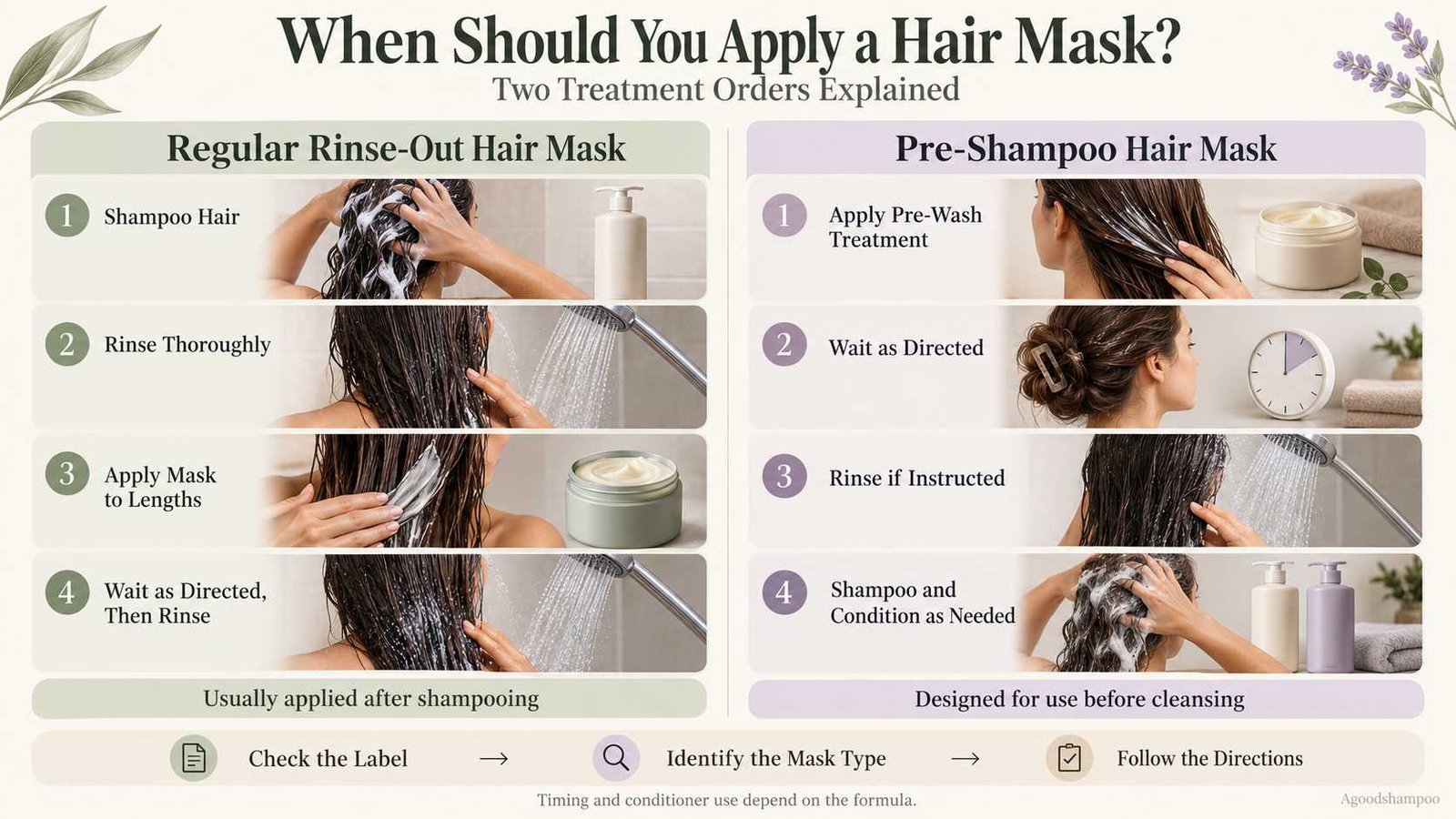
Neither sequence is universally superior.
Should You Use Conditioner After a Hair Mask?
You don’t always need conditioner after a hair mask.
Many rinse-out masks provide conditioning effects similar to those of a regular conditioner, sometimes through richer formulas or different ingredient combinations.
If your mask leaves your hair soft, slippery, and manageable, adding another conditioner may accomplish little.
However, some treatment systems instruct users to apply conditioner after the mask. This is particularly relevant for certain specialized treatments that are not intended to replace ordinary conditioning.
There are also situations where an additional lightweight conditioner may help with detangling, provided your hair tolerates the extra product.
The practical question is whether the additional step improves your hair’s feel without excessive heaviness.
If your hair becomes limp, coated, or unusually difficult to rinse clean, reconsider the amount and combination of products.
Our guide to hair that feels waxy after washing explains why multiple products and residue can sometimes contribute to that uncomfortable feeling.
Does Your Hair Type Change the Order?
Hair type affects how you might use a mask, but it does not override the manufacturer’s application instructions.
| Hair type or concern | Practical approach |
|---|---|
| Fine hair | Use an appropriate amount and avoid unnecessarily heavy layering |
| Thick or dry hair | Concentrate conditioning on the lengths and ends |
| Curly or coily hair | Prioritize slip, gentle distribution, and manageable detangling |
| Bleached or chemically treated hair | Choose suitable conditioning products and avoid excessive handling |
| Oily scalp with dry ends | Cleanse the scalp while targeting the dry lengths |
| Color-treated hair | Follow the treatment’s compatibility and color-care instructions |
Fine Hair That Gets Weighed Down
Using a large amount of rich mask may leave fine hair looking flat.
Try a smaller quantity and concentrate on areas that need conditioning. A lightweight mask may be more suitable than repeatedly switching the washing order.
Dry, Curly, or Bleached Hair
These hair types may benefit from formulas that improve lubrication and reduce friction during detangling.
For bleached hair, conditioning can improve manageability even though it cannot fully undo the chemical changes caused by bleaching.
If you’re unsure whether your shampoo and conditioning products suit your hair, our guide to choosing shampoo and conditioner for different hair types provides additional guidance.
How Often and How Long Should You Use a Hair Mask?
There is no single application time or frequency that works for every product.
Some masks require only a few minutes. Others are formulated for longer contact times or a particular treatment schedule.
For example, certain Kérastase masks direct users to leave the formula on for approximately three to five minutes after shampooing, while other products specify different timings.
Follow the instructions on your own mask rather than copying the timing from another product.
A mask also doesn’t need to be used at every wash unless the product is suitable for that frequency.
Consider your hair’s condition, the richness of the formula, and how it feels between treatments.
If your hair becomes heavy or coated, reduce unnecessary product layering. If it remains difficult to detangle, consider whether your regular conditioning routine provides enough slip.
Avoid assuming that leaving a mask on longer always provides more conditioning.
Choosing the Right Order for Your Mask
Before your next treatment, check the label for three details: whether the mask goes before or after shampoo, whether it should be applied to wet or dry hair, and how long it should remain on.
If it’s a standard rinse-out conditioning mask, shampoo first, apply the mask to the recommended areas, and rinse as directed.
If it’s a pre-shampoo treatment, use it before cleansing and complete the remaining steps specified by the manufacturer.
Don’t add conditioner, extend the application time, or sleep with a rinse-out mask simply because more treatment sounds better.
The most useful routine is the one that follows your product’s intended use and leaves your hair clean, comfortable, and manageable.

Carolina Herrera writes about color-treated, damaged, and chemically processed hair. She focuses on understanding breakage, choosing suitable shampoos, and making sense of repair claims. Her goal is to help readers care for their hair with realistic expectations and informed product choices.