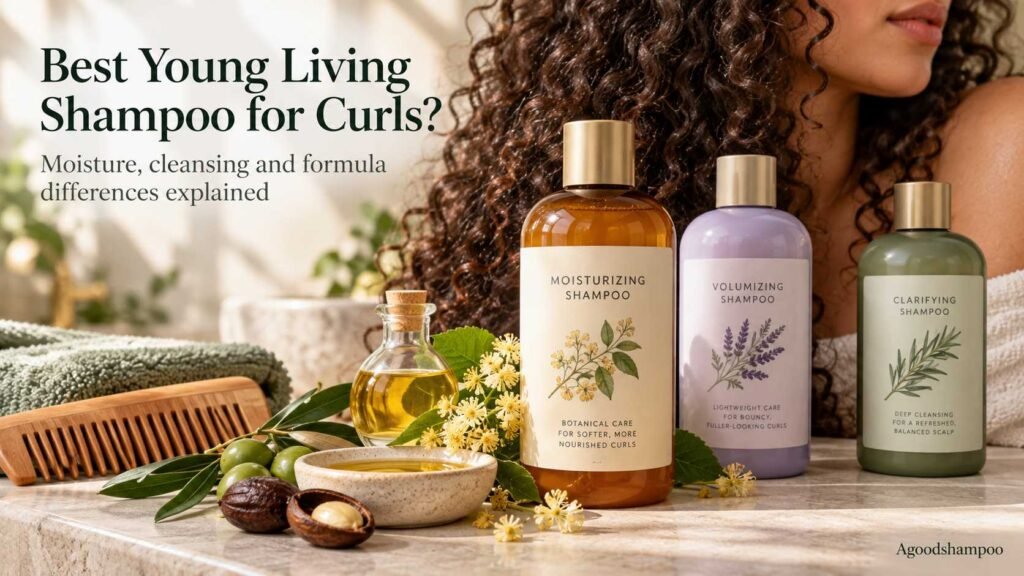
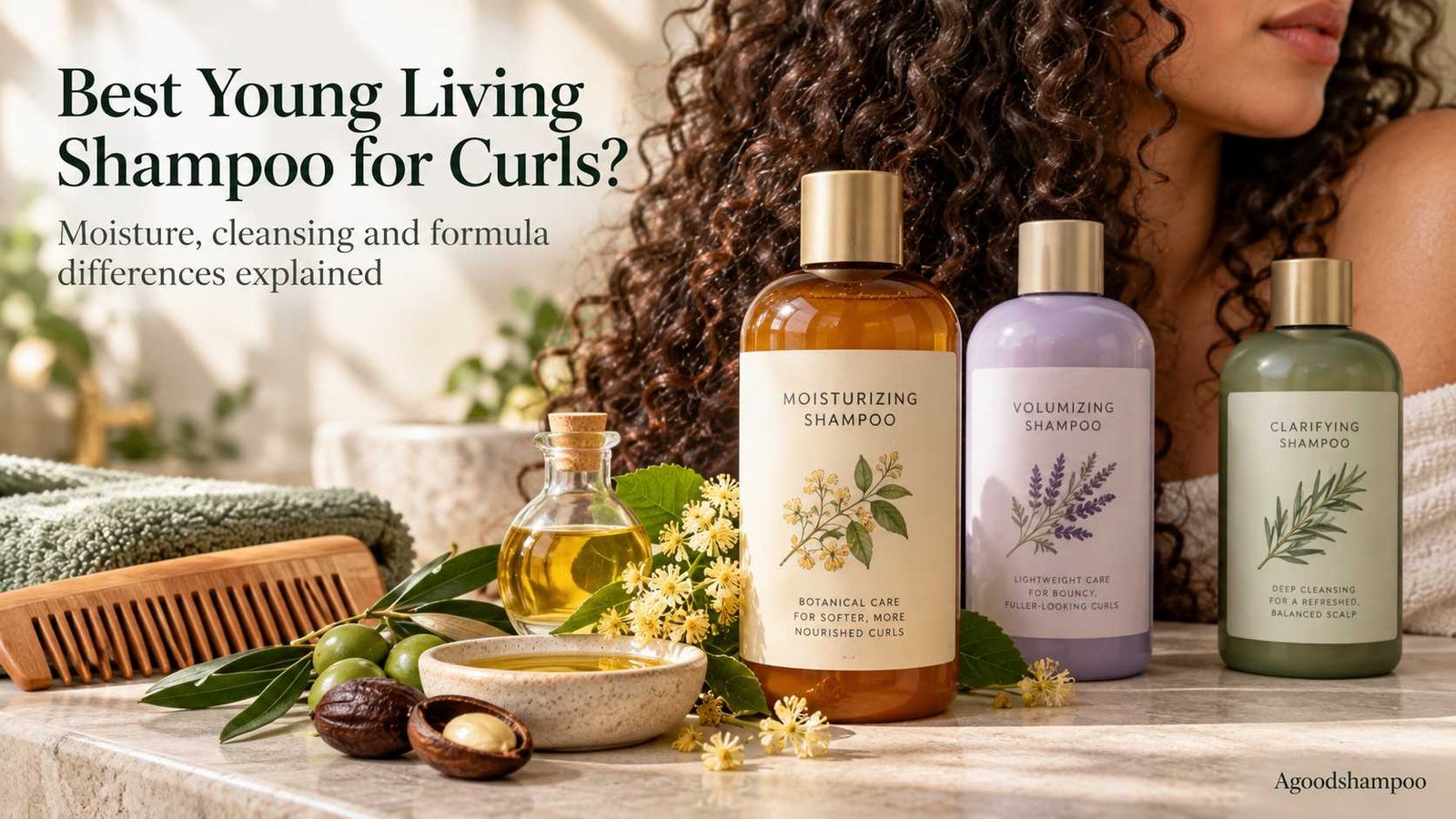
 If you have curly hair and want to stay within Young Living’s hair-care range, Copaiba Vanilla Moisturizing Shampoo is the option I’d consider first for most dry, frizz-prone, coarse, or moisture-hungry curls.
The reason isn’t simply that it is sulfate-free or filled with botanical ingredients. Young Living currently positions Copaiba Vanilla as its moisturizing shampoo for dry or damaged hair, while Lavender Volume Shampoo is aimed more toward fine, thin, or limp hair and Lavender Mint Clarifying Shampoo is intended for a deeper cleanse. That makes Copaiba Vanilla the most logical starting point for curls that tend to become rough or dry after washing.
There is one complication worth knowing before you buy: Young Living does not currently show exactly the same Copaiba Vanilla formula in every country. The Canada, Malaysia, New Zealand, and several other markets display a newer formula with pracaxi seed oil and squalane, while Young Living’s European and Australian pages still show a different formula containing ingredients such as panthenol and silk protein.
That regional difference can change how useful older reviews are, so check the ingredient list on the bottle you can actually buy.
Copaiba Vanilla Is the Young Living Shampoo I Would Choose for Most Curls
Curly hair doesn’t automatically require a product with the word “curl” on the bottle. What matters more is whether the cleansing and conditioning balance suits your scalp, strand thickness, styling routine, and tendency toward dryness.
The American Academy of Dermatology notes that curly and coily hair is particularly prone to dryness and breakage. Its guidance recommends choosing a moisturizing shampoo for curly hair and avoiding unnecessary over-washing.
That is where Copaiba Vanilla fits better than Young Living’s other current shampoo directions.
Young Living describes the current North American-style Copaiba Vanilla Moisturizing Shampoo as suitable for all hair types but particularly suited to dry or damaged hair. The current formula uses several cleansing agents alongside glycerin, pracaxi seed oil, olive-derived ingredients, squalane, linden bud extract, and multiple aromatic plant oils. The company also states that this version is formulated without silicones and what it describes as harsh sulfates.
Those details don’t prove that Copaiba Vanilla will define curls, eliminate frizz, or outperform a specialist curly-hair shampoo. They do, however, make its positioning more compatible with the main challenge many curly-haired people are trying to solve: getting the scalp clean without leaving already-dry lengths feeling unnecessarily stripped.
If you’re still working out what your texture needs generally, our guide to choosing shampoo for curly hair goes deeper into the difference between moisture, cleansing strength, curl pattern, and scalp needs.
Why Copaiba Vanilla Makes More Sense for Curly Hair
The current Copaiba Vanilla formula is more interesting when you look at the entire formula rather than isolating one fashionable botanical.
Its cleanser system includes sodium lauryl glucosides hydroxypropylsulfonate, sodium olivate, decyl glucoside, and disodium cocoyl glutamate. The ingredient list then includes glycerin plus several oil-derived or emollient ingredients, including pracaxi seed oil, ethylhexyl olivate, and squalane.
Here’s how I’d interpret the important parts.
| Formula feature | Why it may matter for curls | Important limitation |
|---|---|---|
| Multiple plant-derived cleansing agents | Provides actual shampoo cleansing rather than relying on conditioner alone | An INCI list cannot tell us exactly how strong the finished shampoo will feel on your hair |
| Glycerin | Functions as a humectant in cosmetic formulations | Its presence doesn’t guarantee hydrated curls |
| Pracaxi seed oil | Adds an oil-derived conditioning component to the formula | Young Living’s hydration language is a manufacturer claim, not independent clinical proof |
| Squalane | Lightweight emollient that can contribute softness and slip | It doesn’t repair follicles or permanently change hair structure |
| Silicone-free formula | May appeal to people intentionally avoiding silicones | Silicone-free is not automatically healthier or better for curls |
| Essential-oil blend | Provides much of the product’s aromatic character | Fragrance-sensitive scalps may prefer a simpler formula |
Young Living specifically says pracaxi seed oil is rich in behenic acid and describes squalane as helping soften and smooth hair. It also attributes moisturizing properties to linden bud extract. Those are the company’s ingredient descriptions, so they shouldn’t be converted into claims that the finished shampoo has been independently proven to transform curly hair.
This distinction matters in natural hair care. A long botanical ingredient list can look impressive, but “natural” doesn’t tell you whether a shampoo will suit your curls.
A good hair shampoo for curly hair still needs to clean enough for your scalp. If your roots are oily or you use gels, creams, butters, oils, or dry shampoo regularly, a very gentle routine can leave residue behind.
On the other hand, stronger cleansing every wash may leave dry lengths rougher.
That’s why the right shampoo and conditioner for curly hair often involves balancing two separate jobs: clean the scalp effectively, then condition the lengths well.
Copaiba Vanilla, Lavender Volume or Lavender Mint Clarifying?
Young Living’s shampoo range becomes easier to understand if you stop looking for one “best” formula and match each product to the problem it is designed to address.
| Young Living shampoo | Most logical fit | How I would use it for curly hair |
|---|---|---|
| Copaiba Vanilla Moisturizing Shampoo | Dry, damaged or frizz-prone hair | Best starting point for many medium, coarse or moisture-hungry curls |
| Lavender Volume Shampoo | Fine, thin or limp hair | Worth considering if richer products make fine curls collapse |
| Lavender Mint Clarifying Shampoo | Excess oil, residue and product buildup | Better as a targeted deeper-clean option than the default moisture shampoo for dry curls |
Young Living says Lavender Volume Shampoo is formulated for all hair types but is particularly suited to fine, thin, or limp hair. Its current newer formula also contains pracaxi seed oil and squalane but adds ingredients such as witch hazel, yeast extract, and a different essential-oil blend.
That could make Lavender Volume more appealing if you have fine 2C or 3A curls that lose shape under richer products. Fine curls need moisture too, but applying more conditioning material isn’t always the answer. Sometimes the better routine is lighter cleansing and conditioning followed by an appropriate curl styler.
Lavender Mint Clarifying Shampoo serves another purpose. Young Living describes it as a deep-cleaning shampoo intended to lift residue, excess oil, and accumulated pollutants. Its current ingredient list also includes pracaxi seed oil, glycerin, squalane, peppermint oil, lavender oil, spearmint extract, cucumber extract, linden bud extract, and nettle extract.
Clarifying can be useful for curly hair because curl routines often involve several leave-in and styling products. The AAD specifically notes that people who use gels, oils, creams, or pomades may consider using a clarifying shampoo before their moisturizing shampoo.
That doesn’t mean you need to clarify every wash. If you’re dealing with buildup, our guide to clarifying shampoo for curly hair explains when deeper cleansing becomes useful.
Check Your Country’s Copaiba Vanilla Formula Before Buying
This is the part many Young Living shampoo reviews miss.
The current Canada, Malaysia, Thailand, and New Zealand listings show a Copaiba Vanilla formula beginning with water followed by sodium lauryl glucosides hydroxypropylsulfonate, sodium olivate, decyl glucoside, and disodium cocoyl glutamate. It also includes pracaxi seed oil and squalane.
Young Living’s European Copaiba Vanilla page currently lists a substantially different formula. It starts with water, decyl glucoside, coco betaine, lauryl glucoside, and coco-glucoside, then includes glyceryl oleate, glycerin, panthenol, silk protein, rosemary extract, seaweed-derived ingredients, and several essential oils. The Australian listing currently displays the same older-style ingredient pattern.
That matters for two reasons.
First, don’t assume a review written about Copaiba Vanilla in one country describes the bottle sold in another.
Second, the European/Australian formula contains silk protein, while the newer formula shown in Canada and several Asian-Pacific markets does not list silk protein.
Protein isn’t automatically bad for curls. Nor is protein automatically necessary because hair itself contains keratin. How a protein-containing product feels depends on the entire formulation, hair condition, frequency of use, and the individual strand.
If protein is part of your concern, our guide on keratin shampoo and curly hair explains why protein treatments and everyday moisturizing care shouldn’t be treated as the same thing.
Before you buy: read the actual INCI list printed on your local bottle. Formula information online can change, and regional listings may remain different.
What a Good Curly-Hair Shampoo Actually Needs to Do
There’s a lot of internet advice suggesting curly hair must follow one fixed set of ingredient rules. Real hair care is less tidy.
A shampoo has one fundamental job: clean the scalp and hair well enough for your routine without creating problems that outweigh the benefits.
For curly hair, three questions are particularly useful.
Does your hair feel dry soon after washing?
If your scalp is comfortable but the lengths feel rough, tangled, or frizzy after every shampoo, moving toward a moisturizing cleanser and consistent conditioner makes sense.
This is the situation where Copaiba Vanilla has the strongest case within Young Living’s range.
Do your roots get greasy while your curls stay dry?
Don’t try to solve both problems by coating your scalp in heavier products.
Concentrate shampoo where oil, sweat, and residue accumulate, then use conditioner through the lengths. Curly hair can have an oily scalp and dry ends at the same time.
Are your curls becoming dull, coated or difficult to style?
Styling creams, oils, gels, leave-ins, environmental residue, and even conditioners can accumulate.
A clarifying wash can make more sense than adding another moisturizing hair product for curly hair. After clarifying, follow with adequate conditioning if your lengths feel dry.
The AAD also advises against washing thick curly or coily hair more frequently than needed because over-washing can contribute to dryness, frizz, and manageability problems. For very thick curly or coily hair, its guidance says hair should still be washed at least every two to three weeks for scalp and hair health. That number is a general dermatology guideline, not a required schedule for every curl type.
How Young Living Compares With Curl-Specific Shampoos
Copaiba Vanilla can make sense for curly hair without being the most curl-specific shampoo available.
That’s an important distinction.
Young Living markets Copaiba Vanilla primarily around dry and damaged hair. It isn’t presented as a specialist curl shampoo.
By comparison, Living Proof Curl Shampoo is explicitly designed for wavy, curly, and coily hair. Its current formula uses a low-lather cleansing system plus several conditioning ingredients, and Living Proof markets it around cleansing, slip, hydration, and curl definition.
So, is Living Proof shampoo good for curly hair? Its Curl Shampoo is certainly more directly formulated and marketed around curls than Young Living Copaiba Vanilla. That doesn’t automatically mean every head of curly hair will prefer it, and its performance claims still need to be distinguished from independent evidence.
You can compare the wider range in our Living Proof shampoo guide.
Maui Moisture takes another route and offers multiple products aimed at different texture and moisture needs. If you’re deciding between natural-positioned brands rather than specifically wanting Young Living, our Maui Moisture shampoo review is a more useful comparison than assuming every “curl” bottle does the same job.
The same principle applies to permed curly hair. A perm is a chemical treatment, so the question isn’t simply which Maui Moisture shampoo is good for perm curly hair or which Young Living bottle says “moisturizing.” Chemically processed curls may be more vulnerable to dryness and damage. A gentle cleansing routine plus appropriate conditioning often matters more than chasing one hero ingredient.
Essential Oils Don’t Automatically Make It Better for Curls
Copaiba Vanilla contains a long list of aromatic plant ingredients and essential oils. The newer formula includes copaiba, blue cypress, ylang ylang, cedarwood, sacred frankincense, grand fir, bergamot, cardamom, Idaho blue spruce, and sandalwood, along with vanilla extract.
That may appeal to someone specifically choosing Young Living for its natural-beauty identity, but botanical origin isn’t proof of superior hair performance.
It’s also worth separating two ideas that often get mixed together:
No synthetic fragrance doesn’t mean no fragrant ingredients.
A shampoo containing numerous essential oils can still have a noticeable scent and may not be the simplest choice for someone whose scalp reacts to fragranced products.
If you already know that strongly scented shampoos make your scalp itch, burn, or become red, the number of botanical oils on the label shouldn’t persuade you to ignore that pattern.
Emily Turner’s approach to ingredient transparency is especially relevant here: clean-beauty terms should help you understand a formula, not replace the actual ingredient list. AGoodShampoo’s author profile describes her focus as translating claims such as sulfate-free, cruelty-free, biodegradable, and other sustainability-oriented beauty language into practical product advice.
Sulfate-Free and Silicone-Free Are Features, Not Proof of Better Hair
Young Living highlights the newer Copaiba Vanilla formula as being made without what it calls harsh sulfates and without silicones.
For some curly-haired users, those characteristics fit their preferred routine. But they shouldn’t become shortcuts for deciding whether a shampoo is good.
Not every sulfate-containing shampoo is excessively harsh. Cleansing strength depends on the full surfactant system, concentrations, formulation, wash frequency, scalp oil, water quality, and other factors.
Silicones are similar. Some people prefer avoiding them, particularly when they feel certain products create buildup. But silicone-free doesn’t automatically mean healthier, lighter, cleaner, or more natural-performing hair.
The better question is simpler: How does the whole formula fit your scalp and curl pattern?
That’s more useful than dividing shampoo ingredients into automatic “good” and “bad” lists.
Who Should Choose Copaiba Vanilla and Who May Want Another Shampoo?
Copaiba Vanilla Moisturizing Shampoo is the Young Living shampoo I’d choose first for curly hair that is dry, coarse, frizz-prone, damaged, or regularly feels stripped after cleansing. Its current Young Living positioning is more aligned with those needs than the brand’s volumizing or clarifying shampoos.
Lavender Volume Shampoo may make more sense if your curls are fine, easily weighed down, or tend to lose volume at the roots. Young Living specifically positions that formula toward fine, thin, and limp hair.
Lavender Mint Clarifying Shampoo makes more sense when buildup is the real problem. Think frequent gels, creams, oils, dry shampoo, or roots that no longer feel properly clean.
I would look outside Young Living if you want a shampoo developed specifically around wavy, curly, and coily hair rather than a general moisturizing formula. Living Proof Curl Shampoo is one example of a product explicitly formulated for that texture range.
And I would be more cautious with Copaiba Vanilla if your scalp is sensitive to fragrance or essential oils. The current newer formula contains many aromatic plant oils, so a simpler fragrance-free or low-fragrance shampoo may be a better match.
Most importantly, check the formula sold in your country before buying. Copaiba Vanilla is not currently one identical product worldwide. That difference is significant enough to affect any ingredient-based recommendation.
For most dry curls, though, the answer to which shampoo from Young Living is good for curly hair is straightforward: start with Copaiba Vanilla Moisturizing Shampoo, pair it with enough conditioning for your lengths, and bring in clarifying only when your scalp or styling routine actually needs it.

Emily Turner explores natural hair care, ingredient transparency, and the claims behind clean beauty products. She helps readers look beyond attractive labels, understand what ingredients actually do, and make thoughtful choices without assuming that natural always means better.