 Dandruff is annoying in a very personal way.
You wear a black shirt, check the mirror, and there it is. Tiny white flakes sitting on your shoulders like they paid rent. You wash your hair more. It comes back. You oil your scalp. It gets worse. You try a “natural” shampoo because it sounds gentler, but after two washes your scalp feels either greasy, itchy, or angry.
So, what is a good natural shampoo for dandruff?
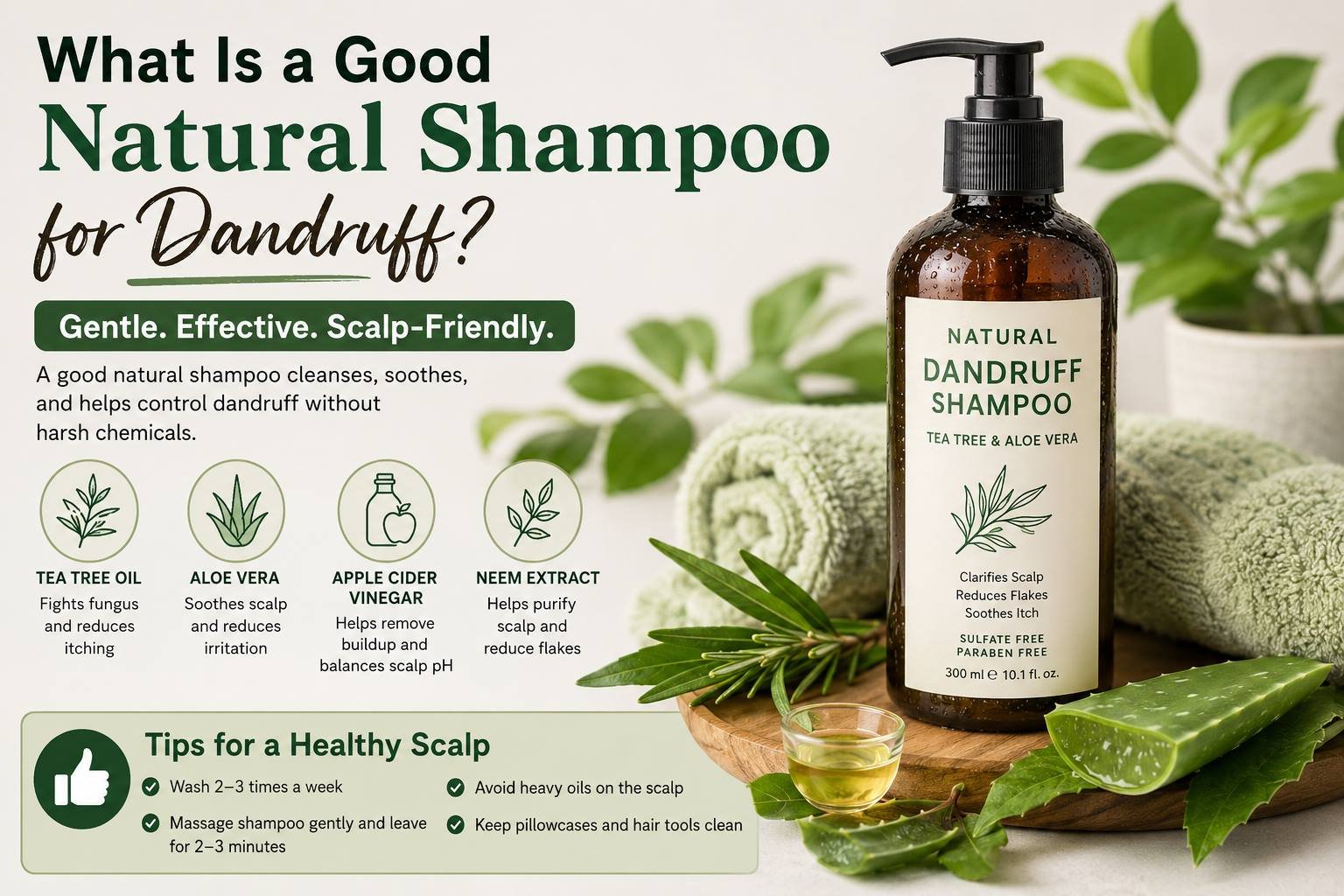
A good natural dandruff shampoo should do three things. It should clean extra oil from the scalp, calm itching, and help control the yeast linked with dandruff. The best natural options usually contain tea tree oil, aloe vera, rosemary, neem, apple cider vinegar, or gentle plant-based cleansers. But here’s the part many people miss. “Natural” does not always mean strong enough. If your dandruff is thick, yellow, painful, or keeps coming back fast, you may need a dermatologist-recommended anti-dandruff shampoo with ingredients like ketoconazole, selenium sulfide, zinc pyrithione, salicylic acid, sulfur, or coal tar. The American Academy of Dermatology lists these as common dandruff-fighting ingredients.
That does not mean natural shampoo is useless. Not at all. It just means you need the right kind, not a pretty bottle with leaves on the label and zero real scalp support.
Let me explain this like we’re standing in the shampoo aisle together, both slightly confused, both pretending we know what half the ingredients mean.
First, dandruff is not always dry scalp
This is where people mess up.
Dandruff looks dry because it flakes. So the first thought is, “My scalp needs oil.” Then comes coconut oil, olive oil, heavy masks, and all kinds of scalp greasing. Sometimes that helps a dry scalp. But true dandruff often comes from a mix of oil, skin shedding, scalp sensitivity, and a yeast called Malassezia. This yeast lives naturally on many scalps, but when the scalp gets oily or irritated, it can trigger more flakes and itching.
Mayo Clinic explains that dandruff causes flaking and can often be managed, but it may come back even after treatment. Mild dandruff may improve with regular gentle shampooing, while stubborn cases may need medicated dandruff shampoo.
So no, dandruff does not always mean your scalp is thirsty.
Sometimes your scalp is oily, inflamed, and overreacting.
That is why a good natural shampoo for dandruff should not feel like a heavy hair mask. It should clean well, but not strip your scalp raw.
Which natural shampoo is best for dandruff?
The best natural shampoo for dandruff is usually a tea tree oil shampoo with gentle cleansers, aloe vera, and no heavy oils near the roots.
Tea tree oil has the strongest natural evidence for dandruff. A clinical trial on 5% tea tree oil shampoo found it was effective and well tolerated for mild to moderate dandruff. A review of tea tree oil research also noted improvement in scalp severity, itchiness, and greasiness when 5% tea tree oil shampoo was used for dandruff.
That does not mean you should pour pure tea tree oil on your head.
Please don’t.
Pure essential oils can burn, irritate, or cause allergic reactions. Tea tree oil should be diluted inside a shampoo formula. A good product will already do that for you.
A strong natural dandruff shampoo usually has some of these ingredients:
| Ingredient | Why it helps | Best for |
|---|---|---|
| Tea tree oil | Helps fight yeast and calm itching | Mild to moderate dandruff |
| Aloe vera | Soothes irritation and dryness | Sensitive scalp |
| Neem | Traditionally used for scalp issues, may support microbial balance | Itchy, flaky scalp |
| Rosemary | Helps scalp freshness and oil balance | Oily scalp |
| Apple cider vinegar | May help reduce buildup, but can irritate if too strong | Occasional scalp rinse, not daily |
| Salicylic acid from willow bark | Helps loosen flakes | Thick flakes and buildup |
| Coconut-derived cleansers | Clean scalp without harsh stripping | Most hair types |
Here’s what matters.
A natural dandruff shampoo should not only say “clean,” “herbal,” or “organic.” It should clearly list scalp-focused ingredients.
If the shampoo only has argan oil, shea butter, coconut oil, avocado oil, and perfume, it may make your hair soft but your dandruff worse. Heavy oils can trap buildup on an oily scalp.
Not always. But often enough that I would be careful.
What I would look for on the label
When I check a natural dandruff shampoo, I don’t get impressed by the front label first. I flip the bottle.
The front says “botanical scalp therapy.”
The back tells the truth.
Look for these signs:
A gentle cleanser like coco-glucoside, decyl glucoside, sodium cocoyl isethionate, or sodium lauroyl methyl isethionate.
A real dandruff-support ingredient like tea tree oil, neem, rosemary, salicylic acid, willow bark, or aloe.
A formula that says pH-balanced or safe for scalp use.
Low fragrance or fragrance-free if your scalp gets itchy fast.
No heavy butter-rich formula if your scalp is greasy.
No strong essential oil overload. More oils do not mean more healing. Sometimes it just means more irritation.
Also, don’t judge a shampoo by foam alone. Some natural shampoos foam less because they use milder cleansers. That’s fine. But your scalp should still feel clean after washing. If your roots feel waxy after two washes, that shampoo is not working for your scalp.
Best natural shampoo types for different dandruff problems
Not every flaky scalp needs the same shampoo. This is where people waste money.
If your scalp is oily and itchy
Choose tea tree oil, rosemary, or neem shampoo.
This type works best when flakes show up fast after washing. Your scalp may feel greasy by day two. You may scratch more near the crown, hairline, or behind the ears.
A tea tree shampoo is the best natural first try here. It has real evidence, and it makes sense chemically because dandruff is often tied to scalp microbes and oil.
Use it two to three times a week at first. Leave it on the scalp for two to three minutes before rinsing. Don’t just slap it on and wash it off in ten seconds. The scalp needs contact time.
If your scalp feels dry and tight
Choose aloe vera, oat, or fragrance-free gentle shampoo.
This may not be true dandruff. It may be dry scalp, irritation, eczema, or product sensitivity. National Eczema Association notes that scalp eczema is not always the same as dandruff, though dandruff can be a mild form of seborrheic dermatitis.
This matters because tea tree oil might feel too sharp for some sensitive scalps.
If your scalp burns, stings, or turns red after many shampoos, go boring. Boring is good.
Fragrance-free. Gentle. Aloe. Oat. No menthol drama. No “cooling volcano scalp blast.” Your scalp is already upset.
If your flakes are thick and stuck
Choose a natural shampoo with willow bark or salicylic acid.
Salicylic acid helps loosen flakes. The American Academy of Dermatology includes salicylic acid among common dandruff shampoo ingredients.
Natural brands may use willow bark as a plant-based source, but the strength can vary. If thick flakes stick to your scalp like crust, a mild natural shampoo may not be enough. You may need a medicated shampoo once or twice weekly.
If your hair is curly, coily, or textured
Choose a gentle scalp shampoo and use it less often.
Dandruff advice often assumes everyone washes daily. That does not work for every hair type. Mayo Clinic notes that people with curly, coiled, or textured hair may need to use dandruff shampoo less often.
For textured hair, I would avoid drying shampoos used too often. Use a scalp-focused shampoo once weekly or as needed, then condition the lengths well. Keep conditioner away from the scalp if your roots get greasy.
Your scalp needs treatment. Your ends need moisture. They are not asking for the same thing.
If your scalp is sensitive
Choose fragrance-free or low-fragrance shampoo.
Natural fragrance can still irritate. Lavender oil, peppermint oil, citrus oil, eucalyptus oil, and tea tree oil can all bother some people.
Yes, even natural ingredients can be rude.
If you get redness, burning, bumps, or worse itching after using a natural shampoo, stop. Do a patch test next time behind the ear or on a small scalp area before using it fully.
How to remove 100% dandruff naturally?
I’m going to be honest here.
You may not remove 100% dandruff naturally forever.
Dandruff often comes back. Mayo Clinic says there is no cure for dandruff, but most people can manage symptoms with treatment.
That’s not bad news. It just means you need a routine, not a one-night miracle.
A natural routine can reduce flakes a lot if your dandruff is mild. Try this for four weeks:
Wash your scalp two to three times a week with a tea tree or neem-based natural shampoo.
Leave the shampoo on the scalp for two to three minutes.
Rinse very well.
Use conditioner only from mid-length to ends.
Wash your brush once a week.
Change pillowcases twice weekly.
Avoid heavy scalp oils for now.
Stop scratching because it makes inflammation worse.
If you want to use aloe vera, apply pure aloe gel to the scalp for 15 to 20 minutes before washing. Do this once or twice weekly. If it burns or itches, rinse it out.
If you want to use apple cider vinegar, dilute it heavily. Think one part vinegar with four to five parts water. Use it only once weekly at most, and never on broken or scratched skin.
But again, if the flakes are thick, yellow, greasy, painful, or spreading beyond the scalp, natural care may not be enough.
What research says
A 5% tea tree oil shampoo showed improvement in mild to moderate dandruff and was well tolerated in a clinical trial.
Dandruff is linked with scalp oil, skin shedding, Malassezia yeast, and scalp sensitivity, not just dryness. A review in the Indian Journal of Dermatology describes dandruff as a very common scalp disorder with several treatment methods and commercial claims around it.
Dermatology groups often recommend active ingredients such as zinc pyrithione, selenium sulfide, ketoconazole, salicylic acid, sulfur, and coal tar when regular shampoo is not enough.
Bottom line. Natural shampoo can help mild dandruff, especially with tea tree oil. But stubborn dandruff often needs proven anti-fungal or keratolytic ingredients.
Natural shampoo versus dermatologist-recommended dandruff shampoo
This is where the internet gets silly.
Some people act like natural shampoo is always safer. Others act like only medicated shampoo works. Real life sits in the middle.
Natural shampoo is good when:
Your dandruff is mild.
Your scalp gets irritated by harsh formulas.
You prefer plant-based ingredients.
You want a maintenance shampoo after controlling flakes.
Your flakes are light and not painful.
Dermatologist-recommended dandruff shampoo is better when:
Your flakes are thick or greasy.
Your scalp is red, sore, or swollen.
You have severe itching.
Natural shampoo did not work after four weeks.
Flakes keep returning quickly.
You also have hair loss.
You have lupus, psoriasis, eczema, or another health condition.
AAD recommends trying dandruff shampoos with active ingredients and even alternating between different active ingredients if one does not work.
That little point matters. Dandruff can be stubborn. Sometimes zinc pyrithione works for one person, ketoconazole works better for another, and salicylic acid helps someone else because their main issue is scale buildup.
Best anti dandruff shampoo suggested by dermatologist
Dermatologists usually suggest shampoos based on active ingredients, not brand hype.
The most common dermatologist-recommended dandruff shampoo ingredients include:
| Active ingredient | What it does | Good for |
|---|---|---|
| Ketoconazole | Helps control yeast linked with dandruff | Stubborn, recurring dandruff |
| Selenium sulfide | Slows flaking and helps with yeast | Oily dandruff |
| Zinc pyrithione | Helps reduce yeast and flakes | Regular dandruff control |
| Salicylic acid | Loosens thick flakes | Scaly buildup |
| Coal tar | Slows skin cell turnover | Severe flaking, psoriasis-like scale |
| Sulfur | Helps reduce flakes and oil | Oily, flaky scalp |
If you want a natural-leaning routine but need stronger help, you can use a medicated shampoo once or twice weekly and a gentle natural shampoo on other wash days.
That is often smarter than forcing your scalp into an all-natural routine that is not working.
Your scalp does not care about your philosophy. It cares about inflammation, oil, yeast, and barrier health.
Annoying, but true.
What shampoo is good for lupus hair loss?
This is important.
If someone has lupus hair loss, dandruff shampoo alone is not the answer.
Lupus can cause hair shedding, scalp inflammation, fragile hair, and sometimes scarring hair loss depending on the type and activity of the disease. If you have lupus and notice hair loss, patches, scalp pain, sores, redness, or scaling, you should talk to a dermatologist or rheumatologist. Do not treat it like basic dandruff.
For shampoo, choose something gentle:
Fragrance-free or low-fragrance shampoo.
Sulfate-free if your scalp feels dry or irritated.
No harsh clarifying shampoo unless a doctor says so.
No strong essential oils if your scalp is inflamed.
No aggressive scrubs.
A gentle anti-dandruff shampoo may help if you also have dandruff or seborrheic dermatitis, but lupus-related hair loss needs medical care. If there are bald patches, sores, tenderness, or scarring, please do not wait.
For lupus hair loss, the best shampoo is not a miracle growth shampoo. It is a gentle scalp-safe shampoo that does not add more irritation while your doctor treats the real cause.
Ingredients I would avoid if you have dandruff
Some ingredients are not “bad” for everyone. But if your scalp is flaky, oily, or itchy, they can make things messy.
Avoid heavy oils on the scalp if dandruff gets worse after oiling. Coconut oil, olive oil, castor oil, and shea butter can feel nice on hair lengths, but they may be too heavy near the roots for some dandruff-prone scalps.
Avoid strong perfume. Fragrance can make itching worse, especially if your scalp barrier is already irritated.
Avoid harsh scrubs. Scrubbing flakes off feels satisfying for about five minutes. Then your scalp gets angry.
Avoid DIY lemon juice. It can sting, dry the scalp, and cause irritation.
Avoid baking soda. It is too alkaline for regular scalp use and can rough up hair.
Avoid undiluted essential oils. Natural does not mean harmless.
Avoid conditioner on the scalp if your roots get greasy. Put it on the ends where it belongs.
How often should you wash dandruff-prone hair?
It depends on your scalp and hair type.
For oily straight or wavy hair, washing every other day may help control oil and flakes.
For dry, curly, or coily hair, washing once or twice weekly may be better, with scalp treatment built into wash day.
For mild dandruff, start with a natural dandruff shampoo two to three times weekly.
For stubborn dandruff, use a medicated dandruff shampoo two to three times weekly if your scalp tolerates it, or less often for textured hair. Mayo Clinic notes that some people can use dandruff shampoo two to three times a week, while curly or coiled hair may need less frequent use.
The biggest mistake is using dandruff shampoo like regular shampoo and rinsing it out instantly.
Massage it into the scalp. Wait. Let it work. Then rinse.
Your hair lengths don’t need a long medicated soak. Your scalp does.
My simple four-week natural dandruff plan
This is the routine I would try before jumping between ten products.
Week one. Use tea tree or neem shampoo twice. Leave it on for two minutes. No scalp oil. No heavy styling cream on roots.
Week two. Wash your brush. Change pillowcases more often. Keep conditioner off the scalp. If flakes are stuck, use a shampoo with willow bark or salicylic acid once.
Week three. If itching improves but flakes remain, keep going. Dandruff does not always vanish after two washes.
Week four. If you see clear improvement, continue once or twice weekly as maintenance.
If there is no improvement after four weeks, switch to a dermatologist-recommended dandruff shampoo with ketoconazole, zinc pyrithione, selenium sulfide, or salicylic acid.
If there is pain, bleeding, hair loss, thick crust, or spreading rash, skip the experiment and see a doctor.
Natural dandruff shampoos that are worth considering
I won’t pretend one shampoo works for every scalp. That’s fake beauty advice.
But these types are usually worth checking:
Tea tree oil shampoo for oily dandruff.
Aloe and tea tree shampoo for itchy but slightly sensitive scalp.
Neem shampoo for people who like herbal scalp care.
Fragrance-free gentle shampoo if dandruff comes with eczema-like irritation.
Willow bark shampoo if flakes stick to the scalp.
Apple cider vinegar shampoo if buildup and oil are part of the problem.
The key is balance. You want enough cleansing power to remove oil and flakes, but not so much that your scalp feels tight and stripped.
A good test: after washing, your scalp should feel clean and calm. Not waxy. Not burning. Not squeaky like a dinner plate.
Can home remedies replace shampoo?
Sometimes they help. But they rarely replace a well-made shampoo.
Aloe vera can calm the scalp.
Diluted apple cider vinegar may help with buildup for some people.
Tea tree oil has evidence when used properly in shampoo.
Neem may help some itchy scalps.
But home remedies have problems. You don’t know the exact strength. You can irritate your scalp. You can make hair smell odd. And sometimes the dandruff keeps winning anyway.
A shampoo formula is more controlled. It has cleansers, preservatives, pH balance, and ingredient dilution. That matters.
I like simple natural care. I do not like kitchen chemistry on an inflamed scalp.
Quick answer for busy readers
A good natural shampoo for dandruff is a gentle tea tree oil shampoo with aloe vera or neem, low fragrance, and scalp-safe cleansers. It should clean oil, reduce itching, and help control flakes without drying your scalp.
If you want the most evidence-backed natural option, choose a 5% tea tree oil shampoo. Research supports it for mild to moderate dandruff.
If your dandruff is severe, greasy, painful, or keeps coming back, use a dermatologist-recommended anti-dandruff shampoo with ketoconazole, zinc pyrithione, selenium sulfide, salicylic acid, sulfur, or coal tar.
And if you have lupus hair loss, scalp sores, bald patches, or painful scaling, don’t self-treat with natural shampoo only. Get medical help.
Final thoughts
So, what is a good natural shampoo for dandruff?
It is not the fanciest bottle. It is not the one with the most plant names. It is the one that respects the scalp.
For most people with mild flakes, I would start with a tea tree oil shampoo that also has aloe vera and gentle cleansers. Use it two or three times a week, give it contact time, and stop putting heavy oils on your scalp for a while.
If your scalp improves, great. Keep it as maintenance.
If nothing changes after a few weeks, don’t feel bad. Dandruff can be stubborn. Move to a dermatologist-style dandruff shampoo and treat the actual cause, not just the flakes you see on your shirt.
Natural is nice.
Effective is better.
The sweet spot is both.

Michael Chen focuses on the science behind shampoos and hair-care ingredients. He explains how cleansing agents, silicones, proteins, and other formula components work, separating useful evidence from marketing claims to help readers better understand the products they use.