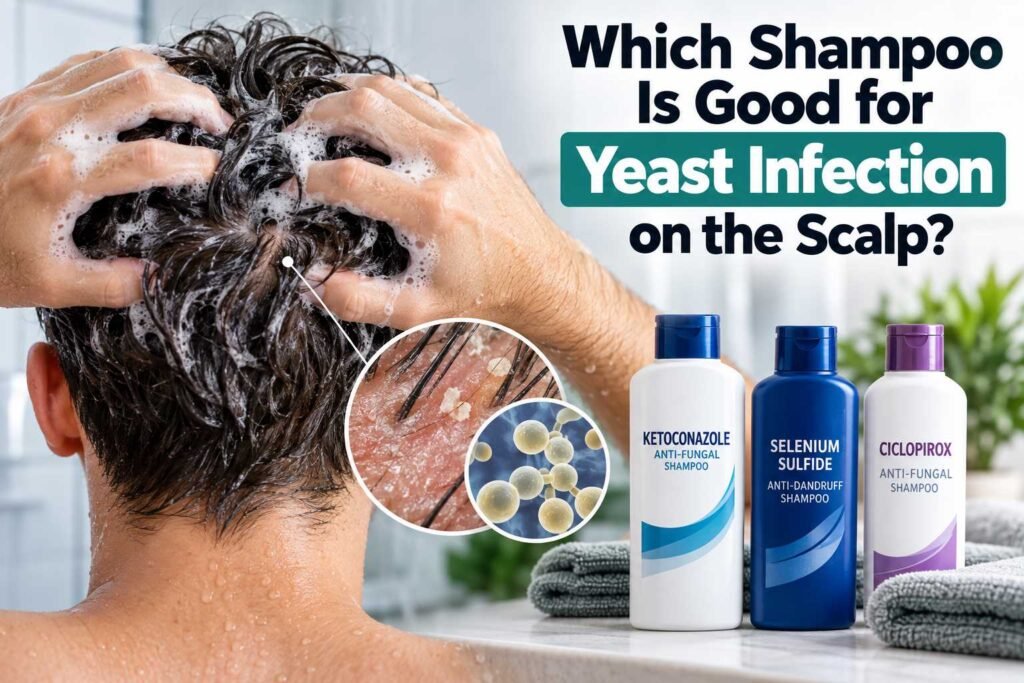
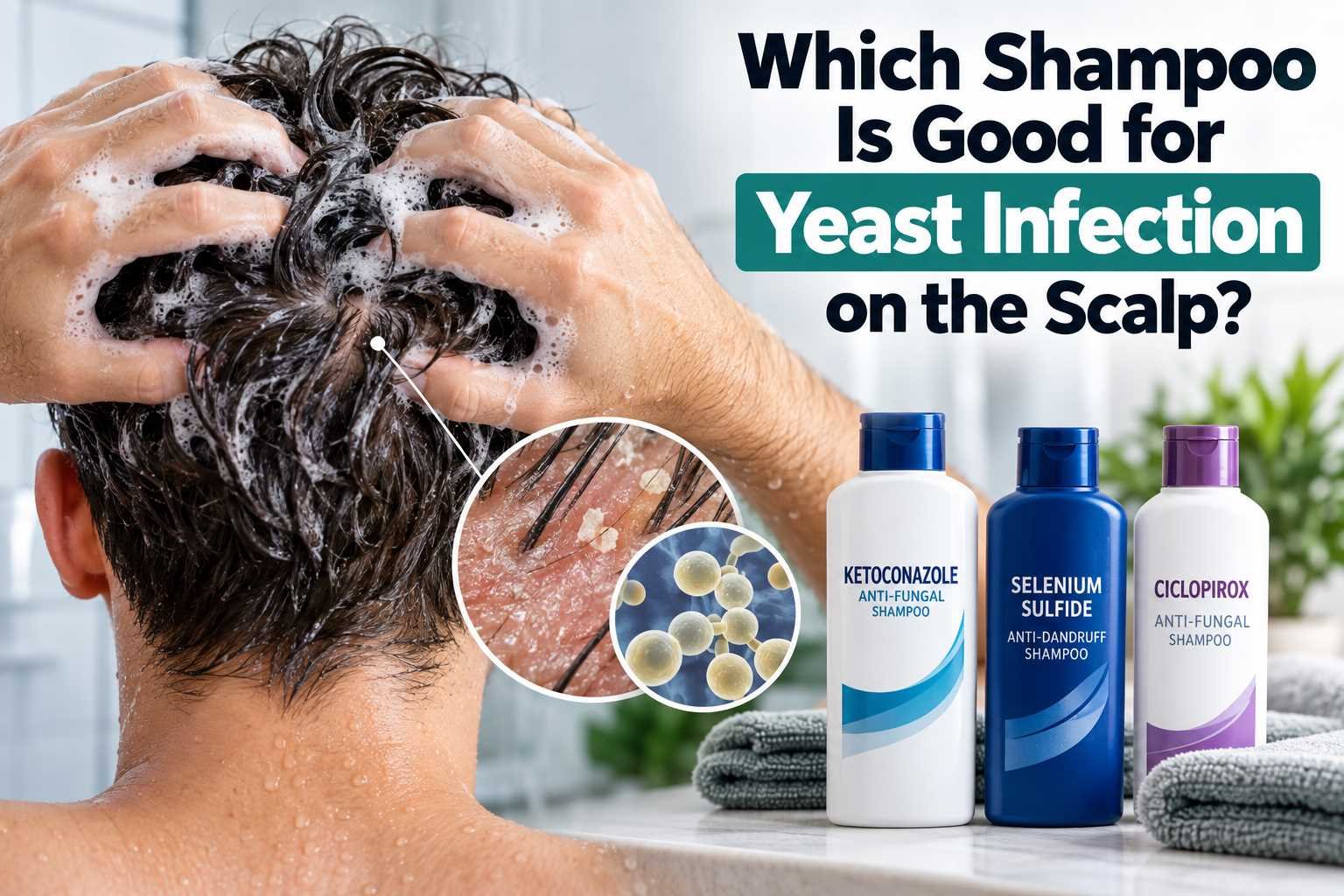
 If you think you have a yeast infection on your scalp, an ordinary moisturizing or beauty shampoo is usually not the most useful place to start. A shampoo containing an antifungal active, such as ketoconazole, may be more appropriate for certain yeast-related scalp conditions. Selenium sulfide and ciclopirox are also well-supported options for conditions associated with Malassezia, particularly dandruff and seborrheic dermatitis.
The important qualification is that “scalp yeast infection” is not one single diagnosis.
A true scalp candidiasis involves Candida yeast. Dandruff and seborrheic dermatitis are more closely associated with Malassezia yeast. Tinea capitis, often called scalp ringworm, is caused by dermatophyte fungi rather than yeast and generally needs oral antifungal medicine. Shampoo alone cannot cure it.
That distinction matters more than the shampoo brand printed on the bottle.
Which Shampoo Is Good for a Scalp Yeast Infection?
For a suspected yeast-related scalp problem, look at the active ingredient and the condition it is intended to treat, not simply whether a shampoo is marketed for dandruff, men, oily hair, natural hair care, or sensitive scalps.
Here is the practical difference:
| Scalp problem | Can antifungal shampoo help? | Actives commonly relevant |
|---|---|---|
| Candida scalp candidiasis | It may form part of antifungal treatment | Clinician-selected antifungal; ketoconazole may be used in some fungal conditions |
| Malassezia-related dandruff | Often yes | Ketoconazole, selenium sulfide, zinc pyrithione where available |
| Seborrheic dermatitis | Often useful for scalp control | Ketoconazole, selenium sulfide, ciclopirox |
| Tinea capitis | Shampoo is only an adjunct | Antifungal shampoo plus oral prescription treatment |
For persistent dandruff or seborrheic dermatitis, ketoconazole is one of the best-studied shampoo ingredients. A randomized trial involving 343 people with severe dandruff or seborrheic dermatitis found both 2% ketoconazole and 1% zinc pyrithione shampoos improved symptoms, with ketoconazole producing the larger reduction in dandruff severity in that study.
That does not mean ketoconazole is automatically the right treatment for every itchy or flaky scalp. Diagnosis comes first when symptoms are unusual, severe or persistent.
If your main problem is recurring dandruff rather than a diagnosed infection, our guide to [zinc pyrithione shampoo for dandruff] may help you compare another evidence-based anti-dandruff active. zinc pyrithione shampoo for dandruff
Not Every Scalp “Yeast Infection” Is the Same
A person searching for the best shampoo for a yeast infection may be dealing with Candida, seborrheic dermatitis, ordinary dandruff or even a completely different fungal condition.
They can look similar at first.
Candida scalp infection
A true scalp yeast infection, or scalp candidiasis, is caused by Candida.
Cleveland Clinic describes scalp candidiasis as a fungal infection that may cause an itchy, flaky rash. Possible signs include white scales, crusting, greasy-looking patches, moist areas and sometimes pus-filled bumps. Hair shedding or hair loss can occur when the scalp becomes significantly affected.
Candida normally exists on the body without causing trouble. Problems can develop when conditions allow it to overgrow.
Because several other scalp conditions can look similar, a healthcare professional may examine a skin sample under a microscope or use a fungal culture when the diagnosis is uncertain.
This is one reason choosing an antifungal shampoo blindly based on symptoms can fail.
Malassezia, dandruff and seborrheic dermatitis
Most people who describe recurring greasy flakes and itching as “yeast on the scalp” may actually be thinking of dandruff or seborrheic dermatitis.
These conditions are closely associated with yeasts of the genus Malassezia, which normally live on human skin.
Malassezia is not the same organism as Candida.
This matters because much of the clinical evidence behind ketoconazole, selenium sulfide, zinc pyrithione and ciclopirox shampoos relates specifically to dandruff and seborrheic dermatitis associated with Malassezia, rather than confirmed Candida infection.
If your symptoms are mainly flakes and itching, our broader guide to [shampoo for an itchy scalp and dandruff] covers other common causes and shampoo choices. shampoo for an itchy scalp and dandruff
Tinea capitis needs a different approach
Tinea capitis is often called scalp ringworm, but no worm is involved. It is a fungal infection caused by dermatophytes.
It can cause scaling, broken hairs and patches of hair loss. More inflammatory cases can produce painful swelling or crusting.
This is one situation where relying on shampoo alone is especially risky.
NHS Inform states that antifungal shampoo cannot cure tinea capitis. Shampoo can help reduce spread and may support recovery, but treatment generally includes an oral antifungal such as terbinafine or griseofulvin, selected according to the organism and clinical situation.
So if you have circular bald areas or large numbers of broken hairs rather than ordinary dandruff, do not simply keep switching shampoos.
Which Antifungal Shampoo Ingredients Have the Best Evidence?
The name on the front of the bottle matters less than the active ingredient, its concentration, the finished formulation and the scalp condition being treated.
Ketoconazole
Ketoconazole is an antifungal medication used in topical preparations including shampoo.
For dandruff and seborrheic dermatitis, it has substantial clinical evidence.
In the randomized trial of 343 participants mentioned earlier, 2% ketoconazole shampoo reduced total dandruff severity by 73% after four weeks, compared with 67% for 1% zinc pyrithione. Both treatments worked, but ketoconazole performed better on the study’s primary dandruff measurements.
Another study comparing 1% and 2% ketoconazole shampoos in severe dandruff and seborrheic dermatitis found the 2% shampoo produced greater reductions in flaking and Malassezia levels.
This is useful evidence, but keep the boundary clear: these trials investigated dandruff and seborrheic dermatitis, not every condition someone might call a scalp yeast infection.
Selenium sulfide
Selenium sulfide, also called selenium disulfide, is another established anti-dandruff active that can be particularly relevant when flaking accompanies an oily scalp.
A 2024 randomized four-week study compared 1% selenium disulfide shampoo with 2% ketoconazole shampoo in 64 adults with moderate-to-severe scalp seborrheic dermatitis.
Disease-severity scores improved by about 71% in the selenium disulfide group and 69% in the ketoconazole group by day 28.
That does not establish selenium sulfide as a treatment for every Candida infection. It does show that it deserves serious consideration when the actual problem is Malassezia-associated seborrheic dermatitis.
AGoodShampoo has a separate breakdown of [selenium sulfide dandruff shampoo and Selsun Blue] for readers whose main concern is recurring dandruff. selenium sulfide dandruff shampoo and Selsun Blue
Ciclopirox
Ciclopirox is another antifungal with evidence for scalp seborrheic dermatitis.
A randomized study involving 350 patients compared 1.5% ciclopirox olamine shampoo, 2% ketoconazole shampoo and placebo. Both antifungal shampoos were more effective than placebo, and ciclopirox was at least as effective as ketoconazole for the scalp seborrheic dermatitis outcomes measured.
A separate U.S. trial involving 499 patients also found 1% ciclopirox shampoo significantly more effective than its vehicle for scalp seborrheic dermatitis.
Ciclopirox may not be available in shampoo form without a prescription in every country, so local availability matters.
Zinc pyrithione
Zinc pyrithione, also known as pyrithione zinc, has antifungal activity against Malassezia and has long been used in anti-dandruff shampoos.
Clinical evidence shows it can reduce dandruff, although the 343-participant trial comparing 1% zinc pyrithione with 2% ketoconazole favored ketoconazole.
There is also an important regional difference.
Zinc pyrithione availability varies because cosmetic regulations differ between countries. A shampoo formula sold in the United States may not match the formula sold in Europe or elsewhere. Always check the current label on the product you are actually buying.
How to Use Medicated Shampoo Without Treating It Like Regular Shampoo
Medicated scalp shampoo should normally be used according to the instructions for that specific active ingredient and product strength.
More is not automatically better.
A useful general approach is:
- Wet the scalp and hair as instructed.
- Apply the medicated shampoo mainly to the affected scalp rather than concentrating it on the hair ends.
- Massage gently enough to distribute the product without scratching inflamed skin.
- Leave the product in contact with the scalp for the amount of time stated on its label.
- Rinse thoroughly.
- Follow the recommended frequency rather than using it more often in the hope of faster results.
Contact time can matter. MedlinePlus, for example, instructs users of certain prescription ketoconazole shampoo applications to leave the product on affected skin for five minutes before rinsing. The instructions for over-the-counter ketoconazole products may differ, so the actual label takes priority.
Medicated shampoos can also leave some hair types feeling dry.
If your lengths are bleached, curly, coily, chemically processed or naturally dry, keep treatment focused on the scalp where possible and use conditioner on the mid-lengths and ends.
Do not compensate by coating an irritated scalp with heavy oils unless a clinician has advised it. What feels moisturizing to the hair shaft is not necessarily helpful for an inflamed scalp.
Can a Yeast-Related Scalp Problem Cause Hair Loss?
A severely inflamed or infected scalp can sometimes be associated with hair shedding, breakage or temporary areas of hair loss.
Cleveland Clinic lists hair shedding and hair loss among possible features or complications of scalp Candida infection, particularly when crusting or follicle damage occurs.
But this does not make antifungal shampoo a general hair-growth treatment.
Hair loss can have many causes, including androgenetic alopecia, alopecia areata, telogen effluvium, nutritional problems, thyroid disorders, medication effects and inflammatory scalp disease.
Treating dandruff or an infection may improve the scalp environment when that condition is contributing to the problem. It does not mean ketoconazole, selenium sulfide or another dandruff shampoo will reverse unrelated follicle-level hair loss.
Bald patches are particularly important. Tinea capitis can produce broken hairs and localized hair loss and usually needs systemic antifungal treatment.
What about shampoo with yeast for hair loss?
A shampoo that contains yeast, yeast extract or fermented ingredients is completely different from an antifungal shampoo intended to control yeast organisms on the scalp.
The word yeast can make these searches confusing.
Adding yeast-derived cosmetic ingredients to shampoo does not mean the product treats Candida or Malassezia infection, and it does not establish that the shampoo prevents medical hair loss.
The same caution applies to products combining garlic and yeast.
Garlic has a long history in home and cosmetic hair-care products, but that does not make a garlic-and-yeast shampoo a substitute for antifungal treatment or an established therapy for common forms of hair loss.
For that separate question, see our analysis of [garlic shampoo for hair growth, dandruff and hair loss]. garlic shampoo for hair growth, dandruff and hair loss
When Shampoo Is Not Enough for a Suspected Scalp Infection
Medicated shampoo is useful because it is easy to apply across a hair-covered scalp. That convenience can also encourage people to keep self-treating symptoms that need a diagnosis.
Seek medical assessment rather than repeatedly changing shampoos if you develop:
- Clearly defined bald patches or many broken hairs
- Painful or swollen areas of scalp
- Pus-filled bumps or significant crusting
- Open sores or bleeding
- Rapidly worsening redness
- A rash spreading beyond the scalp
- Significant unexplained hair loss
- Fever or feeling generally unwell with the scalp problem
- Symptoms that persist despite appropriate treatment
- Recurrent fungal infections
- A scalp infection while your immune system is weakened
Persistent symptoms matter because dandruff, seborrheic dermatitis, psoriasis, eczema, contact dermatitis, bacterial folliculitis, Candida infection and tinea capitis can overlap in appearance.
A healthcare professional may sometimes need a scraping, microscopy or culture to determine what organism is actually present. Cleveland Clinic specifically notes that laboratory examination may be used when diagnosing scalp candidiasis.
And if the diagnosis is tinea capitis, NHS guidance is clear: antifungal shampoo may reduce spread, but oral antifungal treatment is generally required to cure the infection.
Choose the Antifungal Active, Not Just a Shampoo Brand
If you are deciding which shampoo is good for a yeast infection on the scalp, start by asking what scalp condition you are actually treating.
For recurring dandruff or seborrheic dermatitis associated with Malassezia, ketoconazole has some of the strongest shampoo-specific clinical evidence, while selenium sulfide and ciclopirox also have good evidence. Zinc pyrithione remains another anti-dandruff option where it is available.
For suspected Candida scalp candidiasis, an antifungal treatment may be appropriate, but diagnosis matters because ordinary dandruff and several other conditions can look similar.
For tinea capitis, shampoo alone is not enough.
This is also why questions such as which Dove shampoo is good, which Sunsilk shampoo is good, which beer shampoo is good for hair, which Ayurvedic shampoo is good, or which shampoo is best for men do not answer the yeast-infection question. A familiar brand, herbal label or men’s formula tells you very little about whether the product contains the correct antifungal active.
If what you actually have is mild dandruff and you prefer a less medicated approach, our guide to [natural shampoo options for dandruff] explains what the evidence does and does not support. natural shampoo options for dandruff
For a suspected scalp infection, however, effectiveness matters more than whether the bottle is marketed as natural, Ayurvedic, premium, masculine or moisturizing.
The sensible next step is to match the treatment to the cause. If the diagnosis is unclear or symptoms involve pain, sores, significant inflammation or patchy hair loss, get the scalp assessed rather than continuing to experiment with cosmetic shampoos.

Michael Chen focuses on the science behind shampoos and hair-care ingredients. He explains how cleansing agents, silicones, proteins, and other formula components work, separating useful evidence from marketing claims to help readers better understand the products they use.