 Amodimethicone and dimethicone are two silicone ingredients commonly used in conditioners, shampoos, hair masks, and styling products. Both can make hair feel smoother, reduce friction, and improve manageability, but they do not interact with hair in exactly the same way.
The main difference is that amodimethicone is an amino-functional silicone that can preferentially deposit on negatively charged areas of the hair surface, while dimethicone is a nonionic silicone valued for its smoothing and lubricating properties. Neither is automatically better for every hair type.
For damaged hair, an amodimethicone-containing conditioner may offer useful targeted surface conditioning. For general smoothing and slip, dimethicone can work equally well. However, the complete formula matters more than choosing a product based on one ingredient.
Amodimethicone vs. Dimethicone at a Glance
Although their names sound similar, their chemical properties influence how they are formulated and deposited on hair.
| Feature | Amodimethicone | Dimethicone |
|---|---|---|
| Ingredient family | Amino-functional silicone | Nonionic silicone |
| Main function | Conditioning and improving combability | Smoothing, lubrication, and shine |
| Interaction with hair | Can favor negatively charged surfaces | Deposits according to the formulation and application conditions |
| Damaged hair | Useful in formulas designed for damaged or chemically treated hair | Also useful for smoothing damaged hair |
| Fine hair | Depends on the complete formula | Depends on the polymer grade and formula |
| Water solubility | Not inherently water-soluble | Generally water-insoluble |
| Buildup potential | Possible with repeated use | Possible with repeated use |
| Permanent hair repair | No | No |
The distinction is important, but it does not tell you how heavy a conditioner will feel, how easily it will rinse away, or whether it will suit your particular hair.
A lightweight conditioner containing dimethicone may feel less coating than a rich treatment containing amodimethicone. The reverse can also be true.
How These Two Silicones Work on Hair
Hair is covered by overlapping cuticle cells that protect its internal structure. Washing, brushing, heat styling, coloring, and other treatments can change the condition of this surface.
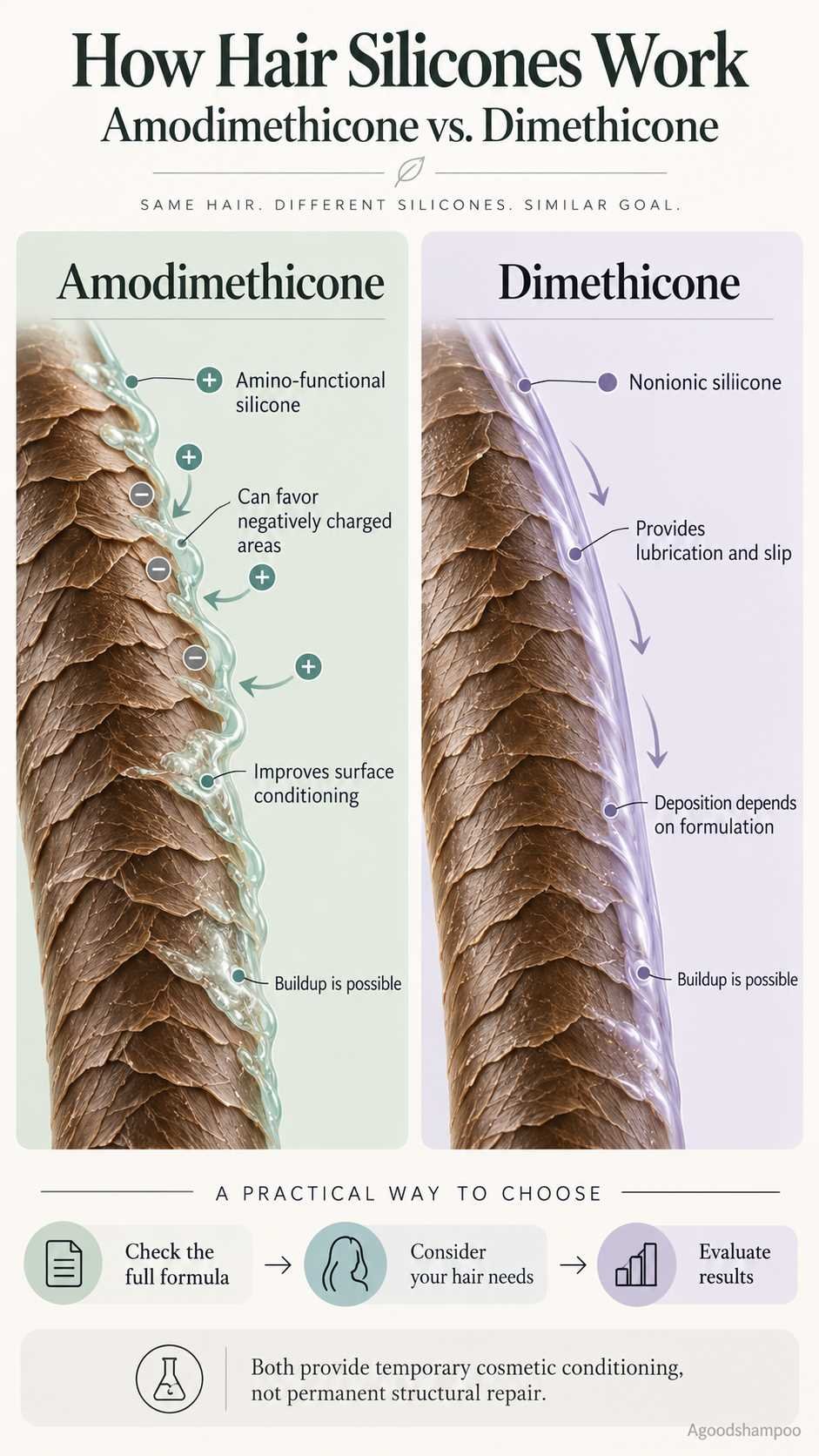
Silicone conditioning ingredients help manage the friction between strands and influence how hair feels during combing and styling.
Why Amodimethicone Can Favor Damaged Surfaces
Amodimethicone is a modified silicone polymer containing amino-functional groups.
Under suitable conditions, some of these groups can become positively charged. Because hair surfaces can carry negative charges, particularly after certain chemical treatments, electrostatic attraction can encourage deposition.
This helps explain why amodimethicone is often incorporated into conditioners designed for damaged, bleached, or difficult-to-detangle hair.
However, claims that it automatically finds and repairs damaged spots are oversimplified.
Amodimethicone does not identify damage or reconstruct broken keratin. Its deposition depends on formulation conditions, the hair surface, and the other ingredients present.
The result is primarily temporary surface conditioning, which may improve softness, combability, and the appearance of rough strands.
How Dimethicone Provides Smoothing and Slip
Dimethicone, also called polydimethylsiloxane, is a silicone polymer that does not have the same amino-functional groups as amodimethicone.
It is used in many cosmetic formulas because of its lubricating and surface-smoothing properties.
When appropriately deposited, dimethicone can reduce friction between hair fibers, improve slip, and help create a smoother appearance.
These effects are particularly useful when hair becomes difficult to comb after washing.
Dimethicone comes in different molecular weights and viscosity grades. Consequently, products containing it can have very different textures and conditioning effects.
Some formulas feel light and spread easily. Others produce a richer, more substantial coating.
The ingredient name alone cannot predict how the finished product will feel.
Which Silicone Is Better for Your Hair Type?
Your hair’s thickness, condition, and response to conditioning products are more useful than a simple silicone ranking.
Fine Hair and Easily Weighed-Down Roots
Fine hair may become limp when a conditioner leaves more material on the strands than the hair needs.
A lightweight product containing amodimethicone may provide useful detangling without an excessively heavy feel. But amodimethicone is not automatically weightless.
Similarly, dimethicone is not necessarily too heavy for fine hair. A low-deposition or otherwise lightweight formula may work well.
If fine hair loses volume after conditioning, try applying less product and concentrating it on the lengths rather than the roots.
For additional guidance, see how to choose a good shampoo and conditioner for your hair.
Bleached, Color-Treated, and Damaged Hair
Chemically treated hair can have a rougher surface and may be more difficult to detangle.
Amodimethicone is particularly interesting for this situation because its amino functionality can influence its attraction to negatively charged hair surfaces.
That does not mean dimethicone is unsuitable.
A well-formulated dimethicone conditioner may also improve slip, softness, and manageability on damaged hair.
Neither ingredient restores broken disulfide bonds or permanently reverses bleaching damage. Their conditioning effects should not be confused with structural repair.
For fragile hair, gentle handling, suitable conditioning, and reducing unnecessary heat exposure remain important.
Curly, Coarse, and Highly Textured Hair
Curly and highly textured hair often benefits from products that reduce friction and make detangling easier.
Both silicones can contribute to those effects.
A richer conditioning formula may suit hair that needs substantial slip, while another person with similar curls may prefer lighter products.
Curl pattern alone cannot determine which silicone will work best.
Consider how your hair behaves after drying. Does it remain manageable, or does it feel coated, stiff, or weighed down?
Your answer provides more useful information than choosing ingredients according to a universal curly-hair rule.
Do Amodimethicone and Dimethicone Cause Buildup?
Yes, both can contribute to buildup under certain conditions. However, their presence in an ingredient list does not mean buildup will necessarily occur.
Buildup describes material remaining on the hair after repeated product use and cleansing. Its effects can vary depending on how much material is deposited and how the hair responds.
Possible signs include:
- Hair feeling coated or unusually heavy
- Reduced volume despite washing
- Strands clumping together more than usual
- Hair feeling smooth yet difficult to style
These signs are not specific to silicone buildup. Oils, styling polymers, other conditioning agents, and hard-water minerals may also contribute to unwanted residue.
Is Amodimethicone Buildup-Free?
No. The claim that amodimethicone never accumulates is not supported as a universal rule.
A 2011 study published in the Journal of the Society of Cosmetic Chemists of Japan investigated amodimethicone accumulation during repeated use and examined a formulation approach intended to reduce it.
The research demonstrates that accumulation can occur under studied conditions. It does not establish how every commercial amodimethicone conditioner will behave.
Can Regular Shampoo Remove These Silicones?
Often, an appropriately formulated shampoo can remove deposited conditioning materials, but results depend on the cleanser and residue.
Neither ingredient should be treated as something that always rinses away with plain water.
Likewise, the idea that every silicone-containing product requires a sulfate shampoo is inaccurate.
If your hair increasingly feels coated, begin by reviewing how much conditioner and styling product you use. Make sure you wash and rinse thoroughly.
If ordinary cleansing is not giving satisfactory results, learn what clarifying shampoos are good for.
Clarifying should respond to an actual cleansing need rather than follow a compulsory weekly schedule. Over-cleansing may leave some hair feeling rough or difficult to manage.
How to Recognize Them on an Ingredient List
Product labels can help you identify the silicone ingredients in a formula, but they cannot tell you everything about performance.
For example, a hypothetical conditioner might contain this combination:
Amodimethicone, Trideceth-12, Cetrimonium Chloride
These ingredients can appear together in conditioning systems where surfactant and emulsifier components help incorporate or disperse amodimethicone.
Their presence does not prove that the product is buildup-free or that the silicone will deposit exclusively on damaged sections.
Another product may list:
Dimethicone
This confirms that dimethicone is present but does not establish the polymer’s viscosity grade, exact concentration, or conditioning strength.
In many cosmetic markets, ingredients above the 1% threshold are generally listed in descending order of concentration, while ingredients at 1% or less can be listed with greater flexibility. Specific labeling requirements vary by jurisdiction.
For this reason, ingredient position can provide clues but cannot reliably tell you how much silicone will remain on your hair.
Look beyond the silicone name. Consider the product’s intended use, overall richness, application instructions, and your experience after several washes.
Are Amodimethicone and Dimethicone Safe for Hair and Scalp?
Both ingredients have been examined within broader cosmetic ingredient safety assessments.
In a 2022 assessment, the Cosmetic Ingredient Review Expert Panel evaluated 30 dimethicone, methicone, and substituted-methicone polymers, including amodimethicone and dimethicone.
The panel concluded that these ingredients are safe under the cosmetic practices and concentrations described in its assessment when formulated to be non-irritating. It also identified insufficient information to determine safety for certain applications involving incidental inhalation through airbrush devices.
This is a qualified safety conclusion, not a statement that every finished product will suit every person.
A conditioner can cause irritation because of its complete formulation, even when an individual conditioning ingredient has an established cosmetic safety profile.
If a product repeatedly causes scalp burning, itching, redness, or discomfort, discontinue it. Persistent symptoms warrant professional medical evaluation.
Ordinary cosmetic silicone use should also not be confused with hair follicle damage or permanent hair loss. Hair-shaft conditioning and follicle-level medical concerns are different subjects.
If you’re concerned about that distinction, read whether conditioner can cause hair loss.
How to Choose Between Amodimethicone and Dimethicone
The most reliable approach is to judge the finished product rather than treating either ingredient as automatically superior.
If your hair is bleached, rough, or frequently tangled, an amodimethicone-containing conditioner is a reasonable option to consider. Its amino-functional structure provides a scientific basis for preferential deposition under suitable conditions.
If you want general smoothing, easier combing, or a more polished appearance, a dimethicone-containing product may be equally appropriate.
For fine hair, prioritize a lightweight formula and controlled application. For coarse or highly textured hair, look for a level of conditioning that provides enough slip without leaving an unwanted coating.
After using a product several times, evaluate three things: how easily your hair detangles, how it feels after drying, and whether it remains manageable between washes.
If a formula performs well, there is no scientific reason to reject it solely because it contains dimethicone or amodimethicone.
Choose amodimethicone for its potential targeted-conditioning advantages, consider dimethicone for effective general smoothing, and let the complete formulation and your hair’s response decide which is better.

Michael Chen focuses on the science behind shampoos and hair-care ingredients. He explains how cleansing agents, silicones, proteins, and other formula components work, separating useful evidence from marketing claims to help readers better understand the products they use.