Choosing between Nizoral and Head & Shoulders is not just about which shampoo removes visible flakes. The more important difference is what each product uses to control dandruff and how frequently it is intended to be used.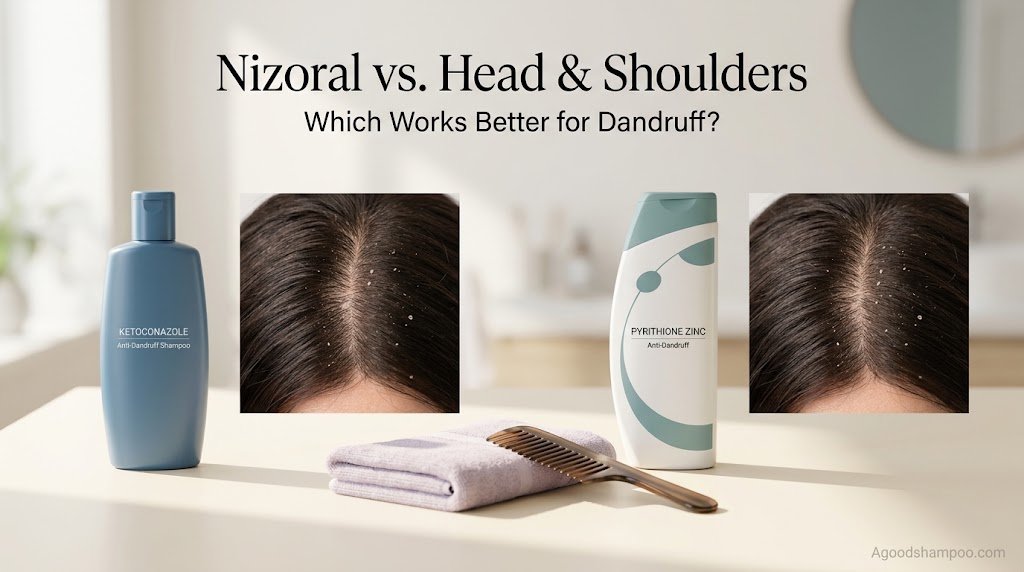
Nizoral A-D contains 1% ketoconazole, an antifungal medication, while US Head & Shoulders Classic Clean contains 1% pyrithione zinc, an antimicrobial ingredient with antifungal activity. Both can help control dandruff, but their active ingredients, directions, and cleansing formulas differ.
Nizoral A-D may be worth trying if a zinc pyrithione shampoo has not controlled your flakes adequately. Head & Shoulders Classic Clean may be more convenient if you prefer an anti-dandruff shampoo designed for regular use.
Neither is guaranteed to work better for everyone. This comparison focuses specifically on the US versions of Nizoral A-D and Head & Shoulders Classic Clean, because other products sold under these brand names may use different ingredients and concentrations.
Nizoral vs. Head & Shoulders at a Glance
| Feature | Nizoral A-D | Head & Shoulders Classic Clean |
|---|---|---|
| Active ingredient | Ketoconazole | Pyrithione zinc |
| Active concentration | 1% | 1% |
| Primary function | Antifungal dandruff treatment | Antimicrobial dandruff control |
| Labeled purpose | Controls flaking, scaling, and itching | Helps prevent recurrence of flaking and itching |
| Use frequency | Every 3–4 days, for up to 8 weeks, then as needed | At least twice weekly for best results; may be used every shampoo |
| Cleansing system | Contains sodium laureth sulfate and other surfactants | Contains sodium lauryl sulfate and sodium laureth sulfate |
| Conditioning ingredients | Includes polyquaternium-7 | Includes dimethicone and conditioning polymer |
| Fragrance | Yes | Yes |
| Main practical distinction | Intermittent medicated use | Regular-use dandruff care |
These details apply to the specified US formulas. Always check the Drug Facts panel on the bottle you purchase.
The table also highlights something often overlooked: both shampoos contain conventional cleansing ingredients alongside their anti-dandruff medications. Their effects on hair softness, scalp comfort, and manageability depend on the complete formulation, not the active ingredient alone.
How Ketoconazole and Zinc Pyrithione Work
Dandruff involves several interacting factors, including scalp oil, skin-barrier responses, and microorganisms naturally present on the scalp.
Yeasts belonging to the Malassezia group are associated with dandruff and seborrheic dermatitis. However, their presence is not automatically abnormal, and dandruff is not simply the result of poor hygiene or an ordinary contagious infection.
Both shampoos address microbial factors, but they use different active ingredients.
Nizoral: Ketoconazole 1%
Ketoconazole belongs to the azole family of antifungal medications.
It interferes with the production of ergosterol, an important component of fungal cell membranes. Disrupting this process helps control susceptible fungi and yeasts.
In Nizoral A-D, ketoconazole is used to control the flaking, scaling, and itching associated with dandruff.
Its antifungal action explains why ketoconazole-containing shampoos are commonly considered when dandruff persists despite ordinary washing.
However, stronger treatment is not necessarily better treatment. Nizoral A-D should be used according to its specific label rather than applied more frequently in the hope of faster results.
Head & Shoulders: Pyrithione Zinc 1%
Pyrithione zinc, also called zinc pyrithione, has antimicrobial activity, including activity against yeasts associated with dandruff.
Its effects involve disruption of important cellular processes in susceptible microorganisms.
Head & Shoulders Classic Clean uses this ingredient to help prevent recurring dandruff flakes and itching.
Unlike some products intended for occasional treatment, Classic Clean is labeled for regular shampooing, with at least twice-weekly use recommended for best results.
That convenience may matter to someone who already washes their hair frequently.
To understand the ingredient more fully, read our guide to zinc pyrithione shampoo for dandruff.
Which Works Better for Dandruff?
There is no reliable basis for declaring one of these exact US products the winner for every person.
Both ketoconazole and zinc pyrithione have evidence supporting their use in dandruff management. Some clinical studies have compared the ingredients, but the tested concentrations, treatment schedules, product formulations, and participant characteristics vary.
This matters because research involving ketoconazole 2% should not automatically be treated as proof that over-the-counter Nizoral A-D 1% is superior to Head & Shoulders Classic Clean 1%.
The two products also have different labeled treatment schedules, making simple comparisons of improvement after a particular number of washes potentially misleading.
When Nizoral may be worth considering
Nizoral A-D can be a reasonable alternative when regular use of a zinc pyrithione shampoo has not provided adequate control.
Its different antifungal mechanism gives readers another established active ingredient to consider.
However, failure to respond to one dandruff shampoo does not prove that ketoconazole will solve the problem.
Persistent flakes may reflect inconsistent application, an unsuitable routine, or a scalp condition that needs a different diagnosis.
When Head & Shoulders may make more sense
Head & Shoulders Classic Clean may be preferable when dandruff is controlled with regular shampooing and the formula leaves the scalp comfortable.
Its labeled regular-use schedule makes it practical for people who wash frequently because of scalp oil, exercise, or personal preference.
If it controls your dandruff without irritation, there is no compelling reason to switch solely because ketoconazole is described as a stronger antifungal medication.
The most useful measure is whether symptoms remain controlled with appropriate use, not which brand makes the more dramatic claim.
How to Use Each Shampoo Correctly
Dandruff shampoos work on the scalp, so application technique matters.
Using Nizoral A-D
For adults and children aged 12 years and older, the US Nizoral A-D label directs users to wet hair thoroughly, apply shampoo, lather generously, rinse thoroughly, and repeat.
The labeled frequency is every 3–4 days for up to 8 weeks, or as directed by a doctor. Afterward, use only as needed to control dandruff.
Do not use Nizoral A-D on a broken or inflamed scalp. For children under 12, seek medical advice before use.
If your condition worsens or does not improve within 2–4 weeks, stop use and consult a doctor.
Using Head & Shoulders Classic Clean
The US label instructs users to shake the bottle, wet their hair, massage the shampoo onto the scalp, rinse, and repeat if desired.
For best results, it recommends use at least twice weekly or as directed by a doctor. The label also permits using it every time you shampoo for maximum dandruff control.
More frequent washing is not automatically necessary for every person, particularly if the scalp or hair becomes dry or irritated.
Can you alternate both shampoos?
The American Academy of Dermatology suggests trying or alternating dandruff shampoos with different active ingredients when one is insufficient.
However, alternating does not mean using multiple medicated products excessively or ignoring their individual directions.
If you want to combine ketoconazole and zinc pyrithione within one routine, follow each product’s label and seek advice from a healthcare professional if you are uncertain about the schedule.
Which Is Better for Your Scalp and Hair?
Oily scalp with recurring flakes
An oily scalp may require relatively frequent cleansing.
Head & Shoulders Classic Clean may suit someone who wants dandruff treatment incorporated into a regular washing routine.
Nizoral A-D may also help dandruff symptoms, but its label specifies a different treatment frequency.
Neither should be selected solely because the scalp is oily. The active ingredient and the overall response both matter.
Dry scalp or dry hair
Dryness and dandruff can overlap, but they are not the same problem.
Dandruff often involves recurring flakes and itching, while a dry scalp may result from environmental conditions, irritating products, or skin-barrier problems.
Using an antifungal shampoo will not necessarily correct dryness unrelated to dandruff.
Both comparison products contain cleansing surfactants, and either may leave some hair types feeling dry.
If the lengths become rough, concentrate the medicated shampoo on the scalp and use a suitable conditioner on the mid-lengths and ends.
Our guide to shampoo options for dry scalp explains related considerations.
Curly, coily, or chemically treated hair
Curly and chemically treated hair can be especially vulnerable to tangling, dryness, and breakage from mechanical handling.
The American Academy of Dermatology recommends concentrating dandruff shampoo on the scalp in curly or coily hair to reduce unnecessary drying of the lengths.
Use gentle finger movements rather than scratching aggressively, and condition according to your hair’s needs.
Hair texture alone does not establish that Nizoral or Head & Shoulders is medically more effective.
Sensitive or persistently itchy scalp
Both shampoos contain fragrance and other ingredients that may irritate some people.
Itching is also not always caused by dandruff.
Contact dermatitis, psoriasis, eczema, and other scalp conditions can produce discomfort or scaling. Some may require different treatment.
If itching happens mainly during sweating or after using particular products, explore other causes of an itchy scalp rather than assuming an antifungal shampoo will solve every case.
Side Effects and When to See a Dermatologist
Possible unwanted reactions to medicated shampoos include irritation, burning, itching, dryness, or sensitivity to ingredients in the formula.
Nizoral A-D specifically warns against use on broken or inflamed scalp skin. Its US Drug Facts label also advises stopping and seeking medical advice if a rash appears, symptoms worsen, or the condition does not improve within 2–4 weeks.
Head & Shoulders Classic Clean advises stopping use and consulting a doctor if the condition worsens or fails to improve with regular directed use.
Avoid contact with the eyes. Both products are intended for external use.
For Nizoral A-D, people who are pregnant or breastfeeding should ask a doctor before use, as directed by its US label.
Seek professional evaluation if you experience painful inflammation, thick persistent plaques, bleeding, discharge, unexplained patches of hair loss, or symptoms that do not respond to appropriate treatment.
A dermatologist can determine whether the problem is ordinary dandruff, seborrheic dermatitis, psoriasis, contact dermatitis, or another scalp condition.
If neither shampoo is suitable, our guide to shampoos for an itchy, dandruff-prone scalp discusses additional product considerations.
Price, Availability and Regional Formulas
Nizoral and Head & Shoulders are sold in different bottle sizes and product varieties, so comparing shelf prices without checking the amount can be misleading.
Price per 100 mL = Bottle price ÷ Bottle volume in mL × 100
A hypothetical 200 mL shampoo costing $16, for example, costs $8 per 100 mL. This is only a calculation example, not a verified price for either brand.
A lower cost per milliliter does not automatically mean better treatment value. The product’s labeled frequency, effectiveness for your symptoms, and scalp tolerance are also relevant.
Regional differences are especially important.
Nizoral products containing 2% ketoconazole are available in some markets, while US Nizoral A-D contains 1%.
Head & Shoulders also sells products with different anti-dandruff active ingredients. Certain Clinical Strength formulas contain selenium sulfide rather than pyrithione zinc.
In addition, European formulations may differ because zinc pyrithione is prohibited in EU cosmetic products.
Therefore, a comparison involving products purchased in Pakistan, the UK, or another market may require different ingredient and labeling details from the US comparison presented here.
Always read the active ingredient, concentration, usage directions, and warnings on your specific bottle.
Which Dandruff Shampoo Should You Choose?
Choose Nizoral A-D 1% ketoconazole if you want to try a different established antifungal active, particularly when a properly used zinc pyrithione shampoo has not provided adequate relief.
Choose Head & Shoulders Classic Clean 1% pyrithione zinc if you want a dandruff shampoo designed for regular use and it already controls your flakes and itching comfortably.
Neither is automatically better for severe scalp symptoms, and neither guarantees permanent freedom from dandruff.
The most sensible approach is to identify your exact product, follow its labeled directions, and assess whether your symptoms improve without irritation.
If dandruff persists despite appropriate treatment, the next useful step is a scalp evaluation, not simply choosing a stronger-sounding shampoo.

Carolina Herrera writes about color-treated, damaged, and chemically processed hair. She focuses on understanding breakage, choosing suitable shampoos, and making sense of repair claims. Her goal is to help readers care for their hair with realistic expectations and informed product choices.